
Top 12 Best Air Pump Bike Picks You Can’t Miss!
Flat tires happen at the worst times, and a pump that struggles to keep up only adds to the frustration. The best air pump bike handles pressure quickly and steadily, so you’re not wasting time with slow or inconsistent airflow. Cheaper models often leak or require too much effort, making a quick fix feel like a chore instead of a simple maintenance step.
The key differences lie in the materials, pressure capacity, and design. Pumps made with metal components usually last longer than plastic ones, especially around the valves. A good pump should reach at least 100 psi to cover most road and mountain bike tires comfortably.
The hose and nozzle fitting must match common valve types like Presta or Schrader, and a firm handle grip helps maintain steady pumping without slipping or fatigue.
Need a Quick Check?
| Image | Product | Price |
|---|---|---|
Our Top Picks 1  | BV Floor Pump | Check Price |
Our Top Picks 2  | ETENWOLF S0 Mini Pump | Check Price |
Our Top Picks 3  | OlarHike Electric Pump | Check Price |
Our Selected Top 12 Air Pump Bike for Different Needs
This list features twelve carefully chosen air pump bikes designed for various uses and preferences. Each review covers performance, ideal users, and key advantages and disadvantages to help you find the right option that fits your specific cycling needs.
1. BV Bicycle Floor Pump
Compact and well-designed, this air pump suits cyclists needing a portable yet powerful option. Its standout feature is handling high pressure up to 160 PSI without much effort, making it great for road bikes requiring firm tires.
Setup is straightforward, with an ergonomic handle that feels comfortable during use. Switching between Presta and Schrader valves happens quickly thanks to the twin valve design, which simply reverses parts on the valve head.
Measuring just over 16 inches, it’s easy to carry along on rides or fit in a backpack.
Pumping to high pressures is smooth, thanks to the manual operation mode and high PSI capability. The build feels solid, and the handle’s comfort eases longer pumping sessions.
Most users praise its valve adaptability and compact size. Some find the manual effort tiring when inflating to the upper pressure limits.
The pump impresses with its easy valve switching and sturdy feel, making high-pressure inflation manageable. However, the manual pumping effort can be demanding when reaching higher pressures, and switching valves requires a small adjustment.
Cyclists needing a reliable, portable pump for different valve types will appreciate this model. Those seeking a pump with less manual effort or automatic valve switching might want to look elsewhere.
Pros
- Ergonomic handle for comfortable pumping
- Twin valve design for Presta and Schrader valves
- High maximum pressure of 160 PSI
- Compact and lightweight for easy carrying
Cons
- Manual pumping tiring at max pressure
- Valve head parts require flipping to switch valves
| Specification | Details |
|---|---|
| Power Source | Handheld |
| Maximum Pressure | 160 psi |
| Operation Mode | manual |
| Length | 16.25 inches |
2. ETENWOLF S0 Mini Bike Pump
A compact design paired with a lithium-ion battery makes the ETENWOLF S0 Mini Bike Pump great for cyclists looking for quick and portable inflation. Its standout feature is ultra-fast inflation, hitting up to 150 PSI with an airflow rate of 18 liters per minute, saving time during tire fills.
Setup involves attaching the appropriate valve adapter since the Presta adapter comes separately as an accessory. Using it on various bicycles, motorcycles, and sports balls is straightforward, just swap the nozzle to match the valve type.
The battery power supply means no fuss with cords, making it easy to carry and operate on the go.
Inflating a road bike tire under one minute shows it’s powerful and efficient. The build feels solid and durable, though some may find the necessity of a separate Presta adapter inconvenient. Strongest praise highlights how quickly it pumps up tires, while the main complaint points to the extra step needed for certain valve types.
The fastest inflation times stand out as a major benefit, making tire inflation quick and time-efficient. The need to attach a separate Presta adapter can slow down the process when switching valve types, which some find inconvenient during rides.
Those who value fast inflation and use multiple valve types with adapters will appreciate this pump. Cyclists wanting a fully integrated valve solution without extra parts might prefer alternative models that include all adapters.
Pros
- Compatible with Presta and Schrader valves
- Battery powered for portability
- Inflates 700×23C tire in 20 seconds
- Suitable for motorcycles and sports balls
Cons
- Presta valve adapter sold separately
- May require additional adapter for some uses
| Specification | Details |
|---|---|
| Power Source | Battery Powered |
| Air Flow Capacity | 18 liters per minute |
| Maximum Pressure | 150 psi |
| Battery Type | Lithium-Ion |
3. OlarHike Portable Electric Bike Pump
Compact and cordless, the OlarHike Portable Electric Bike Pump is perfect for cyclists and adventurers who need quick and easy inflation on the go. Its standout feature is doubling as a power bank, making it handy for charging devices while you’re out and about.
Setting up requires just grabbing it from its built-in accessory slot, so everything needed stays together. The weight of only 1 pound makes it simple to carry around or stow in a backpack.
Switching between PSI, BAR, KPA, and kg/cm² is straightforward, so adapting to different tires or preferences is quick.
Inflating a standard tire is fast, with the motor pumping from 30 to 35 PSI in about a minute. The build quality feels solid for its size and weight, handy for emergency roadside fixes. The biggest praise is how efficient and portable it is, while some users mention it could get warm after continuous use.
The pump is praised for its speed and portability, providing fast tire inflation without the bulk of a corded device. Most users notice it heats up if used repeatedly in quick succession, which can slow down its work or cause cautious handling.
Ideal for cyclists and drivers wanting a compact unit with added USB charging, especially for emergencies. Those needing sustained high-volume inflation might want to consider larger, plug-in compressors instead.
Pros
- Extremely portable and lightweight
- Quickly inflates tires in about one minute
- Includes power bank functionality
- Supports multiple pressure units
Cons
- Can get warm during extended use
- Battery limits continuous pumping time
| Specification | Details |
|---|---|
| Power Source | Battery Powered |
| Weight | 1 pound |
| Pressure Units Supported | PSI, BAR, KPA, kg/cm² |
| Power Output | 15W |
| Additional Feature | Built-in USB output for charging |
4. Schwinn Air Center Floor Pump

Need a manual pump that works easily with both Schrader and Presta valves? The Schwinn Air Center Floor Pump fits that need perfectly, especially for riders wanting accurate pressure control up to 120 PSI. Its standout feature is the easy-to-read gauge with color indicators that signal when to pump, making it straightforward for people looking for precision in their tire inflation.
Setting up involves simply attaching the universal dual head to either valve type, a process that feels intuitive thanks to clear design cues. The stable steel base holds the pump steady while working, and the soft grip handle prevents hand strain during use.
Day-to-day pumping feels consistent and well-supported, and the gauge helps ensure tire pressure hits the ideal target every time without guesswork.
Pumping up tires is reliable and straightforward since the pump reaches up to 120 PSI, covering a wide range of bikes and pressures. The solid steel base and sturdy build add confidence during use, while some find the gauge easier to read than digital alternatives.
On the downside, a few mention that pumping to higher pressures can require more effort than expected with a manual pump.
Strong points include a clear pressure indicator that tells you when tires are ready. Most users find the pump durable and stable, though pumping up to 120 PSI manually takes noticeable effort. The steel base and user-friendly valve head add to overall reliability.
Ideal for anyone wanting precise pressure control with a traditional pump design. Those needing faster inflation or less physical effort might look into electric or higher-efficiency pumps instead.
Pros
- Works with both Schrader and Presta valves
- Gauge shows clear red/green pressure indicator
- Wide steel base provides solid stability
- Soft grip handle feels comfortable during pumping
Cons
- Manual pumping can be tiring at high pressure
- Gauge lacks backlight for low-light situations
| Specification | Details |
|---|---|
| Power Source | Manual |
| Maximum Pressure | 120 psi |
| Operation Mode | Manual |
| Valve Compatibility | Schrader and Presta |
5. AstroAI L7 Portable Air Compressor

Running into a flat tire or needing to quickly inflate a bike tire can happen anytime. Ideal for bike riders who want precise pressure control, this air pump stands out for its accuracy thanks to advanced sensor technology.
It ensures pressure readings you can trust, reducing guesswork and keeping your ride safe.
Setting it up is straightforward, as you can pick from several smart modes including bicycle and motorcycle, matching whatever you need to inflate. The digital interface lets you choose from four pressure units, making it simple to set the exact pressure.
Its portability means it’s easy to carry along, and the automatic shut-off prevents overinflation, so you don’t have to watch it constantly.
Pressure readings come in smoothly with a fast refresh rate, gathering data 200 times per second to give timely updates. Built solid with a 12-volt battery and a 35-liter tank volume, it handles up to 150 psi, enough for most bike tires.
Reviews often highlight how accurate the readings are, but some note it can be a bit noisy at 80 db during operation.
This compressor is praised for delivering very accurate pressure measurements, making inflation safer and more precise. The noise level, however, can be noticeably loud, which might bother some users during operation. Its 12-volt battery power keeps it portable but may limit use if you don’t have easy access to charging.
People who value precise tire pressure and need a portable, multi-purpose inflator will appreciate this tool. Those looking for a quieter or more universally powered device might want to consider alternatives better suited for silent or variable power use.
Pros
- Highly accurate pressure readings
- Multiple smart inflation modes
- Automatic shut-off feature
- Portable and easy to operate
Cons
- Can be noisy during operation
- Limited to 12-volt power source
| Specification | Details |
|---|---|
| Voltage | 12 volts |
| Maximum Pressure | 150 psi |
| Noise Level | 80 db |
| Capacity | 35 liters |
| Power Source | Battery Powered |
6. Compact Portable Bike Floor Pump

Reaching up to 120 psi while fitting into a tiny travel size, this Compact Portable Bike Floor Pump suits cyclists who want something easy to carry without extra bulk. Its main strength lies in being small enough to stash in a backpack or pannier for roadside fixes.
Setting it up involves unfolding a small footrest to stabilize the pump on the ground. Without a pressure gauge, pumping depends on feel rather than exact numbers.
Compatible with both Presta and Schrader valves, it works on bike tires and some stroller tires. Hand-pumping with the T-handle keeps the process straightforward, though it requires some patience due to its compact form.
Pumping reaches the needed pressure for most tires, but lacking a gauge can make it tricky to judge exact inflation. The build feels solid for a travel pump, though it isn’t designed to replace full-size floor models for regular home use. Many praise its portability, while the absence of a built-in gauge is often noted as a drawback.
The pump is praised for its portability and convenience during travel or emergency use. The most frequent complaint is the lack of a pressure gauge, which can make it challenging to know when tires are properly inflated. This means a user must rely on experience and feel when pumping.
Anyone needing a lightweight, small pump that fits in tight spaces will be satisfied with this model. Those who want to monitor exact tire pressure or use a pump at home regularly should consider other options with gauges and larger builds.
Pros
- Compact and easy to carry during rides
- Compatible with popular valve types
- Includes folding footrest for stability
- Manual operation requires no batteries
Cons
- No pressure gauge for precise inflation
- Not intended for full-size floor pump use
| Specification | Details |
|---|---|
| Maximum Pressure | 120 psi |
| Power Source | manual |
| Operation Mode | manual |
| Valve Compatibility | Presta and Schrader |
7. Airmoto Portable Tire Inflator

People who want a compact and cordless air pump for bikes, motorcycles, and cars will find this really useful. It works well across different vehicle types and stands out for its automatic shut-off feature, ensuring the exact tire pressure without any guesswork.
Setting it up is simple. You pick the pressure using the “+” and “-” buttons, connect the air hose, and press start.
The cordless design means no tangled wires, and the LED light helps when inflating tires in low light. Since it fits easily in a glove box or trunk, it’s always within reach for quick fixes.
It delivers up to 120 PSI with precision, pumping air at 20 liters per minute, which works fast enough for most tires. The build quality feels solid with durable materials.
Most appreciate how it shuts off automatically at the right pressure, preventing over-inflation. Some users mention the hose could be a bit longer to reach all tires comfortably.
The most common praise centers around the accurate automatic shut-off that stops inflation at the chosen pressure, preventing overfilling. The frequent complaint is about the hose length being short, which can make it harder to reach some tires without moving the pump around.
Those needing a portable, easy-to-use pump for cars, bikes, and motorcycles will be satisfied. It’s less ideal for users wanting a longer hose or quieter operation during inflation tasks.
Pros
- Automatic shut-off at preset pressure
- Cordless for easy maneuvering
- Compact enough for glove box storage
- Built-in LED light for low-light use
Cons
- Relatively short hose length
- Noise level could be quieter
| Specification | Details |
|---|---|
| Maximum Pressure | 120 psi |
| Air Flow Capacity | 20 liters per minute |
| Power Source | Battery Powered |
| Hose Length | 6.1 inches |
| Voltage | 7.4 volts |
| Noise Level | 78 db |
8. Topeak JoeBlow Sport III Floor Pump

Great for road, gravel, or mountain bike riders, the Topeak JoeBlow Sport III Floor Pump stands out due to its ability to reach high pressures up to 160 psi. It suits cyclists who need precise inflation and a pump that works well with multiple valve types.
Its large, easy-to-read gauge makes it simple to monitor air pressure.
Setup is straightforward with a TwinHead DX5 that fits Presta, Schrader, and Dunlop valves, eliminating hassle when switching between bikes. The long 360-degree hose gives the flexibility to reach tires at tricky angles without strain.
Pumping is comfortable thanks to the oversized padded handle that reduces hand fatigue, making regular maintenance quicker and less tiring.
Performance matches its design, pumping air quickly with its 318 cubic centimeters per second flow capacity. The steel barrel and hardened steel base keep it steady even when pumping up to high pressures. Positive feedback often highlights its accuracy and durability, though some mention it can feel a bit heavy to transport or move around frequently.
The pump is praised for its clear gauge readout and reliable pressure delivery, making it easy to reach the desired tire pressure. Common feedback notes the pump’s weight can make it less convenient to transport frequently, though it remains sturdy in use.
Cyclists needing high-pressure inflation and a solid build will appreciate it, particularly at home or in a workshop. Those looking for a lightweight, compact pump for on-the-go rides may want a smaller option instead.
Pros
- Fits Presta, Schrader, and Dunlop valves
- Large 3″ mid-mount analog gauge for easy reading
- Comfortable oversized padded handle
- Durable steel construction and base
Cons
- Can feel heavy to carry around
- Manual pumping requires consistent effort
| Specification | Details |
|---|---|
| Maximum Pressure | 160 psi |
| Air Flow Capacity | 318 cubic_centimeters_per_second |
| Operation Mode | manual |
| Power Source | Handheld |
9. Fanttik X9 Ace Mini Electric Pump

Fanttik X9 Ace Mini Electric Pump is designed to quickly inflate bike tires with minimal effort. Suited for cyclists who want a compact, battery-powered pump, it impresses most with its ability to inflate multiple tires on a single charge without overheating.
Setup feels straightforward thanks to the all-in-one hose and valve system. Switching between Presta and Schrader valves only requires a quick rotation, making it easy to handle different types of bikes without fumbling for adapters.
The 360° rotating hose lets you attach it comfortably without awkward angles, which really helps when you’re on the go.
Performance delivers on its promise by pushing air at 10 liters per minute and reaching up to 150 psi with automatic operation. The built-in cooling system supports continuous use for 25 minutes, so you can tackle several tires without stopping.
The compact lithium-ion polymer battery provides enough power for about 8 tires per charge. Common praise highlights its battery life and valve versatility, while some mention its weight is noticeable compared to manual pumps.
Strong battery capacity lets it inflate many tires before recharge, which most find very convenient. The all-in-one hose simplifies valve handling, but the pump’s weight can be a drawback during longer rides or for those seeking a super lightweight option.
Cyclists who want an electric pump that balances portability and power will appreciate this model. It suits frequent riders who need quick tire inflation without fuss, while those looking for a lighter or purely manual pump might consider other alternatives.
Pros
- Inflates up to 8 tires per charge
- Automatic operation makes it easy
- 360° rotating hose for better access
- Switches valves with a quick twist
Cons
- Heavier than manual pumps
- Limited to 25 minutes of continuous use
| Specification | Details |
|---|---|
| Power Source | Battery Powered |
| Air Flow Capacity | 10 liters per minute |
| Maximum Pressure | 150 psi |
| Operation Mode | Automatic |
| Battery Type | Lithium-ion Polymer (LiPo) |
| Battery Capacity | 5000 mAh |
10. ETENWOLF S1 Portable Air Compressor
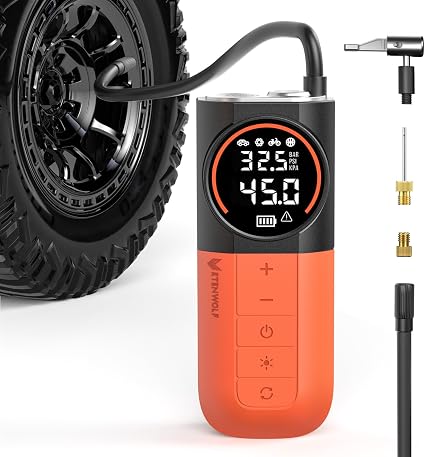
Getting tires back to the right pressure quickly is a relief with this little cordless compressor. Perfect for anyone who needs to pump up car, bike, or motorcycle tires without waiting around.
Its speed in inflating is what stands out most for those who want to save time on tire care.
Setup involves just charging the battery and attaching the nozzle to the tire valve. The compact size and 31-centimeter hose make handling the pump easy without tangled cords getting in the way.
The built-in LED light shines bright for inflations in low light, adding practicality for use anytime. The automatic stop feature ensures you don’t have to hover around, watching the pressure gauge constantly.
Performance meets expectations with a solid 160 PSI max pressure and a 20L/min airflow allowing quick inflation, like getting a 195/65R15 tire from 30 to 35 PSI in about a minute. The 5200mAh battery lasts long enough for multiple tires without breaks.
A common positive note is the fast and cordless convenience, while the 85 dB noise level is often mentioned as a downside during use. The build feels sturdy, which suits frequent use even if it’s slightly noisy.
The most praised feature is the rapid inflation service, handling a wide range of tire types efficiently. The battery supports many inflation cycles per charge, ideal for regular use. The loud noise generated, however, is frequently noted as a downside, as it can be distracting and unpleasant without hearing protection.
Anyone needing quick, cordless tire inflation for cars, bikes, or sports equipment will appreciate the convenience and power. Those who prioritize a very quiet pump or require an even longer hose may prefer to look at alternative models better suited for those specific needs.
Pros
- Fast inflation speed saves time
- Cordless, easy to carry and store
- Automatic stop prevents over-inflation
- Built-in LED light for night use
Cons
- Noise level reaches 85 dB during use
- Hose length could be longer for some tires
| Specification | Details |
|---|---|
| Maximum Pressure | 160 psi |
| Air Flow Capacity | 20 liters per minute |
| Battery Capacity | 5200mAh |
| Hose Length | 31 centimeters |
| Power Source | Battery Powered |
| Noise Level | 85 dB |
11. CYCPLUS AS2Ultra Electric Bike Pump

A compact and lightweight electric bike pump designed for quick and efficient tire inflation. Ideal for cyclists who want a portable tool that fits easily in a pocket or backpack without sacrificing power. Its main advantage is fast inflation speed packed in an impressively small size.
Setup is straightforward thanks to the USB-C rechargeable battery, making it easy to keep charged on the go. The pump’s compact dimensions and 3.17 oz weight make it simple to carry around or attach to your gear. Single-handed operation is very convenient, allowing you to inflate your tires without fuss wherever you are.
Performance delivers on the promise of speed, filling a 700x25C tire from 0 to 80 PSI in about 52 seconds and reaching a max pressure of 120 PSI. The build feels solid and durable enough for frequent use on various types of bikes.
Praised for its portability and power, some users note its small size can make handling a bit fiddly during inflation.
This pump is highly praised for its quick inflation speed and portability, making it a solid companion for cyclists on the move. Handling can be awkward due to its small size, which some find less stable during use.
People looking for a lightweight and fast electric pump will appreciate this unit. Those needing higher pressure or easier grip might want to explore other models better suited for heavier or more frequent use.
Pros
- Extremely lightweight at 3.17 oz
- Compact enough for pocket or backpack
- Rapid inflation times for bike tires
- USB-C rechargeable for convenience
Cons
- Small size can be tricky to handle
- Limited to a maximum of 120 PSI
| Specification | Details |
|---|---|
| Maximum Pressure | 120 psi |
| Power Source | Battery Powered |
| Battery Type | USB-C Rechargeable Battery |
| Connector Type | USB-C |
| Weight | 3.17 oz (90g) |
12. Lamicall Ultra Mini Electric Bike Pump

Compact aluminum design makes it easy to carry while cycling, fitting comfortably in a jersey pocket or bike bag. Suited for cyclists who want a lightweight, quick inflation solution without the bulk. Its biggest strength is the ability to inflate tires up to 100 PSI quickly and automatically stop once done.
Setup is simple thanks to the Type-C charging port, and day-to-day use is straightforward with preset pressure values and memory functions. The pump attaches easily to presta valves, and you can rely on it to pause automatically when your tire reaches the right pressure.
It’s light enough that it doesn’t interfere with your ride, making it convenient for quick stops or emergencies.
The motor pumps air at 32 liters per minute, inflating tires to 100 PSI in under a minute, fast enough for most biking needs. Built with a durable compact body, it handles regular use well although some mention it’s a bit small for those used to larger pumps. The constant automatic stop feature reassures you don’t risk over-inflating, but a minor downside is that the small size can make it fiddly to grip during inflation.
The pump’s automatic stop function receives consistent praise for preventing over-inflation, while a frequent complaint is the compact size can make handling a bit awkward during use. It performs reliably for quick tire inflations but may feel less comfortable when held tightly for longer periods.
Cyclists prioritizing portability and speed will appreciate this pump, especially if you need something light enough to carry all ride long. Anyone preferring a larger grip or multiple valve compatibility might want to consider other options better suited to their habits.
Pros
- Ultra lightweight at just 5 oz
- Automatic stop at preset pressure
- Supports presta valve easily
- Fast inflation to 100 PSI in 50 seconds
Cons
- Small size may be hard to grip firmly
- Limited to presta valve without additional adapters
| Specification | Details |
|---|---|
| Air Flow Capacity | 32 liters per minute |
| Maximum Pressure | 120 PSI |
| Connector Type | Type-C |
| Weight | 5 oz |
Comparison of Top Air Pump Bikes Reviewed
| Product | Power Source | Max Pressure | Air Flow Capacity | Additional Features |
|---|---|---|---|---|
| BV Floor Pump | Handheld | 160 psi | – | Manual operation |
| ETENWOLF S0 Mini Pump | Battery Powered | 150 psi | 18 L/min | Lithium-Ion battery |
| OlarHike Electric Pump | Battery Powered | – | – | – |
| Schwinn Air Center | Manual | 120 psi | – | Manual operation |
| AstroAI L7 Compressor | Battery Powered | 150 psi | 35 L/min | Auto shut-off, digital |
| Compact Bike Floor Pump | Manual | 120 psi | – | Manual operation |
| Airmoto Tire Inflator | Battery Powered | – | 20 L/min | Auto shut-off, LED light |
| Topeak JoeBlow Sport | Handheld | 160 psi | 1908 cc/s | Manual operation |
| Fanttik X9 Ace Pump | Battery Powered | 150 psi | 10 L/min | Automatic operation |
| ETENWOLF S1 Compressor | Battery Powered | – | 20 L/min | Auto stop, LED light |
| CYCPLUS AS2Ultra Pump | Battery Powered | 120 psi | – | USB-C rechargeable |
| Lamicall Ultra Mini Pump | – | 120 psi | 32 L/min | Type-C connector |
- Power SourceHandheld
- Max Pressure160 psi
- Air Flow Capacity–
- Additional FeaturesManual operation
- Power SourceBattery Powered
- Max Pressure150 psi
- Air Flow Capacity18 L/min
- Additional FeaturesLithium-Ion battery
- Power SourceBattery Powered
- Max Pressure–
- Air Flow Capacity–
- Additional Features–
- Power SourceManual
- Max Pressure120 psi
- Air Flow Capacity–
- Additional FeaturesManual operation
- Power SourceBattery Powered
- Max Pressure150 psi
- Air Flow Capacity35 L/min
- Additional FeaturesAuto shut-off, digital
- Power SourceManual
- Max Pressure120 psi
- Air Flow Capacity–
- Additional FeaturesManual operation
- Power SourceBattery Powered
- Max Pressure–
- Air Flow Capacity20 L/min
- Additional FeaturesAuto shut-off, LED light
- Power SourceHandheld
- Max Pressure160 psi
- Air Flow Capacity1908 cc/s
- Additional FeaturesManual operation
- Power SourceBattery Powered
- Max Pressure150 psi
- Air Flow Capacity10 L/min
- Additional FeaturesAutomatic operation
- Power SourceBattery Powered
- Max Pressure–
- Air Flow Capacity20 L/min
- Additional FeaturesAuto stop, LED light
- Power SourceBattery Powered
- Max Pressure120 psi
- Air Flow Capacity–
- Additional FeaturesUSB-C rechargeable
- Power Source–
- Max Pressure120 psi
- Air Flow Capacity32 L/min
- Additional FeaturesType-C connector
How to Choose the Right Bike Air Pump
Choosing the right bike air pump depends on factors like compatibility with your bike’s valve, ease of use, and portability. Selecting a pump that fits your needs ensures efficient inflation, prevents damage, and avoids frequent replacements, ultimately saving time and money.
Compatibility with Valve Types
Trying to inflate a tire only to find the pump head doesn’t fit the valve can ruin your ride. Bikes use mainly Presta, Schrader, or Dunlop valve types, so a pump must handle all to be truly versatile.
Switching between adapters should be straightforward, without air leaks or fiddling that wastes time. A secure connection prevents air from escaping, allowing steady pressure build-up and avoiding repeated attempts.
Look for pumps with reversible or multi-valve heads, often made from metal or reinforced plastic, as these secure tightly onto valves. Models that let you quickly flip or swap adapters without tools prove useful, especially during roadside fixes. A well-designed attachment maintains pressure during pumping and doesn’t lose grip, which means filling tires to the right level on the first try.
Pressure Capacity and Accuracy
Different bikes need different pressure levels. Road tires often require 80-120 psi, while mountain or hybrid tires sit lower around 30-50 psi.
A pump’s max capacity must meet your tire’s needs; otherwise, tires stay underinflated or you risk overexertion pumping. Gauges built into the pump help avoid guesswork, but accuracy varies widely among models.
Types with analog dials often fluctuate or have unclear marks under sunlight, while digital readouts provide more precise readings but need batteries. Consistency in pressure is key, a pump should hold the set pressure without sudden drops, which may indicate leaks or weak valve seals.
Checking the gauge as you pump ensures you don’t stop too soon or go too high.
Portability and Size
Cyclists carrying repair kits and water bottles notice how every extra ounce or bulky item weighs them down. Portable pumps come in small, lightweight sizes to fit in backpacks or attach to bike frames without affecting balance. Size and weight directly influence convenience when riding long distances or commuting daily.
Many models collapse or fold flat, reducing their length but maintaining pumping power. Materials like aluminum keep them light yet sturdy. Avoid full-length floor pumps if frequent transport is necessary; instead, choose a pump under 10 inches and around 100 grams if you want something unobtrusive.
Portability saves space and keeps your load manageable.
Build Quality and Durability
Every ride exposes equipment to mud, rain, and occasional drops. Pumps made with thin plastic bodies often crack or wear out quickly, leaving you stranded.
Strong metal parts, especially around the pump head and handle, last longer and resist damage better. Rust resistance is also important in wet conditions to avoid parts seizing or corroding.
Features like sealed joints and rubber gaskets protect internals from dirt ingress. Some pumps use anodized aluminum or stainless steel components that resist wear.
Solid construction increases reliability over time, so choosing a pump built to handle rough use means fewer replacements.
Ease of Use
Struggling with unclear valve attachments or stiff levers in the middle of a ride is more common than it should be. Pumps that assemble easily, with intuitive valve connectors and simple lock mechanisms, remove stress during roadside repairs. Ergonomically designed handles that fit the hand well reduce fatigue, especially when inflating tires at high pressures.
Clear pressure indicators and stamped instructions on the pump body speed up the process by showing what each part does. Pumps requiring minimal effort per stroke help avoid overexertion, making the task less tiring.
A well-thought-out design translates to fewer mistakes and faster tire inflation under any conditions.
Tips for Efficiently Using Your Bike Air Pump
Start by checking your tire’s recommended pressure, usually printed on the sidewall, before pumping. Using a pump with a built-in pressure gauge can save time and keep you from overinflating. Attach the pump head firmly to the valve, whether Presta or Schrader, to avoid leaks.
Pump steadily rather than hurriedly; this consistent motion makes inflation easier and reduces wear on both the pump and valve. When finished, remove the pump head carefully to prevent losing air.
Additional tips for efficient use:
- Keep the pump hose and connections clean to ensure a tight seal.
- Use a pump with an extendable hose for easier access to valves in tight spaces.
- Double-check that the valve cap is tightened after pumping to protect the valve from dirt.
Following these steps helps you save effort and get your tire pressure right, so your ride stays smooth and safe.
How to Maintain and Care for Your Bike Air Pump
Maintaining your bike air pump extends its life and ensures reliable performance whenever you need it. Store the pump in a dry place to prevent rust on metal parts.
Check the pump’s hose regularly for cracks or leaks and replace it if you find any damage. Lubricate the pump’s moving parts with a light oil once in a while to keep the piston sliding smoothly.
Key maintenance practices include:
- Cleaning the pump head after use, especially if it has dirt or grime on it.
- Inspecting the seal inside the pump head to ensure airtight connections.
- Occasionally testing the pressure gauge accuracy with a stand-alone gauge.
Routine care prevents common issues like air leaks or sticking pistons, which can slow down inflation and frustrate you mid-ride.
Comparing Hand Pumps and Electric Pumps for Different Riding Needs
Hand pumps are small, portable, and fit easily in a backpack or bike frame mount. They require physical effort but are reliable for emergency fixes during rides.
Electric pumps reduce manual labor and typically inflate tires faster. They work well at home or for riders who prefer convenience or have multiple bikes to service.
Consider these points when choosing between the two:
- Portability: Hand pumps are lighter and more compact.
- Speed and effort: Electric pumps inflate tires faster with minimal effort.
- Power source: Electric pumps need batteries or a power outlet; hand pumps require only your energy.
- Precision: Both types come with pressure gauges, but electric pumps often have digital displays for accuracy.
Riders on long tours or in remote areas usually rely on hand pumps, while casual cyclists and home mechanics might prefer the ease of electric models.
People Also Asked
How Do I Choose the Right Size Air Pump for My Bike?
Choose a pump size that matches your valve type and storage needs. Smaller pumps are handy for on-the-go repairs, while larger floor models fill tires faster but can be bulky. Checking the valve compatibility before buying saves frustration during use.
What Safety Tips Should I Follow When Using a Bike Air Pump?
Always secure the pump head firmly on the valve to avoid damage or air leaks. Avoid over-inflating tires, as this can cause blowouts or damage to the rim. Using a gauge to monitor pressure provides control and safety.
How Can I Tell If My Bike Air Pump Is Compatible?
Verify the pump head fits your bike’s valve type, either Presta or Schrader. Some pumps have dual heads or adapters to cover both valve types. Checking the product description or testing the pump on your valve before extended use helps avoid compatibility issues.
How Long Does a Typical Bike Air Pump Last with Regular Use?
A bike pump typically lasts several years with regular maintenance and moderate use. Worn seals or cracked hoses are signs it might need replacement. Cleaning and lubricating seals can extend its working life.
What Are Common Problems When Using a Bike Air Pump?
Common problems include air leaks from worn seals or loose connections and difficulty attaching to the valve. Pump heads can also wear out or break with rough handling. Keeping the pump clean and checking attachments before use can reduce these issues.
Conclusion
Choosing the right bike air pump depends mainly on how quickly and accurately it inflates tires, how durable the pump is, and how easy it is to use or carry around. These factors directly affect your experience, whether you are fixing a flat on a trail or just topping up tire pressure before a ride.
Stick to pumps that clearly show pressure measurements and have reliable valves compatible with your bike tires.
Think about where you will keep the pump and how often you ride. A bulky pump might be fine at home but less useful on the road. A simple model might fit a tight budget but could cost more time and effort over longer use.
Check the comparison table and the detailed reviews above to find a pump that fits your practical needs without wasting money on extra features you won’t use.