What Was The First Harley Davidson Motorcycle – Guide
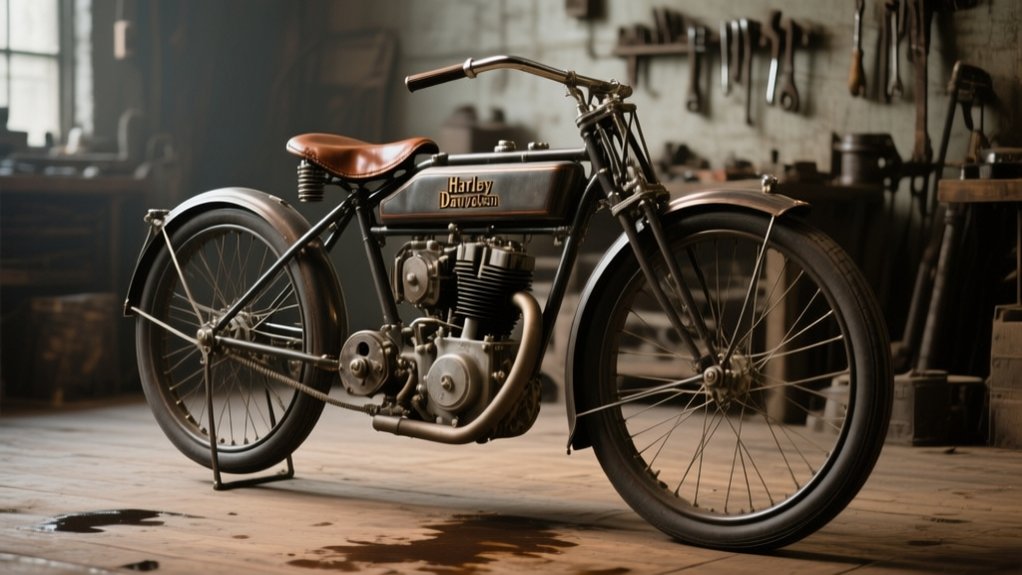
The first Harley-Davidson motorcycle, built in 1903 by William S. Harley and Arthur Davidson, started as a motorized bicycle combining a 410cc single-cylinder engine with a lightweight, durable frame. Known as the 1904 Model W, it used a belt drive and focused on simplicity and function.
It laid the groundwork for Harley’s innovative V-twin engines and racing success. If you want to understand how this humble start shaped one of America’s most iconic brands, there’s much more to explore.
What Was the First Harley-Davidson Model W Motorcycle?
Although the first Harley-Davidson motorcycle, Serial No. 1, was completed in 1903, the Model W came later as a distinct design. You should know that Serial No. 1 was built in Milwaukee by William S. Harley and Arthur Davidson, featuring a 24.74 cubic inch (410 cc) single-cylinder engine mounted horizontally over the rear wheel.
The first Harley-Davidson, Serial No. 1, featured a unique 410 cc single-cylinder engine built in Milwaukee.
This prototype was pretty primitive, designed to fit a bicycle frame, marking Harley-Davidson’s initial venture into motorcycle manufacturing. The early model combined a 1903 engine with a 1905 frame, laying the groundwork for future motorcycles.
Understanding this prototype helps you appreciate how Harley-Davidson evolved from a simple first motorcycle into a brand known for innovative engine designs and durable craftsmanship.
And it all started with that original Milwaukee-built machine.
Who Were the Founders Behind the First Harley-Davidson?
The story of Harley-Davidson’s first motorcycle isn’t complete without recognizing the minds behind its creation. William S. Harley and Arthur Davidson, both born in Milwaukee in the early 1880s, are the founders credited with developing the first Harley-Davidson.
Harley’s early experience working at a bicycle factory gave him mechanical insight, while Davidson’s pattern-making skills at Barth Manufacturing complemented their shared passion for design.
Together, they experimented with motorcycle prototypes, driven by inspiration from a vaudeville act featuring a single-cylinder three-wheeler. Their collaboration in Milwaukee blended technical skill and innovation, laying the foundation for what would become an iconic motorcycle brand.
Understanding these founders’ backgrounds reveals how their combined expertise and local environment shaped the first Harley-Davidson’s inception.
How the First Harley Was Built and Designed
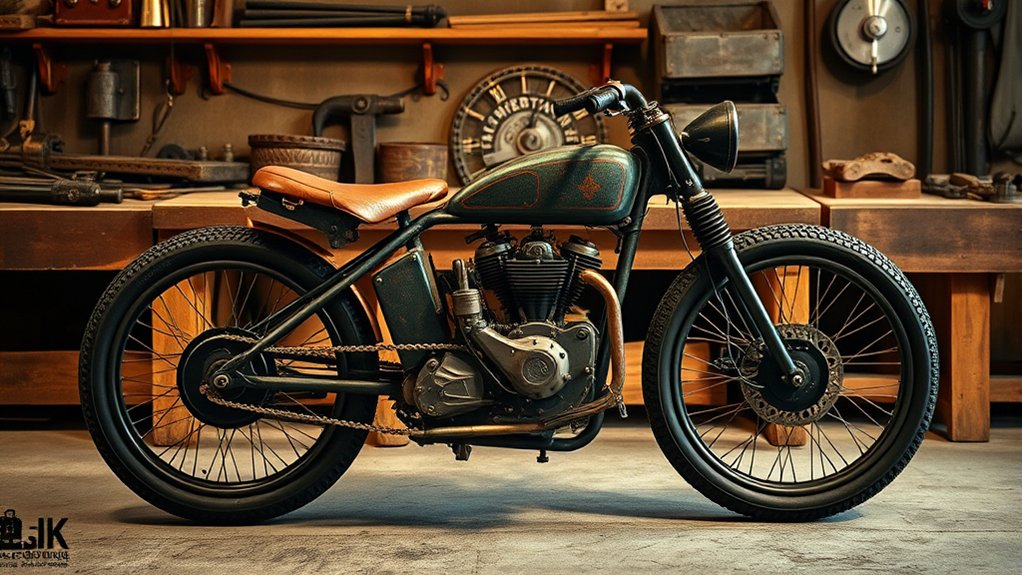
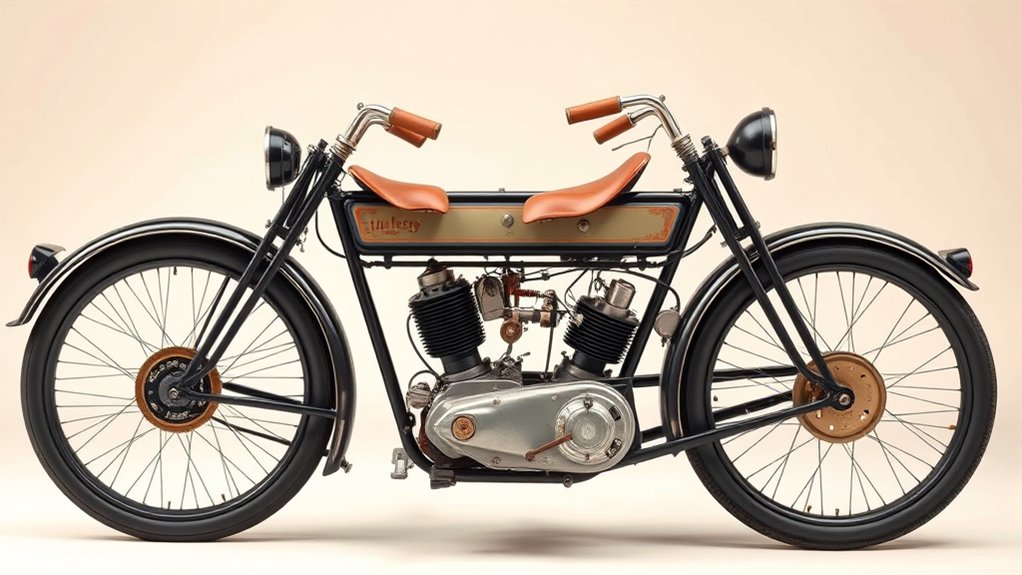
When you look closely at the first Harley Davidson motorcycle, you’ll notice it was built in 1903 by William S. Harley and Arthur Davidson in Milwaukee. They combined a single-cylinder engine design with a modified bicycle frame, transforming a simple bicycle into the first motorcycle.
This lightweight, motorized bicycle featured a 24.5 cubic inch engine and a belt drive system, all crafted in a small shed.
Their innovation laid the groundwork for Harley Davidson’s legacy.
Consider the impact of this creation:
A modest shed sparked a global brand.
A simple engine powered a revolution.
Bicycle frame met motor innovation.
Milwaukee’s spirit fueled determination.
Single-cylinder design embodied ingenuity.
This first motorcycle remains a symbol of precision and visionary engineering.
What Were the Key Features of the 1904 Model W?
If you’re examining early Harley-Davidson motorcycles, the 1904 Model W stands out for its straightforward and efficient engineering. This model featured a single-cylinder engine with a bore of 2.1 inches and stroke of 2.5 inches, delivering an engine displacement of approximately 284cc. Producing around 7.5 horsepower, the Model W balanced power and simplicity.
It used a belt drive system, which was common in early Harley-Davidson designs, ensuring reliable transmission of power. The rigid frame emphasized durability but offered minimal suspension, reflecting the era’s limited rider comfort technology.
Lightweight and robust, the Model W’s design prioritized function over form. This made it a foundational motorcycle that shaped Harley-Davidson’s future engineering choices in their early years.
Why the Model W Launched Harley-Davidson’s Success
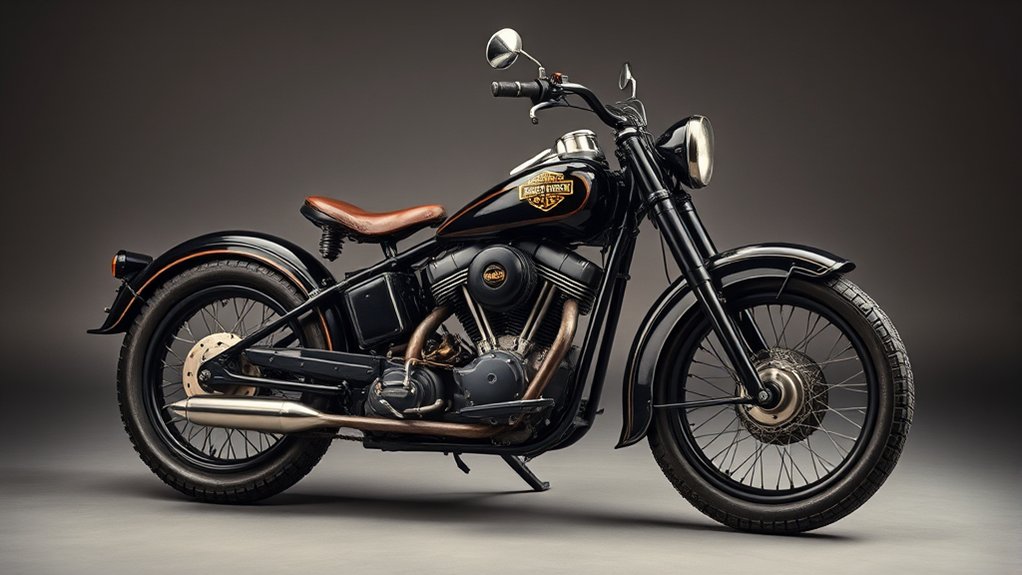
Because Harley-Davidson introduced the Model W as its first mass-produced motorcycle in 1904, it played a pivotal role in launching the company’s long-term success. The Model W’s 24.74-cubic-inch single-cylinder engine delivered reliable power, earning early customer trust.
As Harley-Davidson’s first motorcycle designed for affordability and durability, it attracted a broad customer base. This widespread popularity confirmed the viability of Harley’s innovative engineering and set a foundation for future models.
The success of the Model W proved Harley-Davidson could lead the industry, turning a small operation into a dominant manufacturer.
Feel the thrill of riding an affordable, reliable machine. Experience the legacy of Harley-Davidson’s pioneering spirit. Appreciate the innovation behind the first mass-produced engine.
Recognize the expanding community of early motorcycle enthusiasts. Understand how success was built on trust and durability.
Where the First Model W Was Made and Sold
You’ll find that the first Model W was crafted in a small shed on Juneau Avenue in Milwaukee, Wisconsin. This spot really marks the roots of Harley-Davidson’s manufacturing.
Its initial sales happened locally, mainly around the Milwaukee area, which helped the company get a feel for how the market would respond. When you think about that close-knit production and sales setup, it’s clear how Harley-Davidson started building its reputation right from the very beginning.
Manufacturing Location Details
Although Harley-Davidson is now a global brand, its first model W was built and sold right in Milwaukee, Wisconsin. The Serial No. 1 motorcycle emerged from the company’s initial manufacturing efforts in a modest shed on Juneau Avenue, where Harley and Davidson crafted their early prototype.
This humble setting evolved into Harley-Davidson’s early factory, remaining central to its manufacturing identity. The location wasn’t just a workshop; it was the birthplace of an American icon, anchoring the brand’s legacy in Milwaukee.
- The very first prototype came to life on Juneau Avenue
- Serial No. 1 marked the start of Harley-Davidson’s manufacturing journey
- The early factory laid the foundation for future expansion
- Milwaukee remains the heart of Harley-Davidson’s production
- The original site symbolizes innovation and perseverance
Initial Sales Transactions
Where did the very first Harley-Davidson motorcycle find its first owner? The initial sales transaction took place right in Milwaukee, where William S. Harley and Arthur Davidson built Serial No. 1 in a small shed on Juneau Avenue.
This first Harley was sold directly to Henry Meyer shortly after its completion, marking the company’s very first commercial sale.
This early Harley-Davidson sale was more than just a transaction; it symbolized the brand’s entry into the motorcycle market. By securing this initial sales foothold locally, Harley-Davidson established a foundation for its future growth.
Understanding this early sales transaction reveals how Milwaukee wasn’t just the birthplace of the bike but also the starting point for Harley-Davidson’s enduring legacy in motorcycling history. It’s pretty amazing to think how that small local sale helped kick off such a legendary brand.
Early Market Reception
After securing its very first sale in Milwaukee, Harley-Davidson quickly gained momentum as local riders responded enthusiastically to the new motorcycle. William S. Harley and Arthur Davidson crafted the prototype in a small shed on Juneau Avenue, where they also sold the first Harley-Davidson.
This early market reception in Milwaukee was vital, proving that their vision held real promise.
The positive feedback propelled the company to expand production rapidly. By 1906, Harley-Davidson built its first dedicated factory and began reaching customers beyond Milwaukee, marking the start of a national presence.
- Witness the birth of an iconic motorcycle in a humble Milwaukee shed
- Feel the excitement of local riders embracing innovation
- Experience the drive of two pioneers, Harley and Davidson
- Understand how early enthusiasm fueled rapid growth
- Appreciate the significance of the first Harley-Davidson’s impact
How the First Harley Evolved Over Time
How did Harley-Davidson transform from a modest experimental prototype into a legendary motorcycle manufacturer? The first Harley-Davidson motorcycle, built in 1903, featured a simple single-cylinder engine. This marked the start of its evolution.
By 1906, Harley had shifted from this initial model to a full manufacturing operation. That was a sign of rapid development.
The introduction of the V-twin engine in 1909 was a pivotal moment. It enhanced both power and reliability.
Over the decades, Harley-Davidson kept refining its engine designs and motorcycle models. This effort culminated in significant innovations like the 1936 Knucklehead overhead valve engine.
This continuous evolution shows Harley’s commitment to advancing engineering standards.
You can see how each development phase built on the last. That’s how Harley made sure it stayed at the forefront of motorcycle technology.
How Early Racing Helped Build Harley’s Reputation
You’ll see how Harley-Davidson’s early dive into racing really changed the game for their marketing. Winning races wasn’t just about trophies—it became solid proof that their bikes could perform under pressure.
The “Wrecking Crew” wasn’t just any team either; their winning streak showed off the speed and reliability of Harley motorcycles to more and more fans.
This early success didn’t just build a reputation; it made Harley a leader in motorcycle engineering and gave their sales a serious boost.
Racing’s Marketing Impact
Why did Harley-Davidson shift from opposing motorcycle racing to fully embracing it as a marketing powerhouse? At first, they were worried about the dangers of racing. But pretty quickly, they saw it as a great way to show off how tough and high-performing their motorcycles really were.
By supporting racing teams and celebrating their wins, Harley-Davidson turned racing into a smart marketing move. This helped boost their brand’s reputation all over the world.
You can see how this change made a difference through things like:
- Racing victories that proved mechanical excellence
- A stronger brand image connected to speed and ruggedness
- More sales thanks to the buzz around performance
- International recognition as a leader in motorcycle engineering
- And an emotional bond built by iconic racing bikes
All of this helped Harley-Davidson lock in their reputation as a maker of reliable, high-performance motorcycles.
The Wrecking Crew
What role did the “Wrecking Crew” play in shaping Harley-Davidson’s early reputation? The Harley-Davidson racing team, dubbed the wrecking crew, was pivotal in proving the brand’s performance and durability.
Formed in the early 1910s, this racing team dominated motorsports, particularly in board track and dirt track events, consistently setting speed records.
Their success in competitions like the 1914 AMA races showcased Harley-Davidson’s engineering excellence, elevating the company’s status in the racing world.
By excelling in diverse racing formats, the wrecking crew helped solidify Harley’s reputation as a premier manufacturer.
Their victories not only demonstrated superior motorcycle performance but also attracted enthusiasts, boosting sales and establishing Harley-Davidson as a leader in early motorsports competition.
It’s clear they played a huge role in building the brand’s early image.
How the First Harley-Davidson Set the Stage for Future Innovation
Although it started as a simple adaptation of a bicycle frame with a single-cylinder engine, the first Harley-Davidson motorcycle in 1903 set a powerful precedent for innovation. This early motorcycle wasn’t just a machine; it was the foundation of Harley-Davidson’s commitment to engine innovation and technological advancement.
The founders, William S. Harley and Arthur Davidson, proved that a small, lightweight bike could evolve into something revolutionary. Their work paved the way for the iconic V-twin design, a hallmark of Harley-Davidson’s identity.
By establishing a successful founding prototype, they guaranteed continuous improvements in engine power, frame durability, and ride comfort that still influence motorcycles today.
- Witness the birth of enduring engine innovation
- Feel the thrill of early motorcycle engineering
- Appreciate the roots of the V-twin design
- Understand the impact of technological advancement
- Experience the spirit of Harley-Davidson’s founding
Frequently asked questions
What Is the Current Value of a Vintage Model W Motorcycle?
You can expect a vintage Harley Davidson Model W to be worth between $50,000 and $150,000, depending on its condition and originality.
If your bike is well-preserved or fully restored with original parts, it’ll fetch a higher price.
Provenance and documented history also boost value, especially if it’s award-winning.
The market for these collectible motorcycles is rising, so owning an authentic Model W makes you a part of a valuable niche.
Are There Any Surviving Model W Motorcycles Today?
You won’t find any confirmed surviving Model W motorcycles today. While Harley-Davidson produced the Model W back in 1909, no original units are known to exist now.
Museums and collectors often display replicas or restored early Harley models, but authentic Model Ws are exceedingly rare or lost. The oldest genuine Harley motorcycles typically date from the 1910s onward.
How Many Model W Motorcycles Were Originally Produced?
You’ll find that Harley-Davidson’s Model W motorcycles were made in modest, measured numbers, fewer than 50 units during the early years. Initially, only 3 to 5 motorcycles rolled off the line in 1903, with production slowly scaling to about 10 to 15 by 1904.
This small-scale, selective production reflects the company’s cautious, calculated climb before ramping up manufacturing in later years. It shows how they took their time, making sure everything was right before going bigger.
What Type of Fuel Did the Model W Use?
The Model W used standard automotive gasoline as its fuel, specifically unleaded gasoline since leaded variants weren’t common yet. Its single-cylinder engine was designed to run efficiently on the typical gasoline available in the early 1900s, before modern additives became widespread.
You’ll find that the fuel system was tailored to handle this kind of gasoline, ensuring ideal performance without the need for specialized or high-octane fuels.
Did the Model W Have Any Notable Competitors in 1904?
You might think the Model W ruled the market alone in 1904, but it actually faced stiff competition. Indian was a major rival, especially with their Model F, which shared a similar single-cylinder design.
Companies like Excelsior and Merkel also challenged Harley’s foothold.
This competition pushed Harley to innovate, ensuring the Model W wasn’t just a bike, but a key player in a fiercely contested early motorcycle industry landscape. It was a tough market out there, and every company had to bring their A-game to stay relevant.
Final Thought
You might think the first Harley-Davidson Model W was just a humble beginning, but it was nothing short of a revolution on two wheels. Crafted by visionary founders, its innovative design and features didn’t just start a brand. They ignited a global riding obsession.
Every detail, from its Milwaukee origins to early racing triumphs, set a foundation so strong. Harley’s legacy still roars louder today than any engine ever could.