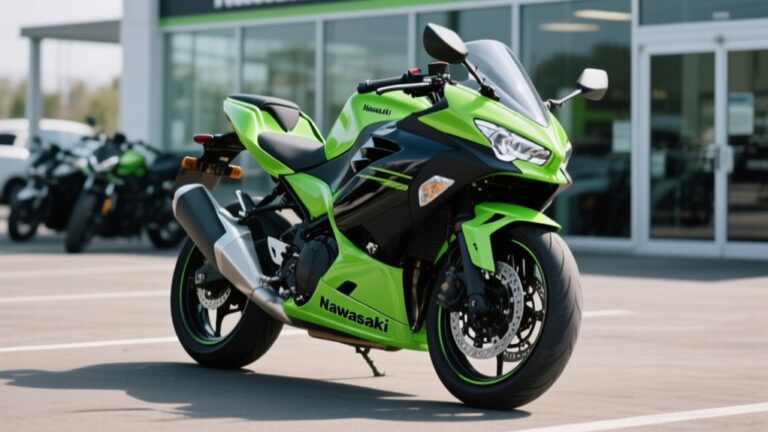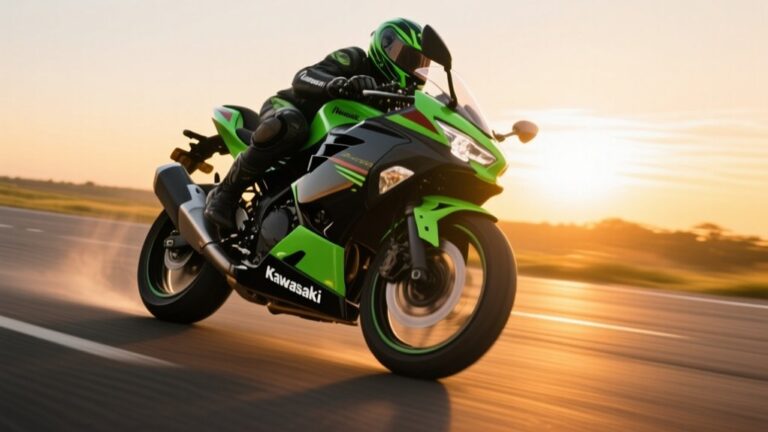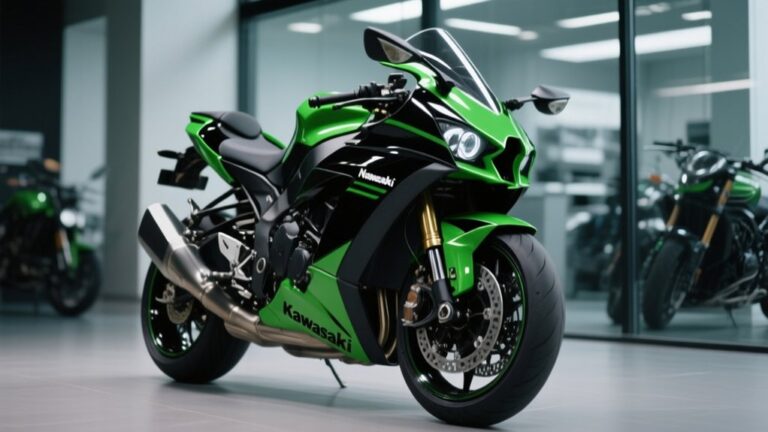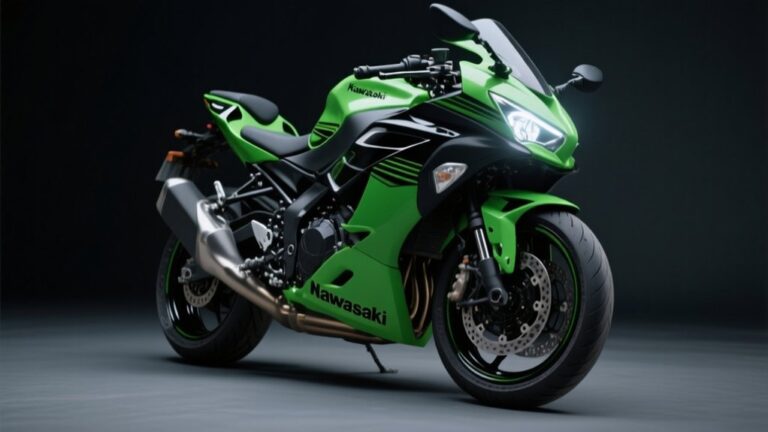
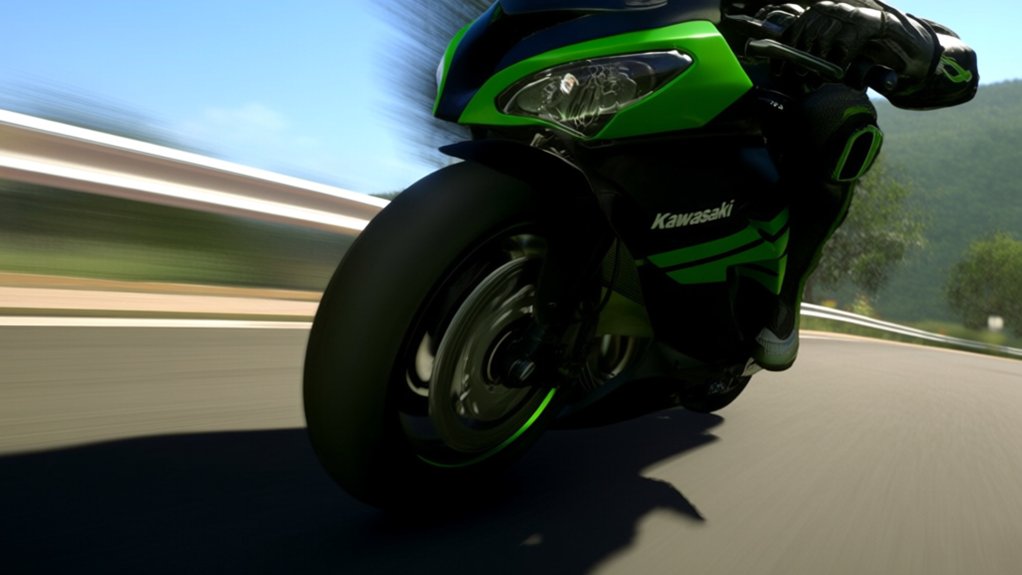
How Fast Is A Kawasaki Ninja 650 – Quick Facts
You can expect the Kawasaki Ninja 650 to reach real-world top speeds around 120-130 mph, with some riders hitting up to 137 mph on lightly modified models. It accelerates quickly, hitting 0-60 mph in about 3.5 seconds, thanks to its 649cc parallel-twin engine delivering 62 hp and a flat torque curve from 4,000 to 9,000 rpm.
Its balance of speed and rideability makes it versatile for daily use. Explore how modifications and riding conditions affect performance.
How Fast Is the Kawasaki Ninja 650?
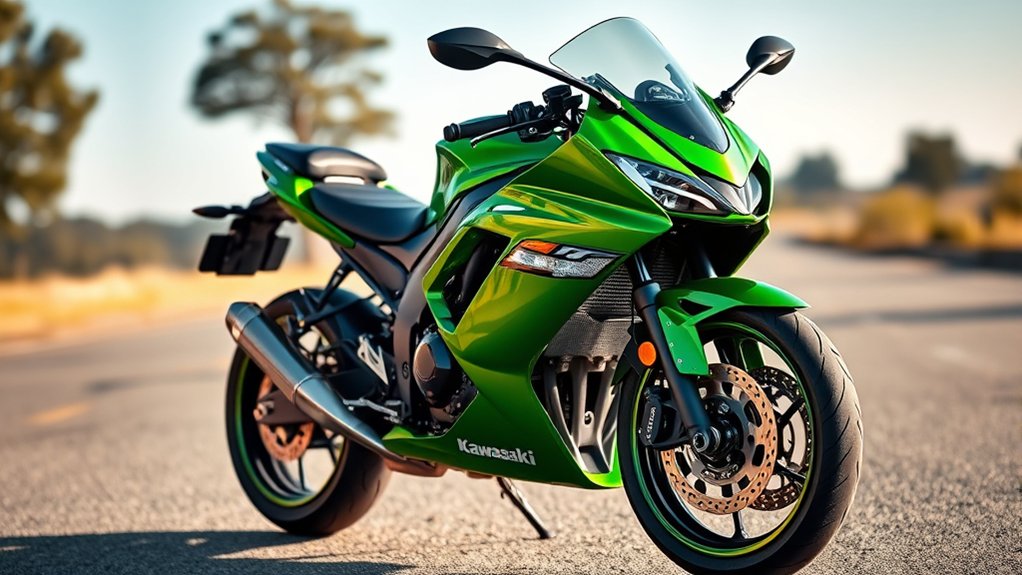
The Kawasaki Ninja 650 can reach a top speed of around 130 mph with its full fairing. Though, most riders experience speeds closer to 120-125 mph in real-world conditions. Its top speed varies slightly depending on the model year and modifications. Some riders have even reported going over 137 mph.
The bike’s performance is powered by a parallel-twin engine that balances strong power delivery with smooth acceleration. While the top speed shows off the bike’s raw capability, its acceleration is just as impressive.
It can go from 0 to 60 mph in about 3.53 seconds, which reflects efficient power transfer and gearing.
This combination of top speed and rapid acceleration means the Ninja 650 delivers both exhilarating performance and practical usability. It’s a versatile choice for riders who want speed without giving up control.
Kawasaki Ninja 650 Acceleration Times You Should Know
Although top speed often grabs attention, understanding the Kawasaki Ninja 650’s acceleration times gives you a clearer picture of its real-world performance. These quick facts reveal how the bike delivers energetic thrust across various speeds. It really emphasizes its top-end capability and responsiveness.
Grasping acceleration times offers a deeper insight into the Ninja 650’s dynamic power and responsiveness.
Here are key acceleration times to know:
- 0 to 10 mph in just 0.57 seconds, showing rapid throttle response
- 0 to 60 mph in approximately 3.53 seconds, reflecting strong mid-range power
- 0 to 100 km/h in about 3.92 seconds, confirming competitive quickness
- 0 to 200 km/h in roughly 18.5 seconds, highlighting sustained top-end capability
How the Ninja 650 Engine Delivers Power and Torque
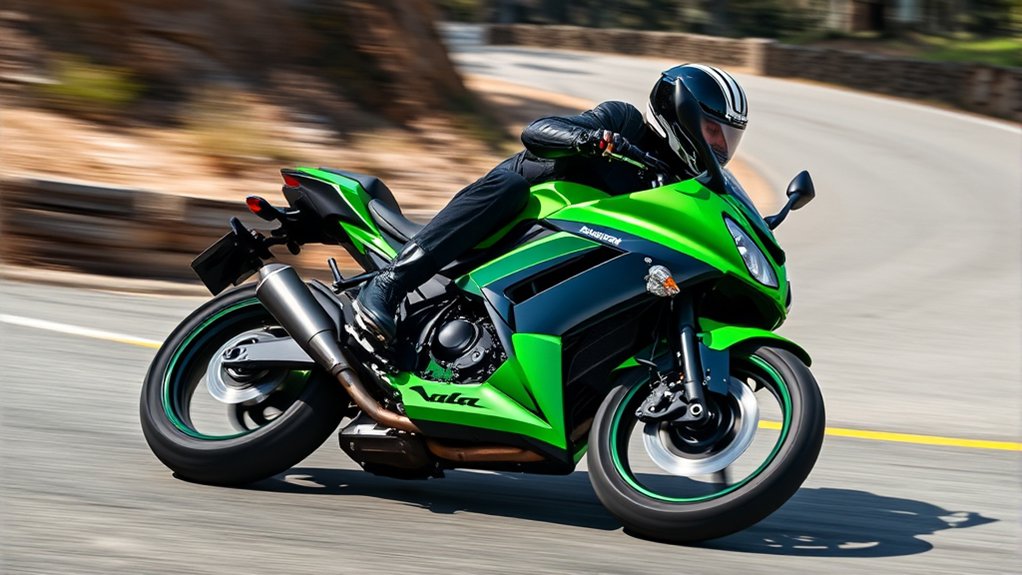
You’ll find the Ninja 650’s 649cc parallel-twin engine delivers strong torque starting as low as 2,500 rpm. What’s great is that it keeps a flat torque curve all the way up to 9,000 rpm, giving you consistent power throughout.
The engine is designed with smooth, real-world performance in mind. You’ll see peak output around 8,500 to 9,000 rpm, which is perfect for getting that ideal acceleration when you need it.
Knowing how this powerband works helps you get the most out of your ride, making the bike feel responsive and easy to handle on the road.
Parallel-Twin Engine Design
When you look under the fairing, Kawasaki’s 649cc parallel-twin engine stands out for delivering smooth, responsive power tailored for everyday riding. This engine design focuses on balancing performance with rideability, guaranteeing you get consistent power without abrupt surges.
The parallel-twin engine layout contributes to compactness and efficient packaging, enhancing handling. It produces strong mid-range performance, making acceleration smooth and predictable across various speeds.
Key features include:
- 83 x 60 mm bore and stroke for optimized combustion
- 62 hp at 8,500 rpm with a flat torque curve starting at 4,000 rpm
- Digital Fuel Injection with 36mm throttle bodies for precise throttle response
- Engine design emphasizing quick response and smooth power delivery
This setup ensures you experience controlled, confident acceleration in daily riding conditions. It’s a great balance for those who want performance without surprises.
Torque Delivery Characteristics
The Ninja 650’s torque delivery builds on its parallel-twin design by offering a broad and flat torque curve that starts as low as 2,500 rpm and peaks at 43 ft/lb around 7,000 rpm. You’ll experience smooth engine response from low revs, making city riding seamless with consistent torque availability.
The engine really shines in midrange power, maintaining strong drive between 4,000 and 9,000 rpm without needing to push to the redline. This broad midrange torque means you get predictable acceleration across various speeds. So, you can confidently modulate throttle inputs without any surprises.
When you short-shift near 8,500 to 9,000 rpm, the Ninja 650 optimizes torque delivery for quick acceleration and efficient performance. This enhances overall rideability without sacrificing responsiveness or power consistency. It just makes the ride feel smooth and controlled.
Optimal RPM Power Range
Although the Ninja 650’s engine starts delivering strong torque as low as 2,500 rpm, its ideal power range lies between 4,000 and 9,000 rpm. This is where the engine responds most efficiently and predictably.
This range represents the prime rpm for power delivery, balancing mid-range torque with smooth engine response. You’ll notice peak torque of 43 ft/lb at 7,000 rpm, with a flat torque curve from 4,000 rpm upward, ensuring consistent thrust.
Beyond 9,000 rpm, power gains diminish. So, short-shifting around 8,500 to 9,000 rpm is the best strategy for acceleration and performance.
- Prime rpm range: 4,000–9,000 rpm
- Peak torque: 43 ft/lb at 7,000 rpm
- Strong mid-range torque starting at 2,500 rpm
- Engine response peaks before 9,000 rpm for best power delivery
Ninja 650 Real-World Riding Speeds vs. Claimed Top Speeds
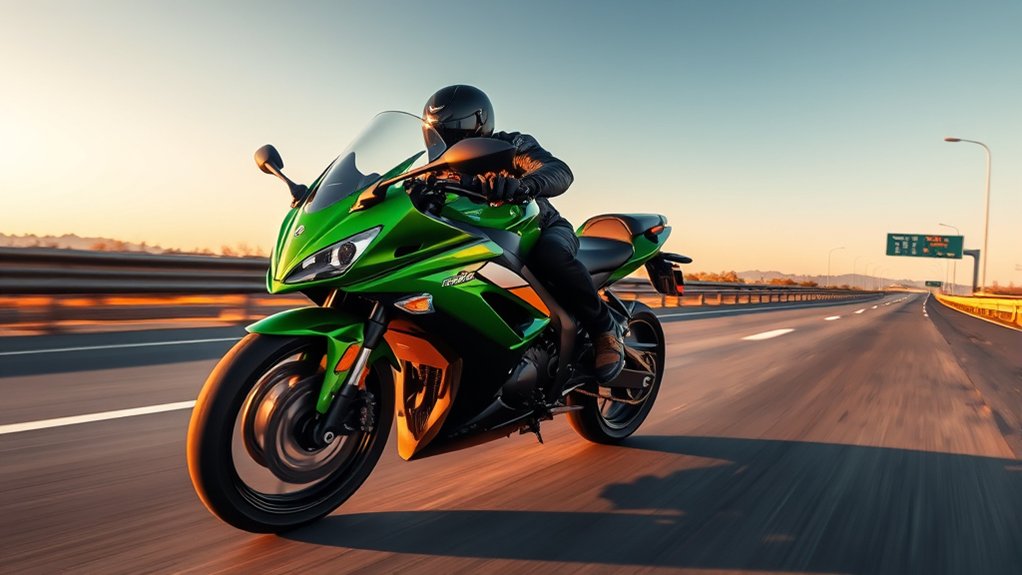
You might notice that the Ninja 650’s speedometer tends to overstate actual speeds. It often shows close to 130 mph, even though in real-world conditions, you’re usually cruising around 120 to 125 mph.
On top of that, things like the model year and rider factors—such as your weight and wind resistance—can also change these numbers.
Speedometer Versus Actual
When you check the speedometer on a Kawasaki Ninja 650, expect it to read about 5 to 10 mph higher than your actual speed. This measurement discrepancy is pretty common because of calibration and manufacturing tolerances. So, don’t be surprised if your speedometer shows a bit more than what you’re really doing.
While the speedometer may show up to 137 mph, the actual top speed usually falls between 120 and 125 mph. Factors like wind resistance, rider weight, and modifications can also affect these readings.
Basically, a bunch of things influence how fast the bike really goes compared to what the speedometer says.
Here are some key points to keep in mind: the speedometer overestimates actual speed by about 5-10 mph. Real-world top speed is typically around 120-125 mph.
If you want more accurate measurements, GPS or timing devices are the way to go. External factors will always cause some variation between what the speedometer shows and your actual speed.
Understanding these nuances helps you interpret the Kawasaki Ninja 650’s speedometer readings accurately and ride with confidence.
Model Year Variations
Understanding the speedometer’s tendency to overstate actual speed sets the stage for examining how different Ninja 650 model years compare in real-world performance versus their claimed top speeds.
For example, the 2009 Ninja 650R achieved a top speed near 137 mph, showcasing strong performance early on.
By contrast, the 2017 Ninja EX650 KRT’s real-world top speed dropped to around 130 mph, reflecting changes in tuning and possible restrictions.
The 2025 stock Ninja 650 typically records about 120 mph on the speedometer, which is often conservative but influenced by added weight and emission modifications.
These variations highlight how engine tuning, weight, and manufacturer-imposed modifications across model years impact top speed and overall performance.
Actual speeds generally range between 120 and 137 mph depending on conditions and adjustments.
Real Riding Conditions
Although the Kawasaki Ninja 650 is rated with a top speed of around 130 mph, real-world conditions usually limit you to about 120–125 mph. The difference between manufacturer claims and real riding speeds comes down to several external factors that affect performance.
Wind resistance, rider weight, and road surface quality all play significant roles.
Also, the bike’s speedometer can sometimes overstate true top speed. Based on user reports, actual speeds tend to be closer to 120 mph.
- Real riding speeds often fall short of the claimed 130 mph top speed
- External factors reduce achievable speeds in everyday conditions
- Aftermarket modifications can push speeds beyond the manufacturer’s stated limits
- Practical speeds are frequently limited by safety and traffic laws rather than mechanical capability
Ninja 650 Top Speed: Effects of Modifications
If you want to push the Kawasaki Ninja 650 beyond its stock top speed of around 120 mph, aftermarket modifications play a vital role.
Upgrading to an aftermarket exhaust can boost the top speed to about 130 mph by improving exhaust flow and reducing weight. Engine remapping and air intake enhancements offer marginal gains by optimizing fuel delivery and combustion efficiency.
Additionally, reducing weight with lightweight aftermarket parts improves the power-to-weight ratio, helping you reach higher speeds more effectively. Some riders report top speeds nearing 137 mph on stock or lightly modified models, though speedometer readings can be optimistic.
How the Ninja 650 Stacks Up Against Other Middleweight Sportbikes
When comparing middleweight sportbikes, the Kawasaki Ninja 650 stands out with a top speed near 130 mph and a quick 0-60 mph time of about 3.53 seconds.
Its acceleration and performance place it above entry-level models like the Ninja 400 and Yamaha MT-07, while it remains close to sportier rivals such as the Honda CBR650R.
The Ninja 650’s 62 hp engine and flat torque curve deliver strong mid-range power, making it responsive for everyday riding and quick overtakes.
You’ll find it balances power, handling, and rideability effectively within its class.
- Top speed around 130 mph, competitive for middleweight sportbikes
- 0-60 mph acceleration at approximately 3.53 seconds
- Strong straight-line performance compared to Suzuki SV650
- Smooth, responsive mid-range power from a 62 hp engine
Best Gear and RPM Range for Ninja 650 Acceleration
Mastering the best gear and RPM range is essential to access the Kawasaki Ninja 650’s full acceleration potential. You’ll find the bike excels when short-shifted between 8,000 and 9,000 rpm, where it delivers prime power and throttle response.
The engine reacts well as low as 2,500 rpm, but for peak acceleration, focus on staying within this rpm range, especially in the first three gears. Shifting beyond 9,000 rpm yields little power gain, only noise.
Managing your gear shifts to keep the engine in this ideal rpm band guarantees rapid acceleration and efficiency.
| Gear | Ideal RPM Range | Acceleration Impact |
|---|---|---|
| 1st | 8,000 – 9,000 | Maximum torque delivery |
| 2nd | 8,000 – 9,000 | Strong in-gear acceleration |
| 3rd | 8,000 – 9,000 | Maintains peak power |
| 4th | 7,000 – 8,500 | Moderate acceleration |
| 5th+ | 6,000 – 8,000 | Efficient cruising |
Why the Ninja 650 Balances Speed With Everyday Rideability
Although the Kawasaki Ninja 650 reaches a top speed of around 130 mph, it balances this performance with everyday rideability through its 62 hp engine and responsive throttle. Its parallel-twin engine provides strong mid-range power, allowing you to accelerate smoothly and confidently in traffic.
The Ninja 650 combines a 62 hp parallel-twin engine with smooth acceleration for confident, everyday riding.
The bike’s flat torque curve from 4,000 rpm ensures responsive performance without harsh surges. You’ll also appreciate the comfortable riding position, which reduces fatigue during longer rides and daily commutes.
This combination makes the Ninja 650 versatile for both spirited highway runs and urban environments.
- Parallel-twin engine delivering balanced power
- Responsive throttle for smooth acceleration
- Comfortable riding position with lower seat height
- Strong mid-range power for real-world usability
Frequently asked questions
What Is the Fuel Efficiency of the Kawasaki Ninja 650?
The Kawasaki Ninja 650 delivers around 45-50 mpg, depending on how you ride. If you keep steady speeds and avoid rapid acceleration, you’ll get better fuel efficiency.
Its 15-liter tank lets you ride roughly 180-200 miles before refueling.
The bike’s fuel injection system optimizes combustion, improving mileage compared to carbureted models.
Terrain and load also affect fuel economy, so riding conditions play a key role in your actual mpg.
How Comfortable Is the Ninja 650 for Long-Distance Rides?
You’ll find the Ninja 650 surprisingly comfortable for long-distance rides. Its low 790 mm seat height lets you plant your feet firmly, while the upright riding position and wide handlebars reduce fatigue and improve visibility.
The thick passenger seat adds comfort for your buddy, and the suspension balances sportiness with smoothness, handling rough roads well.
Plus, adjustable levers help you customize your posture, so you stay comfortable mile after mile.
What Maintenance Does the Ninja 650 Require Regularly?
You need to change the oil every 3,000 to 4,000 miles to keep the engine healthy.
Inspect, clean, and lubricate the chain every 500 to 600 miles for smooth performance.
Replace brake fluid every two years to maintain braking efficiency.
Check and clean or replace the air filter every 6,000 miles or sooner in dusty conditions.
Always check tire pressure before rides to guarantee safety and peak handling.
It’s a simple step that makes a big difference in how your Ninja 650 feels on the road.
How Does the Ninja 650 Perform in Wet or Slippery Conditions?
You’ll find the Ninja 650 performs confidently in wet or slippery conditions thanks to its Traction Control Mode 2, which limits rear-wheel spin without sacrificing power. Its broad midrange torque and smooth throttle response keep you stable.
The lightweight chassis and responsive suspension help maintain control.
You can switch traction control off for aggressive riding, but it’s best to keep it on when traction’s low to enhance safety and handling. It really makes a difference when the road gets tricky.
What Safety Features Come Standard on the Ninja 650?
Imagine riding the Ninja 650 like balancing a spinning top—steady and controlled. You get standard ABS braking, which stops wheel lock-up during sudden halts, and Kawasaki’s Traction Control (KTRC) with multiple modes, reducing wheel spin across conditions.
The lightweight frame and responsive handling boost your control, while a digital instrument panel keeps real-time info at your fingertips.
Plus, you can disable ABS and traction control if you want full riding customization.
Final Thought
So, you want to know how fast the Kawasaki Ninja 650 really is? Spoiler: it’s not breaking any land speed records, but it’s quick enough to make your morning commute feel like a race. With a balanced engine and smart gear ratios, it delivers respectable speed without sacrificing everyday practicality.
If you’re looking for a middleweight that’s fast, fun, and doesn’t require a rocket scientist’s skills, the Ninja 650’s got your back.