
Top 12 Best Stationary Bike After Knee Replacement Revealed
Using a poorly chosen stationary bike after knee replacement can mean discomfort, improper support, and even slower recovery. The best stationary bike after knee replacement provides a smooth pedaling action with adjustable resistance, helping to rebuild strength without strain.
Many people face the frustration of stiff pedals or seats that do not adjust low enough, which can cause pain or reduce the range of motion needed for healing. A suitable bike needs to accommodate limited knee bend and offer stability to avoid any sudden jolts during exercise.
The most important features to look for include a low step-through frame for easy mounting and dismounting, adjustable seat height and distance to align perfectly with your new knee joint, and a quiet flywheel with smooth resistance levels typically ranging from 8 to 20. Durable materials that withstand daily use and a straightforward mechanism for cleaning also matter since hygiene plays a role during recovery. Safety features like sturdy pedals with secure straps help keep feet in place without pressure, making the ride safer and more comfortable.
Need a Quick Check?
| Image | Product | Price |
|---|---|---|
Our Top Picks 1  | Mini Pedal Exerciser | Check Price |
Our Top Picks 2  | Magnetic Recumbent Bike | Check Price |
Our Top Picks 3  | Home Recumbent Bike | Check Price |
Our Selected Top 12 Stationary Bike After Knee Replacement Worth Considering
This list features stationary bikes designed for comfort and support after knee replacement surgery. Each review covers performance, suitability for different users, and highlights both advantages and potential drawbacks to help you find a bike that fits your recovery needs.
1. Pedal Exerciser Mini Exercise Bike
Compact size and adjustability make this mini exercise bike ideal for gentle workouts after knee surgery. It suits anyone needing low-intensity leg and arm exercise with easy resistance controls, helping recovery without overwhelming force.
Setting up takes moments due to its manual operation and self-powered nature. Using the tension knob, you can pick from five resistance levels to match your daily needs. It fits under desks for office use or can be used while watching TV.
Its smooth pedal motion encourages consistent use without pain or strain.
Designed for rehab, it supports light cycling with smooth movement to improve joint flexibility. Built with a handlebar and a sturdy frame, the pedal exerciser stands steady during use.
Most praise its gentle resistance, while some mention the simplicity limits intensity for advanced workouts.
Most users appreciate the smooth pedal motion and easy resistance adjustment, which makes it suitable for gentle rehab exercises. The main complaint revolves around limited resistance intensity, which restricts its use to light workouts only.
People recovering from surgery or seeking mild exercise will find this bike convenient and effective. Those needing a more challenging workout or digital features might want to consider other options.
Pros
- Adjustable tension for low-intensity exercise
- Compact and portable size for home or office
- Supports both leg and arm workouts
- Quiet and smooth pedal motion
Cons
- Resistance levels too low for intense training
- No digital tracking or software updates
| Specification | Details |
|---|---|
| Controls Type | Knob |
| Handle Type | handlebar |
| Number of Resistance Levels | 5 |
| Operation Mode | Manual |
| Power Source | Self-Powered |
2. Recumbent Exercise Bike with Magnetic Resistance
Perfect for anyone recovering from knee replacement, this recumbent stationary bike offers a wide range of resistance levels which help tailor workouts to your exact needs. Its key strength lies in supporting low-impact exercise with comfort, making it easier to maintain a consistent routine without aggravating sensitive joints.
Putting the bike together is straightforward with clear instructions, allowing for quick setup. Daily rides are comfortable thanks to the soft padded seat, which is important when dealing with joint recovery. The magnetic resistance system provides smooth adjustments through 16 levels, making changes in workout intensity feel natural rather than jerky or sudden.
Performance-wise, the bike handles gradual increases and decreases in difficulty well, suitable for rehabilitation and more intense cardio sessions alike. Its thickened steel frame offers excellent stability, supporting users up to 400 lbs without wobbling.
One strong compliment often noted involves how comfortable and sturdy the seat is, while some point out the assembly requires patience with several parts involved.
The bike receives praise for its sturdy build and comfort during long sessions, especially the padded seat which helps users with knee sensitivity stay comfortable. On the downside, assembling the bike requires some patience due to the number of parts involved.
This bike fits well for anyone needing gentle, adjustable exercise to aid knee recovery or maintain fitness with low joint stress. Those looking for a machine with adjustable seat height might want to explore other options that better match those needs.
Pros
- Supports up to 400 lbs with stable frame
- 16 smooth magnetic resistance levels for varied workouts
- Comfortable padded seat ideal for sensitive knees
- Easy to use for rehabilitation and fitness
Cons
- Assembly can be time-consuming and detailed
- No adjustable seat height mentioned
| Specification | Details |
|---|---|
| Resistance Levels | 16 Levels Magnetic Resistance |
| Weight Capacity | 400 LBS |
| Frame Material | Thickened Steel |
| Seat | Soft Padded Seat |
| Model Number | W356 |
| Item Count | 1 Count |
3. Recumbent Exercise Bike for Home
Recovering from knee replacement often means finding exercise equipment that feels gentle but effective. A recumbent exercise bike with a supportive seat and quiet operation suits anyone needing low-impact cardio without aggravating the knees. Its biggest strength lies in the ergonomic design that prioritizes comfort during longer rides.
Setup is straightforward with the lever-based seat adjustment making it easy to find the right fit, whether tall or short. The plush padded seat and ergonomic backrest support your lower back and keep you comfortable.
Using this bike daily doesn’t disturb others since the magnetic resistance system runs almost silently, even at higher levels.
It performs well for gentle cycling with a 16-level magnetic resistance that lets you increase challenge slowly. The frame is built from commercial-grade steel that offers stability and can hold up to 400 lbs without wobbling.
Most users appreciate how quiet and sturdy it is, while some note the seat adjustment could be smoother.
Many appreciate how quiet and sturdy the bike feels during use, making it easy to stay consistent with workouts. The most common issue mentioned is the seat adjustment lever, which can feel a bit stiff at times.
Those wanting a simple, stable bike for low-impact exercise will find it well suited to their needs. It might not be ideal for users seeking high-tech features or very compact storage options.
Pros
- Comfortable padded seat with ergonomic backrest
- Quiet magnetic resistance for early morning rides
- Strong steel frame supports up to 400 lbs
- Easy seat adjustment fits different heights
Cons
- Seat adjustment lever could be smoother
- No advanced tech features beyond pulse display
| Specification | Details |
|---|---|
| Model Name | W239 |
| Resistance Levels | 16-Level Magnetic Resistance |
| Weight Capacity | Supports 400LB |
| Seat Adjustment | Lever-based system |
| Pulse Sensors & Display | LCD Display with Pulse Sensors |
| Manufacturer | XVGVSV |
4. X-Bike Foldable Stationary Exercise Bike

Offering five distinct workout modes, the GOIMU 5-in-1 Folding Exercise Bike suits anyone looking for a versatile indoor fitness option after knee replacement. Its greatest strength lies in combining cardio and strength training in one compact, foldable design, fitting well in smaller spaces.
Setup requires minimal effort as the bike folds easily for storage. Daily use covers a range of workout intensities with modes that target different muscle groups, helpful for knee rehabilitation where gradual build-up is key.
The bike feels stable during rides, and adjustments can be made to suit comfort and pace, aiding consistent use without strain.
Performance is solid for moderate cardio sessions and light strength training. The build quality supports indoor exercise well, with folding functionality adding to practicality. Praise often mentions its versatility, while some find the bike’s design takes a little getting used to when moving between modes.
The strongest praise highlights the bike’s ability to offer a full-body workout in multiple modes, making it useful for gradual knee rehabilitation. Common complaints focus on the initial adjustment period to switch confidently between modes and settings.
People aiming for variable intensity workouts in limited home space will appreciate this bike. Those needing purely high-end precision or faster mode switching might look for alternatives with simpler controls.
Pros
- Five unique workout modes for variety
- Foldable design saves space
- Focuses on both cardio and strength
- Compact and suitable for small rooms
Cons
- Transitioning between modes can feel awkward
- May take time to adjust settings comfortably
| Specification | Details |
|---|---|
| Brand Name | Goimu |
| Model Name | G0605 |
| Number of Items | 1 |
| Recommended Uses For Product | Indoor |
| Part Number | G-0605-0392 |
5. Sunny Health & Fitness Magnetic Pedal Exerciser

Ideal for anyone looking for gentle, low-impact exercise after knee replacement surgery, this under-desk pedal exerciser suits seniors and office workers alike. Its biggest strength is how it combines arm and leg workouts in one compact, easy-to-use machine.
Setup is simple and quick. The pedal exerciser fits comfortably under a desk or in front of a chair, allowing you to pedal while seated. Eight resistance levels let you adjust the intensity gradually, which helps with building strength without overdoing it.
The addition of 20LB exercise bands means you can also work your arms alongside your legs, adding variety to your routine.
Performance is solid for light cardio and rehab exercises, with smooth resistance adjustments. The build is sturdy but lightweight enough to move around easily.
The strongest praise centers on its versatility between arm and leg use, while the most common complaint involves the battery-powered system which may require occasional replacements.
The most praised feature is its ability to provide a full-body, low-impact workout with adjustable resistance and included exercise bands. The most common issue is the need to replace AAA batteries that power the device, which some find inconvenient.
People focused on gentle rehab and light exercise will appreciate the versatility and size. Those wanting more intense sessions or a fully electric stationary bike might want to consider other options.
Pros
- Low-impact design protects sensitive knees
- Works arms and legs simultaneously
- Compact and fits under a desk easily
- Free app offers many guided workouts
Cons
- Battery powered, requires occasional replacements
- Compact size limits intense workouts
| Specification | Details |
|---|---|
| Number of Resistance Levels | 8 |
| Power Source | Battery Powered |
| Number of Batteries | 2 AAA batteries required (included) |
| Exercise Bands | Free 20LB bands included |
| App Access | Free SunnyFit App with 1,000+ workouts |
6. Foldable Mini Pedal Exerciser Bike

Compact design and quiet operation make it an excellent choice for gentle leg and arm workouts during knee recovery. Ideal for seniors needing low-intensity exercise with adjustable resistance to match comfort levels. Its portability is a standout benefit for use at home or while seated at a desk.
Setting it up involves placing it under a table or desk, where it fits easily without taking up floor space. The tension knob lets you dial resistance from very light to a bit more challenging, allowing customized effort without strain.
Pedaling is smooth and quiet enough not to interrupt office meetings or quiet home environments.
The manual operation ensures consistent, controlled movement suitable for rehabilitation purposes. Built with a standard handle and tension knob, it feels sturdy without complex electronics or power sources. Many appreciate its quietness and low resistance, while some find the speed and stride length limited for advanced workouts.
Many appreciate how quiet and gentle the resistance controls are, allowing consistent low-impact cycling without disturbing others. A common complaint centers on the short maximum stride length and lack of motor support, which can feel limiting for more intense sessions.
Those recovering from knee surgery needing a simple, manageable pedaling option will find it helpful. Users seeking advanced training or longer cycling motions might want to explore other stationary bikes with motor assistance or larger stride capacity.
Pros
- Very quiet motor-free design
- Compact and portable for easy placement
- Adjustable resistance knob for personalized workouts
- Suits both leg and arm exercises
Cons
- Manual mode limits workout variety
- Speed and stride length may feel restrictive
| Specification | Details |
|---|---|
| Maximum Speed | 20 revolutions per second |
| Maximum Stride Length | 12 inches |
| Operation Mode | manual |
| Power Source | no need |
| Controls Type | knob |
7. Exerpeutic 2000M Motorized Under Desk Exercise Bike
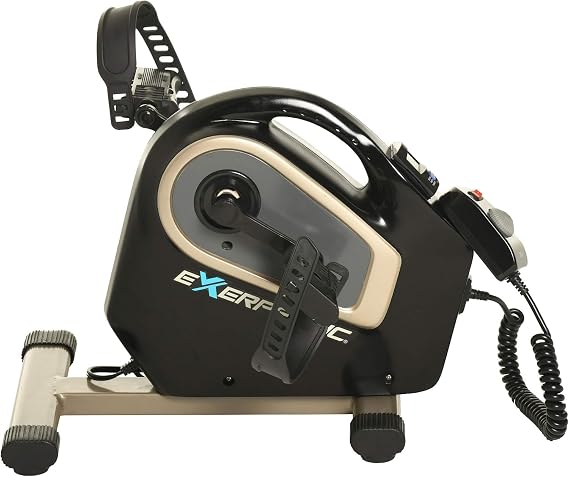
Exerpeutic 2000M Motorized Under Desk Exercise Bike offers motor-assisted, low-impact cycling perfect for knee recovery. It suits those needing gentle movement to rebuild strength and improve joint flexibility without overexerting themselves.
Its biggest strength lies in the adjustable motor that helps control speed for safe rehabilitation.
Setup is straightforward, and the under-desk style fits conveniently in small spaces. A handheld speed controller with a long 6ft cord lets you change settings without bending down, making daily use comfortable. The motor provides automatic 15-minute sessions, but you can also pedal manually for more resistance, adapting your workout according to your knee’s readiness.
The bike performs well in delivering smooth, controlled motion that encourages blood flow and muscle use without strain. It’s built with a rotating D-type handle and an LCD display to track progress. Reviews praise its quiet operation and ease of use, while some mention resistance could feel limited when powered off, especially for users needing a stronger challenge.
The main compliment highlights the smooth motorized motion making knee recovery exercises less tiring and easy to control. The frequent complaint revolves around the limited resistance when using manual pedaling without motor assistance, which might not suit all rehabilitation stages.
People looking for gentle, consistent cycling to help rebuild knee strength will appreciate the adjustable settings and motor support. Those needing long or intense workouts may want to consider alternatives with higher manual resistance or longer session options.
Pros
- Motor-assisted for low-impact exercise
- Hand-held speed controller with 6ft cord
- Adjustable resistance with 24 levels
- Quiet and stable during use
Cons
- More resistance only when motor is off
- 15-minute auto session may feel short
| Specification | Details |
|---|---|
| Controls Type | Knob |
| Display | LCD |
| Number of Resistance Levels | 24 |
| Operation Mode | Automatic |
| Power Source | Electric |
| Number of Programs | 24 |
8. PHYCISER Electric Motorized Pedal Exercise Bike

Having gentle, controlled movement with leg support makes daily recovery after knee surgery much easier. Perfect for anyone needing low-impact exercise that supports healing. What stands out is how it switches between arm and leg workouts, helping keep you active without putting stress on your knees.
Setting up takes just plugging it in and placing it where you have good access. The fixed handles and high-calf leg supports keep your legs stable while pedaling quietly.
The touch controls with an LCD screen let you easily adjust speed and resistance, so your sessions match what your knee can handle each day. Switching between upper and lower body modes adds variety without extra effort.
It performs well with smooth, motor-assisted pedaling reaching up to 55 rpm, offering 20 levels of resistance for gradual progress. The build feels sturdy enough for daily use, with a 60-watt motor delivering consistent power. Most users praise its gentle motion easing stiffness, though some find the electric cord limits where they can place it in the room.
Many find the gentle pedaling eases joint stiffness and swelling very well, helping circulation. Some users mention that the electric cord restricts where the bike can be set up, requiring a nearby outlet.
This is ideal for those recovering from knee or ankle surgery who want low-impact, adjustable exercise with solid leg support. People needing cordless options or longer leg stride length might want to look at other machines.
Pros
- Motorized pedaling with smooth, gentle movement
- Switches easily between arm and leg workouts
- High-calf leg supports provide excellent stability
- Touch controls with LCD for simple adjustments
Cons
- Corded power limits placement flexibility
- Maximum stride length only 6 inches
| Specification | Details |
|---|---|
| Maximum Speed | 55 rpm |
| Number of Resistance Levels | 20 |
| Motor Horsepower | 60 watts |
| Operation Mode | Automatic |
| Controls Type | Touch |
| Power Source | Corded Electric |
9. Sunny Health & Fitness Mini Cycle Pedal Exerciser

Excellent for low-impact workouts after knee replacement, it fits nicely under desks and suits anyone wanting gentle exercise. Its biggest strength is the quiet, adjustable resistance that can match your recovery pace without pain or strain.
Getting started is straightforward, with a manual knob to control 16 levels of resistance. The mini cycle’s lightweight frame and handle make it easy to move from the living room to your workspace.
Its small size means it doesn’t take up valuable space and storage is simple when not in use. The LCD display keeps track of your progress with minimal fuss.
Pedaling feels smooth thanks to the mesh belt-drive design, which keeps noise to a minimum. The build quality is solid for something this compact. Many appreciate how silent it is during use, but some find the manual resistance knob takes a bit of getting used to when adjusting intensity.
Quiet and smooth pedaling is a definite plus, making it easy to use anywhere without disturbing others. The common drawback is the manual knob; some users find it tricky to adjust resistance during a workout. The display and portability add to its convenience for regular use around the house or office.
People recovering from knee replacement who want gentle, adaptable exercise in small spaces will appreciate this mini cycle. Those needing more advanced features or electronic resistance control should consider alternatives better suited for intense rehabilitation.
Pros
- Quiet operation with belt-drive system
- Compact and portable design
- Adjusts resistance smoothly with 16 levels
- Dual use for legs and arms
Cons
- Manual resistance knob can be fiddly
- Limited to battery power (2 AAA batteries)
| Specification | Details |
|---|---|
| Resistance Levels | 16 |
| Display | LCD |
| Operation Mode | Manual |
| Power Source | Battery Powered (2 AAA included) |
| Controls Type | Knob |
10. Foldable Pedal Exerciser with LCD Monitor

Compact and foldable, this mini exercise bike is made for leg and arm workouts, ideal for those recovering from knee surgery. Its biggest strength lies in adjustable tension, allowing gentle or more challenging exercise tailored to recovery stages.
Setup involves placing the pedal exerciser under a desk or in front of a chair, making it easy to use anywhere in the home or office. It includes an LCD monitor showing key exercise stats like time and calories, helping to track progress daily. The manual tension knob lets you smoothly change resistance levels during warm-up or rehabilitation.
The bike performs steady low-impact cycling for both legs and arms, aiding muscle strength without straining the joints. Its build feels durable yet lightweight enough to move and fold away. Strong points include clear exercise feedback on the LCD and easy-twist resistance adjustment.
Some notes mention its manual operation can feel less smooth compared to electric models.
The pedal exerciser is praised for its clear LCD readout and adjustable tension, making it easy to match workout intensity to recovery needs. Some find the manual resistance less fluid compared to powered devices, which may affect prolonged sessions.
This exerciser suits people wanting a simple, portable machine for low-impact rehab exercises at home or desk use. Those needing electric assistance or smoother pedal motion might look for a different model.
Pros
- Adjustable tension with 5 resistance levels
- LCD monitor tracks time, RPM, calories
- Compact and foldable design
- Suitable for leg and arm exercise
Cons
- Manual operation can feel less smooth
- Requires battery for LCD monitor
| Specification | Details |
|---|---|
| Maximum Stride Length | 15.75 inches |
| Number of Resistance Levels | 5 |
| Display | LCD |
| Operation Mode | Manual |
| Power Source | Battery Powered (1 LR44 battery) |
11. Vaunn Foldable Pedal Exerciser with Display

Compact size and strong stability stand out immediately, making it ideal for anyone recovering from a knee replacement looking to build leg strength safely. Its lower height fits comfortably under desks or tables, allowing for versatile leg or arm workouts without strain.
Setting it up takes just moments, thanks to its foldable design and adjustable resistance knob. The wide base keeps it steady while pedaling, and the LCD display tracks progress efficiently. Strapping in your feet on the pedals feels secure, and shifting between resistance levels is simple during daily use.
It’s easy to work on light leg exercises while reading or working at a desk.
The build quality feels solid with a heavy-duty frame that aims for durability and stability. The main task of gently strengthening legs and arms works well, especially at lower intensity settings.
Most praise highlights how steady and safe it feels, while a common drawback is that it isn’t designed for intense workouts or high-resistance cycling.
The strongest praise centers on the stability provided by the wide base and heavy-duty frame, which makes exercising safe and steady. Common feedback notes the device’s limitations for intense or strenuous workouts due to its moderate resistance levels and shorter stride length.
Those needing gentle, consistent activity to improve leg and arm strength after surgery will appreciate this pedal exerciser. Individuals seeking higher-intensity or longer stride workouts may want to consider other options more suited to demanding exercise routines.
Pros
- Compact foldable design for easy storage
- Wide base for increased stability
- Adjustable resistance with five levels
- Versatile for arm and leg workouts
Cons
- Not suitable for strenuous exercise
- Limited stride length of 15 inches
| Specification | Details |
|---|---|
| Resistance Levels | 5 |
| Maximum Stride Length | 15 inches |
| Power Source | Battery Powered (1 AAA battery included) |
| Display | LCD |
| Operation Mode | Automatic |
12. Pedal Exerciser for Seniors

Ideal for seniors recovering from knee replacement surgery, the Pedal Exerciser offers a simple, adjustable way to keep moving without strain. Its biggest strength lies in its customizable resistance and height, allowing gentle, low-impact workouts from the comfort of a chair or sofa.
Setup takes just a few minutes thanks to tools and parts included. The adjustable footstrap and tension let you tailor the workout precisely to your comfort level, making daily use straightforward.
Sitting down to pedal feels natural, and you can work arms or legs without needing a complicated bike frame or bulky equipment.
Performance holds up well for rehab and light exercise, with smooth pedaling and a secure build that supports up to 300 lbs. The main benefit users appreciate is the gentle resistance ideal for sensitive knees.
Some note the resistance may feel too light for longer or more intense sessions, but it’s perfect for steady recovery and mobility improvement.
The exerciser is praised for its easy assembly and gentle, adjustable resistance that suits those recovering from knee issues. Most find the low resistance great for rehab but too light for extensive fitness training.
People needing a safe, light exercise tool for rehab and seniors will find this pedal exerciser fitting. Those wanting a bike with higher resistance or outdoor use should explore bigger options.
Pros
- Adjustable tension for personalized workouts
- Supports up to 300 lbs load capacity
- Compact and easy to set up
- Can be used from chair or sofa
Cons
- Resistance may be too low for intense workouts
- Limited to indoor use only
| Specification | Details |
|---|---|
| Load Capacity | 300 lbs |
| Adjustable Features | Tension and Height |
| Recommended Uses | Indoor |
| Item Count | 1 Count |
| Brand Name | RYGEO |
Best Stationary Bikes for Knee Replacement Comparison
| Product | Resistance Levels | Power Source | Operation Mode | Weight Capacity |
|---|---|---|---|---|
| Mini Pedal Exerciser | 5 | Self-Powered | Manual | – |
| Magnetic Recumbent Bike | 16 | – | – | 400 Lb |
| Home Recumbent Bike | 16 | – | – | 400 Lb |
| X-bike Foldable Bike | – | – | – | – |
| Sunny Magnetic Pedaler | 8 | Battery Powered | – | – |
| Foldable Mini Pedaler | – | NO NEED | Manual | – |
| Exerpeutic 2000M Bike | 24 | Electric | Automatic | – |
| PHYCISER Motorized Bike | 20 | Corded Electric | Automatic | – |
| Sunny Mini Cycle Pedaler | 16 | Battery Powered | Manual | – |
| Foldable LCD Pedaler | 5 | Battery Powered | Manual | – |
| Vaunn Foldable Pedaler | 5 | Battery Powered | Automatic | – |
| Senior Pedal Exerciser | Low | – | – | 300 Lb |
- Resistance Levels5
- Power SourceSelf-Powered
- Operation ModeManual
- Weight Capacity–
- Resistance Levels16
- Power Source–
- Operation Mode–
- Weight Capacity400 Lb
- Resistance Levels16
- Power Source–
- Operation Mode–
- Weight Capacity400 Lb
- Resistance Levels–
- Power Source–
- Operation Mode–
- Weight Capacity–
- Resistance Levels8
- Power SourceBattery Powered
- Operation Mode–
- Weight Capacity–
- Resistance Levels–
- Power SourceNO NEED
- Operation ModeManual
- Weight Capacity–
- Resistance Levels24
- Power SourceElectric
- Operation ModeAutomatic
- Weight Capacity–
- Resistance Levels20
- Power SourceCorded Electric
- Operation ModeAutomatic
- Weight Capacity–
- Resistance Levels16
- Power SourceBattery Powered
- Operation ModeManual
- Weight Capacity–
- Resistance Levels5
- Power SourceBattery Powered
- Operation ModeManual
- Weight Capacity–
- Resistance Levels5
- Power SourceBattery Powered
- Operation ModeAutomatic
- Weight Capacity–
- Resistance LevelsLow
- Power Source–
- Operation Mode–
- Weight Capacity300 Lb
How to Choose the Right Stationary Bike
Choosing a good stationary bike after knee replacement mainly depends on adjustable resistance, comfortable seating, and smooth pedaling to support recovery and prevent strain. Getting these factors right ensures effective exercise while avoiding discomfort, ultimately saving money on replacements or extra therapy.
Adjustability and Comfort
Sitting on a stationary bike that doesn’t adjust right can quickly turn exercise into pain, especially after a knee replacement. When the seat height or position isn’t correct, it forces the knee to bend beyond a comfortable range, causing strain not only on the new joint but also on the muscles around it.
A good bike lets you adjust the seat height and fore-aft position so the leg moves naturally, reducing discomfort during sessions.
Resistance levels matter too, as recovery progresses from gentle rehab to more intense workouts. The best bikes offer fine resistance adjustments with many levels, so you can increase difficulty without stressing the knee.
Look for bikes with easy-to-turn dials or digital controls allowing small increments in resistance. Ergonomic pedals and handlebars designed to put little pressure on the knee and hips add extra comfort for longer use.
Stability and Safety Features
Using a bike that wobbles or feels unstable quickly leads to insecurity and cuts workout time short. Bikes with a wide, sturdy frame made from strong steel can prevent tipping, especially when pushing through harder resistance or uneven pedaling. Stability is key for confidence during rehab.
The pedals should have non-slip surfaces with adjustable straps to keep the feet from sliding, which otherwise risks sharp knee twists. Including an emergency stop button or a quick way to release resistance adds safety, especially for anyone who might lose balance or control unexpectedly. These features aren’t always obvious until they’re needed.
Smooth and Quiet Operation
Noise can be a nuisance in a shared space, but it also hints at how smooth a bike’s mechanism really is. Magnetic resistance systems run quietly and avoid the clunking or rattling typical of cheaper models. Less noise means workouts can happen any time without disturbing others.
More important for knee recovery is the motion itself. Bikes with smooth pedaling reduce jerks or vibrations that might aggravate the replaced joint.
Low vibration levels help keep the knee pain-free during exercise sessions, allowing users to stay consistent without discomfort. This smoothness mostly depends on quality bearings and well-designed resistance setups.
Size and Portability
Space is often tight after surgery when adding rehab equipment around the home. Bikes with a compact footprint fit into small corners without sacrificing durability. Stable support doesn’t require bulky size, especially if the bike is well-built.
Portability matters when moving the bike between rooms or storing it. Lightweight frames or models with built-in transport wheels make relocation easier.
Adjustable pedal spacing also helps accommodate different leg lengths post-surgery, ensuring the pedals aren’t too wide or narrow, which affects comfort and joint alignment.
Ease of Use and Monitoring
Control panels that are complicated or have tiny buttons make bikes frustrating for anyone with limited mobility. Clear, simple interfaces with large buttons or knobs help users focus on their workout instead of fiddling with settings.
Displays should show essential data like time, distance, and resistance level at a glance to track progress without distraction. Bikes compatible with external devices or apps allow more detailed rehab monitoring or motivation, which can be useful for following doctors’ recommendations or staying on track during recovery.
Safe Exercise Practices for Knee Replacement Patients Using Stationary Bikes
Low-impact exercise is essential after knee replacement to protect the joint while promoting strength and mobility. Stationary bikes provide controlled movement that limits stress on the knee compared to many other activities. Adjusting the seat height to ensure a slight bend in the knee at the pedal’s lowest point helps avoid overextension or excessive strain. Starting with short sessions at an easy resistance allows blood flow and gradually rebuilds cartilage without aggravating pain or swelling.
Frequent breaks and monitoring for discomfort signals the need to pause or reduce intensity. Wearing supportive footwear and maintaining proper posture reduces the chance of compensatory movements that could harm other parts of the leg.
Consulting with a physical therapist on form and duration ensures personalized guidance based on the stage of recovery. Regular cleaning of the bike and checking for mechanical issues prevent interruptions or accidents during rehabilitation rides.
Common Mistakes to Avoid When Cycling After Knee Surgery
Ignoring proper bike setup can increase knee pain or delay recovery after knee surgery. One common mistake is setting the seat too low, which forces the knee to bend sharply and puts unnecessary pressure on the joint. Pedaling with high resistance before the leg is ready often leads to swelling and setbacks. Avoid pushing through sharp pain; mild discomfort is normal but intense or lingering pain signals a problem.
Some people pedal too fast in an effort to build endurance quickly, which sacrifices control and can cause improper tracking of the knee. Skipping warm-ups or cool-down stretches can reduce flexibility and increase stiffness.
Not following a gradual progression plan and overusing the bike without rest days may exacerbate inflammation. Lastly, neglecting to clean the pedals and straps can make the foot slip, risking poor alignment and uneven forces on the recovering knee.
Comparing Upright vs. Recumbent Stationary Bikes for Post-Knee Replacement Rehabilitation
Both upright and recumbent stationary bikes offer benefits, but choosing the right type depends on comfort and mobility post-surgery. Upright bikes mimic traditional cycling posture, which can engage core muscles more but may put slightly more load on the knee because of the more vertical position. Many find this option better for later stages of recovery when strength and endurance improve.
Recumbent bikes have a reclined seat and back support, which reduces stress on the knee and lower back. This setup helps those who struggle with balance or have limited range of motion early after surgery. Resistance levels on both types can be adjusted to gradually build muscle without overexerting the joint.
The size and footprint are larger for recumbent bikes, so space availability is a consideration. Trying both types before committing can help identify which feels less painful and more stable during movement.
People Also Asked
Is a Stationary Bike Safe to Use After Knee Replacement?
Stationary bikes are generally safe after knee replacement when used according to medical advice. Starting with low resistance and slow pedaling reduces strain. Always follow your doctor or physical therapist’s guidance for timing and intensity.
How Do I Size a Stationary Bike for Post-Knee Replacement Rehab?
Choose a bike with adjustable seat height and distance to pedals so you can customize the fit as your knee mobility improves. The seat should allow a slight knee bend at the furthest pedal extension to prevent overextension.
What Are the Common Problems with Stationary Bikes After Knee Surgery?
Common issues include discomfort from incorrect seat height and difficulty adjusting resistance smoothly. Low-quality pedals or seats can cause pain, so choose models with ergonomic designs and check for quiet, steady pedaling action.
How Long Does a Stationary Bike Typically Last with Regular Knee Rehab?
A stationary bike can last several years when used regularly for knee rehab, especially if it has durable components. Frequency and intensity of use affect lifespan; keep an eye on parts like pedals and resistance mechanisms for wear.
What Care Tips Help Maintain a Stationary Bike After Knee Replacement?
Wipe down the bike after use to prevent sweat damage, lubricate moving parts according to the manual, and regularly check bolts and screws for tightness. Maintaining adjustments as your knee heals keeps the bike comfortable and effective.
Conclusion
Comfort and adjustability are the key factors to focus on when picking a stationary bike after knee replacement. Look for a bike that allows you to keep your knee at a comfortable angle with low resistance options to avoid strain.
Stability is also important to ensure safety while you build strength and mobility.
Before buying, think about how much space you have and your budget since bikes vary in size and price. Also, consider how often you plan to use it to get the best value. The comparison table and detailed picks above can help narrow down which option fits your needs best.