
Top 12 Best Dead Car Battery Charger You Can’t Miss
Dead car batteries can catch anyone off guard, especially when a charger fails to deliver the power needed to jumpstart the vehicle. A cheap or poorly chosen charger might provide insufficient amps, leaving the battery only partially charged or taking too long to revive it.
The best dead car battery charger should provide reliable power output to handle even fully drained batteries without causing damage or excessive wait times.
What makes a good battery charger stand apart is how much current it can provide, typically between 4 to 10 amps for standard car batteries. It should include automatic shutoff or trickle charge modes to avoid overcharging, which damages battery life.
Durable cables with secure clamps, compact size for easy storage, and clear status indicators are practical features that improve everyday use and safety.
Need a Quick Check?
| Image | Product | Price |
|---|---|---|
Our Top Picks 1  | Smart Car Battery Charger | Check Price |
Our Top Picks 2  | NOCO GENIUS5 Charger | Check Price |
Our Top Picks 3  | Smart 12V/24V Charger | Check Price |
Our Selected Top 12 Dead Car Battery Charger Worth Considering
This list features twelve reliable dead car battery chargers chosen for their performance and ease of use. Each review explains how well the charger works, who it is best suited for, and highlights its main advantages and drawbacks to help you make an informed decision.
1. Smart Car Battery Charger and Maintainer
Great for anyone looking to quickly recharge a dead car battery, this charger offers multiple current options to fit different battery types. Its standout feature is its speed, charging batteries significantly faster than many lower-amp options on the market.
Getting started is straightforward, with clear options to select charging currents at 2A, 10A, 25A, or an automatic setting. The built-in clamps are easy to connect, and the single port keeps things simple.
The charger works smoothly with standard 120-volt outlets and supports various battery types like AGM and GEL, making daily charging simple.
The performance impresses with a maximum 25A output allowing a full charge of a 100Ah battery in about 3.5 hours. The charger is built solidly for regular use, focusing on energy saving and speed.
Users often praise the fast charging while occasionally mentioning that the charger design could benefit from a more compact size for storage.
Charging speed stands out, fully charging a 100Ah battery in under 3.5 hours which saves significant wait time. Most users appreciate this efficiency, though some note the charger’s size could be smaller for easier storage and transport.
Those needing a quick and versatile charger for different battery types will find this product suitable. Users who require a more compact charger or the ability to charge multiple batteries at once may want to consider alternatives.
Pros
- Fast charging with up to 25A current
- Energy-efficient with 85% charging efficiency
- Supports various battery types
- Simple single-port design
Cons
- Charger size is a bit bulky for some users
- No multiple port options for charging simultaneously
| Specification | Details |
|---|---|
| Output Voltage | 12 volts |
| Input Voltage | 120 volts_of_alternating_current |
| Battery Charge Time | 120 minutes |
| Current Rating | 25 A |
| Compatible Devices | AGM, Deep Cycle battery, GEL, STD |
2. NOCO GENIUS5 6/12V Smart Battery Charger
Solidly built with a compact design, this smart battery charger fits well in tight spaces and handles both 6-volt and 12-volt batteries. Suited for cars, motorcycles, boats, and more, its standout feature is the integrated thermal sensor that adjusts charging based on temperature for efficient and safe battery upkeep.
Setting it up is straightforward, just connect the battery clamps to the battery terminals and plug it in. It automatically detects battery type and charge level, then adjusts its output accordingly. The charger works as a maintainer and desulfator too, so it keeps batteries in good health even when not in use.
Its small size makes storing and handling easy without dealing with bulky equipment.
Charging delivers a steady 5-amp current over about eight hours, restoring batteries effectively. The rugged design feels durable enough for regular garage or outdoor use. The main plus is its smart charging adaptability, which prevents damage caused by over or undercharging.
Some users find the single port limiting when managing multiple batteries, but the product performs reliably where it matters most.
The thermal sensor is highly praised for maintaining battery health across different temperatures, ensuring a precise charge. Most find the single port limiting when needing to charge multiple batteries simultaneously.
Anyone needing a reliable charger for one battery at a time and wanting maintenance features will appreciate this product. Those needing to charge multiple batteries at once might need to look for a charger with several ports.
Pros
- Compact size saves storage space
- Thermal sensor prevents battery damage
- Works with a wide variety of battery types
- Includes desulfator for prolonged battery life
Cons
- Only one charging port for one battery at a time
- Charge time of 8 hours may be long for emergencies
| Specification | Details |
|---|---|
| Output Voltage | 12 volts |
| Input Voltage | 120 volts |
| Battery Charge Time | 8 hours |
| Current Rating | 5 A |
| Compatible Devices | Cars, Boats, Motorcycles, ATVs, RVs, Trucks, SUVs, Scooters, Lawn Mowers, Tractors and More |
3. 12V/24V Smart Car Battery Charger and Maintainer
Power stands out immediately with this charger, capable of 25A rapid charging for 12V batteries and 15A for 24V ones. It’s best suited for larger vehicles like trucks, SUVs, boats, and RVs, handling heavy-duty battery needs without breaking a sweat.
Setup is straightforward thanks to an intelligent chip that automatically senses if the battery is 12V or 24V. Five adjustable current settings give you control to match your battery type and charging needs, from a gentle 2A trickle up to a fast 25A boost.
This flexibility makes daily use convenient and tailored, avoiding the pitfalls of generic chargers.
Charging speed impresses, significantly faster than standard maintainers without risking battery damage. Built solidly to work with a variety of battery types, including AGM and LiFePO4, it holds up well under regular use. Most praise notes the quick charge and compatibility, while the most common gripe deals with the manual current adjustments needing some attention to get just right.
Charging happens quickly and works well with a range of battery types, making it reliable for tough conditions. Adjusting the current manually sometimes needs a bit of trial to ensure the perfect charge level. The auto mode simplifies this but might not suit every situation.
This charger fits those with bigger vehicles and a need for rapid, versatile charging. People wanting a more plug-and-play experience without manual adjustments might want to explore alternative options with fewer settings to worry about.
Pros
- Fast 25A charging speeds for large batteries
- Automatic detection of 12V or 24V batteries
- Five adjustable current settings for tailored charging
- Compatible with multiple battery chemistries
Cons
- Requires manual choice for precise current settings
- Limited input voltage of 110 volts only
| Specification | Details |
|---|---|
| Output Voltage | 12 volts, 24 volts |
| Current Rating | 25 A |
| Input Voltage | 110 volts |
| Compatible Battery Types | Lead-Acid (AGM, GEL, SLA, Flooded, EFB), LiFePO4 Lithium |
| Manual Current Settings | 2A, 8A, 20A, 25A, Auto Mode |
4. NOCO GENIUS10 6/12V Smart Battery Charger

Perfect for anyone needing reliable charging for a range of battery types, this charger stands out with its powerful 10 amp output and small size. It suits drivers, boaters, and anyone with 6V or 12V lead-acid or lithium-ion batteries, offering smart, temperature-adjusted charging that prevents damage and extends battery life.
Setup is straightforward with battery clamps and eyelet terminals making connections easy. Its intelligent thermal sensor adapts charging based on outside temperature, which means it handles summer heat and cold winters without you having to adjust anything manually.
Using it daily involves attaching it to the battery, plugging in, and letting it automatically maintain or charge without overdoing it.
Charging delivers solid performance with a full charge taking about ten hours at 10 amps. The compact build feels sturdy, yet it’s lighter and smaller than previous models, making storage and transport simpler. Most praise it for consistent, fast charging, while a rare complaint points to the single port limiting simultaneous use for multiple batteries.
The strongest point is the charger’s smart temperature sensor that prevents overcharging or undercharging based on the environment. Most users appreciate this accuracy and protection, while the common downside is the limitation of just one charging port, which may not suit those with multiple batteries needing simultaneous charging.
This charger fits perfectly for anyone looking to maintain or charge a car, motorcycle, or marine battery efficiently and safely. Those needing to charge multiple batteries at once or looking for faster charging solutions might prefer a different option with higher capacity or additional ports.
Pros
- Compatible with multiple battery types
- Adjusts charging based on temperature
- Compact and lighter than older models
- Includes desulfator for battery maintenance
Cons
- Only one charging port available
- Charge time can reach 10 hours
| Specification | Details |
|---|---|
| Output Voltage | 12 volts |
| Input Voltage | 120 volts |
| Battery Charge Time | 10 hours |
| Current Rating | 10 A |
| Connector Type Used on Cable | Battery Clamps and Eyelet Terminals |
| Number of Ports | 1 |
5. Schumacher Electric 15A Car Battery Charger SC1280
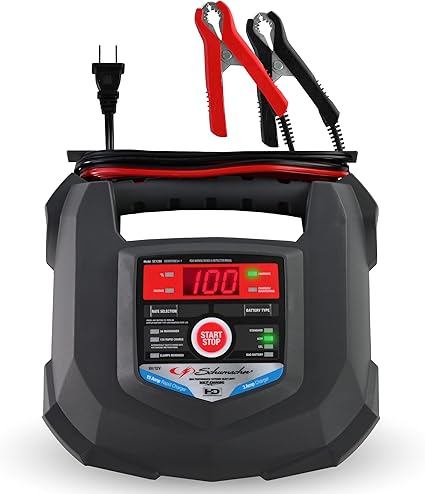
Dead batteries can ruin your day, especially with seasonal vehicles or ones that sit unused for a while. This charger suits anyone looking to quickly revive and maintain batteries for cars, motorcycles, or boats.
Its biggest strength is a fast, reliable 15A charging power that fits various battery types.
Getting started involves clipping the alligator connectors onto the battery terminals and plugging into a standard 120V outlet. The microprocessor handles voltage detection automatically, so no guessing about settings.
Once connected, it switches to smart trickle charging to keep the battery topped off safely without overcharging. There’s no complicated setup, just straightforward operation tailored for different vehicle batteries.
Charging runs at 12 volts with a steady 15A current, completing in about 10 hours for thorough battery care. The unit feels solid enough for a garage environment, handling standard, AGM, gel, and deep-cycle batteries. The main praise is its ability to revive truly dead batteries, while complaints mostly mention the slower overall charging time compared to faster trickle chargers.
The most praised feature is the ability to breathe life back into dead batteries, making it ideal for vehicles left unused for months. Common complaints focus on the 10-hour charge time, which some find slow when in a hurry.
Those needing a reliable charger for a variety of battery types will appreciate its versatility and automatic controls. Users wanting very fast charging or support for higher voltage batteries should explore other options.
Pros
- Rapid 15A charging for quicker starts
- Automatic voltage detection and smart charging
- Safe for multiple battery types including AGM and gel
- Simple alligator clip connectors
Cons
- Charge time may feel long at 10 hours
- Only supports 6V and 12V batteries
| Specification | Details |
|---|---|
| Output Voltage | 12 volts |
| Input Voltage | 120 volts |
| Battery Charge Time | 10 hours |
| Current Rating | 15 A |
| Compatible Devices | 6V and 12V batteries (standard, AGM, gel, deep-cycle) |
6. PLXX 12V/24V Automatic Smart Car Battery Charger

15 amps of charging power make this automatic smart charger great for handling a wide range of 12V and 24V lead-acid batteries. Ideal for anyone with cars, trucks, motorcycles, or even boats, it focuses on making battery maintenance straightforward and adaptable for many battery types.
Setup involves simply connecting the clamps to your battery and plugging it into a 120V outlet. It does the rest with automatic voltage detection and seven charging stages.
You can choose between a fast charge for larger batteries or a slow trickle charge for smaller ones, which means no guesswork or constant monitoring.
It charges well within about two hours for many batteries and handles various lead-acid types, like AGM and flooded batteries, thanks to the pure copper coil and durable casing. Most people like how it manages charge safely and without overcharging.
A common gripe is the unit might feel a bit bulky or heavy compared to smaller chargers.
People appreciate how the charger automatically adjusts and maintains battery health across several types without needing constant attention. However, some mention the physical size and weight make it less convenient for compact storage or frequent transport.
Those looking for a reliable, hands-off charger for a variety of vehicle batteries will be happy. Anyone needing a lightweight or more compact charger might consider alternatives better suited to smaller spaces or occasional use.
Pros
- Works with 4-300Ah lead-acid batteries
- Fully automatic with smart voltage detection
- Dual charging modes: fast and slow
- Durable metal and ABS construction
Cons
- Some find the unit bulky and heavy
- Only compatible with lead-acid battery types
| Specification | Details |
|---|---|
| Output Voltage | 12 volts |
| Input Voltage | 120 volts |
| Battery Charge Time | 2 hours |
| Current Rating | 15 A |
| Amperage | 15 A |
7. NOCO Boost GB40 Portable 12V Jump Starter

Perfect for anyone who needs a reliable jump starter for cars, trucks, or small engines, this device stands out for its powerful 1000 amps of lithium power. It’s ideal for those who want a device that can handle multiple starts and also double as a portable power source.
Setting it up is straightforward thanks to its spark-proof and reverse polarity protection, so hookups are safe and worry-free. Daily use is simple; after charging in about 3 hours, it’s ready to jump gas engines up to 6.0L and diesels up to 3.0L. You also get a handy LED flashlight with multiple modes, making it useful for night emergencies or roadside repairs.
It delivers solid performance, able to jump start up to 20 times per full charge on compatible engines. The build feels sturdy and compact, easy to keep in the glovebox or emergency kit. Users appreciate the safety features the most, though some mention the battery capacity could be higher for longer use between charges.
The jump starter’s safety features are highly rated for preventing accidental sparks and reversed connections, ensuring safe use. Frequent comments note that the 2150 mAh battery sometimes needs recharging sooner than expected, especially after multiple uses.
Anyone looking for a lightweight, compact starter for smaller gas and diesel engines will appreciate its versatility and power bank function. People with larger vehicles or those requiring more jump starts per charge may prefer options with bigger battery capacity.
Pros
- 1000 amps peak power for quick starts
- Safety features prevent sparks and wrong hookups
- Compact and portable design with flashlight
- Power bank for charging phones and devices
Cons
- Battery capacity may require frequent recharging
- Limited jump starts on larger engines
| Specification | Details |
|---|---|
| Battery Type | Lithium |
| Voltage | 12 volts |
| Peak Output Current | 1000 A |
| Battery Capacity | 2150 milliamp_hours |
| Compatible with Vehicle Type | ATV, Motorcycle, Passenger Car, RV, Tractor, Truck, UTV, Van, Watercraft |
8. Schumacher Electric 6A Car Battery Charger SC1281

Powerful and versatile, the Schumacher Electric 6A Car Battery Charger SC1281 suits a wide range of vehicles from cars to boats. Its main strength lies in the high 100-amp engine start capacity that revives dead batteries quickly, making it reliable for drivers who need fast and effective battery support.
Setup involves simply connecting the crocodile clips to the battery and plugging the charger into a 120-volt outlet. Regular use benefits from its microprocessor-controlled charging, which adjusts between 2A and 6A rates and switches to a smart trickle mode to keep the battery voltage steady without overcharging.
The 5-in-1 feature lets you start, charge, maintain, test, and restore different battery types, cutting down the need for multiple devices.
Charging performance impresses with a boost charge ranging from 12 to 30 amps and peak current hitting 100 amps for those tough engine starts. The charger is solidly built for handling standard, AGM, gel, and deep-cycle 6V and 12V batteries. Positive feedback often notes its effectiveness at restoring dead batteries.
Some point out the 10-hour charge time as a bit long in certain situations.
The strongest praise highlights the charger’s ability to bring dead batteries back to life swiftly and maintain voltage without risk of overcharging. The most common complaint centers on the 10-hour charge time required to fully replenish some batteries.
People needing a reliable charger for a variety of battery types and vehicles will appreciate this unit’s versatility and power. Those wanting faster charging or to handle multiple batteries simultaneously might want to look at other options.
Pros
- High 100-amp engine start for quick battery revival
- Smart trickle charge to maintain battery voltage safely
- Compatible with various battery types and vehicles
- 5-in-1 functions for start, charge, maintain, test, restore
Cons
- 10-hour charging time can feel lengthy
- Single port limits charging one battery at a time
| Specification | Details |
|---|---|
| Output Voltage | 12 volts_of_direct_current |
| Input Voltage | 120 volts |
| Battery Charge Time | 10 hours |
| Current Rating | 100 A |
| Amperage | 30 A |
| Connector Type | Crocodile Clips |
9. Heavy Duty 12V/24V Battery Charger and Maintainer

Yourheey Heavy Duty 12V/24V Battery Charger and Maintainer suits anyone needing a reliable charger for different lead-acid batteries. Its biggest strength lies in quickly charging larger batteries with a powerful 20A output while still being compatible with smaller ones. The military-grade materials make it solid enough for long-term heavy use.
Setting it up is straightforward with adaptable battery terminal connectors that fit various battery types. It handles both 12V and 24V systems, so it works well across vehicles, RVs, and lawn equipment.
You just plug it into a standard 110V outlet, connect the clamps, and let it run. Keeping it on maintain mode helps keep batteries healthy over time without overcharging.
Charging performance is reliable and fast, especially appreciated on bigger batteries like trucks and RVs. The sturdy aluminum casing and pure copper coils help with heat dissipation, which makes the charger feel durable and safe.
The most common drawback is it cannot charge lithium batteries, limiting its use if those are in your garage. Build quality and output current are praised frequently.
The charger receives praise for building fast and reliable charge cycles with stable heat management thanks to its quality materials. Many users highlight the solid construction and efficient performance for heavy-duty needs. The key limitation reported is incompatibility with lithium batteries, restricting use if you have that battery type.
This charger is well suited for those needing a dependable lead-acid battery charger across a range of vehicle types from motorcycles to big trucks. Users with lithium batteries should look elsewhere, but for lead-acid systems, it delivers consistent results without fuss.
Pros
- Handles multiple lead-acid battery types
- Powerful 20A max output for faster charging
- Durable aluminum alloy casing
- Adaptable connectors for easy battery hookup
Cons
- Not compatible with lithium/LiFePO4 batteries
- Single port limits charging multiple batteries at once
| Specification | Details |
|---|---|
| Output Voltage | 12 volts |
| Input Voltage | 110 volts |
| Current Rating | 20 A |
| Compatible Devices | Lead-acid batteries (AGM, GEL, Flooded, EFB, Calcium, MF, deep-cycle) |
| Battery Charge Time | 8 hours |
| Connector Type | Adaptable/Interchangeable Battery Terminal Connectors |
10. Schumacher Electric 6/12V Car Battery Starter SC1445

Coming across a dead battery doesn’t have to be a headache with this battery starter around. Ideal for anyone who needs a reliable jumpstart solution for cars, trucks, or even RVs, it delivers a hefty 250-amp surge that gets engines running fast.
Its biggest strength lies in how quickly it can revive a dead battery and make sure you’re back on the road in no time.
Setting it up means clamping onto the battery terminals, which feels secure thanks to the sturdy clips. Most days, it’s a simple process: plug it into a regular 120-volt outlet, set the timer to control how long you want it charging, and then let it do its job.
The 135-minute manual timer gives you the chance to tailor the charge, cutting down the risk of overcharging and making it versatile for different battery sizes and conditions.
Getting the battery going happens quickly with its powerful boost modes, especially the 25-amp and 50-amp charges for deeply drained batteries. It’s built to handle 6V and 12V batteries across vehicles, boats, and sports gear, which means you get a solid feel from the construction and clips.
Most people note how fast the start is, but it can be a bit bulky to carry around for some.
This charger is praised for how quickly it gets a dead battery running again, making it a reliable choice in emergencies. The most common drawback is its size and weight, which can make handling or frequent moving less convenient.
Anyone needing rapid, powerful starts for a variety of vehicles will find this charger suits their needs well. People looking for something lighter or able to charge several batteries at once might want to explore other options.
Pros
- Delivers a strong 250-amp engine start
- Adjustable 135-minute manual timer
- Fast boost charges at 25 and 50 amps
- Works with both 6V and 12V batteries
Cons
- Can feel heavy and bulky to carry
- Single-port design limits charging multiple batteries
| Specification | Details |
|---|---|
| Output Voltage | 12 volts |
| Input Voltage | 120 volts |
| Battery Charge Time | 135 minutes |
| Current Rating | 10 A |
| Amperage | 250 A |
| Compatible Devices | 6V/12V batteries, automotive, marine, and power sport vehicles |
11. CRAFTSMAN 12A Car Battery Charger CMXCESM258

Powerful and straightforward, the CRAFTSMAN 12A Car Battery Charger is ideal for anyone dealing with dead or weak 12V batteries in cars, trucks, or smaller vehicles like motorcycles and ATVs. Its main strength lies in delivering a strong 12A charge that revives various battery types quickly.
Setting it up takes just seconds, thanks to its clamp connectors and auto voltage detection. The digital display keeps you informed about charging status, while the microprocessor controls the process to prevent overcharging. Its reverse hook-up protection reduces worry during connection, and smart trickle charging means it maintains battery health without constant supervision.
Performance is solid with rapid charging and battery testing built-in. It works well on standard, AGM, deep-cycle, and 12V lithium batteries, restoring dead batteries reliably.
The sturdy build feels dependable, but some find the size a bit bulky for tight storage. The clearest praise is for its rapid and reliable charging, while the most common gripe concerns the overall weight and handling.
The charger quickly revives dead batteries and offers helpful features like reverse hook-up protection and smart charging, making the charging process worry-free. Users often note its solid performance, yet many mention that it is a bit bulky, which affects portability and storage options.
Anyone needing reliable, fast charging for different vehicle battery types will appreciate it. Those looking for a more compact or lightweight option might want to consider other models better suited for easy handling and storage.
Pros
- Delivers 12A rapid charging power
- Auto voltage detection for safety
- Works with multiple battery types
- Digital display for clear status updates
Cons
- Can feel bulky and heavy to handle
- Not the smallest charger for easy storage
| Specification | Details |
|---|---|
| Output Voltage | 12 volts |
| Input Voltage | 12 volts |
| Current Rating | 12 A |
| Compatible Devices | Standard, AGM, Lithium (LiFePO4), Deep Cycle batteries |
| Connector Type | Clamp |
12. LOKITHOR JC400 Car Battery Charger and Jump Starter

Lithium polymer build and ultra-compact design make the JC400 a versatile choice for those needing more than just a jump starter. Anyone looking for a tight package that combines multiple functions in one tool will appreciate how much this charger packs into a small frame.
Setup involves plugging into a standard power source and connecting clamps to the battery terminals, which is straightforward. Daily use benefits from its battery maintainer and trickle charger modes that keep a battery topped up without overcharging.
The integrated voltage detection and compass add convenience when dealing with roadside issues, while the six-mode LED lights brighten up dark working conditions.
Jumping a 12-volt car battery is solid thanks to a peak output current of 2500 A, making quick starts possible. The charger feels durable given its size. Highly praised for fitting comfortably in the palm, the main complaint revolves around its relatively limited battery capacity when used as a power bank.
It balances power and portability well.
A standout feature is the easy handling due to its compact size, making roadside emergencies less stressful. Common feedback concerns the power bank capacity, which may not last long with heavy use.
Those who want a versatile tool that fits easily in a glove box will find this attractive. Users needing a longer-lasting power bank or heavy-duty cables might want to look for alternatives.
Pros
- Compact design fits in the palm of your hand
- Supports multiple vehicle types universally
- Includes 6-mode LED lights and a compass
- Functions as a battery maintainer and desulfator
Cons
- Battery capacity limits power bank use duration
- Occasional complaints about clamp cable length
| Specification | Details |
|---|---|
| Battery Type | Lithium Polymer |
| Voltage | 12 volts |
| Peak Output Current | 2500 A |
| Battery Capacity | 8000 milliamp_hours |
| Compatible with Vehicle Type | Passenger Car, Van, ATV, Motorcycle, RV, UTV, Truck, Watercraft, Tractor |
Best Dead Car Battery Chargers Comparison Table
| Product | Output Voltage | Current Rating | Amperage | Battery Charge Time |
|---|---|---|---|---|
| Smart Car Battery Charger | 12 volts | 25 A | 800 A | 120 minutes |
| NOCO GENIUS5 Charger | 12 volts | 5 A | 5 A | 8 hours |
| Smart 12V/24V Charger | 12 volts, 24 volts | 25 A | 25 A | – |
| NOCO GENIUS10 Charger | 12 volts | 10 A | 10 A | 10 hours |
| Schumacher SC1280 Charger | 12 volts | 15 A | 15 A | 10 hours |
| PLXX Smart Battery Charger | 12 volts | 15 A | 15 A | 2 hours |
| NOCO GB40 Jump Starter | 12 volts | – | 1000 A | – |
| Schumacher SC1281 Charger | 12 volts | 100 A | 30 A | 10 hours |
| Heavy Duty Battery Charger | 12 volts | 20 A | 20 A | 8 hours |
| Schumacher SC1445 Starter | 12 volts | 10 A | 250 A | 135 minutes |
| CRAFTSMAN CMXCESM258 Charger | 12 volts | 12 A | 12 A | – |
| LOKITHOR JC400 Charger & Starter | 12 volts | – | 2500 A | – |
- Output Voltage12 volts
- Current Rating25 A
- Amperage800 A
- Battery Charge Time120 minutes
- Output Voltage12 volts
- Current Rating5 A
- Amperage5 A
- Battery Charge Time8 hours
- Output Voltage12 volts, 24 volts
- Current Rating25 A
- Amperage25 A
- Battery Charge Time–
- Output Voltage12 volts
- Current Rating10 A
- Amperage10 A
- Battery Charge Time10 hours
- Output Voltage12 volts
- Current Rating15 A
- Amperage15 A
- Battery Charge Time10 hours
- Output Voltage12 volts
- Current Rating15 A
- Amperage15 A
- Battery Charge Time2 hours
- Output Voltage12 volts
- Current Rating–
- Amperage1000 A
- Battery Charge Time–
- Output Voltage12 volts
- Current Rating100 A
- Amperage30 A
- Battery Charge Time10 hours
- Output Voltage12 volts
- Current Rating20 A
- Amperage20 A
- Battery Charge Time8 hours
- Output Voltage12 volts
- Current Rating10 A
- Amperage250 A
- Battery Charge Time135 minutes
- Output Voltage12 volts
- Current Rating12 A
- Amperage12 A
- Battery Charge Time–
- Output Voltage12 volts
- Current Rating–
- Amperage2500 A
- Battery Charge Time–
How to Choose the Right Car Battery Charger
Look for a charger with the right voltage and appropriate charging speed to match your battery type, ensuring safety and efficiency. Choosing one with reliable safety features prevents damage, saving you money and hassle in the long run.
Charging Power and Speed
Many chargers advertise their maximum amperage, but understanding its role can save time during a roadside battery boost. A higher amperage rating, like 10A or 15A, usually means faster charging, especially useful when dealing with large batteries or when you need a quick start. Lower amperage settings, often around 2A, serve as trickle charge modes that slowly replenish the battery, crucial for maintaining battery health if the car isn’t driven regularly.
Choosing a charger with multiple charging modes helps adapt to various battery sizes and states of charge. For example, a typical 12V car battery between 40-70Ah might need a higher amperage for faster charging, but smaller batteries or maintenance need slower rates to avoid damage. Look for models offering selectable amperage to switch between rapid charging and slow, sustained charging.
Battery Compatibility
The variety of battery chemistries in cars today means a charger must support multiple types like lead-acid, AGM, and lithium-ion. Each type charges differently and requires specific voltage and current controls to avoid damage.
A charger that can handle 6V and 12V batteries adds important flexibility, covering motorcycles, classic cars, and standard vehicles.
Getting stuck with a charger that fits only one battery type or voltage can be frustrating and sometimes risky. A practical charger will adapt to diverse battery sizes and conditions, adjusting charge rate depending on the battery’s discharge level. This adaptability improves usability across different vehicles and battery states.
Safety Features
Safety is a serious concern when charging car batteries. Features like overcharge protection stop the charger from pumping too much current once the battery is full, preventing battery damage or leaks. Short circuit protection avoids potentially dangerous sparks or fires if clips accidentally touch.
Reverse polarity protection is another key element, ensuring the charger won’t start if clamps are connected incorrectly, a common mistake that can cost time and equipment. Thermal protection guards against overheating during prolonged use, which is vital for devices that might be left charging overnight or in hot conditions.
Ease of Use and Portability
Chargers that are simple to operate make a big difference during an emergency. Clear displays or indicator lights showing charging status and errors eliminate guesswork.
Compact, lightweight models are easier to store in a trunk or garage, and their portability is noticeable when moving between multiple vehicles.
Cable length and clamp design also matter. Cables around 6 feet provide enough reach for comfortably accessing the battery without stretching.
Well-insulated clamps with solid grips not only improve connection but also reduce the chance of slipping, especially when working in tight engine bays.
Durability and Build Quality
Daily handling and the environment test a charger’s build quality. Durable chargers use strong, dust-resistant, and moisture-repellent casings, which keep internal components safe in garages or outdoors. Cables need thick insulation that resists cracks and wear, as do clamps made of corrosion-resistant metal.
Frequent use means the charger should hold up over time without broken clips or frayed wires. Solid construction ensures reliable performance even after years in a tool kit. Choosing models known for toughness avoids the frustration of replacements in harsh conditions.
Proper Safety Precautions When Using a Dead Car Battery Charger
Car batteries contain corrosive acid and can produce explosive gases during charging. Always wear protective gloves and eye protection before handling a dead battery charger.
Ensure connections are clean and free from corrosion to improve charging efficiency and safety. Charge the battery in a well-ventilated area to prevent gas buildup that might ignite. Make sure the charger is switched off before attaching or detaching the clamps to avoid sparks.
Connect the positive clamp to the battery’s positive terminal first, then the negative clamp to the vehicle’s chassis or negative terminal. Avoid charging near open flames or sources of sparks.
Regularly check the charger and cables for damage or exposed wires and replace any faulty parts immediately. Following these precautions helps minimize risks of injury and damage while dealing with dead car battery chargers.
Common Mistakes to Avoid When Charging a Dead Car Battery
One frequent error is connecting the clamps to the wrong battery terminals, which can cause sparks or damage the vehicle’s electrical system. Some people start the charger without confirming the battery’s voltage, potentially leading to incorrect charging. Leaving the charger connected for too long risks overcharging, which shortens battery life.
Many users fail to let the battery rest after charging before attempting to start the car, missing proper charge absorption. Never try to charge a battery that is cracked or leaking, as it may explode.
Skipping the step to turn off the charger before disconnecting clamps can cause sparks. Avoid using a charger on incompatible battery types unless it specifies support for them. Taking time to follow the correct sequence and limits preserves the battery and prevents accidents.
Comparing Portable vs. Plug-In Dead Car Battery Chargers for Different Scenarios
Portable dead car battery chargers offer mobility, making them suitable for emergencies away from home or garage. They generally require no external power source, often using built-in batteries or jump-start capabilities.
This makes them handy for road trips or when access to an outlet isn’t available. Plug-in chargers connect to a wall outlet and provide steady, controlled charging over longer periods, which can be better for maintaining battery health. These units tend to be heavier and less convenient to carry but are useful for regular upkeep of a vehicle’s battery at home.
Portable chargers usually provide faster, less gentle charging, ideal for quick starts, while plug-in models work well for deep charging and prolonged use. Choosing between the two depends on daily needs, location, and how often the vehicle requires battery assistance.
People Also Asked
How Do I Choose the Right Size Dead Car Battery Charger?
Pick a charger with an amp rating that matches your battery size; a 2-10 amp charger works for most car batteries. Bigger chargers charge faster but risk overheating if used improperly. Look for chargers designed for the battery type in your car to avoid damage.
Is It Safe to Leave a Car Battery Charger Connected Overnight?
Leaving a charger connected overnight is generally safe with modern chargers that have automatic shutoff. Older models without this feature can overcharge and damage the battery. Always check your charger’s instructions and remove it once the battery is fully charged.
How Long Does a Typical Dead Car Battery Charger Last?
Typical car battery chargers last several years if used and stored properly. Battery charger longevity depends on quality and frequency of use. Keeping it clean and avoiding drops or exposure to moisture can extend its life.
Can I Use a Dead Car Battery Charger on Any Battery Type?
Not all chargers work with every battery type; some are designed for lead-acid batteries only. Using the wrong charger on lithium or gel cell batteries can cause damage. Verify the charger’s compatibility with your specific battery before use.
What Are Common Problems When Using a Dead Car Battery Charger?
Common problems include incorrect connection leading to sparks or damage, charger incompatibility with battery type, and poor or slow charging due to a faulty charger or severely drained battery. Double-check your connections and ensure your charger matches your battery’s requirements.
Conclusion
Choosing a dead car battery charger depends mainly on how fast it can charge, whether it has protection features to prevent overcharging, and if it can work with different battery types. A charger that is user-friendly and durable also makes a difference, especially if you might use it in cold or rough conditions.
Consider where you will store or use the charger, your budget, and how often you expect to need it. A smaller, simpler model might suffice for occasional use, while frequent use could require a more advanced option. Check the comparison table and product details above to find what fits your needs best.