
Top 12 Best Car Battery for Inverter That Lasts Long
Choosing the best car battery for inverter can prevent a common issue where a cheap or incompatible battery struggles to supply steady power. A poorly matched battery might cause the inverter to shut down unexpectedly or fail to start, especially during peak power draws.
Many people have faced the frustration of a battery that drains quickly or cannot handle the load required by their inverter setup.
The key factors in selecting a good car battery for an inverter include the battery’s capacity, usually measured in ampere-hours (Ah), and its cold-cranking amps (CCA), which indicate how well it performs under load. Deep cycle batteries with higher Ah ratings, often above 70 Ah, tend to sustain inverter use better than standard starting batteries. Battery type matters as well; sealed lead-acid or AGM batteries generally provide safer and cleaner operation compared to flooded options, plus they require less maintenance.
Need a Quick Check?
| Image | Product | Price |
|---|---|---|
Our Top Picks 1  | Pure Sine 2000W Inverter | Check Price |
Our Top Picks 2  | Modified Sine 1000W Inverter | Check Price |
Our Top Picks 3  | XS Power D3100 Battery | Check Price |
Our Selected Top 12 Car Battery for Inverter for Every Budget
This list features a variety of car batteries suitable for powering inverters, covering different budgets and needs. Each review explains how the battery performs, its ideal user, along with the main advantages and drawbacks. This helps readers choose the right option for their specific requirements.
1. Pure Sine Wave Inverter 2000W 12V to 120V
People looking for reliable power from 12V batteries for their sensitive electronics will appreciate a solid 2000W inverter like this. It fits well for those needing clean, stable AC power that won’t harm delicate devices such as televisions or home theater systems.
The main strength lies in delivering pure sine wave output that mimics utility power.
Setup revolves around simply connecting it to a 12V battery source or solar panel. Having three outlets lets you run multiple devices at once without extra adapters.
The graphical LCD display keeps you informed on power and load, which helps manage usage. Low standby power shutoff means it conserves battery when not heavily used, important for day-to-day efficiency.
Turning 12V DC into 120V AC with a peak of 4000W on startup gives enough juice for high-demand appliances briefly. It’s designed to maintain a steady 2000W output at 60 hertz without any trouble. The pure sine wave output protects equipment and extends lifespan, highly praised in feedback.
Some note the size and weight could be cumbersome for portable setups.
Pure sine wave output closely matches utility power, reducing faults and extending device life, which many find essential. Common complaints usually mention the unit’s weight and size making it less portable for some users.
This inverter suits those running sensitive or multiple home electronics from a 12V source, like solar setups or car batteries. Users needing lightweight, travel-friendly power solutions might want to look for different options with fewer watts but smaller form factors.
Pros
- Produces clean AC power for sensitive electronics
- Handles surge loads up to 4000W
- Includes graphical LCD for monitoring output
- Low standby power consumption mode
Cons
- Can feel heavy and bulky to transport
- Only three outlets might limit simultaneous use
| Specification | Details |
|---|---|
| Power Source | Solar and Battery Powered |
| Input Voltage | 12 volts |
| Output Power | 2000 watts |
| Peak Output Power Watts | 4000 |
| Electrical Output Waveform | Pure Sine Wave |
| Frequency | 60 hertz |
2. Modified Sine Wave Power Inverter 1000W 12V to 120V
Designed to convert 12V DC from a vehicle battery into 120V AC household power, this 1000W modified sine wave inverter stands out for its solid continuous power output and handy surge capacity. It’s ideal for anyone needing reliable power on the go for tools, electronics, or small appliances without fussing over compatibility with a pure sine wave inverter.
Setup involves connecting the included red and black clamp cables directly to a 12V battery, which skips the less reliable cigarette lighter plugs. Day-to-day use is straightforward as it handles devices up to 1000 watts consistently, with peak power up to 2000 watts for motorized tools or appliances that start with a surge.
This makes it practical for running everything from laptops to cordless tool chargers without needing to worry about tripping the system.
Performance is steady and dependable under its 1000W continuous rating, providing steady power for TVs, consoles, and power tools that work fine with modified sine wave output. The inverter is solidly built with clear voltage and frequency specs at 120 volts and 60 hertz.
The most frequent complaint revolves around the modified sine wave output, which may not suit all devices, especially sensitive electronics that prefer pure sine wave. On the positive side, it reliably delivered power without overheating or disconnecting during use.
The strongest point is its ability to handle startup surges up to 2000W, well-suited for motors and power tools. Most common issues arise from the modified sine wave output, which can cause interference or incompatibility with sensitive devices like certain laptops or medical equipment.
People needing steady power for basic electronics, tools, and appliances will appreciate this inverter. Those with devices requiring pure sine wave power or protective features should consider other options better matched to their needs.
Pros
- Supports 1000W continuous power
- High surge power up to 2000W
- Direct battery connection for stability
- Runs a wide range of household devices
Cons
- Modified sine wave not ideal for all electronics
- No cigarette lighter plug included
| Specification | Details |
|---|---|
| Wattage | 1000 watts |
| Peak Output Power Watts | 2000 |
| Input Voltage | 12 volts |
| Output Voltage | 120 volts_of_alternating_current |
| Electrical Output Waveform | Modified Sine Wave |
| Frequency | 60 hertz |
3. XS Power D3100 12V AGM High Output Battery
XS Power D3100 12V AGM High Output Battery suits those needing reliable, powerful energy for inverters in cars and boats. Its biggest strength is the high cold cranking amps of 1360, helping start devices fast and keep powering them through demanding use.
Setting it up is straightforward thanks to sealed, valve-regulated construction making spills a non-issue. The battery’s spill-proof design and ability to mount in almost any position give flexibility on placement.
Vibration resistance adds durability, so daily driving or boating conditions won’t affect its function. Low internal resistance helps maintain consistent output, which is crucial for inverter use.
Power delivery is strong and steady, handling continuous loads well due to the 110Ah capacity. Built with Absorbed Glass Mat technology, it offers durability and safety without needing maintenance. Many users value its sturdy build, though the heavier weight common to AGM batteries can make installation in tight spaces more challenging.
Users note the battery provides solid, reliable power with the ability to handle vibration and spills without problems. However, the heavier weight and size require planning during installation, especially in smaller vehicles or spaces.
Those needing dependable energy for car or boat inverters will appreciate the durability and performance. People with tight installation space or looking for a lighter battery might want to explore alternative options.
Pros
- High cold cranking amps for strong starts
- Spill proof and safe to mount in any position
- Vibration resistant for rough driving and boating
- Low internal resistance for stable power output
Cons
- Heavier than some other battery types
- Might be too large for compact battery compartments
| Specification | Details |
|---|---|
| Voltage | 12 volts |
| Cold Cranking Amps (CA) | 1360 |
| Capacity (Ah) | 110 |
| Number Of Cells | 6 |
| Terminal Type | M6 |
| Fit Type | Vehicle Specific Fit |
4. XS Power D6500 12V AGM High Output Battery

Strong power delivery and flexible installation make this 12 Volt battery a solid choice for anyone relying on an inverter at home or on the go. Its best feature is the ability to mount it in almost any position, which suits tricky spaces. It’s designed for boats and passenger cars, where dependable output really counts.
Setting it up is straightforward thanks to the vehicle-specific fit and M6 terminals. The absorbed glass mat design keeps it spill proof and valve regulated, so maintenance is minimal.
It handles vibration well, which means daily jostling doesn’t affect performance, making it reliable for steady inverter use.
Delivering high capacity at 86 amp_hours with an ultra-low internal resistance, the battery supports strong continuous power, ideal for inverter needs. The sealed construction prevents leaks and corrosion.
Praised for lasting power and vibration resistance, some find it a bit heavier than comparable options but that’s common with AGM types.
Strong power output and reliable vibration resistance are the most praised features, making it ideal for demanding inverter setups. The common complaint involves its heavier weight, which might affect handling during installation but contributes to its sturdy build.
Anyone needing a rugged, high-capacity battery that fits securely in tight spaces will appreciate this model. Those looking for a lighter or more universally compatible battery might want to explore other options better suited to less specific needs.
Pros
- Spill proof sealed design
- Vibration resistant for durability
- Mount in almost any position
- Ultra low internal resistance for strong output
Cons
- Heavier than some other AGM batteries
- Specific vehicle fit limits universal use
| Specification | Details |
|---|---|
| Voltage | 12 volts |
| Battery Capacity | 86 amp_hours |
| Terminal | M6 |
| Number Of Cells | 6 |
| Compatible Vehicle Type | Boat, Passenger Car |
5. Pro Chaser 400W Power Inverter 12V to 110V

Great for powering small devices while on the road, the Pro Chaser 400W Power Inverter suits those seeking reliable 12V to 110V conversion with ample outlets. Its biggest strength lies in providing steady 400W output, enough for laptops, tablets, and other essentials during trips.
Setup is straightforward, just plug it into a 12V car battery or similar source. Day-to-day, the dual 110V AC sockets handle devices needing up to 400W without fuss, while two 3.1A USB ports offer quick charging for phones and cameras.
The inverter keeps tech running, whether you’re charging multiple gadgets or using entertainment devices on the go.
The power stays steady, supporting 400W with peaks up to 800W for short bursts. It’s built solidly for car or travel use and includes six outlets total, enhancing versatility. Most praise notes reliable output and fast USB charging, while common complaints mention the modified sine wave might not suit sensitive electronics perfectly.
Review highlights focus on reliable power delivery and quick USB charging across multiple devices. The common issue mentioned concerns the modified sine wave, which might cause problems with delicate electronics like certain medical devices or advanced audio gear.
Ideal for road trips or powering basic gadgets during outages, this inverter may not suit those who require strong power for sensitive or high-demand equipment. Everyday users looking for a practical, multi-outlet 12V to 110V converter find it well-suited for travel and family use.
Pros
- Dual 110V AC sockets for multiple devices
- Fast 3.1A USB charging ports
- Handles devices up to 400W continuously
- Compact and easy to set up
Cons
- Modified sine wave can affect sensitive electronics
- Limited to 400W continuous output
| Specification | Details |
|---|---|
| Wattage | 400 watts |
| Number of Outlets | 6 |
| Input Voltage | 12 volts |
| Output Voltage | 110 volts |
| Peak Output Power Watts | 800 |
| Electrical Output Waveform | Modified Sine Wave |
6. Power Inverter 3000W 12V to 110V/120V

Built with a durable casing and designed for high power output, the Power Inverter 3000W 12V to 110V/120V is ideal for those needing reliable AC power from a 12V battery. Its single biggest strength lies in providing 3000 continuous watts, which suits powering multiple devices simultaneously during outages or outdoor use.
Setup involves connecting to a standard 12V battery, which is straightforward. The intelligent LCD display shows input/output voltage, battery capacity, load, and output frequency, making monitoring simple during daily use.
Four AC outlets alongside four USB ports allow charging several gadgets at once without swapping cables, covering a range of basic home or work appliances well.
Performance delivers consistent 3000 watts continuous power with 6000 watts surge, handling peak demands effectively. The modified sine wave output is suitable for many devices but might not suit delicate electronics. The unit has a sturdy build but some noted it can get warm during extended use.
The LCD error codes help in troubleshooting any abnormal states clearly.
The most praised feature is its ability to provide 3000 watts consistently with clear screen-readouts on power and battery status. The frequent complaint involves the inverter getting warm after extended operation, which users should monitor to prevent overheating. The modified sine wave limits compatibility with some sensitive equipment but works well for most common devices.
Good fit for anyone needing strong, battery-powered AC output for general appliances and multiple device charging. Those requiring pure sine wave output for sensitive electronics or very quiet operation might want to consider different models better suited for specialized needs.
Pros
- High continuous power output of 3000 watts
- Includes 4 AC outlets and 4 USB ports for versatility
- LCD display shows battery and load status
- Good surge power of 6000 watts for starting devices
Cons
- Modified sine wave not ideal for sensitive electronics
- Can get warm during prolonged use
| Specification | Details |
|---|---|
| Power Source | Battery Powered |
| Wattage | 3000 watts |
| Battery Capacity | 100 amp_hours |
| Output Voltage | 120 volts |
| Number of Outlets | 8 |
| Electrical Output Waveform | Modified Sine Wave |
7. Pure Sine Wave Inverter 3000W 12V to 120V

Delivering 3000 watts of continuous power with a pure sine wave output, this inverter suits anyone needing reliable, clean electricity from 12V DC to standard 120V AC. Its main strength lies in providing stable power that protects sensitive electronics and handles heavy startup appliances without issue.
Setup involves linking the inverter to a 12-volt battery or a solar power source. The LED display keeps you informed on output status, and the unit runs quietly with minimal conversion loss thanks to over 91% efficiency.
Daily use is straightforward, making it a solid choice for RVs, homes, or emergency backup systems powering devices from laptops to coffee machines.
Performance matches expectations for a pure sine wave inverter, delivering grid-quality AC power that minimizes interference and flicker. The build feels sturdy enough for various environments, though some users mention its weight as a minor downside. Most users appreciate its ability to handle large startup surges smoothly, making it reliable for both sensitive and heavy-duty loads.
Many find the inverter’s ability to smoothly manage startup surges and safe power delivery for sensitive devices its biggest advantage. Common complaints focus on its weight, which can be inconvenient for those needing frequent portability.
People needing a dependable power source with clean output for appliances and electronics will be satisfied. Those seeking something lightweight or compatible with other voltages might want to consider alternatives.
Pros
- Pure sine wave output protects sensitive electronics
- Handles heavy startup loads without issues
- High conversion efficiency reduces power loss
- Clear LED display for easy monitoring
Cons
- Relatively heavy for portable use
- Limited to 12V DC input only
| Specification | Details |
|---|---|
| Wattage | 3000 watts |
| Input Voltage | 12 volts_of_direct_current |
| Output Voltage | 120 volts |
| Conversion Efficiency | > 91% |
| Peak Output Power Watts | 6000 |
| Electrical Output Waveform | Pure Sine Wave |
8. Power Inverter 750W 12V to 110V
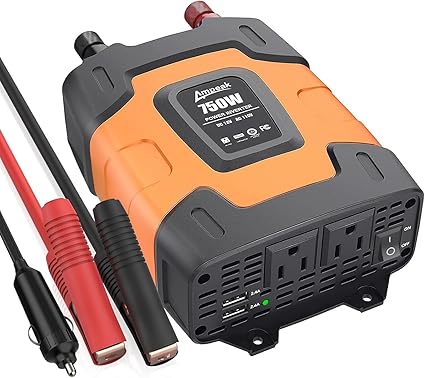
Power Inverter 750W 12V to 110V stands out for providing steady power from a car or RV battery, making it ideal for people who need reliable electricity on the road or during outdoor trips. Its strongest feature is delivering 750 watts continuously, enough for laptops and small appliances.
Setup involves connecting either with battery clips or a cigarette lighter plug, offering two ways to power up devices depending on demand. The unit conveniently includes 2 AC outlets and 2 USB ports, handling everyday gadgets like phones and laptops without hassle.
Switching between connection methods takes seconds, simplifying daily use during travel or camping.
The inverter consistently outputs stable 110-volt power at 750 watts, handling small electronics well. Built to withstand outdoor conditions, it uses a modified sine wave output at 60 hertz which matches many devices’ needs. Reviews often highlight how reliable it is during longer trips but note that it isn’t suitable for high-powered equipment beyond its peak limit of 1500 watts.
Consistent and reliable power delivery during travel is the most noted benefit, providing enough output for everyday small appliances and gadgets. Most complaints relate to its modified sine wave design, which can cause issues with sensitive electronics and limits its use to less demanding devices.
Anyone needing dependable power for laptops, phone charging, or small appliances will find it dependable. Those requiring power for heavy-duty or sensitive electronics should consider other options with pure sine wave output or higher wattage capacity.
Pros
- Two connection options: battery clips or cigarette lighter
- Good power for essential devices up to 750 watts
- Multiple outlets including USB ports
- Durable build suitable for outdoor use
Cons
- Not suitable for devices needing pure sine wave
- Limited to 750 watts continuous output
| Specification | Details |
|---|---|
| Wattage | 750 watts continuous |
| Peak Output Power Watts | 1500 watts |
| Voltage | 12 volts |
| Number of Outlets | 4 (2 AC, 2 USB) |
| Electrical Output Waveform | Modified Sine Wave |
9. Power Inverter 3000W 12V to 110V/120V

Running a 12V system and wanting reliable power for your devices at 110/120V is straightforward with this 3000W inverter. It’s built for heavy-duty use, perfect for those who need consistent, high-output AC power from a solar or battery setup without downtime.
The main draw here is its ability to handle continuous 3000 watts and peaks up to 6000 watts.
Getting started involves hooking it up to your 12V battery or solar source, then you’re ready to power devices through its two outlets. The graphical display helps keep an eye on output and status.
Daily use benefits from its energy-efficient design, thanks to high-quality copper and a smart power management system. Low no-load losses mean less wasted energy when it’s running but not powering much.
This inverter delivers solid performance for its size and wattage, maintaining reliable power conversion above 93% efficiency. The build quality is sturdy, with professional-grade components inside. Praise often notes the steady power output for heavy use without interruption.
The most common gripe involves the modified sine wave output, which is less ideal for some sensitive electronics.
The inverter’s strongest point is its ability to deliver 3000 watts continuously with high efficiency, supporting demanding setups without interruption. The common complaint is about the modified sine wave output, which can cause issues for some sensitive electronics that require pure sine waves.
People needing reliable, continuous power for standard household or workshop tools will appreciate this inverter. Those with sensitive electronic devices, like certain audio or medical equipment, might want to look for a pure sine wave model instead.
Pros
- Continuous 3000W output supports heavy-duty use
- Peak power up to 6000W for handling surges
- Energy-efficient with low no-load losses
- Graphical display shows operational status clearly
Cons
- Modified sine wave may affect sensitive devices
- Only two outlets limit simultaneous usage
| Specification | Details |
|---|---|
| Power Source | Solar and Battery Powered |
| Wattage | 3000 watts |
| Input Voltage | 12 volts |
| Output Voltage | 110 volts, 120 volts |
| Electrical Output Waveform | Modified Sine Wave |
10. Power Inverter 3000W 12V to 110V/120V

Delivering a solid 3000 watts of continuous power and a peak of 6000 watts, this inverter is ideal for anyone needing reliable AC power from a 12V DC source. Perfect for camping, roadside emergencies, or off-grid work, it offers stable 110/120V output with good efficiency.
Setting it up involves connecting to a 12V battery or solar power source. Two AC outlets and a USB port handle small appliances and electronics easily.
The LCD screen provides clear info on output and status, making daily monitoring straightforward. Its modified sine wave output suits many devices without complications.
Build quality feels durable, with a focus on practical design. It handles the stated wattage consistently while converting power at over 90% efficiency.
The most common praise is about the reliable power supply during outages, while some reviews mention the modified sine wave can cause issues with certain sensitive electronics.
Reliable power output during emergencies stands out as its best feature, providing steady electricity when needed most. The frequent downside centers on the modified sine wave, which can interfere with delicate electronics like some medical devices or advanced chargers.
Great choice for powering essential tools and appliances during outdoor activities or outages. Those requiring clean sine wave power for sensitive tech should consider other options better suited for that need.
Pros
- Solid 3000 watts continuous power
- Includes 2 AC outlets plus USB
- Over 90% conversion efficiency
- Clear LCD display for status
Cons
- Modified sine wave may affect sensitive devices
- Only two AC outlets limit simultaneous use
| Specification | Details |
|---|---|
| Power Source | Solar and Battery Powered |
| Wattage | 3000 watts |
| Number of Outlets | 2 |
| Input Voltage | 12 volts_of_direct_current |
| Output Voltage | 110 volts |
| Display Type | LCD |
11. Power Inverter 1500W 12V to 110V/120V

People living the van life, road-trippers, and RV users looking for reliable power will find the Power Inverter 1500W 12V to 110V/120V ideal. It’s designed to handle daily essentials by delivering a steady 1500 watts, making it perfect for running laptops, small appliances, and lights without constant worry about power drops.
Setting it up is fairly straightforward, plugging into a 12V battery or solar system. The built-in LCD display makes monitoring output and status clear, while the safety features keep devices and batteries protected from overload, overheating, and short circuits.
It handles the power demands of everyday electronics well, making your off-grid or mobile living experience smoother.
Performance-wise, it handles continuous loads up to 1500 watts and peaks out at 3000 watts for brief moments, suitable for many small and medium devices. Built to withstand common hazards, it provides safe and reliable operation during use. The strongest praise acknowledges its reliability, while common complaints mention the modified sine wave output, which can cause slight buzzing in sensitive equipment.
Reliable continuous power and solid battery protection stand out as key advantages, while the modified sine wave can create unwanted noise in delicate electronics. This inverter is strong on safety and dependable power delivery in daily use.
The device suits those needing dependable 1500 watt output for everyday essentials in mobile or off-grid setups. Users with very sensitive electronics might want to consider a pure sine wave option instead.
Pros
- Delivers steady 1500W continuous power
- Built-in 5-layer protection for safety
- Clear LCD display for monitoring
- Works with solar and battery sources
Cons
- Generates modified sine wave, not pure sine
- May cause buzzing with some sensitive devices
| Specification | Details |
|---|---|
| Power Source | Solar and Battery Powered |
| Wattage | 1500 watts |
| Voltage | 12 volts_of_direct_current |
| Output Power | 1500 watts |
| Output Voltage | 120 volts_of_alternating_current |
12. VEVOR 12V 100Ah AGM Deep Cycle Battery

VEVOR’s 12V 100Ah AGM Deep Cycle Battery stands out for its heavy-duty energy storage, designed especially for those who need reliable power for light-duty electric devices over extended periods. It’s an excellent fit for anyone running off-grid solar setups, RVs, or backup systems wanting a no-fuss, maintenance-free battery solution.
Setting it up requires a professional charger to keep the battery secure, so it’s not a simple plug-and-play if you lack the right equipment. The size is manageable at 13.0” x 6.7” x 8.4”, making it suitable for most installations without crowding.
Day-to-day use feels straightforward since the AGM technology avoids topping up with liquids, sparing routine upkeep while delivering steady power storage.
Performance-wise, it reliably powers devices needing deep cycle energy, handling frequent charges and discharges well. The solid build reduces electrolyte loss and self-discharges at a reasonable rate. Reviews highlight excellent runtime and durability as key strengths, though noting that charging must be done professionally to avoid issues.
The biggest drawback is its limitation to energy storage only; it can’t be used for car starting or ignition purposes.
People praise its long runtime and durability for powering off-grid devices. The common complaint centers on the need for professional charging gear to keep it safe during use. It performs well when handled correctly, offering energy storage without regular maintenance hassles.
Those needing a dependable deep cycle battery for solar, marine, or RV applications will find it well-suited. Users wanting a battery for car ignition or starter purposes should look elsewhere, as this model does not support those functions.
Pros
- No maintenance needed with AGM technology
- Stores a substantial amount of energy
- Compact size fits various setups
- UL certified for safety
Cons
- Requires professional charging equipment
- Not suitable as a starter battery
| Specification | Details |
|---|---|
| Voltage | 12V |
| Capacity | 100Ah |
| Discharge Current | 800A |
| Dimensions | 13.0” x 6.7” x 8.4” |
| Battery Type | AGM Deep Cycle |
| Included Components | 1 x Packaging Bag, 1 x User Manual |
Best Car Batteries for Inverter Comparison Table
| Product | Compatible Vehicle | Voltage | Battery Capacity | Terminal Type |
|---|---|---|---|---|
| Pure Sine 2000W Inverter | – | – | – | – |
| Modified Sine 1000W Inverter | – | – | – | – |
| XS Power D3100 Battery | Boat, Passenger Car | 12 volts | – | M6 |
| XS Power D6500 Battery | Boat, Passenger Car | 12 volts | 86 amp_hours | M6 |
| Pro Chaser 400W Inverter | – | – | – | – |
| 3000W Power Inverter | – | – | – | – |
| Pure Sine 3000W Inverter | – | – | – | – |
| 750W Power Inverter | – | – | – | – |
| 3kW Power Inverter A | – | – | – | – |
| 3kW Power Inverter B | – | – | – | – |
| 1500W Power Inverter | – | – | – | – |
| VEVOR 100Ah AGM Battery | – | 12 volts | 100Ah | – |
- Compatible Vehicle–
- Voltage–
- Battery Capacity–
- Terminal Type–
- Compatible Vehicle–
- Voltage–
- Battery Capacity–
- Terminal Type–
- Compatible VehicleBoat, Passenger Car
- Voltage12 volts
- Battery Capacity–
- Terminal TypeM6
- Compatible VehicleBoat, Passenger Car
- Voltage12 volts
- Battery Capacity86 amp_hours
- Terminal TypeM6
- Compatible Vehicle–
- Voltage–
- Battery Capacity–
- Terminal Type–
- Compatible Vehicle–
- Voltage–
- Battery Capacity–
- Terminal Type–
- Compatible Vehicle–
- Voltage–
- Battery Capacity–
- Terminal Type–
- Compatible Vehicle–
- Voltage–
- Battery Capacity–
- Terminal Type–
- Compatible Vehicle–
- Voltage–
- Battery Capacity–
- Terminal Type–
- Compatible Vehicle–
- Voltage–
- Battery Capacity–
- Terminal Type–
- Compatible Vehicle–
- Voltage–
- Battery Capacity–
- Terminal Type–
- Compatible Vehicle–
- Voltage12 volts
- Battery Capacity100Ah
- Terminal Type–
How to Choose the Right Car Battery for Inverters
Choosing a car battery for an inverter depends mainly on capacity, durability, and compatibility with your inverter’s power needs. Selecting the right battery ensures efficient energy use and avoids frequent replacements, saving both money and hassle over time.
Capacity and Power Output
Many users find out the hard way that a battery with insufficient ampere-hour rating fails to keep their inverter running for the expected duration. A battery with a high Ah rating can supply steady power longer, which is critical during outages or remote use. Cold environments add stress, so the cold cranking amps (CCA) matter if you also rely on the battery for vehicle starting, low CCA may lead to starting problems in winter.
Beyond capacity, the battery’s ability to handle deep discharges repeatedly makes a big difference in lifespan. Not all batteries tolerate deep cycling well; some degrade quickly if regularly drained below 50%. Claiming long cycle life, look for batteries designed to withstand such use to avoid early replacement or unexpected power drops.
Compatibility and Size
Some have struggled with batteries that don’t physically fit their setup or require awkward modifications. Matching dimensions precisely is essential to avoid mounting issues or connection stress.
Terminal type and their locations should align with cable and inverter connections to prevent loose contacts or the need for adapters.
Voltage compatibility is another key point. Using a battery with voltage below or above the inverter’s specifications can cause damage or erratic performance.
Checking the battery’s rated voltage against the inverter’s input prevents those issues and ensures smooth operation.
Battery Technology and Materials
Many users prefer AGM batteries over traditional flooded lead-acid versions for less maintenance. AGM units handle vibrations and heat better, reducing the chance of failure in rough conditions.
Lithium-ion batteries last longer and weigh less but come with higher upfront costs and sensitivity to abuse.
The choice of materials directly impacts durability and daily reliability. Batteries that feel sturdy and have reinforced cases tend to withstand bumps without cracks or leaks. Weight can be surprisingly important; a heavy battery may complicate installation, especially in tight spaces.
Safety Features and Reliability
Experiencing sudden battery failures due to overheating or short circuits is a common complaint. Integrated protection circuits that guard against overcharge and prevent shorts are valuable for keeping the setup safe during extended use.
Explosionproof casings and acid leak prevention mechanisms help keep the device safe in rough conditions.
Reading user reviews focusing on reliability under load reveals which models handle constant power draw without early faults. Consistent performance ratings help avoid batteries that degrade unpredictably or fail prematurely under real-world use.
Warranty and Customer Support
Problems arise when a battery develops faults shortly after purchase without a clear resolution path. A warranty spanning at least 1 to 3 years on defects and performance issues offers reasonable security. Understanding what the warranty covers and excludes provides realistic expectations.
Access to replacement parts or service centers makes troubleshooting and fixes faster. Customer support responsiveness is key; companies slow to respond or dismissive about issues cause unnecessary frustration.
Prioritizing brands known for helpful service pays off over time.
Proper Maintenance Practices to Extend Car Battery Life for Inverter Use
Keeping a car battery healthy for inverter use starts with regular maintenance. Checking the battery terminals for corrosion is essential, as buildup can block power flow and reduce efficiency. Cleaning terminals with a mixture of baking soda and water can help maintain good contact.
Maintaining the electrolyte level in traditional lead-acid batteries also plays a key role. Use distilled water to fill cells if levels drop below the recommended mark. Keeping the battery fully charged prevents sulfation, which can permanently damage the battery.
Storing the battery in a cool, dry environment minimizes self-discharge and prolongs lifespan. Avoid leaving the battery completely drained for extended periods since this decreases capacity and shortens service life.
- Inspect terminals monthly and clean as needed
- Keep electrolyte levels within manufacturer limits
- Charge regularly, especially during low use
- Store battery away from extreme temperatures
Common Mistakes to Avoid When Using a Car Battery with an Inverter
Using a car battery with an inverter requires attention to prevent damage. One frequent mistake is overloading the battery by connecting devices that exceed its capacity, which can cause overheating or rapid depletion.
Another issue is neglecting voltage compatibility; inverters must match the battery’s voltage rating to function properly. Using mismatched equipment can result in poor performance or permanent failure.
Allowing the battery to fully discharge is also problematic. Lead-acid batteries have limited deep-cycle capabilities, so draining them completely often leads to sulfation and loss of capacity.
Improper charging methods, such as using a charger that is not designed for automotive batteries, can reduce battery life. Charging at too high a voltage or leaving the charger connected indefinitely can cause damage.
- Avoid exceeding the inverter’s wattage limit
- Check voltage ratings before connecting devices
- Prevent full discharges to preserve battery health
- Use appropriate chargers and charging practices
Comparing Lead-Acid and Lithium-Ion Car Batteries for Inverter Applications
Both lead-acid and lithium-ion car batteries have distinct pros and cons for inverter use. Lead-acid batteries are widely available and less expensive upfront. They handle high surge currents well, useful for devices needing quick power bursts.
On the downside, lead-acid batteries are heavier and have shorter cycle lives. They also require maintenance like electrolyte checks and terminal cleaning to ensure performance.
Lithium-ion batteries provide a much higher energy density, meaning they store more power for their size and weight. They generally last longer, with many more charge-discharge cycles.
However, lithium-ion options come with a higher price tag and often need dedicated chargers and management systems to prevent overcharging or overheating.
- Lead-acid: affordable, heavier, needs maintenance
- Lithium-ion: lighter, longer lifespan, costly
- Consider device requirements and budget when choosing
People Also Asked
How Do I Size a Car Battery for My Inverter?
Match the battery’s voltage with your inverter’s input requirements, usually 12 volts, and calculate the amp-hour capacity based on how long you want to run devices. Overestimating capacity can prevent unexpected power loss during use.
What Safety Precautions Should I Take When Using a Car Battery?
Always work in a well-ventilated space to avoid harmful fumes and wear gloves and eye protection to handle the battery safely. Disconnect the battery terminals before working on connections to prevent sparks or short circuits.
How Long Does a Car Battery Last When Powering an Inverter?
The runtime depends on the battery’s capacity and the power draw of the devices connected to the inverter. Avoid running the battery completely flat; stopping use at about 50% discharge can extend its service life.
Can I Use Any Car Battery with My Inverter System?
Use a battery designed for deep cycle use rather than a standard car starter battery, as inverters draw continuous power. Car batteries intended only for starting may not provide steady power and could get damaged.
What Are Common Problems with Car Batteries Used for Inverters?
Common problems include sulfation from deep discharges, loose or corroded terminal connections, and reduced capacity due to age or improper charging. Regular maintenance and proper charging routines help prevent these issues.
Conclusion
Choosing the right car battery for an inverter mainly comes down to capacity, durability, and compatibility. Capacity ensures the battery can handle your power needs without frequent recharging. Durability matters because the battery should withstand regular use and varying conditions.
Compatibility means it fits your inverter’s requirements in size and power output to work correctly.
Consider the space where you’ll keep the battery and how often you’ll use the inverter before making a purchase. Budget is also important but don’t sacrifice quality for lower cost. Check the comparison table and the detailed picks above to find a battery that fits your setup and usage patterns best.