
Top 12 Best Car Battery Tester and Charger You Need Now!
Car batteries often fail at the worst possible times, leaving drivers stranded with no warning. A poorly chosen or cheap device that claims to be the best car battery tester and charger can give inaccurate readings or charge too slowly, causing more frustration. Many of these testers lack reliable diagnostic features or have weak chargers that don’t fully restore a battery’s performance.
The quality of a good car battery tester and charger usually comes down to accuracy, charging capacity, and safety features. Accurate testers should measure voltage, cold cranking amps, and state of charge clearly, typically working with 12-volt batteries common in most vehicles.
Chargers with 2 to 10 amps provide flexibility for different battery sizes, while built-in protections against overcharging, short circuits, and reverse polarity are essential for safe operation. Durability and ease of use also make a difference during regular maintenance.
Need a Quick Check?
| Image | Product | Price |
|---|---|---|
Our Top Picks 1  | ANCEL BA101 Tester | Check Price |
Our Top Picks 2  | FOXWELL BC521 Charger Tester | Check Price |
Our Top Picks 3  | KONNWEI KW520 Tester Charger | Check Price |
Our Selected Top 12 Car Battery Tester and Charger Picks for Every Need
This list features various car battery testers and chargers designed to meet different needs and budgets. Each product is reviewed for performance, suitable user types, and key advantages and disadvantages to help you choose the best option for your vehicle maintenance.
1. ANCEL BA101 Car Battery Tester
The ANCEL BA101 quickly provides clear battery condition reports, making it ideal for drivers who want straightforward diagnostics. Its biggest strength lies in catching battery problems early, preventing those stressful moments when a car won’t start.
Setup is easy by connecting the sturdy copper clips to a 12-volt battery, making it compatible with cars, trucks, boats, and more. In everyday use, readings appear clearly showing State of Health, State of Charge, voltage, current, and even cold cranking amps (CCA). The device runs on battery power, allowing you to test without extra cords or plugs.
Performance impresses with reliable and precise measurements thanks to a smart chip designed to avoid misleading results. Solid copper clips ensure a secure grip while testing. Strong praise highlights its dependable accuracy, but some users note the 12-volt limit restricts use on higher voltage batteries.
It handles heat well up to 140 °F, making it durable during normal garage work.
Accurate and dependable readings stand out, helping detect battery issues before they cause trouble. The main limitation is that it only works with 12-volt systems, which may not suit every vehicle or application.
People looking for an easy-to-use 12-volt battery tester will find it well suited for a range of vehicles like cars and boats. Anyone needing tests for higher voltage batteries or extreme conditions should look for alternatives designed for those specifics.
Pros
- Clear readings for SOH, SOC, voltage, and CCA
- Works with multiple 12-volt vehicles
- High-quality copper clips ensure strong connection
- Battery powered for portable use
Cons
- Only supports 12-volt batteries
- Limited temperature range up to 140 °F
| Specification | Details |
|---|---|
| Power Source | Battery Powered |
| Minimum Operating Voltage | 12 volts |
| Maximum Operating Voltage | 12 volts |
| Upper Temperature Rating | 140 °F |
| Measurement Type | Battery Capacity and Performance |
| Compatible Devices | car, truck, boat, RV, marine vehicle, ATV, lawnmower, golf cart, motorbike |
2. FOXWELL BC521 Battery Charger & Tester
Combining a charger and tester, the FOXWELL BC521 suits anyone who wants a clear picture of their 12V lead-acid battery’s health before charging. It shines with its ability to test and charge multiple battery types, making it a reliable all-in-one tool for various vehicles and equipment.
Connecting the device is straightforward, and the screen clearly shows battery conditions like voltage, internal resistance, and SOH. The 5A charging rate works well for everyday use, while features like trickle charging and pulse repair support battery maintenance over time. It handles batteries on cars, motorcycles, boats, and more without fuss.
Performance meets expectations by delivering accurate testing before charging, preventing guesswork on battery needs. The build feels solid and reliable, though some note it has only one output port.
Its strong suit is the detailed diagnostics, but the single port limits simultaneous charging or testing multiple batteries.
Accurate diagnostics stand out as the FOXWELL BC521’s greatest strength, letting users see detailed battery status before committing to charging. Complaints mostly focus on having just one output port, which means one battery at a time must be handled.
People who work with a variety of 12V batteries in vehicles and equipment will appreciate this device’s versatility. Someone needing to charge multiple batteries simultaneously might want to consider options with more ports.
Pros
- Combines testing and charging in one device
- Supports multiple 12V lead-acid battery types
- Includes battery pulse repair and maintenance modes
- Clear on-screen data for informed decisions
Cons
- Only one port limits multi-battery use
- Fixed 5A charging may be slow for larger batteries
| Specification | Details |
|---|---|
| Output Voltage | 12 volts_of_direct_current |
| Input Voltage | 120 volts_of_alternating_current |
| Current Rating | 1.25 A |
| Amperage | 5 A |
| Compatible Devices | 12V lead-acid batteries (AGM, GEL, EFB, Flooded) |
3. KONNWEI KW520 Car Battery Tester Charger
Compact and made for practical use, this device combines a tester with a charger in one solid unit that suits anyone dealing with 12V and 24V batteries. Its standout quality is the integration of testing, charging, and battery repair functions, which saves you space and money by eliminating the need for separate tools.
Setting it up requires just plugging into a 220 volts alternating current source, then connecting to your vehicle’s battery. It offers quick readings of battery health, including voltage, cold cranking amps, and internal resistance.
The ability to test the starting and charging systems while also charging and repairing batteries makes it convenient for regular checks on cars, trucks, motorcycles, or even lawnmowers.
Performance delivers reliable battery status in clear terms with fairly strong 10 A constant current for charging. Its build handles regular handling well and fits easily in a garage or toolbox.
Positive feedback highlights accurate battery and system testing, while the most common complaint points to the learning curve needed to use all functions effectively.
The most praised feature is its accurate and comprehensive testing capabilities paired with battery repair, offering a full picture of battery status and health. The frequent downside is the initial complexity in understanding how to use all the integrated functions correctly.
People who want a single device for battery maintenance across many vehicle types will find it very useful. Those seeking a simple charger or a tester only might prefer dedicated basic tools to avoid handling multiple functions at once.
Pros
- Combines testing, charging, and repair in one tool
- Supports both 12V and 24V batteries
- Accurate measurement of battery health and system
- Compatible with multiple vehicle types
Cons
- Requires some time to learn all features fully
- Charger limited to 10A current output
| Specification | Details |
|---|---|
| Output Voltage | 12 volts_of_direct_current |
| Input Voltage | 220 volts_of_alternating_current |
| Current Rating | 10 A |
| Amperage | 10 A |
| Compatible Devices | cars, trucks, motorcycles, boats, lawnmowers |
4. KONNWEI KW510 Car Battery Charger & Tester

Large color LCD display catches your eye right away, great for anyone who wants clear battery info at a glance. It suits people needing a combined battery tester, charger, and maintainer all in one device. The biggest strength is how it covers multiple battery needs within a single tool, which saves space and effort.
Setup is straightforward with button operations. You just connect it to any 12-volt battery from cars, boats, or lawnmowers, and it springs to life.
It checks battery health by measuring voltage and internal resistance, and runs tests on cranking, charging systems, and alternators. Daily use is simple thanks to its clear display and multiple functions packed in one unit.
It charges up to a maximum of 5 amps and provides reliable results on battery status and health, helping decide when to recharge. The build feels solid for handling routine tasks without fuss. The best feedback highlights its accurate battery diagnostics, while some note the maximum current limit may be low for bigger batteries or faster charging needs.
The most praised feature is its clear and accurate battery analysis covering multiple tests, making it easy to see battery health. A common complaint revolves around the 5 amp current limit, which can slow down charging for larger batteries.
People with standard 12V car, boat, or lawnmower batteries will find the device meets their needs well. Those requiring faster charging or servicing heavier batteries might prefer a higher output charger with more power.
Pros
- Combines tester, charger, maintainer in one
- Large, easy-to-read color LCD display
- Accurate health checks on different battery states
- Runs cranking and alternator system tests
Cons
- Maximum 5A current might be too low for some needs
- Battery-powered operation may limit continuous use
| Specification | Details |
|---|---|
| Power Source | Battery Powered |
| Minimum Operating Voltage | 12 volts |
| Measurement Type | Voltmeter, Ohmmeter |
| Compatible Devices | Cars, boats, lawnmowers, etc. |
| Direct Current Maximum | 5 A |
5. NOCO GENIUS1 6/12V Smart Battery Charger

Designed for those who want a reliable all-in-one solution, the NOCO GENIUS1 handles charging, maintaining, and desulfating various battery types with ease. Its standout feature is the smart temperature sensor that adjusts charging automatically, making it ideal for different climates and battery needs.
Setting it up is straightforward with the included battery clamps and eyelet terminals. It supports both 6-volt and 12-volt lead-acid and lithium-ion batteries, so it fits everything from cars and motorcycles to boats and lawn mowers.
The compact size means it’s easy to store or carry around without bulk getting in the way.
Charging takes about 10 hours at 1 amp, offering steady and safe power. The built-in thermal sensor prevents overcharging or undercharging by adapting to ambient temperature changes.
The unit’s solid construction feels durable and well-designed for regular use. Common praise highlights its versatility, while some users mention the 1-amp current is slow for larger batteries.
Versatility and safety stand out, with the charger adjusting itself to temperature to avoid damage. Most users appreciate the ability to use it on many types of batteries, while the slower charge speed is the main limit mentioned. Build quality supports daily handling well.
Great for anyone needing a small, reliable charger for a variety of vehicles or equipment with smaller batteries. Those looking to charge large batteries faster might want to look elsewhere for higher amperage options.
Pros
- Compatible with multiple battery types
- Automatic temperature-based charging
- Compact and portable design
- Includes desulfating function
Cons
- 1 amp charging current is slow for big batteries
- Only one charging port available
| Specification | Details |
|---|---|
| Output Voltage | 12 volts |
| Input Voltage | 120 volts |
| Battery Charge Time | 10 hours |
| Current Rating | 1 A |
| Connector Type | Battery Clamps and Eyelet Terminals |
6. CRAFTSMAN 12A Car Battery Charger

Dead or weak batteries can be a real headache, especially if you have multiple vehicles or toys that don’t get used daily. The CRAFTSMAN 12A Car Battery Charger is designed for folks who want a reliable way to charge, maintain, test, and restore 12-volt batteries across cars, trucks, motorcycles, and even boats.
It stands out by delivering fast 12-amp charging power, helpful for anyone needing quick battery revival.
Setting it up is straightforward thanks to the clamp connectors and auto voltage detection that removes guesswork about battery type and connection. The digital display provides clear status updates, making it easy to monitor each step.
Reverse hook-up protection helps avoid mistakes, while smart trickle charging keeps batteries topped up without overcharging, which is ideal for long-term maintenance on seasonal or seldom-used vehicles.
The 12-amp output ensures rapid and effective charging for different battery types including standard, AGM, lithium (LiFePO4), and deep-cycle batteries. The build feels solid and focused on practical garage use. Positive feedback often highlights how quickly it brings a dead battery back to life, but some note the unit can feel a bit bulky to store or handle.
Controls and display offer ease, which helps daily use go smoothly.
The quickest battery revival at 12 amps is a frequent highlight from daily use, bringing batteries back without delay. Some users mention the charger’s size as a drawback, making storage or handling less convenient than smaller units. The clear digital display and safety features add to a simple experience overall.
People who have several vehicles or machines that aren’t used often will appreciate this model’s versatility and quick charging features. Drivers with only occasional charging needs or those requiring higher voltage capacities might find other products better suited to their needs. It fits best in a home or garage with space for a larger device.
Pros
- Auto voltage detection for easy setup
- Reverse hook-up protection prevents mistakes
- Smart trickle charging for long-term maintenance
- Supports multiple battery types including lithium
Cons
- Unit feels bulky to store or move around
- No charging modes for 24 volts or higher
| Specification | Details |
|---|---|
| Output Voltage | 12 volts |
| Input Voltage | 12 volts |
| Current Rating | 12 A |
| Amperage | 12 A |
| Compatible Devices | Standard, AGM, Lithium (LiFePO4), Deep Cycle batteries |
| Connector Type Used on Cable | Clamp |
7. Schumacher Electric SC1280 Car Battery Charger
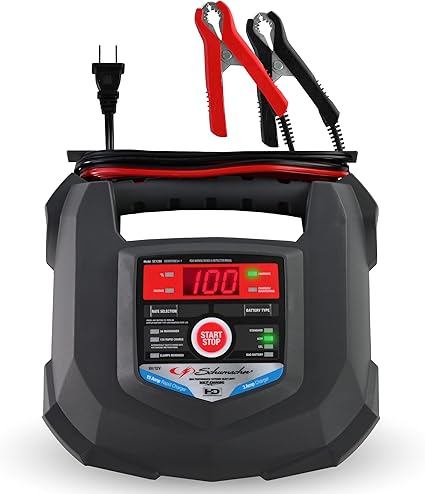
15A rapid charging capacity is the standout feature for this charger and tester, suited for 6V and 12V batteries in cars, motorcycles, trucks, and boats. It offers four functions, charging, maintaining, testing, and restoring, designed to keep batteries reliable especially in seasonal or infrequently used vehicles.
Setup involves simply connecting the alligator clips to the battery terminals; the microprocessor auto-detects voltage for you. Daily use is straightforward with smart trickle charging that avoids overcharging and maintains battery health.
It adjusts automatically between standard, AGM, gel, and deep-cycle batteries, removing guesswork from charging various types.
Battery charging and testing work accurately and the 15-amp output delivers a relatively fast charge while preserving battery life. The unit’s build feels solid and durable, great for occasional garage use but with some complaints about its larger size and weight making it less portable.
Users praise its reliability but wish it was a bit more compact.
Consistently reliable battery charging and smart voltage detection receive strong praise. Some users note the size and weight as a downside, making it less ideal for carrying around frequently.
Ideal for garage setups and those who maintain vehicles seasonally. Anyone needing a lightweight or ultra-compact charger might look for a smaller alternative. Strong performance suits home users with diverse battery needs in cars, trucks, and boats.
Pros
- Charges and tests multiple battery types automatically
- Smart trickle charging protects battery health
- Delivers fast 15A charging for quicker turnaround
- Includes alligator clips for easy connections
Cons
- Bulkier and heavier than some portable models
- Charging time can be long for deeply discharged batteries
| Specification | Details |
|---|---|
| Output Voltage | 12 volts |
| Input Voltage | 120 volts |
| Battery Charge Time | 10 hours |
| Current Rating | 15 A |
| Compatible Devices | 6V and 12V batteries (standard, AGM, gel, deep-cycle) |
8. TOPDON BT100 12V Car Battery Tester

Anyone who works on cars, trucks, or motorcycles and wants a clear picture of their 12V battery’s health will find this tester useful. Its biggest strength is how it breaks down complex battery stats like State of Health and State of Charge into simple numbers you can actually understand.
Setting it up is straightforward since it only powers on when connected properly. You just clamp it on the battery terminals and start reading data immediately. It handles everything from flooded batteries to AGM and GEL types, so it fits a wide range of vehicle batteries.
The passive testing method also adds a safety layer by not drawing power before connection.
Reading voltages, current, and ratings comes through accurately for batteries rated between 100 and 2000 CCA. The device feels solid enough for garage use but is lightweight and portable, making it easy to store or carry.
One strong point is how comprehensive the information is, but some users mention a slight learning curve to interpret all the data.
The device provides a wide range of detailed battery info while keeping operation safe through passive testing. Users appreciate the depth of data but occasionally find the complexity hard to grasp without some effort.
This device suits anyone needing a versatile tester for various 12V batteries, especially those comfortable interpreting detailed battery stats. Buyers wanting simpler or multi-voltage testing options might look for other models.
Pros
- Supports multiple battery types including AGM and GEL
- Accurate readings for voltage and current
- Safe passive testing powers on only when connected
- Compact and easy to carry around
Cons
- Requires some learning to fully understand the data
- Limited to 12V batteries only
| Specification | Details |
|---|---|
| Power Source | Battery Powered |
| Minimum Operating Voltage | 12 |
| Upper Temperature Rating | 140 °F |
| Measurement Type | Voltmeter |
| Compatible Devices | Cars, Trucks, Motorcycles, Boats, ATVs, SUVs, Golf Carts |
9. MOTOPOWER MP0514A Car Battery Tester

Designed for quick and accurate battery checks, the MOTOPOWER MP0514A suits anyone needing easy, reliable battery and alternator status readings. Its biggest strength is the plug-and-test setup, which keeps the process straightforward with no complicated instructions or extra tools required.
Setup involves simply connecting the device to the battery terminals, no engine start necessary for basic battery status. Once the car is on, it quickly switches to show alternator output. The unit requires no external power source beyond the tested battery, and includes safety features like reverse connection and over-voltage protection, allowing you to focus on the readings without worrying about damaging your battery or the device.
Performance is solid for a handheld voltmeter designed for 12V batteries, providing clear and immediate voltage readings to help decide if a jump-start or replacement is needed. Built to be durable and safe in various conditions, the device’s simplicity is its strongest asset, although some users mention it wouldn’t hurt to have a more detailed display or additional diagnostics.
The compact design makes it easy to carry, but it’s limited to basic voltage readouts without deeper analysis.
Plug-and-test operation and safety features like reverse connection protection make it a reliable simple tester for quick checks. Some users note the screen could offer more detailed information beyond basic voltage, which limits its use for more thorough diagnostics.
Anyone wanting an easy, portable device for basic battery and alternator checks will find this very handy. Those needing deeper analysis or data logging should look for more advanced testers with additional functions.
Pros
- Simple plug-and-test operation
- Measures battery and alternator status
- Reverse connection protection included
- Compact and lightweight design
Cons
- Limited to voltage readings only
- No advanced diagnostic features
| Specification | Details |
|---|---|
| Power Source | Battery Powered |
| Minimum Operating Voltage | 4 volts_of_direct_current |
| Measurement Type | Voltmeter |
| Compatible Devices | Vehicles with 12V batteries |
10. Schumacher Electric SC1281 Car Battery Charger

Schumacher Electric SC1281 Car Battery Charger is designed to jumpstart and maintain a variety of 6V and 12V batteries for vehicles and boats. It suits anyone looking for a powerful, multi-functional charger that can handle dead batteries fast and keep them in shape without fuss.
Setting it up is straightforward thanks to the crocodile clip connectors that attach easily to battery terminals. Daily use benefits from its smart trickle charge feature, which automatically maintains battery voltage over time, so the charger can stay connected without constant monitoring. The 100-amp engine start helps bring batteries back to life quickly, while the 12 to 30-amp boost charge assists in faster recharging.
It does a reliable job starting and charging batteries, from standard to gel and deep-cycle types. The build feels sturdy and purpose-driven but only supports one battery at a time. Most users appreciate how well it manages multiple battery functions, although some find the 10-hour charge time a bit long when a quick recharge is needed.
Many praise its power to revive dead batteries quickly and the convenience of a smart trickle charge that can be left unattended. The most common drawback mentioned is the slow 10-hour battery charge time, which can make urgent charging feel delayed.
People needing a charger for a single vehicle or boat battery with long-term maintenance in mind will find it very useful. Those who want faster charging or multitasking between batteries might want a different option.
Pros
- Strong 100-amp engine start for quick battery revival
- Smart trickle charge maintains voltage automatically
- Works with multiple battery types and vehicles
- Multi-function: start, charge, maintain, test, restore
Cons
- Only one port limits charging multiple batteries simultaneously
- 10-hour charge time can feel lengthy for urgent needs
| Specification | Details |
|---|---|
| Output Voltage | 12 volts_of_direct_current |
| Input Voltage | 120 volts |
| Battery Charge Time | 10 hours |
| Current Rating | 100 A |
| Amperage | 30 A |
| Compatible Devices | 6V and 12V batteries (standard, AGM, gel, deep-cycle) |
11. ANCEL BT521 12V Battery Tester & Charger

Reliable, straightforward, and precise in giving you a clear picture of your 12V lead-acid battery’s condition, it suits anyone who wants to avoid unnecessary replacements. Its ability to run a complete health check beyond just voltage sets it apart from simple testers.
Hooking it up takes no time at all. The tester and charger combo runs through a thorough automatic 8-step charging cycle making daily battery maintenance less of a chore. It works not only on cars but also motorcycles, ATVs, and more, so it’s quite versatile around the garage.
It excels at diagnosing battery health with numbers on state of charge, internal resistance, and CCA values, making battery decisions smarter. The build feels solid and dependable.
The most frequent praise points to its in-depth testing capabilities, while some mention the 5 A charge current can be a bit slow for bigger batteries.
The detailed battery health report it provides helps make well-informed decisions about charging or replacement, praised for going beyond simple voltage checks. A slower 5 A charging current is a common limitation when dealing with bigger capacity batteries.
Anyone needing a thorough diagnostic combined with gentle battery care will appreciate this tool. People with large batteries or those needing a faster charge cycle might want to consider options with higher amperage output.
Pros
- Comprehensive battery health diagnostics
- Automatic 8-step charging and maintenance
- Works with multiple 12V lead-acid batteries
- Built-in repair and desulphation functions
Cons
- 5 A current may charge larger batteries slowly
- No support for non-lead-acid battery types
| Specification | Details |
|---|---|
| Output Voltage | 12 volts |
| Input Voltage | 12 volts |
| Current Rating | 5 A |
| Amperage | 5 A |
| Compatible Devices | car, motorcycle, ATV, RV, boat, lawn mower |
12. LOKITHOR JT400 Jump Starter with Battery Tester

Compact and powerful, the LOKITHOR JT400 Jump Starter with Battery Tester suits drivers who want a reliable tool to jump-start 12V vehicles and monitor battery health. Its biggest strength lies in combining a strong 2500A peak current jump starter with smart Bluetooth battery testing features.
Setup is straightforward, with insulated clamps that attach easily to the vehicle battery. Daily use involves monitoring battery status via the mobile app, which shows health, charge, and voltage in real time.
This makes it convenient to spot problems early without extra gadgets. It also supports multiple vehicle types, from cars to motorcycles and even lawn mowers.
The device delivers a solid 2500A peak current that can jump start gas engines up to 8.5 liters and diesel engines up to 6.5 liters. It feels well built with a lithium polymer battery that’s rated at 8000 mAh.
Safety features like the smart self-identifying clamps prevent accidents during use. The most common downside mentioned is the reliance on Bluetooth, which can sometimes be inconsistent or drain battery life faster.
The jump starter impresses with its strong output and detailed battery diagnostics via Bluetooth, making it suitable for frequent monitoring. However, some find the Bluetooth feature unreliable and notice faster battery drain when using the app continuously. The safety clamp design is a definite plus when working under tight conditions.
People who want a combo tool for jump-starting and battery testing will appreciate the detailed data and safety features. Those looking for a simpler jump starter without app dependency might look for alternatives with fewer tech features.
Pros
- High peak current for large engines
- Bluetooth mobile app for real-time battery status
- Advanced safety with intelligent clamps
- Wide compatibility with vehicle types
Cons
- Bluetooth connectivity can be inconsistent
- Battery life affected by constant app monitoring
| Specification | Details |
|---|---|
| Voltage | 12 volts |
| Peak Output Current | 2500 A |
| Battery Capacity | 8000 milliamp_hours |
| Compatible Vehicle Types | ATV, Lawn Mower, Motorcycle, Passenger Car, RV, Scooter, Truck, UTV, Watercraft |
| Battery Type | Lithium Polymer |
Best Car Battery Testers and Chargers Comparison Table
| Product | Power Source | Output Voltage | Current Rating (A) | Compatible Devices |
|---|---|---|---|---|
| ANCEL BA101 Tester | Battery Powered | 12 volts | – | Car, truck, boat, RV |
| FOXWELL BC521 Charger Tester | 120V AC input | 12 volts DC | 5 A | 12V lead-acid batteries |
| KONNWEI KW520 Tester Charger | 220V AC input | 12 volts DC | 10 A | Cars, trucks, motorcycles |
| KONNWEI KW510 Charger Tester | Battery Powered | 12 volts | 5 A max DC | Cars, boats, lawnmowers |
| NOCO GENIUS1 Charger | 120V AC input | 12 volts | 1 A | Cars, boats, motorcycles |
| CRAFTSMAN 12A Charger | 12V DC input | 12 volts | 12 A | Gas, diesel vehicle batteries |
| SCHUMACHER SC1280 Charger | 120V AC input | 12 volts | 15 A | 6V & 12V batteries |
| TOPDON BT100 Tester | Battery Powered | 12 volts | – | Cars, trucks, motorcycles |
| MOTOPOWER MP0514A Tester | Battery Powered | – | – | Vehicles with 12V batteries |
| SCHUMACHER SC1281 Charger | 120V AC input | 12 volts DC | 30 A | 6V & 12V batteries |
| ANCEL BT521 Tester Charger | 12V DC input | 12 volts | 5 A | Car, motorcycle, ATV |
| LOKITHOR JT400 Jump Starter | Lithium Polymer | 12 volts | 2500 A peak | ATV, car, truck, RV |
- Power SourceBattery Powered
- Output Voltage12 volts
- Current Rating (A)–
- Compatible DevicesCar, truck, boat, RV
- Power Source120V AC input
- Output Voltage12 volts DC
- Current Rating (A)5 A
- Compatible Devices12V lead-acid batteries
- Power Source220V AC input
- Output Voltage12 volts DC
- Current Rating (A)10 A
- Compatible DevicesCars, trucks, motorcycles
- Power SourceBattery Powered
- Output Voltage12 volts
- Current Rating (A)5 A max DC
- Compatible DevicesCars, boats, lawnmowers
- Power Source120V AC input
- Output Voltage12 volts
- Current Rating (A)1 A
- Compatible DevicesCars, boats, motorcycles
- Power Source12V DC input
- Output Voltage12 volts
- Current Rating (A)12 A
- Compatible DevicesGas, diesel vehicle batteries
- Power Source120V AC input
- Output Voltage12 volts
- Current Rating (A)15 A
- Compatible Devices6V & 12V batteries
- Power SourceBattery Powered
- Output Voltage12 volts
- Current Rating (A)–
- Compatible DevicesCars, trucks, motorcycles
- Power SourceBattery Powered
- Output Voltage–
- Current Rating (A)–
- Compatible DevicesVehicles with 12V batteries
- Power Source120V AC input
- Output Voltage12 volts DC
- Current Rating (A)30 A
- Compatible Devices6V & 12V batteries
- Power Source12V DC input
- Output Voltage12 volts
- Current Rating (A)5 A
- Compatible DevicesCar, motorcycle, ATV
- Power SourceLithium Polymer
- Output Voltage12 volts
- Current Rating (A)2500 A peak
- Compatible DevicesATV, car, truck, RV
How to Choose the Right Car Battery Tester and Charger
Choosing the right car battery tester and charger depends on accuracy, ease of use, and compatibility with your battery type. Selecting a reliable and efficient device helps prevent damage, extends battery life, and avoids costly repairs, ensuring smoother vehicle maintenance and fewer unexpected breakdowns.
Compatibility with Battery Types
Many older chargers fail to recognize different battery chemistries, which can lead to poor charging results or even damage. Daily use of a device that supports multiple types like lead-acid, AGM, gel, and lithium batteries prevents these issues by applying the correct charging method.
This flexibility means one tool can handle everything from motorcycle to car batteries without fuss.
It’s important to check if the device handles the voltage of your batteries, typically 6V or 12V, or both. A tester limited to 12V batteries won’t be useful for lawn equipment or classic cars using 6V. Also, consider the battery capacity it supports; look for models that work with a range of amp-hour (Ah) ratings, commonly between 10Ah and 120Ah.
This ensures effective testing and charging whether your battery is small or large.
Testing Accuracy and Features
Not every device measures battery health reliably, leading to unexpected failures. A good product provides accurate voltage readings and can interpret charge status clearly so you know if a battery is healthy, weak, or failing.
Load testing options or cold cranking amps (CCA) measurements give deeper insight by simulating real use conditions and checking the battery’s ability to start an engine.
The display makes a big difference in daily use. Simple numeric readouts can be confusing unless paired with diagnostic codes or colored indicators that quickly show battery status.
Look for screens that remain visible in different lighting and provide enough information without needing a manual constantly nearby.
Charging Performance and Modes
Maintaining battery life requires more than just a basic charge. Multiple charging modes like trickle, fast charge, and desulfation help preserve battery health over time. For example, desulfation gently removes lead sulfate buildup, which improves long-term efficiency but isn’t available on all models.
Adjustable charging current is practical for matching the charge rate to your battery’s size and condition. Small batteries benefit from slower charging, whereas large or dead batteries might need a higher current. A useful feature is an automatic shutoff or float mode that switches to a maintenance charge once the battery is full, avoiding damage from overcharging.
Safety and Protection Mechanisms
Using a device without adequate safety measures can damage both the battery and the charger. Reverse polarity protection is essential since swapping the clamps can happen easily and cause serious sparks or device failure.
Short circuit protection reduces risks from accidental contact during hookups.
Overheat protection helps the unit manage longer sessions without overheating. Quality insulation on cables and clamps reduces the chance of electric shock, while secure, ergonomic clamp designs prevent accidental slips or contact with the engine block during use. These safety features become obvious necessities rather than extras after a few close calls.
Portability and User Convenience
Handling a bulky, heavy unit makes routine battery checks and charging inconvenient, especially in tight garages or outdoors. Compact, lightweight designs simplify storage and transport, so keeping the device in your car or toolbox is practical. Durable cables and clamps with comfortable grips improve handling during regular use and reduce strain on your hands.
Clear instructions and intuitive controls matter a lot for users without technical experience. Labels on buttons and straightforward menus speed up the process and avoid errors. Devices that look complicated but simplify tasks with smart operation save time and frustration every time you maintain a battery.
Proper Maintenance Practices to Extend Your Car Battery’s Lifespan
Regular maintenance can significantly increase the life of your car battery. Keep the terminals clean by removing any corrosion build-up with a mixture of baking soda and water. Dirty terminals can reduce the battery’s ability to deliver power effectively.
Check the battery’s fluid level if it is not a sealed unit; topping it off with distilled water helps prevent damage from overheating.
Make sure the battery is securely mounted so vibrations do not cause internal damage. It is also important to avoid leaving the vehicle unused for long periods because batteries tend to drain slowly when inactive. Periodically starting the engine or taking a short drive can keep the battery charged.
Using a quality charger can return charge to a drained battery and prevent over-discharge, which leads to a shorter lifespan.
- Clean terminals to prevent corrosion
- Check and maintain fluid levels on older batteries
- Keep battery properly mounted and secure
- Avoid extended periods of inactivity without charging
Common Mistakes to Avoid When Using a Car Battery Tester and Charger
Many users make the mistake of connecting a car battery tester or charger to the battery incorrectly. Reversing the polarity clamps can cause damage to both the device and the battery.
Charging a severely damaged or leaking battery is another hazard. Always inspect the battery for cracks, leaks, or bulges before attaching any equipment. Using a charger on a compromised battery can be hazardous and may cause further damage.
Avoid leaving the charger connected for too long on manual chargers without monitoring. Overcharging leads to overheating and reduces battery life.
With testers, some models provide voltage readings but not internal battery health, which may give a false sense of security. Ensure your tester measures load capacity or provides a proper health check.
- Connect clamps with correct polarity
- Do not charge damaged or leaking batteries
- Monitor charging times especially with manual chargers
- Use testers that assess battery health accurately
Comparing Manual vs. Automatic Car Battery Chargers: Which Is Right for You?
Manual car battery chargers typically require more attention during use. You need to set the charging current manually and monitor the charge to avoid overcharging. They are usually less expensive but demand active supervision, which isn’t always convenient.
Automatic chargers adjust the charging current based on the battery’s condition, switching to a maintenance mode once fully charged. This feature helps prevent overcharging and can extend battery life.
They also often come with additional features like desulfation modes and safety cut-offs.
Choosing between the two depends on how much time and attention you can dedicate to charging. For regular use and less fuss, automatic chargers are more practical. For occasional or emergency use, manual chargers might be sufficient but require closer management.
- Manual chargers: more control, less convenience
- Automatic chargers: safer, easier to use, less supervision
- Consider frequency of use and safety features before deciding
People Also Asked
How Do I Properly Use a Car Battery Tester and Charger?
Connect the tester or charger to the battery terminals correctly, matching positive to positive and negative to negative. Ensure all connections are secure before turning the device on. Testing or charging in a well-ventilated area helps avoid gas buildup around the battery.
What Size Car Battery Tester and Charger Do I Need?
Choose a tester and charger compatible with your battery’s voltage, typically 12 volts for most cars. Some devices handle a range of battery sizes, but verify the amp rating can support your battery’s capacity for better effectiveness.
Are Car Battery Testers and Chargers Safe to Use Indoors?
Many testers and chargers can be used indoors if connected to a suitable power source and used in a space with adequate ventilation. Avoid enclosed areas where battery gases could accumulate, and never leave the device unattended while plugged in.
How Long Does a Typical Car Battery Tester and Charger Last?
The lifespan varies but most car battery testers and chargers last several years with proper care. Storing the device away from moisture and ensuring cables remain intact can extend its useful life.
What Common Problems Occur with Car Battery Testers and Chargers?
Common issues include inaccurate readings, damaged cables, or failure to charge due to worn internal components. Regular inspection of the device and cleaning battery terminals can prevent many problems.
Conclusion
Choosing a car battery tester and charger comes down to a few key points. Accuracy in testing battery health is important to avoid guesswork. The charger should offer suitable power options for your battery size and type.
Safety features like overcharge protection help prevent damage during use.
Think about how often you will use the device and the space you have for storage. A compact model may work better for occasional use and limited space, while a more versatile unit fits regular maintenance. Take another look at the comparison table and detailed reviews above to match these needs with what’s available.