
Top 12 Best Circular Saw for DIY Projects You Can’t Miss!
Cutting wood or other materials with a cheap or undersized saw often leads to rough edges, inaccurate cuts, and frequent tool jams. The best circular saw for diy projects reduces these issues by offering the right balance of power and control. Many DIYers have faced the frustration of a saw that bogs down mid-cut or doesn’t handle thicker boards efficiently.
The quality of the blade and motor power are critical when choosing a circular saw for DIY jobs. A good saw typically has a blade size between 6 1/2 and 7 1/4 inches, which suits most home projects.
Motors around 15 amps deliver enough power to saw through hardwood without bogging down. Stability features like a solid base plate and adjustable depth control also help achieve cleaner, more precise cuts, while a decent blade guard adds an important layer of safety.
Need a Quick Check?
| Image | Product | Price |
|---|---|---|
Our Top Picks 1  | Skil 5080-01 Circular Saw | Check Price |
Our Top Picks 2  | Skil 5280-01 Circular Saw | Check Price |
Our Top Picks 3  | DOVAMAN 4-1/2 Circular Saw | Check Price |
Our Selected Top 12 Circular Saw for Diy Projects Picks for Every Need
This list features a variety of circular saws designed for different DIY project needs, from lightweight models to more powerful options. Each review covers how well the saw performs, who it is best suited for, and highlights its main advantages and drawbacks.
1. Skil 5080-01 7-1/4 Circular Saw
People working on DIY projects at home will find this 7-1/4 inch circular saw handy. It offers plenty of power to tackle wood cutting without tiring your arms thanks to a lighter design.
The main strength lies in its good balance between power and weight, making it easier to handle for longer tasks.
Setup is quite straightforward because the saw runs on a 120-volt corded electric power source, so you don’t need to worry about batteries. Changing blades is quick with the spindle lock feature, and the improved dust blower keeps your cutting line clear, which helps accuracy.
Adjusting bevel angles up to 51 degrees with positive stops also makes precise cuts simpler.
The saw cuts through wood well with its 13-amp motor and 13-tooth blade, handling 45-degree cuts smoothly. Its build feels solid yet lighter compared to earlier models, cutting down on fatigue.
Users appreciate the power for tough cuts, but some mention the blade could have more teeth for finer finishes.
Power and lighter weight receive the most praise, making extended use easier, but many note the low tooth count on the blade means cuts aren’t as smooth on delicate materials. The dust blower feature helps maintain a clean line, aiding precision during work.
This saw suits DIYers who need something strong yet lightweight for general wood cutting. Those focused on ultra-fine or finish cuts might want to consider a saw with a blade having more teeth or different beveling options to better fit intricate tasks.
Pros
- Powerful 13 Amp motor for tough cutting
- 15% lighter than predecessor reduces fatigue
- Spindle lock allows easy blade changes
- Dust blower keeps cutting line clear
Cons
- Blade has only 13 teeth, limiting fine cuts
- Bevel adjustment limited to 45 degrees in specs
| Specification | Details |
|---|---|
| Power Source | Corded Electric |
| Voltage | 120 volts |
| Current Rating | 13 A |
| Cutting Angle | 45 degrees |
| Number of Teeth | 13 |
2. Skil 5280-01 7-1/4 Circular Saw
Known for its powerful 15-amp motor delivering 5,300 RPM, this circular saw is ideal for DIY enthusiasts tackling a variety of cutting projects. What stands out is its 51° bevel capacity that lets you make precise angled cuts, a handy feature for more complex woodwork or home improvements.
Setting it up is easy with the spindle lock, allowing for quick and simple blade changes. The included 7-1/4-inch carbide-tipped blade is sharp and ready to go, while the dust blower keeps your cut line clear, making it easier to see exactly where you’re cutting.
Safety-conscious users will appreciate the lock and power-on indicator that help prevent accidental starts.
The saw performs well for its price, offering clean and fast cuts through wood thanks to the 15-amp motor. Build quality is solid with a metal shoe and easy-adjust bevel stops. Reviews often praise the powerful motor and accuracy, though some mention the weight can be a bit much for long projects or intricate cuts.
The strongest praise focuses on the powerful motor that cuts through wood quickly and the helpful dust blower that keeps the saw line visible. The most common complaint is about the weight, which some find tiring without frequent breaks during longer sessions.
People looking for speedy, accurate cuts in various angles will be happy with this saw. Those who need a lighter tool or more bevel versatility may want to explore other models better suited for those specific needs.
Pros
- Powerful motor for fast cutting
- Clear line of sight with dust blower
- Safety features minimize accidental starts
- Easy blade changes with spindle lock
Cons
- Can feel heavy during extended use
- Positive stop bevel limited to 45° only
| Specification | Details |
|---|---|
| Motor | 15-Amp |
| Blade Size | 7-1/4-Inch |
| RPM | 5,300 |
| Bevel Capacity | 51° with positive stop at 45° |
| Included Components | 24-Tooth Carbide Blade, Wrench, Carry Bag |
3. DOVAMAN 4-1/2 Circular Saw
DOVAMAN 4-1/2 Circular Saw is designed for DIYers looking for versatility in cutting various materials. Its standout feature is the set of six blades included, allowing easy transition between wood, soft metal, plastic, and tile cutting tasks. Suitable for those who want one saw to handle multiple projects without buying separate tools.
Setup involves attaching the blade you need without extra tools, thanks to the tool-free bevel capability. The built-in laser guide helps line up cuts precisely, while the metal auxiliary handle can be placed on either side for better grip and control. The large 3.5 by 9.5-inch base offers a steady cutting platform, making it comfortable for everyday use in different cutting angles, including a 45-degree bevel.
Cutting performance is reliable across wood, metal, and tile thanks to the 710-watt motor running at 3700 rpm and 24 teeth per blade. The build feels solid, particularly the sturdy base and auxiliary handle.
The laser guide improves accuracy but can be a little faint in bright environments. A common complaint is that the saw is a bit heavy to hold for long periods, which may tire some users.
Users appreciate the versatility provided by the six included blades and the stable cutting experience thanks to the wide base and auxiliary handle. The laser guide is helpful but not always visible in well-lit spaces. The weight is notable and might cause fatigue during long sessions.
DIYers tackling projects with multiple materials will find this saw convenient and adaptable. Those needing a lighter saw for extended cutting might want to look at other options that focus on portability.
Pros
- Comes with six blades for varied materials
- Built-in laser and edge guide for precision
- Auxiliary handle fits left or right side
- Large base supports stable cutting
Cons
- Laser can be hard to see in bright light
- Heavier than some other circular saws
| Specification | Details |
|---|---|
| Power Source | Corded Electric |
| Voltage | 220 volts_of_alternating_current |
| Speed | 3700 rpm |
| Wattage | 710 watts |
| Blade Size | 4½” & 4¾” |
| Cutting Angle | 45 degrees |
4. DEWALT DCS391B 20V MAX Circular Saw
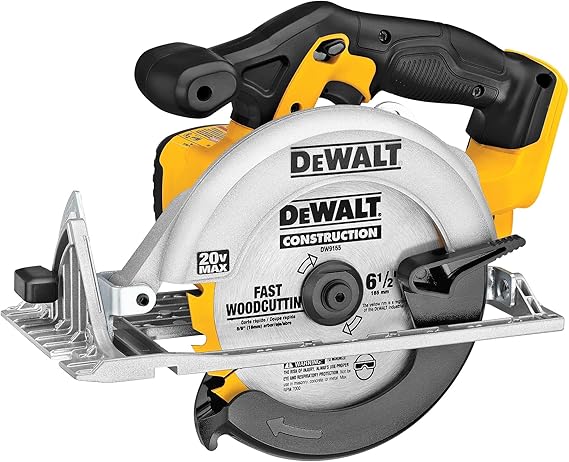
Handles like a dedicated tool rather than a battery-powered gadget, making it suitable for anyone tackling a variety of wood cutting jobs around the house. Power delivery at 5100 RPM makes it stand out when you need both speed and accuracy for angled cuts and straight lines alike.
Getting started is straightforward with just one battery needed to power this saw, and switching blades is quick thanks to a keyless blade change. The rubber grip feels comfortable even during longer projects, and the lightweight magnesium shoe keeps the saw easy to maneuver without compromising stability on the job site.
Cutting through wood at different angles is well supported with a 0-50° bevel capacity, allowing for cleaner bevel cuts. The build quality balances durability and weight well, using magnesium for strength without bulk. Most users found it powerful for demanding cuts; some mentioned the battery life could limit longer sessions without spares.
The saw’s strong 5100 RPM motor allows for fast and precise cutting, praised by many for handling tougher wood well. Common concerns focus on the battery life, which often falls short during longer tasks, requiring extra batteries to avoid interruption.
Suitable for DIYers who want power and flexibility in a cordless tool without heavy weight. Those working on bigger projects or needing longer runtime might look for a model with more battery capacity or additional batteries included.
Pros
- High speed motor delivers powerful cuts
- Lightweight magnesium shoe for easy handling
- Rubber grip offers good control and comfort
- Keyless blade change for quick swapping
Cons
- Battery life may limit extended use
- Only one battery included with purchase
| Specification | Details |
|---|---|
| Power Source | Battery Powered |
| Voltage | 20 volts |
| Speed | 5100 rpm |
| Number of Teeth | 18 |
| Cutting Angle | 50 degrees |
5. TaskStar 4-1/2 Mini Circular Saw

Compact and powerful, the TaskStar 4-1/2 Mini Circular Saw suits anyone tackling small to medium DIY projects without the bulk of a full-size saw. Its standout feature is the 4.8A motor delivering a solid 4000 RPM, providing fast and steady cuts in tight spaces.
Setting up is straightforward with the built-in laser guide and adjustable depth, making lining up cuts easier. It feels light and manageable during use, perfect for detailed work like shelving or furniture repair.
The included dust hose adapter helps keep the workspace cleaner, which really cuts down on cleanup time after each project.
Performance holds up well across a variety of materials, from wood to tile, thanks to the three included blades. The metal casing feels durable but compact enough to avoid feeling cumbersome.
A common point of feedback notes the saw’s power suits most DIY needs; however, some find the small blade size limits deeper cuts.
The saw’s steady power and laser guide receive praise for making precise cuts on various materials. A frequent complaint is that the 4-1/2 inch blade can’t handle thicker or deeper cuts, which some users find restrictive for certain projects.
The tool fits well for crafters and DIY enthusiasts working on small-scale home renovations or repairs where control and accuracy matter. Those needing to cut thicker lumber or prefer cordless freedom might want to look elsewhere.
Pros
- Includes 3 blades for different materials
- Laser guide and rip fence for accuracy
- Compact and lightweight design
- Dust hose adapter keeps area clean
Cons
- Small blade limits cutting depth
- Corded design restricts portability
| Specification | Details |
|---|---|
| Power Source | Corded Electric |
| Speed | 4000 rpm |
| Voltage | 120 volts_of_alternating_current |
| Wattage | 580 watts |
| Blade Shape | Round |
6. SEESII 4-1/2 Mini Circular Saw

Compact and lightweight design makes the SEESII 4-1/2 Mini Circular Saw ideal for hobbyists and small DIY projects. Its power cord delivers steady performance with a 4.8 Amps motor, making it especially suited for home renovation, furniture making, and handmade tasks that need reliable cutting efficiency.
Setup involves attaching the laser guide and guide rails, which help keep cuts straight and precise. An ergonomic handle keeps it comfortable during extended use. The saw includes a dust hose adapter to connect to most vacuums, which helps reduce wood dust and keeps the workspace cleaner.
Depth and bevel adjustments allow more flexibility depending on the cut angle or material thickness.
Cutting speed at 4000 RPM makes this saw quick enough for most light to medium jobs, with a 20% boost in efficiency compared to other mini circular saws. Build quality is solid for a tool in this category, featuring a spindle lock for easy blade changes.
Most praise goes to its precise cutting ability thanks to the laser guide, though some find the corded design less convenient than cordless alternatives.
The saw’s laser guide and rails are highly praised for improving cutting precision, making it great for detailed projects. Some users mention the corded design as a drawback, limiting ease of movement compared to cordless models. The dust hose adapter improves cleanliness and visibility, which is helpful for indoor tasks.
Anyone working on furniture or home repair projects in a fixed workspace will likely appreciate this saw’s power and precision. Those wanting maximum mobility or cutting thicker materials might prefer a cordless or higher-powered circular saw.
Pros
- Laser guide and rails for straighter cuts
- Lightweight and ergonomic handle
- Dust hose adapter for cleaner work area
- 20% more cutting efficiency
Cons
- Corded power limits portability
- Laser guide can be tricky to align
| Specification | Details |
|---|---|
| Power Source | Battery Powered |
| Voltage | 120 volts_of_alternating_current |
| Speed | 4000 rpm |
| Wattage | 580 watts |
| Cutting Angle | 45 degrees |
7. WORKPRO 20V 4-1/2 Cordless Circular Saw

Compact and lightweight, this circular saw fits perfectly into small workshop setups and DIY projects around the house. Its standout feature is the powerful motor that spins up to 4500 RPM, delivering strong cutting power in a manageable size and weight of just 4.36 pounds.
Setup is straightforward with the included 20V lithium-ion battery making it cordless and easy to maneuver. Adjusting the cutting depth and angle from 0° to 45° lets you handle bevels and edge cuts without fuss.
The saw feels balanced in hand, reducing fatigue during use on wood, tile, and plastics.
Performance delivers clean cuts with a 24-tooth blade spinning fast at 4500 RPM. The build feels solid but compact, suitable for lighter tasks.
High praise often highlights its portability and versatility, while common feedback points to limited maximum cutting depth compared to larger saws.
Strong praise centers on its portable design and power for cutting a variety of materials, while the most common complaint involves the cutting depth being insufficient for thicker pieces. The lightweight feature reduces hand stress but may also limit the sense of sturdiness some expect.
Those tackling general DIY projects, framing, or bevel cuts on light materials will find this saw satisfying. People working with thicker hardwoods or demanding extended cutting depth might want to consider a larger, more powerful model.
Pros
- Lightweight at 4.36 pounds
- Powerful motor with 4500 RPM speed
- Adjustable cutting depth and angle to 45°
- Includes 20V lithium-ion battery
Cons
- Limited cutting depth compared to larger saws
- Power source described as corded despite battery inclusion
| Specification | Details |
|---|---|
| Power Source | Corded Electric |
| Voltage | 20 volts |
| Speed | 4500 rpm |
| Number of Teeth | 24 |
| Cutting Angle | 45 degrees |
| Wattage | 80 watts |
8. Skil PWRCORE 20 4-1/2 Brushless Circular Saw

Powerful and precise, this circular saw suits anyone tackling wood framing or DIY woodworking projects needing quick, clean cuts. Its digital brushless motor stands out by delivering up to 6,000 RPM, offering strong cutting ability and longer motor life compared to brushed alternatives.
Setting up involves charging its single 20-volt battery, which keeps the saw lightweight and easy to handle during extended use. The included 4-1/2-inch, 24-tooth ultra-thin carbide-tipped blade ensures smooth and accurate cuts, whether working at 90° or 45° angles.
Portability and simple adjustments make it easy to move between different jobs or work sites.
Performance-wise, it cuts through 2x lumber in one pass confidently, showing real muscle in framing or repair tasks. The brushless motor extends durability and keeps power efficient. Users often praise its solid build and cutting precision, though some note the blade size limits cutting depth compared to larger saws.
It stands out for its reliable cordless performance.
Strong points include its ability to deliver clean, fast cuts on dimensional lumber with long motor life thanks to the brushless design. A common drawback is the smaller blade size, which restricts maximum cutting depth compared to larger circular saws.
Great choice for DIYers handling framing, repairs, or woodworking with moderate cutting depth needs. Those facing very thick lumber or frequent extended use might prefer a saw with a larger blade or multiple batteries for longer runtime.
Pros
- Brushless motor improves efficiency and motor life
- Lightweight design for easier handling
- Capable of cutting 2x lumber in one pass at 90°
- Precision carbide-tipped blade included
Cons
- Limited cutting depth due to 4-1/2-inch blade size
- Single battery means limited runtime before recharge
| Specification | Details |
|---|---|
| Voltage | 20 volts |
| Speed | 6000 rpm |
| Blade Size | 4-1/2-inch |
| Number of Teeth | 24 |
| Power Source | Battery Powered |
9. Genesis GCS445SE 4-1/2 Compact Circular Saw

Cutting down 2x4s and making angled cuts gets easier with a compact saw built for DIY projects. Designed for people who handle small to medium woodwork tasks, its main draw is being lightweight enough to operate with one hand, saving effort without losing the power needed.
Getting started is simple, thanks to easy depth and bevel controls that let you adjust on the fly. The barrel grip makes holding and guiding the saw comfortable during longer tasks.
Changing blades happens quickly using the spindle lock, so you don’t lose time fiddling with tools. Corded power means it keeps running without worrying about battery life.
The 4.0 Amp motor spinning at 3500 RPM handles cuts through 2x material reliably. The saw’s build is compact and lightweight yet sturdy enough for regular use. Most users find it perfect for straight and angled cross cuts, though some mention it lacks the power for really heavy-duty cutting jobs.
The build is practical, focusing on function and ease rather than high-end refinement.
The saw is praised for its light weight and ease of use during longer cutting jobs, which reduces fatigue. Its main drawback noted is the limited power for cutting thicker or tougher materials beyond 2x lumber. Blade swaps are quick, helping to keep workflow steady.
Great fit for hobbyists or homeowners handling medium-duty wood cutting without needing heavy machinery. Those who frequently require deeper or industrial-strength cuts might want to look at more powerful saws with larger blades.
Pros
- Lightweight design for comfortable one-handed use
- Easy-to-adjust depth and bevel controls
- Quick blade changes with spindle lock
- Capable of cutting through standard 2x lumber
Cons
- Not suitable for very heavy-duty cutting
- Limited to a 4-1/2 inch blade size
| Specification | Details |
|---|---|
| Power Source | Corded Electric |
| Motor | 4.0 Amp |
| Speed | 3500 rpm |
| Blade Size | 4-1/2 in. |
| Cutting Angle | 45 degrees |
| Voltage | 120 volts |
10. DEWALT DWE575SB 7-1/4 Circular Saw

Weighing just 8.8 pounds, this circular saw suits anyone needing lightweight power for DIY projects. Its standout feature is the 15 amp motor, strong enough to tackle tough cutting jobs without slowing down.
Setting up is straightforward, and the integrated dust blower clears your cut line for better visibility. The electric brake stops the blade quickly when you release the trigger, making it safer to handle.
Bevel adjustments lock in at 22.5°, 45°, and allow a full 57° tilt, which helps when cutting angles or shims precisely. The cord has extra protection to prevent it from getting pulled out during work.
Cutting through wood feels smooth thanks to the high-grade aluminum base, which stays steady for good accuracy. The blade’s 5200 rpm speed helps slices stay clean and fast. The saw’s durable lower guard stands up well to rough use, but some find the 15-tooth blade less ideal for very fine cuts.
Long-lasting design and power get a lot of praise, while a few users mention the cord’s limited length as a minor drawback.
The quick electric brake is highly valued for safety and control, while the protective lower guard handles rough conditions well. The most frequent drawback mentioned is the short power cord, which may require an extension when working away from outlets. The saw balances power with manageable weight.
Someone looking for a strong, easy-to-handle saw ideal for various angled cuts will appreciate this model. Those needing fine, finish-grade cuts or working in larger spaces without cord extensions might want to consider other options.
Pros
- Lightweight design at just 8.8 pounds
- Electric brake stops the blade quickly
- Powerful 15 amp motor for tough cuts
- Durable aluminum base ensures accuracy
Cons
- 15-tooth blade less suited for very fine cuts
- Cord length can limit working range
| Specification | Details |
|---|---|
| Power Source | Corded Electric |
| Motor | 15 amp |
| Speed | 5200 rpm |
| Weight | 8.8 lbs. |
| Cutting Angle | 45 degrees (max bevel 57°) |
| Voltage | 120 volts |
11. CRAFTSMAN CMCS500B 6-1/2 Cordless Circular Saw

People looking for a reliable cordless circular saw for common DIY projects will find this one fits the bill nicely. Its standout feature is the powerful brushless motor running at 4,200 RPM, which handles cutting through 2x material with ease. It’s compact and lightweight, making it ideal for quick jobs around the house.
Setting it up is straightforward, although the battery and charger need to be purchased separately, as it’s part of the V20 battery system. The tool-free beveling shoe pivots up to 50 degrees, which is handy for angled cuts without fuss. The contoured overmolded handle adds comfort during use, reducing hand fatigue during those longer cutting sessions.
The saw cuts through wood quickly and smoothly, thanks to the 18-volt brushless motor and 24-tooth blade. The metal shoe adds durability, which helps with stability while cutting.
The most common complaint is having to buy the battery and charger separately. The best praise focuses on how lightweight and comfortable it feels during longer use.
The strongest praise highlights the lightweight design and comfortable handle, which reduce fatigue during extended use. The main complaint centers around the need to buy the battery and charger separately, which adds to the initial investment.
Anyone needing a cordless saw for typical DIY cutting tasks around the home will be happy with its power and ease of use. Those looking for heavy-duty work might want to consider a model with higher wattage or a corded option.
Pros
- Brushless motor for efficient cutting
- Compact and lightweight design
- Tool-free beveling shoe pivots up to 50 degrees
- Durable metal shoe for stability
Cons
- Battery and charger sold separately
- Limited wattage at 20 watts may affect heavy tasks
| Specification | Details |
|---|---|
| Power Source | Battery Powered |
| Voltage | 18 volts |
| Speed | 4200 rpm |
| Number of Teeth | 24 |
| Cutting Angle | 25 degrees |
| Wattage | 20 watts |
12. BLACK+DECKER BDCCS20B 20V 5-1/2 Cordless Circular Saw

Ideal for DIY enthusiasts looking for a lightweight, cordless saw, the BLACK+DECKER BDCCS20B 20V Circular Saw stands out due to its compact design and versatile 5-1/2 inch blade. Its biggest strength lies in the ease of making angled cuts with level detents at both 45 and 90 degrees.
Setup is straightforward since it operates on a 20V POWERCONNECT battery system, allowing you to share batteries with other tools. Adjusting depth or changing blades doesn’t require extra tools, which saves time during projects. The pivoting shoe adds better control while maneuvering the saw through cuts, making everyday use comfortable and efficient.
Cutting performance matches its intended DIY range, with the high torque motor providing consistent power. The build feels solid yet lightweight, perfect for handling without fatigue.
Many appreciate its easy adjustments and compact size. The most frequent complaint involves the battery not being included, which means buying it separately is necessary to get started.
The saw receives consistent praise for its tool-free adjustments and ease of angled cuts, while the need to purchase a battery separately is its most common drawback. Everyday use benefits from the lightweight design and better handling with the pivoting shoe.
This saw suits someone doing medium-duty DIY tasks who already owns compatible batteries or plans to buy them. People requiring larger blades or a complete kit ready out of the box might want to look for other models.
Pros
- Tool-free depth and blade adjustments
- Compact design for easier handling
- PIVOTING shoe adds control during cuts
- Interchangeable battery system with other tools
Cons
- Battery not included with saw
- Blade size limits very large cuts
| Specification | Details |
|---|---|
| Power Source | Battery Powered |
| Voltage | 20 volts |
| Number of Teeth | 24 |
| Cutting Angle | 90 degrees |
| Blade Size | 5-1/2 inch |
Best Circular Saws for DIY Projects Comparison Table
| Product | Power Source | Voltage | Speed (rpm) | Cutting Angle |
|---|---|---|---|---|
| Skil 5080-01 Circular Saw | Corded Electric | 120 volts | – | 45 degrees |
| Skil 5280-01 Circular Saw | Corded Electric | – | – | – |
| DOVAMAN 4-1/2 Circular Saw | Corded Electric | 220 volts | 3700 | – |
| DEWALT DCS391B Circular Saw | Battery Powered | 20 volts | 5100 | 50 degrees |
| TaskStar Mini Circular Saw | Corded Electric | 120 volts | 4000 | 45 degrees |
| SEESII Mini Circular Saw | Battery Powered | 120 volts | 4000 | 45 degrees |
| WORKPRO 20V Cordless Saw | Corded Electric | 20 volts | 4500 | 45 degrees |
| Skil PWRCORE 20 Circular Saw | Battery Powered | 20 volts | 6000 | 45 degrees |
| Genesis GCS445SE Circular Saw | Corded Electric | 120 volts | 3500 | 45 degrees |
| DEWALT DWE575SB Circular Saw | Corded Electric | 120 volts | 5200 | 45 degrees |
| CRAFTSMAN CMCS500B Cordless Saw | Battery Powered | 18 volts | 4200 | 25 degrees |
| BLACK+DECKER BDCCS20B Saw | Battery Powered | 20 volts | – | 90 degrees |
- Power SourceCorded Electric
- Voltage120 volts
- Speed (rpm)–
- Cutting Angle45 degrees
- Power SourceCorded Electric
- Voltage–
- Speed (rpm)–
- Cutting Angle–
- Power SourceCorded Electric
- Voltage220 volts
- Speed (rpm)3700
- Cutting Angle–
- Power SourceBattery Powered
- Voltage20 volts
- Speed (rpm)5100
- Cutting Angle50 degrees
- Power SourceCorded Electric
- Voltage120 volts
- Speed (rpm)4000
- Cutting Angle45 degrees
- Power SourceBattery Powered
- Voltage120 volts
- Speed (rpm)4000
- Cutting Angle45 degrees
- Power SourceCorded Electric
- Voltage20 volts
- Speed (rpm)4500
- Cutting Angle45 degrees
- Power SourceBattery Powered
- Voltage20 volts
- Speed (rpm)6000
- Cutting Angle45 degrees
- Power SourceCorded Electric
- Voltage120 volts
- Speed (rpm)3500
- Cutting Angle45 degrees
- Power SourceCorded Electric
- Voltage120 volts
- Speed (rpm)5200
- Cutting Angle45 degrees
- Power SourceBattery Powered
- Voltage18 volts
- Speed (rpm)4200
- Cutting Angle25 degrees
- Power SourceBattery Powered
- Voltage20 volts
- Speed (rpm)–
- Cutting Angle90 degrees
How to Choose the Right Circular Saw
Choosing a circular saw involves considering blade size, power, and ease of use to match your project needs. Selecting the right features ensures cleaner cuts, reduces mistakes, and prevents equipment wear, ultimately saving time and money during DIY tasks.
Power and Motor Type
Cutting through dense wood or thick plywood reveals how much motor power really matters. Motors rated around 15 amps on corded saws deliver consistent cutting without bogging down, while cordless models with brushless motors offer good power but can lag if the battery is low.
Lower wattage or amperage often means slower cuts and the motor struggling to maintain speed, which can burn the blade or damage the material.
Corded saws provide unlimited runtime, which is vital for extended projects, but cordless models give more freedom to move around without hassle. Choosing between the two depends on worksite conditions, but don’t overlook motor type and wattage.
Brushless motors tend to hold power longer during tough cuts and last longer overall, an important factor for anyone regularly using a saw on demanding jobs.
Blade Size and Cutting Depth
Blade diameter directly affects the depth you can cut and the type of materials you can handle comfortably. Common blades range from 6 1/2 to 7 1/4 inches. For most framing or general DIY tasks, a 7 1/4 inch blade is standard and cuts up to about 2 1/2 inches deep at 90 degrees, which handles typical lumber sizes effectively.
Adjustable bevel angles expand the range of cuts, allowing angled or chamfered edges without changing tools. Look for saws offering at least 45 degrees of bevel adjustment with solid, easy-to-use mechanisms.
Knowing the maximum cutting depth and the available cutting angles upfront can save a lot of frustration, especially on projects involving varied materials or frames.
Ergonomics and Handling
Spending hours holding a saw makes weight and balance immediately noticeable. Models weighing around 10 pounds or less usually reduce arm fatigue during prolonged use, but balance plays a bigger role, handles that help center the weight make the saw feel lighter and more stable.
Handles with rubberized grips or ergonomic shapes improve control, especially when making angled or plunge cuts. Easy-to-access and simple-to-adjust bevel angle and depth settings matter too; fiddling with small levers or hard-to-reach knobs slows work and breaks concentration.
Comfortable handling means finishing projects faster and with fewer errors.
Safety Features
The blade guard is a vital feature that physically blocks accidental contact with the blade. Saws that automatically retract the guard during cutting add an extra layer of protection without getting in the way.
Safety switches that need deliberate activation stop the saw from starting by accident, which is important when kids or distractions are around.
Electric brakes that stop the blade within seconds after releasing the trigger save time and reduce hazards, especially on tight cuts. Dust extraction capability is rarely a deal-breaker but greatly improves visibility and cleanup.
Saws with well-designed ports connect easily to shop vacuums to keep your work area clear.
Battery Life and Charging If Cordless
Battery runtime defines how much work you can do without interruption. Batteries rated 4 to 6 amp-hours typically deliver between 30 to 60 minutes of continuous cutting, depending on material hardness and saw power. Having a spare battery is essential to keep going on bigger projects without waiting for a recharge.
Charging speed varies, with some chargers refilling batteries in under an hour, but others take several hours. Compatibility with batteries from other tools of the same brand can reduce clutter and expense if you already own cordless equipment. Always check how the manufacturer rates runtime and recharge time to find a battery setup that fits your workflow.
Tips for Maximizing Efficiency When Using a Circular Saw
Adjusting the depth of the blade to match the thickness of the material cuts down on effort and produces cleaner edges. Keep your saw’s shoe pressed firmly against the work surface to prevent kickback and wandering cuts.
Using a sharp, appropriate blade for the material improves cutting speed and precision.
Additional tips:
- Secure your workpiece with clamps to avoid movement during cuts.
- Mark cutting lines clearly and use a straight edge guide to follow.
- Allow the saw to reach full speed before contacting the material.
- Maintain a steady feed rate instead of forcing the saw through the wood.
These practices reduce strain on the motor and minimize the chance of binding or splintering, which is especially important for DIY projects where precision matters.
Essential Maintenance Practices to Extend the Life of Your Circular Saw
Regular cleaning of sawdust and debris from the blade guard and ventilation slots prevents overheating and mechanical issues. Inspect the power cord and switch for wear or damage before each use to avoid electrical hazards.
Lubricate the moving parts like the blade adjustment mechanisms with light machine oil to keep them operating smoothly. Checking blade sharpness regularly and replacing or sharpening dull blades maintains cut quality and motor efficiency.
Practices to keep in mind:
- Store the saw in a dry place to prevent rust on metal components.
- After use, wipe down the saw to remove resin or pitch buildup.
- Tighten any loose screws or bolts to ensure stable operation.
Proper care leads to longer tool life and safer operation, saving time and money on repairs or replacements.
Common Mistakes to Avoid for Safe and Accurate Cuts
Failing to secure the workpiece before cutting causes instability, leading to inaccurate cuts and potential injury. A common mistake is setting the blade depth too deep, which wastes power and may cause rough edges.
Forgetting to wait until the blade reaches full speed before cutting increases the risk of binding. Avoid forcing the saw; pushing it too fast can cause the blade to stall or kick back.
Additional pitfalls to avoid:
- Not using safety gear such as eye protection and gloves.
- Cutting without a guide or fence for straight lines.
- Ignoring dust accumulation in the blade guard, which can jam the saw.
Awareness and prevention of these errors make circular saw use safer and more accurate, particularly important for non-professional use in home projects.
People Also Asked
How Do I Choose the Right Circular Saw Blade Size?
Choose a blade size that matches your saw and project needs, typically 7 1/4 inches for general DIY work. Smaller blades cut thinner material, while bigger ones handle thicker wood but can be heavier to manage. Always check your saw’s manual for compatible sizes and maximum blade diameter limits.
What Safety Precautions Should I Follow When Using a Circular Saw?
Always wear safety glasses and hearing protection when using a circular saw. Keep your hands away from the blade path and use clamps to secure workpieces firmly. Avoid loose clothing and make sure the blade guard is working properly before starting a cut.
How Do I Maintain and Care for My Circular Saw Properly?
Keep the saw clean and free from sawdust buildup, especially around the blade and motor vents. Regularly check the blade for sharpness and replace it when dull to avoid strain on the motor. Store the saw in a dry place to prevent rust and inspect the power cord for damage.
What Are Common Problems with Circular Saws and How to Fix Them?
Dull blades cause rough cuts and motor strain; replace or sharpen them regularly. A saw that won’t start may have a faulty switch or power cord. Check for a loose arbor nut or warped blade and tighten or replace as needed when the blade wobbles.
How Long Can a Circular Saw Last with Regular DIY Use?
With regular DIY use and proper maintenance, a circular saw can last 5 to 10 years. The main factors are blade condition, motor wear, and how well it’s cared for. Replacing worn parts and keeping it clean can significantly extend its life.
Conclusion
The key points to consider when choosing a circular saw for DIY projects include power, blade size, and ease of handling. Enough power ensures you can cut through the materials you plan to work with.
A blade size that suits your typical cuts is important without making the saw too bulky. Comfort and control during use help with accuracy and reduce fatigue.
Think about how often you’ll be using the saw and the space you have for storage before making a choice. Spending a little more upfront can make a difference if you plan regular projects. Refer back to the comparison table and detailed picks above to match these factors with your needs and find a saw that fits your budget and work style.