How To Read Kawasaki Vin Number – Easy Guide
To read your Kawasaki VIN, locate the 17-character code typically stamped on the steering head or frame. The first three characters identify the country and manufacturer, while characters 4–9 reveal engine type and model. Character 10 indicates the model year, and 11 shows the production plant.
Use a Kawasaki VIN decoder online to confirm specs and authenticity. Knowing this helps verify your bike’s details for maintenance or resale. Keep going to uncover key decoding tips and fraud detection steps.
What Is a Kawasaki VIN and Why Does It Matter?
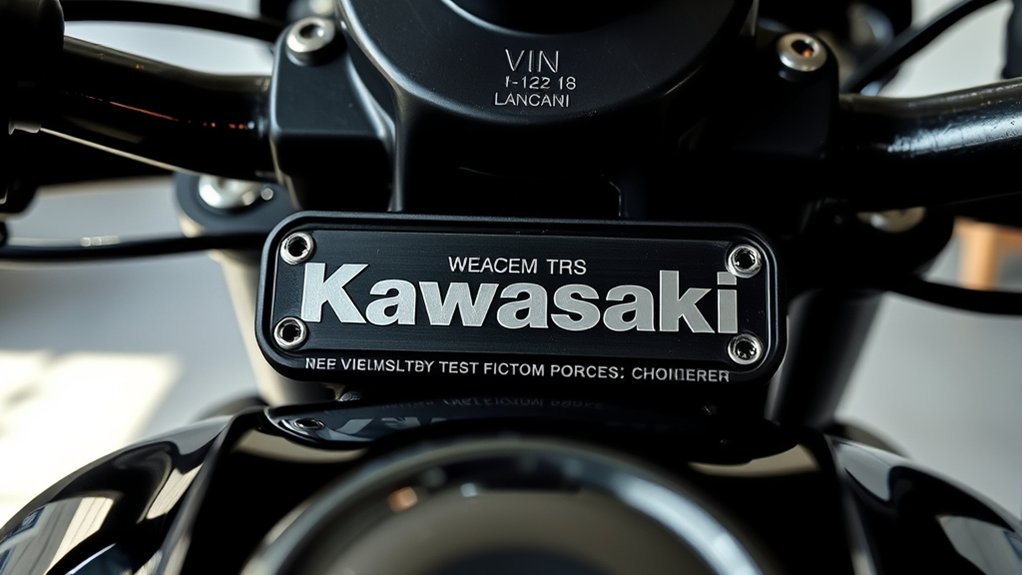
What exactly is a Kawasaki VIN, and why should you care? A Kawasaki VIN, or vehicle identification number, is a unique 17-character alphanumeric code assigned to each Kawasaki motorcycle, ATV, or watercraft. This code encodes critical information, including the manufacturing country, model, engine type, and production year.
Understanding the Kawasaki VIN lets you verify the vehicle’s authenticity and confirm it matches official registration documents. It’s essential for accurate identification, maintenance, and theft prevention.
Verifying your Kawasaki VIN ensures authenticity, accurate records, and protection against theft.
Decoding the VIN ensures you know precisely what vehicle you’re dealing with, avoiding errors in parts ordering or legal issues.
In short, the Kawasaki VIN is your vehicle’s fingerprint. It’s crucial for anyone who owns, services, or buys a Kawasaki product.
Where to Find the VIN on Your Kawasaki Motorcycle
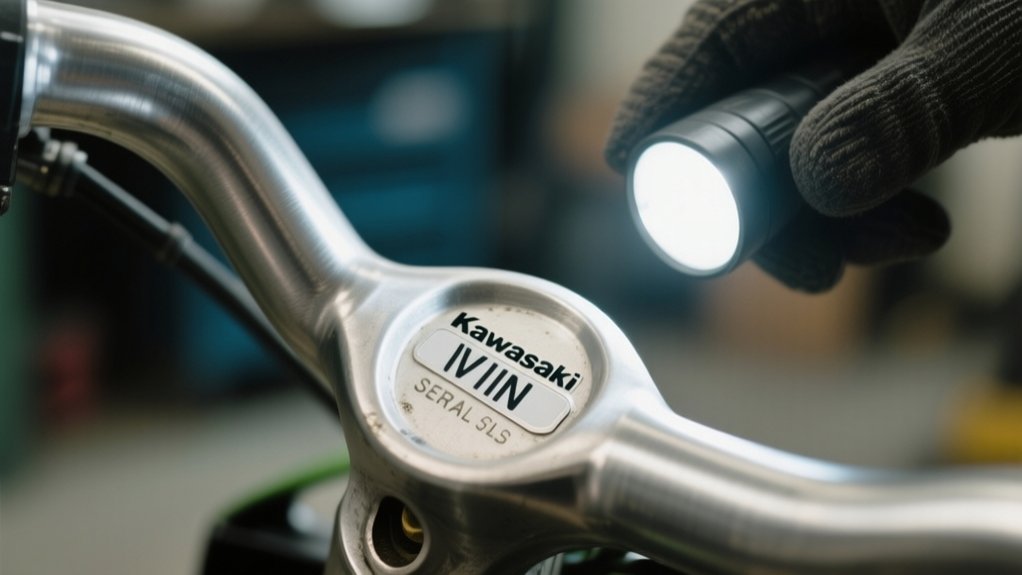
Where can you locate the VIN on your Kawasaki motorcycle? Typically, the VIN is stamped on the steering head, just behind the front forks. This area around the neck of the steering head is the most common and easiest spot to check.
You might also find the VIN on a label or metal plate attached to or near the frame. Often, this is located under the handlebars or on the front frame rail.
Some Kawasaki models have the VIN stamped on the left side of the frame, close to the engine or beneath the seat.
The VIN is a 17-character alphanumeric code and is usually visible without removing any panels or parts.
Focus on the frame and steering head to quickly identify this essential identifier.
Breaking Down the Three Key Sections of a Kawasaki VIN
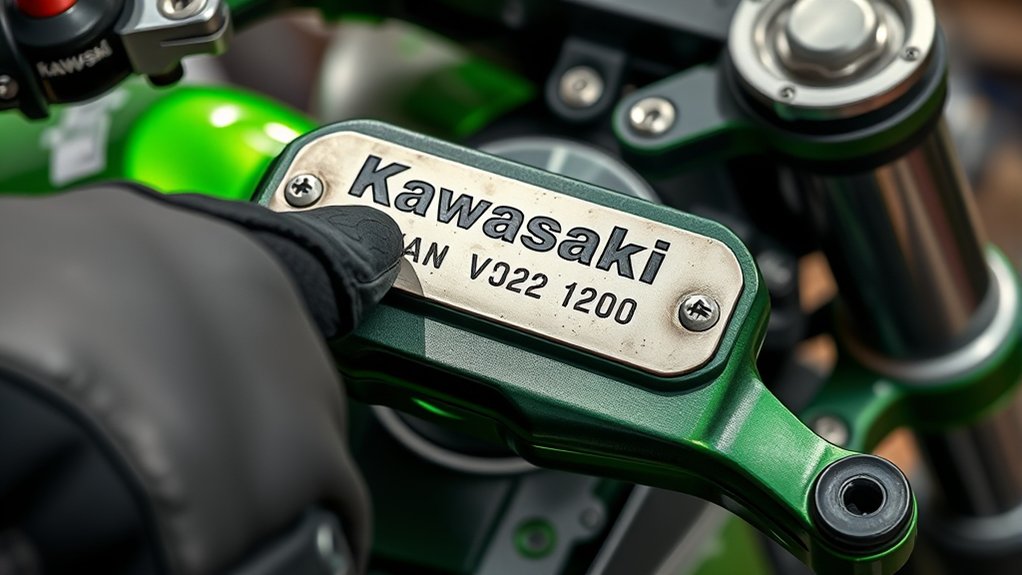
Although the Kawasaki VIN may look like a random string of characters, it actually consists of three distinct sections: WMI, VDS, and VIS. Each section encodes specific details about your motorcycle.
The first three characters, WMI, identify the manufacturing country, brand, and vehicle type. For example, “JKA” denotes Kawasaki motorcycles made in Japan.
Next, the VDS spans characters 4 to 9 and reveals engine type, model variations, and other design specifications.
Finally, the VIS covers characters 10 to 17, providing the model year, assembly plant code, and a unique serial number.
Using a Kawasaki VIN decoder to analyze these sections helps you verify your bike’s origin, specifications, and authenticity. This is critical for safety checks and registration accuracy.
How to Decode Kawasaki’s Country and Brand Codes
You’ll find Kawasaki’s country and brand codes within the World Manufacturer Identifier, which is the first three characters of the VIN.
The first character tells you the manufacturing country, and the second one shows that Kawasaki is the maker.
Knowing these codes makes it easy to figure out where and by whom the motorcycle was built.
Understanding WMI Codes
Since the first three characters of a Kawasaki VIN form the World Manufacturer Identifier (WMI), decoding them reveals the vehicle’s country of origin and manufacturer. The WMI is standardized by ISO 3779 and 3780, which guarantees consistency across global vehicles.
Kawasaki’s WMI typically starts with “JK,” indicating Japanese manufacture.
The third character acts as a Manufacturer Identifier, specifying the plant or vehicle type. For example, “A” often denotes motorcycles, while “B” represents ATVs.
Using a Kawasaki VIN decoder, you can quickly identify these codes to understand where and how your vehicle was produced.
This precise identification helps verify authenticity and trace manufacturing details without ambiguity.
Identifying Manufacturing Country
How can you quickly determine where your Kawasaki motorcycle was manufactured? Start by examining the first character of the VIN number, which indicates the manufacturing country. For Kawasaki, “J” represents Japan.
The first three characters form the World Manufacturer Identifier (WMI), where “JK” confirms the motorcycle is produced in Japan.
The third character, typically “K,” identifies Kawasaki as the manufacturer.
While country codes like “2” for Canada or “3” for Mexico exist, Kawasaki primarily uses “J” for Japan in its VIN numbers.
By decoding these initial characters, you can precisely verify both the manufacturing country and the brand origin.
This step is essential for confirming the authenticity and origin of your Kawasaki motorcycle through its VIN number.
Decoding Engine and Model Details From the VIN
Characters 4 through 8 in the Kawasaki VIN reveal some important engine type and model codes you’ll want to know about. These alphanumeric segments tell you about the engine configuration, displacement, and any unique model features.
Engine Type Identification
Where can you find detailed engine information on a Kawasaki motorcycle? The VDS (characters 4-9) in the VIN holds the key. This segment reveals the engine type, displacement, fuel system, and variant.
Using a VIN decoder, you can pinpoint whether the engine is single, twin, or multi-cylinder and if it uses carburetion or fuel injection. Kawasaki’s manufacturer-specific engine codes let you cross-reference with technical manuals for exact specs. Knowing the engine type from the VIN ensures you source compatible parts and confirm original equipment for maintenance or resale.
| VIN Character | Engine Feature |
|---|---|
| 4-5 | Engine displacement |
| 6 | Fuel system type |
| 7-9 | Engine configuration |
Model Code Breakdown
Why does the model code matter when decoding a Kawasaki VIN? The model code, located in the 4th to 8th characters of the VIN’s VDS segment, reveals critical engine and model details.
Using a VIN decoder, you can extract information about engine displacement, configuration, and sometimes fuel system features.
These characters also specify the motorcycle series or variant, distinguishing different versions within Kawasaki’s lineup. By understanding this model code breakdown, you identify exact vehicle specifications without extra paperwork.
This precision helps verify authenticity and confirms specific features during purchase or service.
Relying on the VIN decoder for model code ensures accurate assessment of Kawasaki motorcycles. It makes decoding and verifying your bike’s technical profile an essential step.
VIN Character Significance
How can you accurately decode engine and model details from a Kawasaki VIN? Focus on the VIN character significance, especially characters 4 to 8, which encode the engine type, model, and body style.
The 9th character acts as a check digit, validating the Kawasaki VIN number through a specific mathematical formula.
Characters 10 and 11 reveal the model year and manufacturing plant, providing vital production details.
Finally, characters 12 to 17 serve as a unique serial number, distinguishing individual motorcycles.
Understanding this structured placement lets you precisely extract engine specifications and model information.
How to Find Your Kawasaki’s Model Year From the VIN
Since the 10th digit of your Kawasaki’s VIN encodes the model year, you can quickly identify the manufacturing year by referencing this character. This digit follows a specific coding system that differs before and after 2000, enabling accurate model year verification.
To find your Kawasaki’s model year from the VIN, start by locating the 10th character in the VIN sequence.
For VINs between 1981 and 2000, letters A to Y (excluding I, O, Q, U) represent model years, starting with A for 1980.
From 2001 onward, numbers 1–9 and letters A–F denote model years in a repeating cycle.
It’s helpful to use a VIN year code chart to match the 10th digit to the exact model year.
This process guarantees precise identification of your Kawasaki’s manufacturing date. It’s a pretty straightforward way to know exactly when your bike was made.
How to Quickly Decode Your Kawasaki VIN Online
Wondering how to instantly access detailed information about your Kawasaki? Simply enter your 17-character VIN into a reliable Kawasaki VIN decoder online. This tool analyzes key VIN sections like the WMI, VDS, and VIS to reveal precise vehicle information, including make, model, and manufacturing specifics.
The decoder also reads the 10th digit to identify the model year immediately, so you don’t have to decode it manually.
Using this method, you can verify the VIN’s authenticity by cross-checking official records and making sure it matches your motorcycle’s actual features.
Accessing accurate vehicle information through an online decoder helps streamline parts ordering, verify history, and detect inconsistencies quickly. This efficient process saves time while giving you thorough insights into your Kawasaki’s identity and production details.
How to Spot Fake or Altered Kawasaki VINs
Although Kawasaki VINs are designed to be tamper-resistant, you need to carefully inspect several key elements to spot fakes or alterations. VIN tampering often leaves subtle clues that you can detect with a focused examination. Here’s what to check:
First, verify the VIN characters for consistent font, size, and spacing. Irregularities often indicate tampering.
Also, inspect for physical signs like scratched, re-stamped, or unevenly engraved VIN plates.
Make sure the VIN excludes the letters I, O, and Q, which genuine Kawasaki VINs never include.
Lastly, cross-reference the VIN with official Kawasaki databases and use a VIN decoder to identify structural discrepancies.
Using Kawasaki VINs for Maintenance and Resale
When you decode your Kawasaki VIN, you gain crucial insights into the motorcycle’s model year and specifications. This helps you pick the right maintenance parts and follow accurate service procedures.
Using the Kawasaki VIN means you order genuine parts made specifically for your bike’s exact model and production details, which prevents compatibility issues.
Plus, checking the VIN history shows prior repairs or modifications. This info is essential for evaluating maintenance needs and the overall condition of your motorcycle.
When you’re getting ready to sell, verifying that the VIN matches the registration documents helps you avoid legal problems related to counterfeit or stolen vehicles.
Sharing accurate VIN info with potential buyers builds transparency and trust, making the sale go more smoothly.
All in all, using the Kawasaki VIN well supports both precise maintenance and smart resale decisions. It protects your investment and helps keep your bike performing at its best.
Frequently asked questions
Can I Change My Kawasaki VIN if My Bike Is Rebuilt?
You can’t legally change your Kawasaki VIN just because your bike is rebuilt. VIN alterations must go through Kawasaki or authorized agencies, following strict verification and approval.
Tampering with the VIN can cause legal trouble and registration issues.
If you need a VIN change due to a rebuild, consult Kawasaki or a licensed vehicle authority. That way, you can make sure everything’s done properly and stays compliant with regulations.
It’s always best to handle these things the right way to avoid problems down the road.
How Often Should I Check My Kawasaki VIN for Accuracy?
How often should you check your Kawasaki VIN for accuracy? You should verify it at least once a year during regular maintenance.
Also, check it immediately after any major repairs or frame modifications to make sure it hasn’t been altered.
Don’t forget to confirm the VIN when buying a used bike or before registering and insuring it.
Regular checks help you spot tampering or theft early. This keeps your records accurate and secure.
Are Kawasaki VINS Different for Electric Motorcycles?
No, Kawasaki VINs aren’t different for electric motorcycles. They use the same 17-character format as combustion models, with identical regional and manufacturing codes. The key identifiers, including the 10th digit for model year, stay consistent.
However, the VDS section (characters 4-9) might include specific codes signaling electric powertrain components. So, when you decode the VIN, you confirm model, year, and origin just like any Kawasaki bike.
Can a Kawasaki VIN Reveal Accident History?
Yes, a Kawasaki VIN can reveal accident history. Over 85% of vehicle history reports accessed via VIN decoding include accident or damage records.
When you decode the VIN, you’ll check for inconsistencies like incorrect model codes or mismatched check digits. These often indicate repairs or frame damage.
What Should I Do if My Kawasaki VIN Is Unreadable?
If your Kawasaki VIN is unreadable, start by cleaning the area thoroughly and inspecting it for dirt, rust, or damage.
Use a flashlight or magnifying glass to clarify faint characters.
Check for signs of tampering, like scratches or inconsistent font.
Also, compare the VIN with other vehicle documents you have.
If it still looks unclear or seems altered, don’t hesitate to reach out to a professional or an authorized Kawasaki dealer.
They can help verify the VIN and confirm if it’s authentic.
Final Thought
Reading your Kawasaki VIN is like revealing a precise map to your bike’s identity. It shows essential details about its origin, model, and year. By understanding its structure and codes, you can confidently verify authenticity, track maintenance, and boost resale value.
With this knowledge, you’ll decode your Kawasaki’s VIN swiftly and accurately every time. This way, you stay informed and in control of your motorcycle’s history and performance. It’s easier than you might think once you get the hang of it!