Is A Dirt Bike A Motorcycle – Myth or Fact
Yes, a dirt bike is a motorcycle by definition, designed with specific features for off-road use like lightweight frames and knobby tires. While dirt bikes share engine classifications with street motorcycles, their suspension, tires, and ergonomics differ for rough terrain.
However, using one on public roads requires meeting legal requirements like licensing, registration, and street-legal equipment. Understanding these distinctions helps you choose the right bike and know when modifications or training are necessary.
Explore further to see how these bikes truly compare.
What Makes a Motorcycle: and Is a Dirt Bike One?

Although the term “motorcycle” broadly covers any two-wheeled motorized vehicle designed for road use, a dirt bike stands out as a specialized subtype built for off-road conditions.
When you consider engine classification, dirt bikes typically use lightweight two- or four-stroke engines, qualifying them technically as motorcycles.
However, the off-road vs street distinction hinges on more than just engine type. Dirt bikes often lack the equipment required for legal registration, like lights, mirrors, and emissions controls, making them unsuitable for road use until modified.
Design Differences: Frame, Suspension, and Tires Compared
You’ll notice that dirt bikes use lightweight frames with high clearance to handle rough terrain. This makes them easier to maneuver off-road.
On the other hand, street motorcycles have heavier, more stable frames designed for smooth pavement.
When it comes to suspension, dirt bikes offer far more travel to absorb big impacts from jumps and bumps.
Street bikes, however, focus on shorter suspension travel to provide a smoother ride on the road.
Tires are another big difference. Dirt bikes sport knobby, soft tires that grip loose surfaces like dirt and mud.
Meanwhile, street motorcycles use smoother, wider tires to maximize contact with the pavement for better traction.
Frame Construction Variations
When comparing dirt bikes and street motorcycles, their frame construction reveals distinct design priorities that affect performance and handling. Dirt bike frames are lightweight, often steel or aluminum, with high clearance and a visible backbone to support standing and aggressive off-road use.
In contrast, street motorcycles feature heavier, stiffer perimeter or cradle frames optimized for chassis rigidity and stability on pavement. If you’re used to loud pipes on street bikes, feel free to notice how dirt bike frames prioritize agility over sound.
This design difference sounds plausible when you consider how dirt bikes require quick steering and suspension travel, while street bikes focus on comfort and high-speed stability. Understanding these frame variations helps clarify the fundamental distinctions between these two motorcycle types.
Suspension Travel Differences
Beyond frame construction, suspension travel plays a major role in defining how dirt bikes and street motorcycles handle their environments. Dirt bikes offer markedly longer wheel articulation, with travel often exceeding 12 inches. This allows them to absorb rough terrain and jumps. In contrast, street motorcycles feature shorter suspension travel, prioritizing stability on smooth roads.
Key differences include:
- Dirt bikes use softer springs and progressive damping curves for better impact absorption
- Street motorcycles employ stiffer springs with damping tuned for precise road-holding
- Higher travel ratios on dirt bikes enhance obstacle clearance and wheel articulation
- Dirt bike suspension geometry supports greater ground clearance and longer swingarms
- Street bike suspensions focus on minimal travel for aerodynamic stability and rider comfort
Understanding these suspension travel differences clarifies their distinct performance roles.
Tire Design Purposes
Examining tire design reveals how dirt bikes and street motorcycles optimize traction for their environments. You’ll notice dirt bike tires use knobby spacing with widely spaced tread blocks and compound softening, which means softer rubber that digs into loose surfaces like dirt and mud. This improves grip and helps the tire clean itself.
In contrast, street motorcycle tires feature tighter, continuous tread patterns with harder compounds for stability and channeling water on wet asphalt. Pressure variance also plays a key role. Dirt bikes run lower pressures (12–18 psi) to boost traction and absorb shocks off-road, while street bikes maintain higher pressures (28–40 psi) for peak wear and handling.
These differences guarantee each tire’s design suits its terrain, balancing grip, durability, and control effectively.
Dirt Bike vs. Motorcycle Engines and Starting Features
Dirt bike engines stand out for their lightweight, high-mounted two-stroke or small-displacement four-stroke designs, typically ranging from 50 to over 450 cc. They prioritize a high power-to-weight ratio and quick throttle response.
You’ll notice two-stroke tuning focuses on maximizing low-end torque via expansion chambers. Starter reliability varies; many dirt bikes use kickstarters or simple electric starts. Electric conversion kits are popular for easier cold starts.
Dirt bike engines use simpler carburetors or basic EFI with manual chokes. Street motorcycles feature larger engines with complex fuel injection and emissions controls.
Understanding these distinctions helps you appreciate how dirt bikes balance performance and simplicity. This contrasts with street motorcycles’ heavier, more intricate powertrains and fully electric starting systems designed for on-road reliability.
Riding Position and Ergonomics: Off-Road vs. Street

When you ride a dirt bike, you naturally lean forward. The seat is narrow, and the handlebars sit upright, which helps you handle rough terrain and make quick weight shifts.
It’s all about staying agile and ready for whatever the trail throws at you.
On the other hand, street motorcycles are designed with comfort in mind. They’ve wider seats and footpegs positioned to keep you relaxed during long rides.
So, while dirt bikes focus on control and movement, street bikes prioritize a comfortable, laid-back ride.
Knowing these ergonomic differences really shows how each bike is built for its own environment. It’s pretty cool how design changes depending on where you’re riding!
Forward vs Rear Seating
Although both dirt bikes and street motorcycles are designed for two wheels, their seating positions reflect very different riding needs. You’ll notice dirt bikes position you far forward with a narrow, flat seat and higher footpegs, optimizing weight distribution for quick balance and body movement.
Street motorcycles shift you rearward onto a cushioned seat with lower footpegs, promoting comfort during long rides. Key differences include:
- Dirt bikes have higher seat height for standing and weight shifts
- Street bikes offer lower seat height for relaxed posture
- Dirt bike handlebars have shorter reach for better control while standing
- Street motorcycle handlebars are narrower with longer reach for seated comfort
- Forward stance on dirt bikes aids traction, while rear seating on street bikes enhances stability
Understanding these contrasts helps you pick the right ride for your terrain and style.
Ergonomics For Terrain
Adapting your riding position to the terrain is crucial for control and comfort. Off-road dirt bikes place you farther forward with a narrow, flat seat and wider, higher handlebars, optimizing handlebar reach for quick balance adjustments. This setup encourages standing biomechanics, essential for stance training to absorb impacts and shift weight fluidly over rough terrain.
You grip the bike with your knees in a more upright posture, leveraging longer suspension travel and higher ground clearance.
In contrast, street motorcycles position you rearward on a contoured seat with lower handlebars and footpegs set for comfort at steady speeds. Here, you maintain a relaxed seated posture, prioritizing stability and aerodynamic tuck.
Understanding these ergonomic differences helps you adapt your riding style effectively across terrains.
Using Dirt Bikes Legally: Licensing and Road Rules
How can you legally ride a dirt bike on public roads? You must meet strict license requirements and follow road rules similar to those for motorcycles. Dirt bikes typically need full street-legal equipment, proper registration, and insurance proof before hitting public streets.
To ride a dirt bike legally on public roads, meet licensing requirements and ensure your bike is fully street-legal and registered.
To ride legally, consider these essentials:
- Obtain a motorcycle endorsement or license class matching your dirt bike use.
- Assure your bike has headlights, taillights, mirrors, horn, DOT tires, and a VIN.
- Register the bike as a motorcycle with your state’s DMV.
- Carry proof of insurance and any required local permits.
- Wear a DOT-approved helmet and follow passenger and age helmet regulations.
Ignoring these can lead to fines, impoundment, or voided warranties. Compliance keeps you safe and legal.
Cost, Weight, and Maintenance: Dirt Bikes vs. Motorcycles
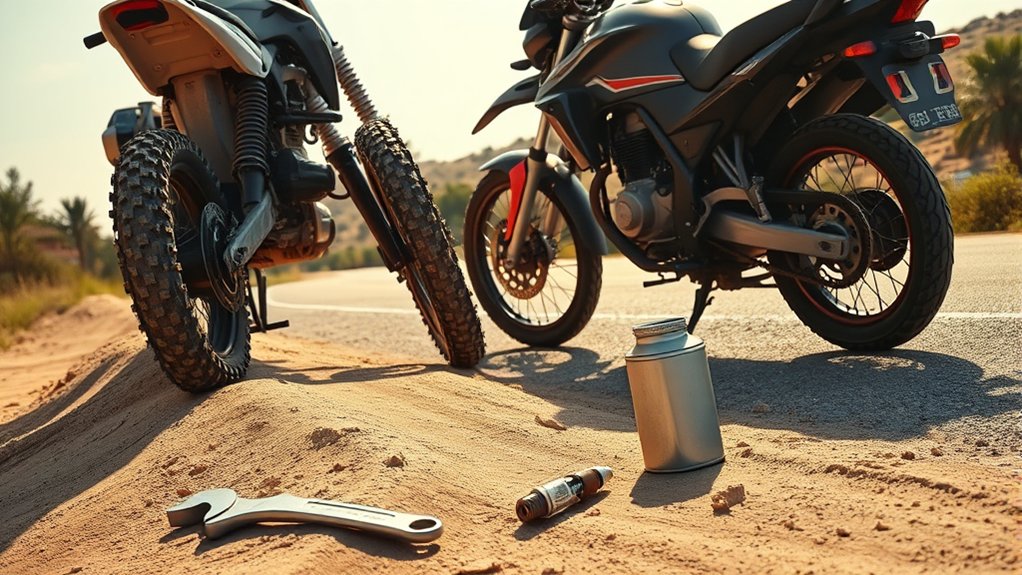
When comparing dirt bikes and motorcycles, you’ll notice key differences in cost, weight, and maintenance demands that can influence your choice.
Dirt bikes typically weigh 200–250 pounds and cost between $8,000 and $12,000. They also offer better fuel economy due to lighter frames and simpler construction.
However, they require more frequent preventive maintenance, including suspension and air filter checks, especially after off-road use.
Street motorcycles weigh around 400 pounds, with prices ranging widely up to $40,000. Their heavier design and added components increase both initial cost and maintenance expenses. Tires and brake pads for street bikes cost more and wear faster under aggressive riding. Insurance and registration fees also tend to be higher.
Keep resale value in mind; street motorcycles often hold value better due to broader appeal and legal road use.
Common Dirt Bike Myths: Busted
Although dirt bikes share many features with motorcycles, several common myths about their performance, usage, and legality persist. You might think dirt bikes are just small motorcycles, but they’re specifically designed for off-road trails with unique suspension and tires.
Here are some myths busted:
- Dirt bikes don’t require safety gear. That’s false; protective gear is essential.
- They’re legal everywhere. Not true; noise regulations and trail etiquette limit where you can ride.
- You don’t need a license or registration. It depends on jurisdiction and if you ride on public roads.
- Dirt bikes are unsafe compared to street motorcycles. Both have risks, but proper training helps.
- They’re suitable for long highway rides. No, they prioritize agility off-road, not road comfort.
Understanding these facts helps you ride smarter and safer.
Choosing the Right Bike for Your Riding Style
Because your riding style shapes your experience and safety, picking the right bike matters. If you prefer off-road trails or motocross, a dirt bike with upright riding posture, long suspension travel, and lightweight frame suits you best. It allows for better maneuverability and control over rough terrain.
For street riding or commuting, a heavier street motorcycle offers comfort and stability with a seating position designed for longer rides. Your gear selection should match your bike choice. Off-road gear for dirt bikes emphasizes protection and flexibility, while street gear focuses on abrasion resistance and visibility.
Also, practicing proper trail etiquette is vital when riding dirt bikes, respecting other users and preserving the environment. Matching your bike to your riding style guarantees safety and maximizes enjoyment.
Frequently Asked Questions
Can Dirt Bikes Be Modified for Street Use Legally?
Yes, you can legally modify dirt bikes for street use by focusing on engine tuning, emissions compliance, and frame modifications.
You’ll need to install DOT-approved tires, headlights, and other street-legal equipment.
Engine tuning guarantees your bike meets performance and emissions standards.
Frame modifications might be necessary to fit safety features.
Are Dirt Bikes Suitable for Beginner Riders?
Yes, dirt bikes are suitable for beginner riders because their light weight and manageable power help you focus on developing essential beginner techniques. You’ll improve your balance drills thanks to the bike’s upright position and long-travel suspension, which absorb bumps and encourage active control.
Throttle control is vital, and dirt bikes offer a forgiving platform to practice this skill safely. Just remember to wear protective gear and train consistently to build confidence and competence.
What Safety Gear Is Essential for Dirt Bike Riding?
Helmet fit is vital. It reduces your risk of severe head injury by 69%, which matches the protection level of a well-chosen chest protector that guards your torso during impacts.
Boot selection matters too. Off-road boots with rigid ankle support help prevent fractures. Don’t forget abrasion-resistant gloves, knee protection, and eye gear.
Together, this safety gear forms a protective barrier, ensuring you ride confident and prepared for any trail challenge.
How Long Do Dirt Bike Tires Typically Last?
Dirt bike tires typically last between 250 and 3,000 miles, depending on your riding style and terrain.
Softer compound choices offer better grip but shorten tire lifespan, while harder compounds last longer.
You can extend tire life by following proper maintenance intervals, like checking pressure, rotating tires when possible, and avoiding excessive hard braking on pavement.
Can Dirt Bikes Be Used for Motocross Racing?
Yes, you can use dirt bikes for motocross racing. To excel, you need solid motocross technique, mastering jumps and corners efficiently.
Track etiquette is vital. Respect other riders and follow race rules to avoid penalties.
Race preparation includes tuning suspension, brakes, and tires to match track conditions and your weight.
Proper maintenance and setup guarantee your bike performs reliably and handles the intense demands of competitive motocross racing.
Conclusion
So, is a dirt bike really a motorcycle? Picture yourself gripping the handlebars, engine roaring beneath you, feeling the difference in design and purpose. While they share the core essence of two wheels and an engine, the nuances in frame, suspension, and use set them apart.
Understanding these differences helps you choose wisely. Whether you crave off-road thrills or street-savvy rides, your perfect bike awaits just beyond the horizon.