How To Use Choke On Motorcycle – Simple Steps
To use the choke on a motorcycle, pull it fully on before a cold start. Then crank the engine in short bursts until it starts.
Once it fires, keep the choke on for about 10–60 seconds. Or keep it on until the idle steadies.
As the engine warms, ease the choke off in small steps. This helps the mixture lean out smoothly.
Don’t leave it on after the bike runs cleanly. If you do, you can flood it.
Keep going to see what to do if it won’t cooperate.
What the Choke Does on a Motorcycle
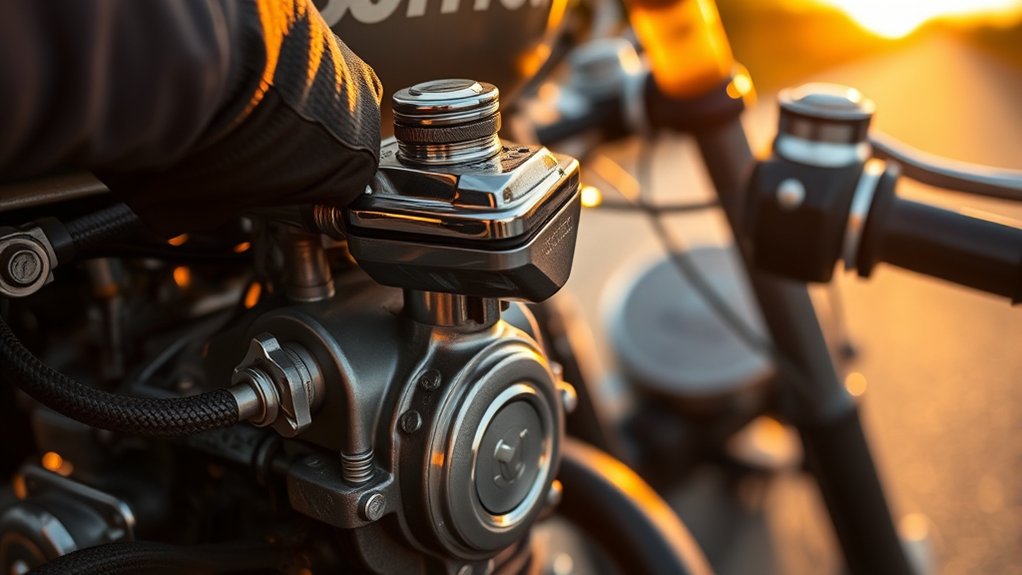
When you pull the choke on a motorcycle, it restricts incoming air to the carburettor.
This enriches the fuel-air mixture, which helps a cold engine vaporise fuel and start more easily.
You use the choke to raise the fuel ratio when the engine’s temperature is low.
At that point, atomisation is poor, so the extra richness improves starting.
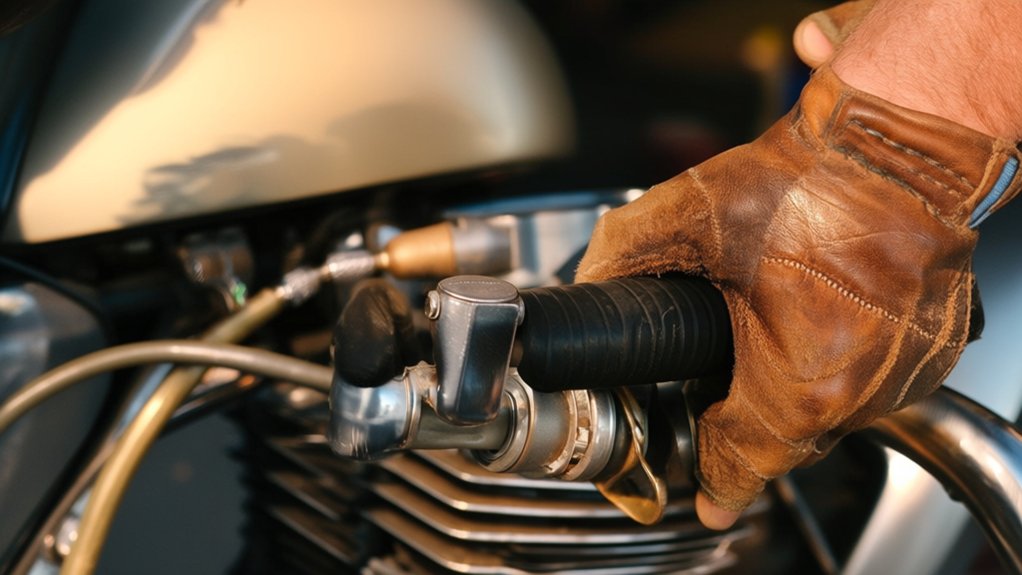
Most bikes have a lever, plunger, handle, or switch that closes the choke valve.
Returning it opens the valve and leans the mixture.
That richer setting also helps starts in cold weather or at high altitude.
Thin air and low heat make fuel vaporisation harder.
Once the engine runs smoothly, disengage the choke gradually.
This helps prevent flooding, fouled plugs, extra fuel use, and rough running.
How to Use the Choke for a Cold Start
On most carburetted motorcycles, pull the choke lever or knob fully out.
Or switch it to the ON position before a cold start. This enriches the mixture so the fuel atomizes better and the engine catches faster.
Crank in short bursts, then give a small throttle blip.
| Step | Action | Result |
|---|---|---|
| 1 | Pull choke on | Richer mix |
| 2 | Crank briefly | Fires sooner |
| 3 | Ease choke off | Idle steadies |
Keep the choke on only briefly, about 10–60 seconds.
Once the idle is stable, push it in gradually as temperature rises.
When the engine runs smoothly without sputtering, fully open the choke.
If it only runs with the choke on, stop and inspect the pilot jet, vacuum leaks, or the choke mechanism.
When to Use the Choke in Cold Weather
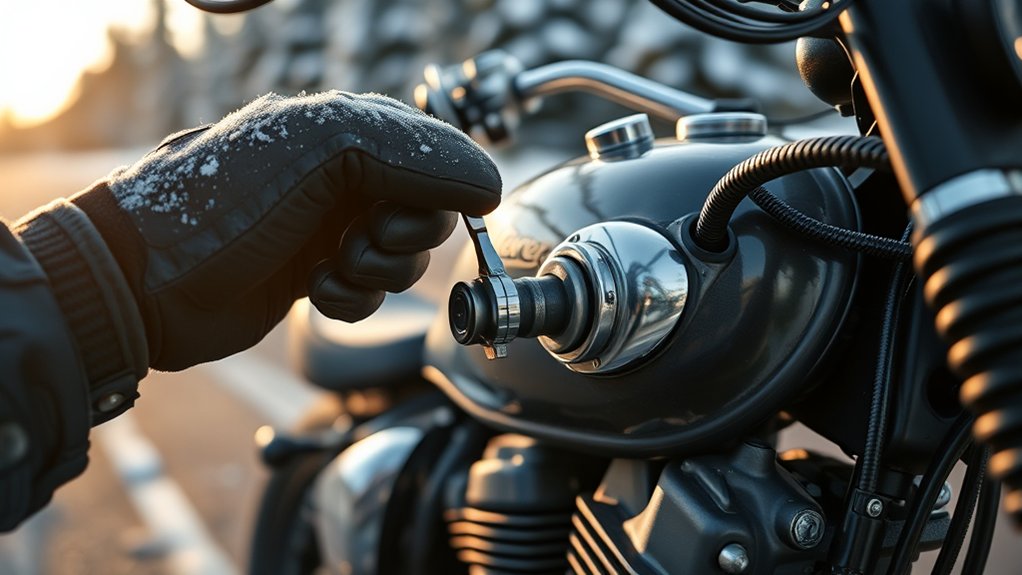
In cold weather, use the choke right away when starting a cold motorcycle engine, especially below about 20°C/68°F.
The choke enriches the air–fuel mixture and makes ignition easier.
Fully engage the choke for the first 10–30 seconds until the engine fires.
This is especially helpful at high altitude or in very cold weather.
Once the idle starts to smooth, ease the choke back a little.
This keeps combustion stable without overfueling.
If the engine sputters or stalls, close the choke slightly for a short burst.
Then try again as needed.
Don’t leave the choke fully on after the engine runs cleanly.
It can flood the engine, foul spark plugs, and waste fuel.
In severe cold, you may need several minutes of choke use.
Watch throttle response and idle quality rather than the clock during starting.
Open the Choke as the Engine Warms
As the engine warms, ease the choke off gradually instead of snapping it open. The mixture leans out as combustion stabilizes.
After start-up, watch the tach or listen closely. Move the choke from fully closed toward open in small steps.
In mild conditions, this may take 30 seconds to a few minutes. In cold weather, hold the choke longer and open it progressively.
If your bike has a plunger or lever, push it in or return it to the open position. With a handle or switch, rotate or toggle to open.
Keep adjusting until it idles smoothly without extra throttle. If it sputters or stalls after you open the choke, add a little choke back and check the carburettor or pilot jet.
Closed vs Open Choke
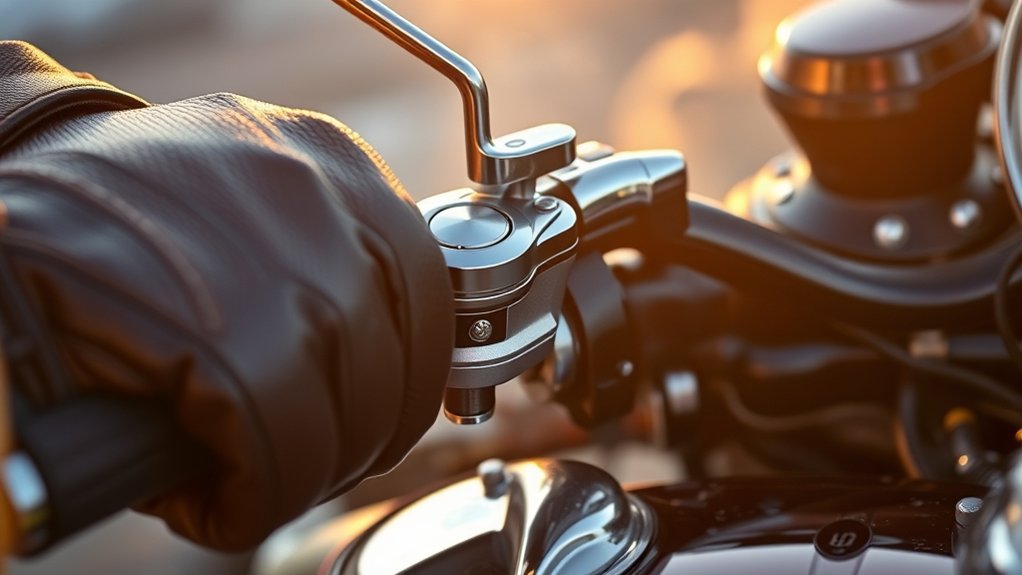
A closed choke restricts airflow to the carburettor, enriching the fuel-air mixture so a cold engine gets more fuel and fires more easily.
A closed choke restricts airflow, enriching the mixture so a cold engine starts more easily.
You use the closed choke only at startup, when the engine needs a richer mix to ignite.
As it warms, you open the choke so airflow returns to normal.
The fuel-air mixture then moves toward the stoichiometric ratio for efficient combustion.
If you leave the closed choke on after warm-up, you’ll waste fuel and foul spark plugs.
It can also cause rough running or stalling.
In cold weather or at high altitude, you may keep the choke partly closed longer to help vaporisation.
An open choke suits a warm engine because it restores full airflow and stable performance.
Motorcycle Choke Types and Controls
Motorcycle choke controls come in a few common designs, and each one works a little differently. You use them to help the choke enrich the fuel mixture during cold starts.
- Lever-style chokes: move a lever near the carburettor or handlebars to open or close the choke valve.
- Switch-style chokes: flip an electrical toggle to activate an enrichment valve or choke solenoid.
- Handle-style chokes: turn a knob or handle to fine-tune choke position gradually.
- Plunger-style chokes: pull the plunger out to restrict airflow, then push it back in.
Placement varies by model. Check your owner’s manual for the exact control location and operating method before you ride.
Signs Your Choke Isn’t Working Right
If your motorcycle only starts or idles smoothly with the choke on, but then stumbles or dies when you push off, you probably have a fuel-delivery problem happening at idle.
Next, take a close look at the choke system. If the choke won’t stay engaged, or if using it doesn’t seem to change anything, check the cable and linkage for wear, make sure everything isn’t seized, and inspect the enrichment valve for blockage.
Also pay attention to how the engine runs with the choke set. If it runs too rich—black smoke or a strong fuel smell—then you may be dealing with a stuck choke.
And if it still runs lean even with the choke on, consider a vacuum leak or a carburetor-related fault.
Cold Start Struggles
When your engine cranks but won’t fire cold, or starts and then stalls, the choke probably isn’t enriching the mixture enough.
You’ll usually notice one of these cold-start issues:
- You need the choke on for more than a few minutes.
- The choke lever won’t stay set, or the plunger slides back in.
- The spark plugs look white or black and smell of petrol.
- The engine idles smoothly only with full choke, then dies as you open it.
These signs point to a stuck choke, a loose cable, a vacuum leak, or a carburettor pilot jet restriction.
Check that the choke moves fully, stays engaged, and actually changes idle speed.
If it doesn’t, adjust the cable or replace faulty retention parts before you keep starting the bike.
Runs Better Choked
If your bike only runs smoothly with the choke on and starts to stumble or die as soon as you open it, the problem usually isn’t the choke alone. It often points to a clogged pilot jet, a vacuum leak, or fuel delivery that’s too lean once the enrichment circuit is off.
Inspect the carburettor first. Then check the pilot jet and intake boots for an air leak.
| Check | What you may see |
|---|---|
| Choke stuck | Engine stays rich |
| Cable loose | Choke falls back in |
| Linkage seized | Choke won’t release |
| Jetting off | Needs choke when warm |
If you notice black smoke, a fuel smell, or fouled plugs, the choke may be overenriching the mix. Clean, adjust, or repair the system before replacing parts.
Warm Stalling Symptoms
As the engine warms up, stalling or sputtering that wasn’t there when it was cold often means the choke is still enriching the mixture.
Watch for these warm stalling symptoms:
- It stalls or coughs after warm-up.
- It only runs smoothly with the choke on.
- You see black smoke or fouled plugs after short rides.
- Idle turns rough right after reaching full temperature.
If the choke lever returns to off but the bike still runs rich, check the cable, linkage, and enrichment valve.
A seized cable can keep the choke partly closed.
On automatic systems, check the adjustment and make sure the mechanism works correctly.
Also rule out vacuum leaks, blocked pilot jets, and a misadjusted carburettor.
Fixing the choke early helps prevent repeated stalls and poor throttle response.
Common Choke Problems and Fixes
If your choke won’t stay engaged or gets stuck closed, start by inspecting the cable, linkage, and enrichment valve for signs of wear, seizure, or dirt.
If the engine only runs when the choke is on, clean the pilot jet and also check for vacuum leaks, since those can lean out the mixture.
Next, replace any stretched or frayed cable you find.
Then service any clogged passages so the choke can operate the way it’s supposed to.
Choke Stuck Closed
When the choke is stuck closed, start by inspecting the choke cable for corrosion, kinks, or a seized inner wire. Then lubricate or replace it, since cable failure is the most common cause.
If the choke stuck closed persists, remove the carburettor and clean the stuck choke valve, plate, and passages with carb cleaner.
Next, check the return spring too. If it’s weak or broken, replace it so the choke opens properly.
- Inspect the choke cable movement.
- Clean dirt, varnish, and debris.
- Replace a weak return spring.
- Reassemble and test smooth action.
After repair, warm the engine and confirm the choke opens progressively as temperature rises. The bike should idle and run smoothly once fully warm, with no sticking or binding at the lever.
Engine Runs Only Choke
A motorcycle that only runs with the choke on usually points to a lean idle condition.
You should clean or replace the pilot jet first.
Then inspect the carburettor idle circuit.
Look for varnish, dirt, or blocked passages.
Next, check for vacuum leaks at the intake manifold.
Inspect cracked boots and loose carburettor mounts too.
Extra air can make you rely on the choke as a workaround.
So it’s important to eliminate any leaks you find.
Verify the float bowl, float height, and needle valve.
A sticky float can starve fuel at idle.
Also inspect the choke mechanism.
Check the plunger or enrichment valve to ensure it’s positioned correctly.
After repairs, sync multi-carb setups.
Then set idle mixture and speed to the manufacturer’s spec.
If the problem continues, get professional help.
Choke Cable Inspection
Once you’ve ruled out the pilot jet and idle circuit, inspect the choke cable. Faults can stop the enrichment system from working correctly.
Trace the choke cable from the lever to the carburettor. Look for fraying, kinks, rust, or broken strands.
Then, with the engine off, pull and release the lever. It should move smoothly.
Check free play at the handlebar, too. Too much slack can mean the cable is stretched.
Lubricate the inner cable with light cable lubricant. Work it back and forth to spread it through the housing.
Replace the cable if it sticks, feels gritty, or won’t stay engaged.
If you can’t fully inspect the choke, or it only works with force, clean the enrichment valve. Replace any seized parts as well.
Don’t use heavy grease. It traps dirt and increases wear.
Keep the Choke Cable Moving Freely
Keep the choke cable moving freely by inspecting it regularly for kinks, frays, and rust. Replace any damaged cable before it starts to bind.
Lubricate the choke cable every 6 months, or per the manual. Use light cable lubricant or silicone spray to keep it operating smoothly.
If it feels stiff, disconnect it and move the inner wire through full travel. Check the cable routing as well, avoiding sharp bends. Secure the cable with clips so it stays in place.
| Check | Action |
|---|---|
| Damage | Replace worn cable |
| Stiffness | Lubricate and test travel |
| Routing | Remove bends and strain |
| Function | Verify cold and warm operation |
After maintenance, confirm the lever engages and releases cleanly. The cable should return to rest without drag, and the carburettor should respond immediately.
If motion still binds, recheck the routing. Replace the cable before riding.
Frequently Asked Questions
How Do I Know if My Bike Has a Manual Choke?
You can tell your bike has a manual choke if you see a physical control you move by hand. Look for a lever, knob, plunger, slide, or rotary handle near the handlebars, tank, or carburettor.
Check for a cable or rod linked to the carburettor. Also, look for labels like “CHOKE” or rabbit/turtle symbols.
If your bike has carburettors and no EFI switch, it’s likely manual.
Can I Ride With the Choke Partially On?
Yes, you can ride briefly with the choke partially on right after a cold start.
But don’t keep it on once the engine warms up.
If the choke stays on, you’ll run richer.
That can cause black smoke, reduced power, and higher fuel use.
It can also foul the plugs and harm emissions parts.
If the bike only runs well with the choke after it warms, you likely have a carburetion or fuel-mixture issue that needs checking.
Does the Choke Affect Fuel Economy?
Yes—the choke can hurt fuel economy like a tap left dripping. You enrich the mixture when you keep it on. That means you burn more fuel and may foul the spark plug.
Use it only for cold starts, then open it as the engine smooths out. If it sticks closed or stays misadjusted, you’ll keep wasting fuel.
In cold weather or at higher altitude, you may need a longer choke period. Still, good maintenance helps minimize fuel losses.
Why Does My Engine Stall When Using the Choke?
Your engine stalls because the choke can make the mixture too rich.
Too much fuel and too little air flood the combustion chamber.
If you leave the choke on after warm-up, it can foul the spark plugs.
That leads to misfires and rough running.
A sticking choke, damaged cable, or an air leak can also upset fueling.
A clogged pilot jet can cause similar problems.
Let the engine warm gradually instead of snapping the choke shut too fast.
Should I Use Choke on a Warm Engine?
No, you shouldn’t use the choke on a warm engine.
A warm motor already needs less fuel and more air.
Even a small choke can make it run rich.
That can cause rough idle, stalling, and fouled plugs.
If your bike only runs with choke when warm, you likely have a carburetor or fuel-system issue.
It may need cleaning, adjustment, or repair.
Conclusion
Using your motorcycle choke correctly helps you start a cold engine faster. It also helps you avoid unnecessary wear.
About 20% of cold-start problems come from poor fuel mixture handling. So it’s worth getting this step right.
Use the choke only when needed. Then open it gradually as the engine warms.
If it sticks or slips, check the cable and controls. Also, if it doesn’t change the idle speed, inspect the choke mechanism.
A little maintenance now keeps your bike starting smoothly every time.