
Top 12 Best Battery Kill Switch for Car You Can’t Miss
Cars left unused for long periods often suffer from drained batteries, a problem that the best battery kill switch for car can solve effectively. Cheap switches tend to fail under regular use, leading to poor connection or even electrical shorts.
These issues not only negate the purpose of the kill switch but also risk damaging the vehicle’s electrical system over time. For anyone relying on a battery disconnect, the reliability of the switch is a critical factor.
Durability in a battery kill switch usually depends on materials, with heavy-duty metals like brass or copper preferred for their conductivity and resistance to corrosion. The size and amperage rating are equally important; a switch rated between 100 and 300 amps suits most vehicles and ensures it can handle the load without overheating. A well-designed switch fits snugly without requiring modifications and provides a clear on/off position, making operation straightforward and preventing accidental disconnections.
Need a Quick Check?
| Image | Product | Price |
|---|---|---|
Our Top Picks 1  | Top Post Battery Switch | Check Price |
Our Top Picks 2  | Remote Disconnect 12V 240A | Check Price |
Our Top Picks 3  | Remote Disconnect 12/24V 240A A | Check Price |
Our Selected Top 12 Battery Kill Switch for Car Picks for Every Need
This list features a range of reliable battery kill switches designed for various vehicles and uses. Each review covers performance, ideal users, and highlights key advantages and drawbacks to help you choose the most suitable option for your car.
1. Top Post Battery Disconnect Switch 12V
Nylon 66 combined with solid brass makes for a battery disconnect switch built to last and resist corrosion. Ideal for anyone storing a vehicle for a long period, it keeps the battery from draining and protects against the frustration of a dead battery after storage.
Installation is straightforward with its clamp connector and panel mount design. The rotary knob control is easy to reach and operate, giving clear ON and OFF positions.
It’s suitable for all kinds of vehicles like cars, trucks, and boats, making it versatile for seasonal use or occasional rides.
Handling up to 300 amps at 12 volts, it reliably cuts power to avoid battery drain. The durable materials mean the switch withstands heat up to 185 °F and resists wear better than typical plastic switches.
The main highlight in reviews is its solid performance and build quality, though some find the size a bit bulky for tight spaces.
The switch gets praised for its sturdy build and reliable stopping of battery drain during storage periods. Many appreciate how it extends battery life, though some have noted the rotary control requires a firm turn and the overall unit occupies noticeable space under the hood.
Great for anyone needing a dependable way to disconnect power on seasonal or stored vehicles. Those with limited space in their battery area or looking for a smaller switch might consider alternatives that are more compact or easier to grip.
Pros
- Durable Nylon 66 and brass construction
- Easy rotary knob for quick power disconnect
- Supports high current of 300 amps
- Works on multiple vehicle types
Cons
- Larger size may not fit all tight engine bays
- Mechanical switch can feel stiff initially
| Specification | Details |
|---|---|
| Current Rating | 300 A |
| Operating Voltage | 12 volts |
| Mounting Type | Panel Mount |
| Actuator Type | Rotary |
| Upper Temperature Rating | 185 °F |
2. Remote Battery Disconnect Switch 12V 240A
Easy remote control and a clear LED voltage display stand out with this battery kill switch. Great for anyone needing reliable battery protection and management in cars, boats, or even ATVs. Its smart voltage cutoff feature prevents over-discharge without any complicated setups.
Installation is straightforward with the surface mount design and blade terminals that clamp easily to the battery. Day-to-day use involves switching the battery on and off through the remote or manual push button, which feels responsive. The automatic shutdown activates when voltage drops below 11.8V, cutting power after 300 seconds to protect battery life smartly.
Handles a strong current of up to 240A with a peak starting surge of 1200A, so it manages power well for multiple vehicle types. The latching relay inside draws almost no standby current (0.001A), making it efficient for long-term use.
Its sturdy construction can withstand heat up to 197 °F. Some mention the remote control can be unresponsive above 13.6V, requiring manual switches in those cases.
Many appreciate how the switch smartly cuts off power to prevent battery over-discharge, extending battery lifespan, though the remote sometimes stops responding at higher voltages, requiring manual operation. This balance of protection and occasional inconvenience is a trade-off users deal with.
This switch suits those looking for reliable battery management in diverse vehicles and who value safety features over a continuously responsive remote. Drivers wanting uninterrupted remote control at all voltages might look for alternatives with less restricted remote functions.
Pros
- Very low standby current saves battery power
- Smart auto-disconnect protects battery life
- Remote and manual control options
- Handles high startup current surges
Cons
- Remote control unresponsive above 13.6V
- Manual override needed while driving
| Specification | Details |
|---|---|
| Current Rating | 240 A |
| Operating Voltage | 12 volts |
| Contact Type | Normally Open |
| Control Method | Remote, Touch |
| Mounting Type | Surface Mount |
| Upper Temperature Rating | 197 °F |
3. Remote Battery Disconnect Switch 12V/24V 240A
Ideal for anyone looking to protect their vehicle’s battery from deep discharge and theft, this remote battery disconnect switch works with 12V and 24V systems. Its standout feature is an ultra-low standby draw that prevents power loss during long storage, making it reliable for cars, boats, RVs, and more.
Setup requires mounting on the negative pole, which ensures consistent performance. Installation is easier than older models thanks to added mounting space and a design that fits a wide range of vehicles.
Operation happens via a push button remote, meaning cutting power is simple without needing to reach under the hood every time.
Handling up to 240 amps on a 12-volt circuit, this switch cuts power cleanly and holds steady once activated. Its housing avoids the tight fit issues common with other switches. Users appreciate how well it stops battery drain and acts as an anti-theft measure.
Some wish it came with more detailed installation instructions.
Many praise the ultra-low standby current that effectively prevents battery drain during long-term storage, while the most common complaint concerns limited guidance during installation. The housing design reduces fitment issues but some still find setup tricky.
This switch suits anyone needing strong battery protection combined with theft deterrence on various vehicles. People wanting a more complex switch with multiple positions or easier installation might prefer a different model.
Pros
- Ultra-low 1mA standby power draw
- Fits wide range of 12V/24V vehicles
- Negative-pole mounting for steady performance
- Remote operation for convenience
Cons
- Installation instructions could be clearer
- Only supports single ON-OFF operation mode
| Specification | Details |
|---|---|
| Current Rating | 240 A |
| Operating Voltage | 12 volts |
| Control Method | Push Button, Remote |
| Mounting Type | Surface Mount |
| Upper Temperature Rating | 80 °C |
4. Remote Battery Disconnect Switch 12V/24V 240A
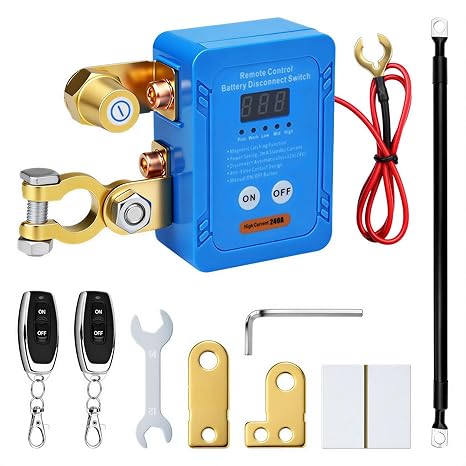
Losing power to your vehicle at the wrong moment or worrying about theft calls for a reliable battery kill switch. Perfect for cars, trucks, boats, and more, this model shines with its remote control feature that stops power instantly from your fingertips.
Installing the switch involves clamping it onto your battery terminals, and from there, managing your vehicle’s power is as simple as pressing a button on the remote. It suits anyone looking to protect against battery drain and unauthorized engine starts, with added comfort thanks to the real-time LED voltage display revealing the battery’s health clearly.
Handling a current of up to 240A at 24 volts, it reliably cuts or restores power as needed with a click. The build is solid enough for different vehicle types, enduring temperatures up to 100 °C without trouble. High marks come from its accuracy in voltage monitoring, while some users mention the mounting on a DIN rail requires careful installation.
The precise voltage monitoring and remote power cut-off are strong selling points, providing clear alerts on battery health and fast security response. Some find fitting the switch on a DIN rail somewhat complex, which slows down initial installation.
Ideal for people using 24-volt vehicles who want remote control and detailed battery feedback. Those driving strictly 12-volt vehicles may want to look at alternatives tailored for lower voltages.
Pros
- Remote control operation for quick power cut-off
- LED voltage display with ±0.5V accuracy
- Supports vehicles from cars to marine vessels
- Handles currents up to 240A safely
Cons
- DIN rail mounting can be tricky during setup
- Designed solely for 24-volt systems, not 12V
| Specification | Details |
|---|---|
| Current Rating | 240 A |
| Operating Voltage | 24 volts |
| Operation Mode | ON-OFF-ON |
| Mounting Type | DIN Rail Mount |
| Upper Temperature Rating | 100 °C |
5. Joinfworld Top Post Battery Disconnect Switch 12V-48V

Offering a solid 250A continuous current rating, this battery disconnect switch suits vehicles running between 12V and 48V where reliable power control matters most. Its on/off operation makes cutting power straightforward, ideal for drivers wanting a simple but effective way to safely disconnect their battery.
Setting up involves attaching the switch to the battery’s negative terminal using the included clamp and tapering post, which streamlines installation compared to standard options. Daily use is easy with a clear on/off hinge lever that lets you control your car’s power with a simple touch.
The surface mount ensures it stays firmly in place without complicated wiring.
The switch handles power disconnection cleanly and safely, with its ABS plastic housing built to withstand use without damage. Reviews often highlight its durable quality and ease of installation as standout points, but some mention that the single on/off position might feel limited for users wanting more control options.
Strong points include its easy installation thanks to the negative clamp and reliable ABS plastic build that holds up well in everyday use. Users appreciate the clear on/off control, though some find the single position limiting for more complex setups.
Anyone needing a straightforward battery disconnect switch for common 12-48V vehicles will find it a good fit. Those needing higher current capacity or multiple switch positions might look for alternatives better suited to demanding or specialized needs.
Pros
- Straightforward on/off operation
- Includes negative battery clamp for easy installation
- Durable ABS plastic construction
- Supports a broad voltage range (12-48V)
Cons
- Only one on/off position available
- Limited to 250A continuous current rating
| Specification | Details |
|---|---|
| Current Rating | 250 A |
| Operating Voltage | 12-48 Volts |
| Switch Type | Kill Switch, On-Off |
| Circuit Type | 2-way |
| Mounting Type | Surface Mount |
6. Remote Battery Disconnect Switch 12V

Drivers wanting to avoid battery drain when their car sits unused for a long time will appreciate the Remote Battery Disconnect Switch 12V. It’s especially ideal for those who want to protect their vehicle’s battery and reduce theft risk with simple remote control. Its standout feature is easy remote operation combined with solid power handling.
Installation is straightforward with through hole mounts and clamp connectors. The remote push-button control allows switching the battery on and off without messing under the hood. Day-to-day use is simple, just press the remote button to disconnect power when parking your vehicle for extended times.
It fits well for cars, trucks, and RVs, so a variety of drivers can benefit from it.
It handles up to 250A current with a spike tolerance of 450A, making sure it manages most automotive electrical demands well. High-quality materials and pure copper wiring support durability and good connectivity. The main praise is for its ability to keep the battery charge stable, while the most frequent complaint is the limited control range of the remote in some vehicles.
Most reviews highlight this switch’s strength in maintaining full battery charge even after long periods of inactivity, protecting against unwanted drain. On the downside, some find the remote’s effective range less than expected, which can limit convenience depending on the vehicle’s layout.
Drivers who park their vehicles for long durations and want straightforward remote control will appreciate this switch. Those needing longer remote range or easier installation might want to consider alternatives better suited to those specific needs.
Pros
- Remote push-button control for convenience
- Handles instantaneous current up to 450A
- Pure copper wire for better connectivity
- Compatible with cars, trucks, and RVs
Cons
- Remote range may be limited inside some vehicles
- Requires wired installation with clamp connectors
| Specification | Details |
|---|---|
| Current Rating | 250 A |
| Operating Voltage | 12 volts |
| Control Method | Remote |
| Connector Type | Clamp |
| Operation Mode | ON-OFF |
| Switch Type | Kill Switch |
7. Remote Battery Disconnect Switch 12V

Remote Battery Disconnect Switch 12V suits drivers looking to protect their vehicle battery with smart automatic features. Its biggest strength is the ability to cut power when voltage drops below 11.8V, preventing battery drain without needing constant manual attention.
Setup involves mounting the switch on a surface and connecting clamps to the battery terminals. Once installed, it automatically disconnects the battery after 120 seconds if voltage falls too low. The remote control disables automatically when vehicle voltage is over 13.2V to avoid accidental power cuts while driving, combining safety and convenience for daily use.
Performance lines up well with its technical specs, handling up to 240A and operating on 12 volts. Built from durable materials able to withstand temperatures up to 300 °C, the switch uses a rotary actuator and a mechanical magnetic design to minimize standby power usage.
Most praise highlights the very low standby current of 0.003A, while some note the limited remote range and manual override as minor drawbacks.
Its standout feature is the automatic power cut at low voltage, helping avoid battery drain during parking. The most common drawback involves the remote control’s limited operational range, which can sometimes be inconvenient depending on installed location.
People who want a mostly hands-off battery protection with reliable performance and safety features will appreciate this switch. Those needing longer remote control distance or fully manual operation might consider alternative models.
Pros
- Automatic cutoff at low voltage after 120 seconds
- Remote disables above 13.2V prevents accidental shutdown
- Very low standby current of 0.003A
- Supports up to 240A current rating
Cons
- Remote control range can feel limited
- Manual control overrides may require extra handling
| Specification | Details |
|---|---|
| Current Rating | 240 A |
| Operating Voltage | 12 volts |
| Standby Current | 0.003 A |
| Upper Temperature Rating | 300 °C |
| Control Method | Remote |
| Mounting Type | Surface Mount |
8. Remote Battery Disconnect Switch 12V 240A

Remote Battery Disconnect Switch 12V 240A excels at cutting off battery power remotely to protect your vehicle from battery drain, making it a great fit for cars, trucks, and boats. Its biggest strength lies in handling high current loads while drawing minimal power in standby mode.
Installing the switch involves straightforward panel mounting with screw terminals and plug-in connectors, making setup manageable. The remote control push-button operation means you can disconnect or reconnect the battery without needing to reach under the hood. It triggers the cut-off when voltage drops to 11.8V, preventing battery damage and keeping power consumption extremely low at just 3mA while idle.
Performance is solid, with the 240A continuous current rating covering most vehicle needs and a 1000A surge capacity handling instant current spikes. Built for durability, it covers temperature ranges from -30 °C to 90 °C, suitable for various climates. The magnetic latching relay provides reliable circuit control, but some find the single ON-OFF position limiting for complex electrical setups.
High marks come from its ability to control battery power remotely with minimal energy drain and strong current handling. The most frequent complaint involves the one-way circuit type, which some find restrictive for more complex vehicle setups requiring multi-position switches.
Those who want a straightforward battery cut-off with remote control and minimal standby current will appreciate this switch. Users needing advanced control over multiple circuits or configurations might benefit from exploring other options better suited to complex electrical systems.
Pros
- Handles 240A continuous current reliably
- Low standby power consumption of 3mA
- Remote control push-button for convenience
- Wide temperature rating from -30 °C to 90 °C
Cons
- Single ON-OFF position limits flexibility
- May not suit vehicles needing multi-circuit control
| Specification | Details |
|---|---|
| Current Rating | 240 A |
| Operating Voltage | 12 volts |
| Switch Type | Push Button |
| Operating Temperature Range | -30 °C to 90 °C |
| Controller Type | Remote Control |
9. Remote Battery Disconnect Switch 12V 240A

Putting a switch between your car battery and system that you can control remotely feels like gaining a new layer of control over your ride. It’s perfect for anyone who wants to keep their battery safe from drain without physically opening the hood every time. The strongest point is its power handling, coping with big surges while sipping minimal standby current.
Setting the switch up involves mounting the panel device and connecting terminals using spade connectors. The toggle switch gives a straightforward ON-OFF control, while the remote function saves you from fiddling with wires under the dash.
Magnetic latching means the switch holds its position firmly but uses very little energy when engaged, which helps keep your battery from going dead.
Handling up to 240A current and punchy instant bursts up to 1000A means it cuts power reliably in demanding conditions. The build supports temperatures up to 90 °C, making it tough enough for vehicles like trucks and boats.
Praises often mention how well it cuts power without a hitch, but some note the 2.2 A rating for operation can feel a bit low compared to the max current it can handle, which might confuse some buyers.
High power handling paired with low standby current wins praise for reliability and efficiency. Most common complaint centers on operation current rating seeming low compared to the maximum current the switch can disconnect.
People looking for reliable remote battery cutoffs for large vehicles will appreciate this switch’s performance. Those seeking a more flexible mounting or higher operation current rating might want to look at different models.
Pros
- Handles up to 240A current, good for heavy loads
- Remote control offers convenient power management
- Consumes only 3mA on standby, saves battery life
- Magnetic latching keeps switch firmly in place
Cons
- 2.2 A operation rating might confuse some users
- Panel mount limits installation options for some vehicles
| Specification | Details |
|---|---|
| Current Rating | 2.2 A |
| Operating Voltage | 120 volts |
| Contact Type | Normally Open |
| Switch Type | Toggle |
| Mounting Type | Panel Mount |
| Upper Temperature Rating | 90 °C |
10. Battery Disconnect Switch 12V/24V Manual Rotary

Ideal for cars, trucks, and boats, this 12V/24V battery disconnect switch excels in providing reliable power control with a simple manual rotary mechanism. It’s a solid choice for anyone needing a dependable solution to quickly cut off battery power and reduce electrical load without complicated electronics.
Installation is straightforward with surface mount design and through-hole terminals that fit most vehicle setups. Controlling power is easy, just rotate the switch 90 degrees upward to disconnect, and back down to reconnect.
The manual rotary control is direct, making daily use intuitive and fast without needing additional tools or electronics.
Performance-wise, it handles up to 250 amps at 12 volts, delivering strong power control. Pure copper contacts reduce resistance and maintain steady current flow, which helps keep systems running efficiently.
The build feels solid and practical, though some may find the manual switch less convenient than electronic alternatives. Most praise its reliability, while some note occasional stiffness in rotation.
The switch reliably cuts off and restores battery power with minimal energy loss, praised for its solid copper contact design. However, some find the rotary action firm, which might take some getting used to in daily handling.
Those looking for a straightforward, heavy-duty manual kill switch will appreciate this model’s simplicity and build. Users wanting electronic control or a lighter touch might want to explore other options better suited to those preferences.
Pros
- High electrical conductivity with pure copper contacts
- Quick, manual rotary operation without electronics
- Supports up to 250 A current rating
- Compatible with multiple vehicle types
Cons
- Manual switch can feel stiff to rotate
- Limited to 12V operation despite 24V mention
| Specification | Details |
|---|---|
| Current Rating | 250 A |
| Operating Voltage | 12 volts |
| Contact Type | Normally Open |
| Mounting Type | Surface Mount |
| Control Method | Touch |
11. Remote Battery Disconnect Switch 12V 250A

Constructed with a smart voltage-sensing system and a magnetic latching relay, the Remote Battery Disconnect Switch 12V 250A suits drivers wanting to protect their car battery from over-discharge and accidental power cuts. Its intelligent voltage protection stands out as the key feature for safety and battery longevity.
Installation involves placing the switch where it can monitor the battery voltage continuously. It automatically disconnects power when voltage falls below 11.8V, which helps prevent deep discharge damage.
While driving, the remote control deactivates between 13.6V and above to avoid accidental shutdown. The very low standby current of just 0.005A keeps battery drain minimal during periods of inactivity.
It performs the main task of cutting power precisely at low voltage levels and disables manual control at higher voltages for safety. The build quality supports stable operation, with a light weight of around 1.1 pounds aiding ease of installation in tight engine bays.
A common praise centers on its reliable voltage monitoring, while some note slight delays before it disconnects.
The strongest point lies in its reliable voltage monitoring and automatic disconnection to protect the battery, which many appreciate. The delay in shutting off power after voltage drops is the most frequent complaint but often expected given the safety buffer built in. Remote disablement during charging phases ensures safety but may feel inconvenient occasionally.
Those seeking smart, energy-efficient battery management with automatic safeguards will find this switch very suitable. Drivers needing immediate manual control without delay or temporary disablement might look for alternatives offering instant response without voltage lockouts.
Pros
- Automatic cut-off below 11.8V prevents battery damage
- Remote control disabled above 13.6V for safety
- Ultra-low standby current of only 0.005A
- Lightweight design makes installation easier
Cons
- Delay before power disconnect can be noticeable
- Remote control temporarily disabled can confuse at times
| Specification | Details |
|---|---|
| Brand | Trosfina |
| Voltage | 12V |
| Current Rating | 250A |
| Standby Current | 0.005A (5mA) |
| Weight | 1.1 pounds |
| Warranty | 1 year |
12. Side Post Remote Battery Disconnect Switch 12V

A remote control for disconnecting a car battery stands out for convenience, especially with GM side post batteries. Ideal for anyone wanting to prevent battery drain without opening the hood, its single biggest strength is the easy-to-use FOB remote that works up to 100 feet away.
Installation involves connecting the switch to GM side post or similar threaded stud battery terminals using the screw terminals. Once mounted through a hole, daily use is simple, just press the remote’s button to disconnect or reconnect the battery.
No more crawling under the hood or fiddling with clamps before leaving the vehicle for extended periods or during storage.
Handling up to 200A continuous current and 1000A crank amps means it reliably starts vehicles in cold weather without cutting power. The solid-state relay inside delivers durability and swift operation. Many appreciate how well it prevents parasitic battery drain, though some might find the remote range a little short for certain setups.
Build quality appears solid and well suited for various vehicles.
Many find the remote control easy and handy for disconnecting the battery without opening the hood. The most frequent downside mentioned is that the remote range does not always reach far enough for every vehicle setup. The solid-state relay and mounting style deliver reliable performance in daily use.
Vehicles with GM side post batteries benefit most since compatibility is built-in. Anyone needing a kill switch for 12V cars, trucks, or similar equipment will appreciate the power handling. Those wanting compatibility beyond 12V systems or longer remote reach might look elsewhere.
Pros
- Works with GM side post battery terminals
- Remote control works up to 100 feet away
- High current capacity for cold weather starts
- Push button control preprogrammed from the box
Cons
- Remote range may fall short for some installations
- Designed mainly for 12V systems, limited for others
| Specification | Details |
|---|---|
| Current Rating | 200 A |
| Operating Voltage | 12 volts |
| Control Method | Remote |
| Connector Type | Crimp |
| Switch Type | Kill Switch |
| Upper Temperature Rating | 185 °F |
Comparison of Top Car Battery Kill Switches
| Product | Current Rating | Operating Voltage | Switch Type | Mounting Type |
|---|---|---|---|---|
| Top Post Battery Switch | 300 A | 12 volts | Rotary | Panel Mount |
| Remote Disconnect 12V 240A | 240 A | 12 volts | Kill Switch | Surface Mount |
| Remote Disconnect 12/24V 240A A | 240 A | 12 volts | Kill Switch | Surface Mount |
| Remote Disconnect 12/24V 240A B | 240 A | 24 volts | Remote | DIN Rail Mount |
| Joinfworld Top Post Switch | 250 A | 12 volts | Kill Switch | Surface Mount |
| Remote Disconnect 12V A | 250 A | 12 volts | Kill Switch | Through Hole Mount |
| Remote Disconnect 12V B | 240 A | 12 volts | Kill Switch | Surface Mount |
| Remote Disconnect 12V 240A A | 240 A | 12 volts | Push Button | Panel Mount |
| Remote Disconnect 12V 240A B | 2.2 A | 120 volts | Toggle | Panel Mount |
| Manual Rotary Disconnect 12/24V | 250 A | 12 volts | Kill Switch | Surface Mount |
| Remote Disconnect 12V 250A | 250 A | 12 volts | Switch | – |
| Side Post Remote Switch | 200 A | 12 volts | Kill Switch | Through Hole Mount |
- Current Rating300 A
- Operating Voltage12 volts
- Switch TypeRotary
- Mounting TypePanel Mount
- Current Rating240 A
- Operating Voltage12 volts
- Switch TypeKill Switch
- Mounting TypeSurface Mount
- Current Rating240 A
- Operating Voltage12 volts
- Switch TypeKill Switch
- Mounting TypeSurface Mount
- Current Rating240 A
- Operating Voltage24 volts
- Switch TypeRemote
- Mounting TypeDIN Rail Mount
- Current Rating250 A
- Operating Voltage12 volts
- Switch TypeKill Switch
- Mounting TypeSurface Mount
- Current Rating250 A
- Operating Voltage12 volts
- Switch TypeKill Switch
- Mounting TypeThrough Hole Mount
- Current Rating240 A
- Operating Voltage12 volts
- Switch TypeKill Switch
- Mounting TypeSurface Mount
- Current Rating240 A
- Operating Voltage12 volts
- Switch TypePush Button
- Mounting TypePanel Mount
- Current Rating2.2 A
- Operating Voltage120 volts
- Switch TypeToggle
- Mounting TypePanel Mount
- Current Rating250 A
- Operating Voltage12 volts
- Switch TypeKill Switch
- Mounting TypeSurface Mount
- Current Rating250 A
- Operating Voltage12 volts
- Switch TypeSwitch
- Mounting Type–
- Current Rating200 A
- Operating Voltage12 volts
- Switch TypeKill Switch
- Mounting TypeThrough Hole Mount
How to Choose the Right Battery Kill Switch
Choosing a battery kill switch involves considering durability, ease of installation, and safety features to ensure reliable performance. Selecting the right type helps prevent battery drain and electrical issues, ultimately saving money on repairs and avoiding inconvenient breakdowns.
Compatibility with Vehicle
Battery terminals come in various sizes, and the hardware on the switch needs to fit snugly to avoid loose connections that cause starting issues or power loss. Some vehicles use larger post terminals while others have side posts, so it’s important the switch clamps firmly on your specific type. Voltage ratings also vary; passenger cars typically run on 12V systems, but trucks or commercial vehicles often operate on 24V batteries, meaning the switch must handle the correct voltage to avoid damage or failure.
Switches designed only for positive terminals won’t work properly on setups using negative terminals, and vice versa. Compatibility information on the packaging or product description usually states the exact terminal size range and voltage ratings supported. Look for a switch specified for your car’s battery type and both positive and negative terminal compatibility if your vehicle requires it.
Build Quality and Materials
Switches made of solid brass or copper stand up better over time and resist corrosion from moisture and acid exposure common under the hood. Cheaper metals may start to rust or discolor after a few months, affecting conductivity and reliability.
The actuator or knob should feel sturdy, not flimsy, since it will be turned on and off repeatedly.
Insulated coverings on the terminals and body add a layer of protection against accidental shorts when working around the battery. This insulation also helps prevent minor shocks. Pay attention to how thick and well-made the plastic or rubber coverings are; thin plastic can crack and wear quickly under heat and vibration.
Ease of Installation
Most switches come with mounting bolts and detailed instruction sheets, but some require additional tools like wrenches or screwdriver sets you might not have on hand. The best switches include everything needed for a straightforward install.
Installation should not require disassembling other components unless there’s very limited space.
Compact designs that fit easily near the battery posts or on the battery terminal itself save time and effort in tight engine bays. Look out for switches with simple bolt-on mounting brackets or clamp-on designs.
A confusing or overly complex installation process can lead to mistakes or improper wiring, affecting performance.
Safety Features
Switches that include a locking mechanism, such as a key lock or twist-and-click lock, help avoid accidental shutdowns while driving or working nearby. Accidental activation can cause the engine to die or electronic components to lose power unexpectedly.
Good designs keep terminals spaced to prevent sparks during switching. In addition to physical separation, many models use internal insulation to reduce shorting risks. A switch that fully isolates the battery when off also prevents battery drain in parked vehicles, keeping ignition and other connected systems safe from power loss.
Operational Reliability
Smooth operation across thousands of cycles is key. Cheap switches tend to get stiff, loose, or fail to maintain a solid connection after repeated use, which can lead to intermittent starting problems.
Resistance to engine vibrations and temperature changes is critical since the switch lives in a harsh environment.
Look for products listing a rated number of cycles or backed by a solid warranty, indicating the manufacturer expects long-term dependability. A reliable switch clicks cleanly on and off without delay or roughness, giving confidence it will work every time it’s needed.
Installation Tips for Optimizing Your Car Battery Kill Switch
Positioning the battery kill switch close to the battery terminals helps reduce wire length, which minimizes voltage drop and improves responsiveness. Use insulated tools to prevent accidental shorts during installation. The switch should connect directly to the positive battery cable, ensuring all electrical loads can be controlled by it.
Secure all connections tightly; loose terminals cause unreliable operation and increased resistance, which can lead to heat buildup. Route wires away from moving parts and sharp edges to avoid wear over time.
- Choose a mounting location that is easy to access without removing other components.
- Follow the manufacturer’s wiring diagram precisely to avoid damaging your vehicle’s electrical system.
- Double-check polarity and connection points before activating the switch for the first time.
Proper grounding is critical; poor ground connections can cause the switch to malfunction or create electrical noise in your system. Taking time to plan your installation will result in consistent performance and improve safety.
Maintenance Practices to Extend the Lifespan of Your Battery Kill Switch
Regular inspection of your battery kill switch wiring and terminals prevents corrosion buildup that can interfere with conductivity. Applying dielectric grease to connection points helps repel moisture and reduces oxidation.
Check that the switch’s mounting remains secure; vibrations from driving can loosen screws or damage the switch housing over time. Operating the switch periodically ensures internal contacts stay clean and function smoothly.
- Wipe down exposed parts with a dry cloth to keep dust from accumulating.
- Replace any damaged or frayed cables immediately to prevent shorts or failure.
- Inspect fuse holders and replace fuses if they show signs of corrosion or discoloration.
Keeping the battery terminals clean and tight complements the switch’s role, maintaining reliable power control and extending the system’s overall lifespan.
Common Mistakes to Avoid When Using a Car Battery Kill Switch
Many users make the mistake of installing the kill switch in a hard-to-reach spot, which complicates emergency disconnection and regular use. Avoid using the switch as a daily on/off mechanism; it’s designed for secure shutdown, not constant toggling.
Failing to verify wiring connections before use can cause serious electrical issues, including shorts and drained batteries. Using the incorrect switch rating for your vehicle’s electrical system risks overheating and premature failure.
- Don’t neglect grounding; poor ground connections disrupt switch operation and can cause erratic behavior.
- Do not bypass inline fuses as they protect the wiring and switch from overload.
- Avoid routing wires near heat sources or moving parts, which can damage insulation over time.
Proper installation and careful use prevent common pitfalls that reduce the effectiveness and safety of your battery kill switch.
People Also Asked
How Do I Install a Battery Kill Switch Safely in My Car?
Disconnect the car battery before starting the installation to avoid electrical shocks or shorts. Use proper connectors and secure the switch in an easily accessible spot. Make sure the main power line to the battery passes through the switch for it to effectively cut power when turned off.
What Size Battery Kill Switch Do I Need for My Vehicle?
Choose a battery kill switch rated for the amperage of your vehicle’s electrical system. Most passenger cars use switches rated for at least 100 to 200 amps. Check your vehicle manual or fuse box for the main fuse rating to match the switch size closely for safety.
How Long Does a Typical Battery Kill Switch Last Before Replacement?
Battery kill switches generally last many years with no issues if installed correctly and kept dry. Signs to replace include corrosion on terminals or difficulty turning the switch. Routine checks during maintenance help spot wear before it creates electrical problems.
Can a Battery Kill Switch Damage My Car’s Electrical System?
A properly installed battery kill switch should not harm your car’s electrical system. Problems arise if it’s wired incorrectly or uses a switch not rated for the vehicle’s power load. Avoid cheap switches that may fail and cause shorts or draining of the battery.
What Common Problems Should I Watch for with Battery Kill Switches?
Common problems include switch contacts corroding or sticking, poor connections causing intermittent power loss, and wiring that may loosen over time. Regularly inspect the switch, clean terminals, and tighten wires to keep it functioning smoothly without unexpected failures.
Conclusion
Choosing the right battery kill switch for your car depends mainly on how easy it is to install, how reliable it is at cutting power, and whether it fits your vehicle’s wiring setup. Durability also matters since the switch will be exposed to heat and vibrations. Pick one that feels solid and has clear instructions to avoid installation issues.
Think about your available space and how often you’ll actually use the switch before deciding on the model. Matching those factors with your budget helps narrow down the choices. Have another look at the comparison table and detailed picks above to find the best balance for your specific needs.