
Top 12 Best Float Charger for Car You Can’t Miss Out
Car batteries often lose charge during periods of inactivity, and a cheap or unsuitable charger can either fail to keep the battery healthy or cause overcharging that shortens battery life. The best float charger for car maintains a steady, low voltage to keep the battery fully topped off without risk of damage.
It’s common knowledge that a charger designed specifically for automotive batteries performs better than generic models, which might not provide the correct charging profile or protections.
Key aspects that distinguish a quality float charger include precise voltage regulation, keeping output around 13.5 to 13.8 volts to prevent overcharge. Built-in safety features such as short-circuit protection and reverse polarity safeguards matter to avoid electrical issues. Chargers that supply steady current between 1 to 3 amps are typical, balancing efficient maintenance charging with battery health.
A compact size improves usability, allowing easy storage and installation in tight spaces.
Need a Quick Check?
| Image | Product | Price |
|---|---|---|
Our Top Picks 1  | MOTOPOWER MP00205A Charger | Check Price |
Our Top Picks 2  | Battery Tender Plus 12V | Check Price |
Our Top Picks 3  | Automatic 6V/12V Charger | Check Price |
Our Selected Top 12 Float Charger for Car Worth Your Money
This list features reliable float chargers designed to maintain and protect your car battery over time. Each review covers performance, ideal users, and highlights strengths and weaknesses to help you choose the best option for your specific needs.
1. MOTOPOWER MP00205A Battery Charger
Providing a steady 800 milliamps output, this charger suits anyone with 12-volt lead-acid batteries looking for a reliable maintainer and desulfator. Its standout strength lies in automatic desulfation that improves battery life without any manual input.
Setup involves simply clipping the alligator clips to your battery terminals and plugging it into a 110-volt outlet. The unit automatically detects battery sulfation and applies pulse current to fix it, so day-to-day use requires no adjustments. It also switches to zero output on standby, ensuring no battery drain while connected, which adds convenience and safety.
The charger performs solidly for keeping car and powersport batteries in shape. The build feels durable and compact, suitable for indoor or outdoor use.
Praise often highlights how well it maintains battery health automatically, while some users note the 800mA amperage could be slow for bigger batteries.
Automatic desulfation is praised for extending battery life without user effort. The most common gripe comes from people expecting faster charging due to the modest 800mA amperage. The spark-proof clip design and zero drain standby make it a safe daily charger.
Someone looking for quiet, low-maintenance care for smaller 12V batteries will appreciate this charger. Users needing rapid recharging on large batteries or multiple devices at once might prefer a higher amperage or multi-port model.
Pros
- Automatic battery desulfation and optimization
- Zero output power in standby mode
- Works on all 12V lead-acid battery types
- Spark proof connection for safety
Cons
- 800mA output may be slow for larger batteries
- Single port limits charging multiple batteries simultaneously
| Specification | Details |
|---|---|
| Output Voltage | 12 volts_of_direct_current |
| Input Voltage | 110 volts_of_alternating_current |
| Current Rating | 800 milliamps |
| Compatible Devices | Cars, Motorcycles, ATVs, RVs, Powersports, Boats |
| Connector Type | clamp/alligator clip |
| Number of Ports | 1 |
2. Battery Tender Plus 12V Battery Charger
People looking for a reliable charger to maintain their car, motorcycle, or lawn mower battery will find this a solid choice. Its biggest strength is an adaptive charger system that adjusts to the battery’s needs, helping extend the battery’s life instead of just charging it blindly.
Setup is straightforward with alligator clips and a ring terminal for flexible connections. The quick disconnect harness makes it easy to attach or remove without hassle. Day-to-day use feels simple because the charger handles all the monitoring and adjusts current to keep the battery healthy without constant supervision.
Charging follows a 4-step program that safely brings the battery up to full and maintains it without overcharging. The unit itself is compact and built with durability in mind.
One common praise is how it effectively prolongs battery life, while some find the charging current of 1.25 amps rather slow for bigger batteries.
The strongest point is the adaptive smart charging that prevents overcharging and keeps batteries healthy for a longer time. The most common complaint relates to the 1.25 A current rating, which can feel slow when charging bigger car batteries.
People with smaller batteries or those who value battery health over speed will appreciate this charger. Those needing faster charging or handling multiple batteries at once might want a different model with higher amperage or more ports.
Pros
- Adaptive charging extends battery life
- Quick disconnect harness for easy use
- Comes with fused ring terminal and clips
- Lifetime customer support included
Cons
- Charging speed may be slow for large batteries
- Single port limits multi-battery use
| Specification | Details |
|---|---|
| Output Voltage | 12 volts |
| Input Voltage | 120 volts of alternating current |
| Current Rating | 1.25 A |
| Compatible Devices | ATV, PWC, car, lawn mower, motorcycle |
| Connector Type | Alligator Clips, Ring Terminal |
3. 6V/12V Automatic Battery Charger Maintainer
Designed for a wide range of lead-acid batteries, this automatic charger maintainer works equally well on 6V and 12V systems. It’s perfect for anyone with multiple vehicles or seasonal toys who needs a reliable way to keep batteries topped off without overcharging.
Its biggest strength is the built-in 5-stage smart charging process that manages battery health thoughtfully.
Setup is straightforward with alligator clips and an SAE connector that fit most battery terminals securely. You just connect it to a power source and battery, then the charger takes over with automatic detection and soft start, so you don’t have to babysit it. Keeping track of battery status is simple as it moves through the bulk and absorption phases before steady float maintenance ensures the battery is ready whenever you need it.
Charging at a steady 1.5A current, it does its job quietly and keeps your batteries maintained without overheating. The build feels practical enough for garage or shed use, though it has just one output port, limiting use to one battery at a time.
The strongest praise revolves around how well the smart charging system preserves battery life. Some users wished it charged a bit faster or offered more connection options.
The charger’s smart 5-stage system helps maintain battery readiness by managing the charging phases well, which many users appreciate. However, charging a battery can take a full 24 hours, leading to complaints from those needing quicker turnaround times.
People with several vehicles or seasonal equipment will find this charger useful because of its versatility across battery types. Those who need faster charging or multiple port options will want to look at different models better suited to higher power or simultaneous charging needs.
Pros
- Compatible with multiple lead-acid battery types
- Automatic 5-stage charging process
- Easy to hook up with alligator clips and SAE
- Steady 1.5A current keeps batteries safe
Cons
- Only one charging port limits simultaneous use
- Charge cycle can take up to 24 hours
| Specification | Details |
|---|---|
| Output Voltage | 12 volts |
| Input Voltage | 240 volts |
| Battery Charge Time | 24 hours |
| Current Rating | 1.5 A |
| Connector Type Used on Cable | Alligator Clips, SAE |
4. FOVAL 12V Automatic Battery Charger
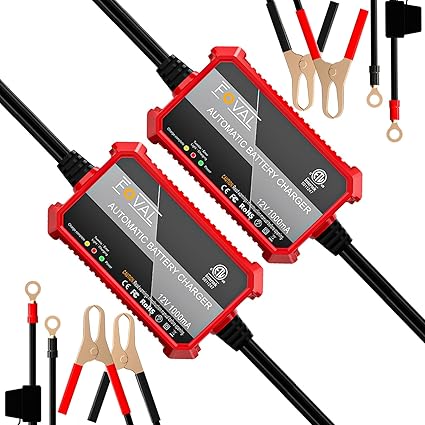
FOVAL 12V Automatic Battery Charger offers reliable battery maintenance for various lead acid batteries. Ideal for anyone needing a compact, smart charger that handles tricky battery types with ease, it really stands out for its automatic 4-step charging program that keeps batteries healthy without constant supervision.
Setting up is straightforward with two DC output cables, one with ring connectors and one with alligator clips, so you can pick what fits your battery terminals best. The long cables give flexibility when charging vehicles or other equipment without moving them around. It switches through charging phases automatically, so you just plug it in and leave it, making daily maintenance simple and low effort.
Performance is solid thanks to the built-in battery desulfator and the 1 amp current that matches smaller batteries well without risk of overcharging. The charger’s build is compact and lightweight, about the size of a phone, making it easy to store or carry.
Common praise highlights its smart charging cycle that really helps extend battery life. On the downside, the 1 amp output isn’t suited for larger battery banks that need faster charging.
The smart 4-phase charging system is highly praised for providing consistent, safe maintenance that prolongs battery life. Common feedback notes the lower amperage limits rapid charging and some users find the cable length more than needed for tight spaces.
This charger suits those with smaller 12V batteries on motorcycles, lawn mowers, or cars needing daily upkeep. Users with larger battery setups or faster charging needs might look for something with a higher amp rating or multi-volt options.
Pros
- Automatic 4-step charging program
- Compact and lightweight design
- Includes two connector types for versatility
- Built-in battery desulfator helps battery health
Cons
- Only 1 amp output, slow for large batteries
- Cable length may be excessive for close charging spots
| Specification | Details |
|---|---|
| Output Voltage | 12 volts |
| Input Voltage | 12 volts |
| Current Rating | 1 A |
| Dimensions | 3.9 x 2.4 x 1.25 inches |
| Weight | 10.5 oz |
| Connector Types | Alligator, Ring |
5. NOCO GENIUS2D 12V Battery Charger

Keeping your vehicle’s battery healthy is simple with this onboard charger designed for 12-volt batteries. It works well for anyone wanting a reliable and permanent solution to battery maintenance, especially if you often leave vehicles unused for long stretches.
Its key strength is the direct-mount design that stays securely in place under the hood.
Installation feels straightforward thanks to the durable snap-fit mounting bracket and self-tapping screws, which make attaching it to most surfaces quick and steady. The charger is mainly used by plugging it into a standard power source to maintain the battery without frequent monitoring, making it ideal for busy or forgetful people.
The 2-amp output gently charges and maintains various battery types, including AGM and gel, fitting a range of vehicles from cars to lawn mowers. The build is sturdy and meant to stay in one spot without fuss.
Praise often highlights how dependable it is, while some mention the 40-hour charge time as longer than expected.
Most people appreciate the secure mounting system that keeps the charger fixed under the hood without extra effort, making ongoing battery care simple. Common complaints focus on the slower 40-hour charging speed, which might feel inconvenient when a faster charge is needed.
Those who want a permanent, steady battery maintainer will enjoy this charger’s setup and reliability. Anyone needing a faster charging option or more power capacity should look into alternatives better suited to quick battery replenishing.
Pros
- Secure direct-mount bracket included
- Works with multiple 12-volt battery types
- Easy installation with self-tapping screws
- Maintains battery year-round with slow charge
Cons
- Charge time can be quite long at 40 hours
- Limited to 2 amp current output
| Specification | Details |
|---|---|
| Output Voltage | 12 volts |
| Input Voltage | 120 volts |
| Current Rating | 2 A |
| Battery Charge Time | 40 hours |
| Connector Type | eyelet terminals |
6. NOCO GENIUS5 6/12V Battery Charger

Compact and powerful, the NOCO GENIUS5 suits anyone needing reliable charging for a range of 6V or 12V batteries. Its standout feature is delivering over 65% more power than similar models, fitting neatly into tight spaces while handling various battery types from cars to lawn mowers.
Setup is straightforward with simple battery clamps that fit easily on terminals. The charger automatically adjusts based on ambient temperature, so it modifies charging speed to avoid damage or inefficiency. Day-to-day use means you can leave it connected for maintenance without worry about overcharging, and it supports multiple battery chemistries, including lithium-ion.
Charging takes about 8 hours at 5 amps, which balances quick refills and safe, steady power delivery. The build feels solid and compact, being 34% smaller than older models, making it easy to store and move.
Praised for its precise temperature control, the most common complaint is needing a single port for only one battery at a time, which might slow work when managing multiple vehicles.
The precision in temperature sensing and power delivery earns consistent praise for maintaining battery health, ensuring efficient charging without damage. At the same time, some users find the single-port limit inconvenient when working on several vehicles, which extends the total charging time across multiple batteries.
People with a handful of vehicles or varied battery types will appreciate the multi-battery compatibility and safety-focused features. Those needing faster charging or simultaneous multi-battery charging might want to explore alternatives with higher amperage or multiple output ports.
Pros
- Small size fits into tight storage spaces
- Automatic temperature-based charging adjustments
- Supports multiple battery types including lithium-ion
- Delivers 5 amps for balanced charging speed
Cons
- Only one charging port available
- Charging process takes around 8 hours
| Specification | Details |
|---|---|
| Output Voltage | 12 volts |
| Input Voltage | 120 volts |
| Battery Charge Time | 8 hours |
| Current Rating | 5 A |
| Connector Type | Battery Clamps |
7. Battery Tender Junior 12V Charger

Designed with a compact and practical build, the Battery Tender Junior 12V Charger is perfect for anyone needing to keep a 12V lead-acid battery topped off during long periods of inactivity. Its biggest strength lies in switching automatically to float mode to maintain safe voltage levels without overcharging.
Setup is straightforward, with included alligator clips or ring terminals to connect securely to the battery. The charger runs through a full 4-step charging cycle and then holds the battery at the correct voltage. Daily use is low maintenance since it doesn’t require you to watch over it or disconnect once the battery is charged, which makes it easy to leave connected during winter storage.
The charger handles its job well, carefully moving through initialization, bulk charging, absorption, and finally float mode to keep batteries healthy. The build feels solid and well designed for outdoor storage situations.
Common praise focuses on its reliable maintenance without damaging batteries. A noted downside is the relatively low 750 milliamp current, which can make charging slower for larger batteries.
Many praise the charger’s ability to maintain battery health over long storage by switching to float mode automatically. The most common complaint is that its 0.75 amp output slows charging on larger capacity batteries, requiring more patience. It excels at keeping smaller batteries topped up without manual monitoring.
People needing steady voltage maintenance for motorcycles, ATVs, or seasonal vehicles will find this charger reliable and worry-free. Those who want faster charging or need to handle multiple batteries simultaneously might want to explore options with higher amperage or more ports.
Pros
- Automatic float mode for long-term battery maintenance
- Compatible with multiple 12V lead-acid battery types
- Simple setup with versatile connectors
- Compact and lightweight design
Cons
- Low current rating means slower charging time
- Single port limits simultaneous battery management
| Specification | Details |
|---|---|
| Output Voltage | 12 volts |
| Input Voltage | 12 volts |
| Current Rating | 750 milliamps |
| Amperage | 0.75 A |
| Connector Type Used on Cable | Alligator Clips, Ring Terminals |
| Number of Ports | 1 |
8. Battery Tender 3 AMP Battery Charger

Compact design and ease of use stand out the most for anyone looking for a reliable float charger for a car. It suits drivers who want a simple plug-and-play option that keeps the battery healthy without constant monitoring.
The 3 amp output provides a steady charge while preventing overcharging.
Setup only takes a minute with the included ring terminal and alligator clip combo cable. The long combined cord length of 11 feet makes it easy to reach the battery even in tight spaces.
Once plugged in, it switches to float mode automatically, so you don’t have to worry about disconnecting it or overcharging the battery.
Charging performance is solid, delivering a controlled 12 volts DC that maintains battery levels effectively. The unit feels well-built and lightweight, perfect for occasional or long-term use. Most praise focuses on how well it maintains battery voltage, while some mention that the 3 amp rate might be slower for quickly charging very depleted batteries.
Steady maintenance of battery voltage without user intervention is well appreciated by those who rely on it. Some find the charging speed slower when dealing with very drained batteries, which means it’s better for upkeep rather than rapid charging needs.
People needing a straightforward maintainer that stays connected long-term will be happy here. Those wanting faster charging or multiple battery options should look at other higher-amperage or multi-port models instead.
Pros
- Automatic float mode to prevent overcharging
- Lightweight and compact for easy storage
- Long combined cord for versatile reach
- Includes both ring terminal and alligator clips
Cons
- 3 amp current may be slow for very low batteries
- Single port limits charging only one battery at a time
| Specification | Details |
|---|---|
| Output Voltage | 12 volts_of_direct_current |
| Input Voltage | 120 volts_of_alternating_current |
| Current Rating | 3 A |
| Amperage | 3 A |
| Connector Type Used on Cable | Ring Terminal and Alligator Clip Combo |
| Number of Ports | 1 |
9. 2A Smart Battery Maintainer and Charger
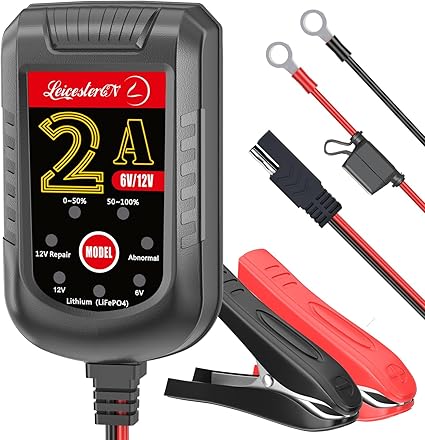
Ideal for anyone needing a charger that handles multiple battery types without swapping devices, it stands out with its ability to charge both 6V and 12V Lead Acid and Lithium batteries. Versatile use across cars, motorcycles, boats, and more makes it a smart pick for keeping various vehicles and equipment ready.
Setup involves selecting the right mode for your battery type and voltage using a simple button press, which controls the charge process without fuss. Day-to-day maintenance mode keeps batteries topped up automatically, eliminating the guesswork and constant monitoring. Connectors include alligator and ring types, accommodating different battery terminals smoothly around the garage or yard.
Charges deliver a steady 2A current suitable for a broad range of battery chemistries and voltages. The unit feels solidly built with clear controls and practical cables. Popular praise highlights reliability in maintaining battery health over extended periods, while common complaints focus on the slower charge time of up to 72 hours for a full charge.
It reliably maintains battery health over long periods without user intervention. The charge speed is relatively slow, requiring patience for full power restoration. Setup and daily use keep the process straightforward, with mode selection making it adaptable to multiple battery types.
Great for people with multiple vehicles who want a single charger and prioritize long-term battery care. Not the best fit for those needing quick charging or extremely high amperage output from a battery charger. Ideal for low-maintenance, varied-vehicle setups rather than fast turnaround demands.
Pros
- Supports multiple battery chemistries and voltages
- Automatic float maintenance mode included
- Works with a wide range of vehicles and equipment
- Easy mode switching with a single button
Cons
- Full charge can take up to 72 hours
- May not suit users needing faster charging
| Specification | Details |
|---|---|
| Output Voltage | 12 volts |
| Input Voltage | 12 volts |
| Battery Charge Time | 72 hours |
| Current Rating | 1100 milliamps |
| Amperage | 1.5 A |
| Connector Type Used on Cable | Alligator & Ring Connectors |
10. FOVAL 12V Automotive Battery Charger

Keeping a car battery healthy during long periods of inactivity can be a real headache. Ideal for vehicles with 12V lead-acid batteries, the FOVAL 12V Automotive Battery Charger offers steady, automatic maintenance without needing you to monitor it constantly. Its biggest strength lies in managing different battery types with a smart, 4-step charging process that protects and maintains battery life.
Setup is straightforward: just clamp it onto the battery terminals of your car, motorcycle, or lawn mower. Once plugged into a 12V power source, the charger takes over, moving through initialization, bulk charging, absorption, and then float mode.
You won’t have to worry about overcharging since it adjusts power flow automatically and keeps the battery topped up without draining or damage risks.
Performance matches the promises. It handles all lead-acid batteries, including SLA and AGM, with a steady 1A charging current.
The charger’s plastic build feels solid and durable enough for garage use. Most find the automatic operation helpful since it requires minimal intervention; however, a few mention the 1A output might be slow for larger batteries needing faster power.
FOVAL 12V Automotive Battery Charger provides a steady, automatic charging process for various lead acid batteries including AGM and GEL types. It maintains battery health through a 4-step charging program and prevents overcharging with its float mode. The most frequent drawback noted is the slow charging speed when using the 1A current setting, which requires patience.
People with smaller batteries or those who need a device for occasional maintenance will find this charger meets their needs well. Users requiring rapid charging or handling large batteries may look for a charger with a higher amperage for faster results. Its simplicity suits everyday car battery upkeep without frequent manual intervention.
Pros
- Automatic 4-step charging process
- Works with SLA, VRLA, GEL, AGM, WET batteries
- Simple clamp connectors for easy setup
- Suitable for various vehicles and equipment
Cons
- 1A output may be slow for large batteries
- Requires 12V DC input to operate
| Specification | Details |
|---|---|
| Output Voltage | 12 volts_of_direct_current |
| Input Voltage | 12 volts_of_direct_current |
| Current Rating | 1 A |
| Compatible Devices | Motorcycle, ATV, Car, Lawn Mower, and other lead-acid batteries |
| Connector Type | Battery Terminal Clamp |
11. 12V Automatic Battery Charger Maintainer

Automatic 3-stage charging makes managing 12V lead-acid batteries straightforward and reliable. Perfect for anyone needing to keep car, motorcycle, or lawn mower batteries healthy without fuss. Its greatest strength lies in switching to float mode once fully charged, preventing overcharging and extending battery life.
Setting up involves simply clipping the alligator connectors to the battery terminals and plugging it in. The LED indicators make it easy to see if the battery is charging, fully charged, or if there’s a connection issue. Daily use requires no intervention as the charger adapts automatically between constant current, constant voltage, and float maintenance modes.
It handles charging and maintenance smoothly, with a quiet 0.75 A output that suits smaller 12V lead-acid batteries. The compact design and clear LED signals make it user-friendly.
Most praise focuses on its reliability and clarity of status lights, while complaints often mention it’s not compatible with lithium or larger capacity batteries beyond 36Ah.
The charger earns strong approval for reliable automatic maintenance and clear LED feedback on charging status. The most frequent issue is its limited compatibility, excluding lithium batteries and higher voltage systems.
Ideal for anyone with standard 12V lead-acid batteries in vehicles and small engines wanting a simple, hands-off charger. Those needing faster charging or support for lithium batteries should look for alternative models.
Pros
- Automatic 3-stage charging prevents overcharge
- LED indicators clearly show battery status
- Compatible with several 12V lead-acid types
- Compact and easy to connect with alligator clips
Cons
- Not suitable for lithium or 24V batteries
- Limited output current; slow for large batteries
| Specification | Details |
|---|---|
| Output Voltage | 12 volts |
| Current Rating | 0.75 A |
| Charging Range | 3–18Ah |
| Maintenance Range | Up to 36Ah |
| Compatible Battery Types | AGM, GEL, SLA, VRLA, WET |
12. Victron Energy Blue Smart 12V Marine Charger

Anyone looking to keep their car battery in top shape will appreciate this charger, especially those wanting to track charging remotely. It suits people with various vehicles, like cars, boats, or motorbikes, and shines in its ability to monitor and adjust charging wirelessly.
Setting it up is straightforward, using a standard NEMA 5-15 plug. Daily use is simple because you can check the voltage and current on your phone and tweak settings without unplugging the charger.
It works quietly in the background and automatically switches to the right charging step, even bringing batteries back from deep discharge.
It delivers a stable 12 volts at 25 amps, supporting a careful 7-step charging process that preserves battery life. The build feels solid and durable, rated IP67 to handle damp environments like boats or workshops. Most people praise how well it revives dead batteries.
Some find the wireless setup a bit tricky at first, but that eases with use.
The most praised feature is the charger’s ability to revive deeply discharged batteries while maintaining their health through a detailed charging process. The most common issue is the learning curve involved in setting up and using the wireless features effectively.
People who want detailed control and monitoring of their battery maintenance will find this a solid choice. Those who prefer ultra-simple chargers without app integration may want to look elsewhere for a more straightforward device.
Pros
- Wireless monitoring of voltage and current
- 7-step charging ensures battery health
- Recharge deeply-discharged batteries safely
- IP67 rating fits marine and workshop use
Cons
- Wireless setup can be complicated initially
- Only compatible with 12V batteries
| Specification | Details |
|---|---|
| Output Voltage | 12 volts |
| Input Voltage | 120 volts_of_alternating_current |
| Current Rating | 25 A |
| Amperage | 25 A |
| Connector Type | NEMA 5-15 Plug |
Best Float Chargers for Cars Compared Side by Side
| Product | Output Voltage | Current Rating | Compatible Devices | Connector Type |
|---|---|---|---|---|
| MOTOPOWER MP00205A Charger | 12 volts DC | 800 milliamps | Cars, Motorcycles, ATVs, RVs, Boats | clamp/alligator clip |
| Battery Tender Plus 12V | 12 volts | 1.25 A | ATV, PWC, Car, Lawn Mower, Motorcycle | Alligator Clips, Ring Terminal |
| Automatic 6V/12V Charger | 12 volts | 1.5 A | Automotive, Motorcycles, ATVs, RVs, Boats | – |
| FOVAL 12V Charger | 12 volts | 1 A | Car, Motorcycle, Boat, Lawn Mower, ATV | alligator, ring |
| NOCO GENIUS2D 12V | 12 volts | 2 A | Cars, Boats, ATVs, RVs, Trucks, SUVs | eyelet terminals |
| NOCO GENIUS5 6/12V | 12 volts | 5 A | Cars, Boats, Motorcycles, ATVs, RVs | Battery Clamps |
| Battery Tender Junior | 12 volts | 0.75 A | – | Alligator Clips, Ring Terminals |
| Battery Tender 3 Amp | 12 volts DC | 3 A | – | Ring Terminal and Alligator Clip |
| 2A Smart Maintainer | 12 volts | 1.5 A | Car, Motorcycle, Boat, Lawn Mower, ATV | – |
| FOVAL 12V Auto Charger | 12 volts DC | 1 A | Motorcycle, ATV, Car, Lawn Mower | Battery Terminal Clamp |
| Automatic 12V Maintainer | 12 volts | 0.75 A | Motorcycle, Car, ATV, Boat, Lawn Mower | Alligator Clip |
| Victron Blue Smart 12V | 12 volts | 25 A | Car, Boat, Yacht, Motorbike, Workshop | NEMA 5-15 Plug |
- Output Voltage12 volts DC
- Current Rating800 milliamps
- Compatible DevicesCars, Motorcycles, ATVs, RVs, Boats
- Connector Typeclamp/alligator clip
- Output Voltage12 volts
- Current Rating1.25 A
- Compatible DevicesATV, PWC, Car, Lawn Mower, Motorcycle
- Connector TypeAlligator Clips, Ring Terminal
- Output Voltage12 volts
- Current Rating1.5 A
- Compatible DevicesAutomotive, Motorcycles, ATVs, RVs, Boats
- Connector Type–
- Output Voltage12 volts
- Current Rating1 A
- Compatible DevicesCar, Motorcycle, Boat, Lawn Mower, ATV
- Connector Typealligator, ring
- Output Voltage12 volts
- Current Rating2 A
- Compatible DevicesCars, Boats, ATVs, RVs, Trucks, SUVs
- Connector Typeeyelet terminals
- Output Voltage12 volts
- Current Rating5 A
- Compatible DevicesCars, Boats, Motorcycles, ATVs, RVs
- Connector TypeBattery Clamps
- Output Voltage12 volts
- Current Rating0.75 A
- Compatible Devices–
- Connector TypeAlligator Clips, Ring Terminals
- Output Voltage12 volts DC
- Current Rating3 A
- Compatible Devices–
- Connector TypeRing Terminal and Alligator Clip
- Output Voltage12 volts
- Current Rating1.5 A
- Compatible DevicesCar, Motorcycle, Boat, Lawn Mower, ATV
- Connector Type–
- Output Voltage12 volts DC
- Current Rating1 A
- Compatible DevicesMotorcycle, ATV, Car, Lawn Mower
- Connector TypeBattery Terminal Clamp
- Output Voltage12 volts
- Current Rating0.75 A
- Compatible DevicesMotorcycle, Car, ATV, Boat, Lawn Mower
- Connector TypeAlligator Clip
- Output Voltage12 volts
- Current Rating25 A
- Compatible DevicesCar, Boat, Yacht, Motorbike, Workshop
- Connector TypeNEMA 5-15 Plug
How to Choose the Best Float Charger
Selecting a float charger with the right voltage, compatibility with your car battery type, and safety features ensures efficient charging and prevents damage. Choosing the appropriate charger saves money by extending battery life and avoids costly repairs or replacements down the line.
Compatibility with Battery Types
Connecting a charger that doesn’t match your car battery’s voltage or chemistry often leads to poor charging results or even damage. Batteries come in different types like lead-acid, AGM, and gel, each requiring specific charging profiles.
Using a charger designed solely for lead-acid on an AGM battery, for instance, can cause undercharging or excessive gassing.
Assessing compatibility means checking if the charger supports both 12V and 24V systems, especially for larger vehicles or setups with dual batteries. Battery capacity is another important factor; a charger rated too low won’t fully replenish the battery, while a high-amp charger can risk overloading if not properly regulated.
Selecting a charger with clear specs for voltage, chemistry type, and amp rating avoids frequent errors and battery wear.
Charging Modes and Features
Several chargers operate through multiple stages such as bulk, absorption, and float modes. These steps ensure the battery receives proper current and voltage during different phases, preventing damage caused by constant high current.
A charger with automatic switching between these stages simplifies the process, removing the need to monitor and manually adjust settings.
Some models offer maintenance or desulfation modes which help reverse sulfate buildup on battery plates and maintain capacity over time. This is especially useful for long-term storage or infrequent use.
Choosing a charger with these features increases battery life, reducing the chances of premature failure due to poor charge management.
Safety Protections
Safety features are essential to prevent accidents during charging. Reverse polarity protection stops current flow if the clamps are connected incorrectly, saving both the battery and device from damage.
Short circuit safeguards offer further protection against wiring faults or connection problems.
Look for chargers with built-in protections for overvoltage, overcurrent, and overheating, which help avoid risks resulting from electrical surges or extended use. Certifications that confirm compliance with safety standards, such as UL or CE marks, are reassuring indicators that the device meets recognized regulations and has passed testing for electrical safety.
Ease of Use and Installation
Several chargers come with clamps or connectors that can be tricky to attach securely, leading to unstable connections or sparks. Devices designed for easy connection simplify battery hook-up, saving time and reducing frustration.
Clear indicator lights or digital displays that show charging stages or completion status help monitor progress at a glance without guessing.
Portability is another practical concern. Compact, lightweight chargers with built-in handles or storage compartments for cables make moving and storing the device more straightforward. This can be important if the charger is used for multiple vehicles or needs to be taken on the road frequently.
Durability and Build Quality
Durability starts with a charger housing strong enough to endure drops, knocks, or harsh working environments. Look for designs made from impact-resistant plastics or metals. Water and dust resistance ratings like IP65 or higher allow use outdoors and in garages without worrying about moisture or dirt affecting performance.
Since cables and connectors undergo repeated bending and handling, their quality directly influences the charger’s lifespan. Thick, well-insulated cables and sturdy clamps that don’t loosen or break after repeated use are indicators of reliable build quality.
Spending time on these aspects prevents early failures and avoids replacements due to worn parts.
Proper Maintenance and Care for Your Float Charger
Keeping a float charger in good condition requires regular attention to both the device and the battery it supports. Clean the charger’s terminals periodically to prevent corrosion, which can lead to poor connections and reduced charging efficiency.
Store the charger in a dry, dust-free environment when not in use to avoid damage from moisture or dirt.
Check the cables for any signs of wear or fraying, replacing them promptly to ensure safety and consistent performance.
It’s wise to monitor the charger’s indicator lights during operation to catch any signs of malfunction early, avoiding potential battery damage.
- Disconnect the charger if you notice unusual heating or smells.
- Use the charger only within its recommended voltage and amperage range.
- Regularly inspect the battery’s water levels, as some types require maintenance alongside charging.
These steps help maintain both the charger and the battery in optimal working condition over time.
Common Mistakes to Avoid When Using a Float Charger
Many users run into issues by connecting the float charger incorrectly. Attaching the clamps in reverse polarity can damage the battery and the charger.
Leaving the charger connected to a battery that’s already fully charged is another common mistake; although float chargers are designed for long-term connection, using one not suited for the battery type can cause overcharging.
Failing to match the charger’s output to the battery’s specifications often reduces effectiveness and life span. For instance, using a charger with too high an amperage on a small battery can cause problems.
Using float chargers on batteries with underlying faults such as dead cells or internal shorts usually won’t fix the issue and might worsen it.
Always follow the manufacturer’s guidelines carefully and avoid modifying the charger or connections in ways not intended for safe use.
Comparing Float Chargers with Other Battery Charging Options
Float chargers differ fundamentally from standard trickle chargers and fast chargers. They provide a low, steady voltage that keeps the battery topped off without overcharging.
Standard trickle chargers often run continuously regardless of the battery’s charge state, which can lead to damage if left connected too long.
Fast chargers deliver high current to quickly restore a depleted battery but should not be used for ongoing maintenance charging since they risk overheating and reduced battery longevity.
Compared to other chargers, float chargers are best for maintaining batteries over extended periods, especially for vehicles stored for months at a time.
They automatically adjust or shut off charging to prevent battery damage, which typical chargers may not do without manual intervention.
People Also Asked
How Do I Choose the Right Size Float Charger for My Car?
Choose a float charger that matches your car battery’s voltage, usually 12 volts, and has enough amperage output suitable for your battery size. A charger with too high amperage can damage smaller batteries, so a model offering adjustable settings or lower amperage works well for most cars.
Is It Safe to Leave a Float Charger Connected Overnight?
Leaving a float charger connected overnight is generally safe since they are designed to maintain battery charge without overcharging. Make sure the charger has an automatic shutoff or maintenance mode to prevent battery damage from prolonged charging.
How Do I Properly Use a Float Charger for Car Batteries?
Connect the charger clamps securely to the battery terminals, positive to positive, negative to negative, and plug the charger into a power source before turning it on. Check the charger’s indicator lights to confirm it’s charging properly, then leave it connected until it switches to maintenance mode.
What Common Problems Should I Watch for with Float Chargers?
Common problems include corroded or loose battery connections and using the wrong charger settings causing under- or overcharging. Regularly inspect clamps and wires for damage and clean battery terminals to ensure good contact and safe operation.
How Long Does a Typical Float Charger Last with Regular Use?
A typical float charger can last several years if kept clean and stored properly when not in use. Avoid exposure to moisture and extreme temperatures to prevent internal damage and maintain reliable performance over time.
Conclusion
Choosing the best float charger for your car depends mainly on compatibility with your vehicle’s battery type, the charger’s safety features, and how well it maintains the battery without overcharging. You also want something reliable that can handle the voltage and amperage suitable for your car to avoid any issues over time.
Consider how much space you have for storing or mounting the charger and how often you’ll use it when making your choice. Setting a clear budget can help narrow down the options too.
Check the comparison table and the detailed picks above to find the charger that fits your specific needs best.