
Top 12 Best Indoor Smart Bike Trainer for Home Workouts
Many riders experience frustration with indoor bike trainers that slip, wobble, or fail to sync accurately with training apps. The best indoor smart bike trainer avoids these pitfalls by providing stable, reliable resistance and precise data tracking, so every ride feels productive and secure.
Cheap models often lack consistent power measurement and can be noisy or unstable during intense sessions.
The key factors that separate a good trainer include build quality, power accuracy, and compatibility with different bikes. Solid steel or heavy-duty aluminum frames minimize shaking and noise.
Power readings within ±2% accuracy allow for controlled workouts, while trainers that fit a wide range of wheel sizes and axle types ensure versatility. Easy cleanup and resistance mechanisms that replicate climbing and sprint efforts add to the experience.
Need a Quick Check?
| Image | Product | Price |
|---|---|---|
Our Top Picks 1  | ThinkRider X2Max Trainer | Check Price |
Our Top Picks 2  | Saris M2 Smart Trainer | Check Price |
Our Top Picks 3  | ThinkRider XXPRO Trainer | Check Price |
Our Selected Top 12 Indoor Smart Bike Trainer Worth Buying
These indoor smart bike trainers offer various features for riders looking to train at home with realistic resistance and connectivity options. Each review covers how well they perform, their suitability for different cyclists, and the main advantages and drawbacks to consider before buying.
1. ThinkRider X2Max Smart Bike Trainer
ThinkRider X2Max is a solid choice for cyclists focused on accurate power measurement and realistic resistance indoors. It suits those wanting detailed feedback and compatibility with popular cycling software while keeping noise levels manageable. The standout feature is its precision in power output combined with intelligent resistance matching real-world gradients.
Setting up the trainer is straightforward thanks to its smart connection options via BLE and ANT+ protocols. Linking it with apps like ZWIFT happens quickly, and the automatic resistance adjustment based on the ride’s virtual terrain adds a natural feel while pedaling. The relatively quiet operation at about 58dB at 30 km/h makes it suitable for indoor use without disturbing others nearby.
Power delivery reaches up to 2000W and holds accuracy within ±2%, reflecting strong performance for training intensity. The I-beam triangular frame preserves stability throughout sessions, though the unit’s weight of 35.2 pounds requires a designated spot for setup. Praised mostly for its quiet operation and stable structure, the common drawback is its bulkiness, which can be tricky for those needing frequent transport or storage.
Quietness and power accuracy receive strong praise, making indoor sessions feel close to outdoor riding. Bulk and weight are repeatedly noted as the main inconveniences, especially when shifting the trainer between locations or storing it after use.
Anyone looking for a stable, quiet trainer with precise power readings and smart resistance control will find this a fitting option. Those requiring a lightweight and easily portable trainer might consider smaller or foldable alternatives instead.
Pros
- Accurate power meter with ±2% error
- Simulates real road inclines up to 18%
- Compatible with major cycling apps like ZWIFT
- Quiet operation at moderate speeds
Cons
- Heavy at 35.2 pounds, hard to move
- Bulk limits portability and easy storage
| Specification | Details |
|---|---|
| Power Output | Up to 2000W |
| Power Meter Accuracy | ±2% |
| Resistance Simulation | Up to 18% incline |
| Connectivity | BLE and ANT+ dual mode |
| Weight | 35.2 pounds |
| Noise Level at 30 km/h | About 58 dB |
2. Saris M2 Smart Indoor Bike Trainer
Heavy steel construction supports the rear wheel of your bike for indoor training with minimal setup hassle. Designed for cyclists who prefer a straightforward, reliable trainer that connects easily to popular apps. Its biggest strength lies in consistent electromagnetic resistance that keeps every ride precise and controlled.
Setting up requires attaching the trainer to your bike’s rear wheel using the included steel quick release skewer, so there is no need to remove the wheel. Connection to apps works via dual ANT+ FE-C and Bluetooth, compatible with Zwift and including a one-month Rouvy subscription. Daily noise at moderate speeds sits around 69 decibels, which is noticeable but manageable in typical home conditions.
The M2 delivers training accuracy within plus or minus 5 percent, providing consistent workout intensity thanks to its electromagnetic resistance system. The frame feels solid and stable on most surfaces, though some users mention occasional slipping on very smooth floors if not properly secured. Most praise the direct wheel-on design for its simplicity, while the main complaint is the noise level during harder efforts.
Consistent, measured resistance wins praise for steady training sessions. The wheel-on design reduces setup time, but the noise level can become distracting during intense rides. Stability holds for most uses, though slipping on slick surfaces requires extra caution.
Cyclists looking for straightforward indoor training with quick setup will appreciate this trainer. Those needing near-silent operation or who frequently ride on very smooth floors might prefer a direct drive model or additional sound dampening accessories. The trainer offers solid value and reliability for steady workouts at home.
Pros
- Does not require removing rear wheel for setup
- Accurate resistance control within +/- 5%
- Includes one-month Rouvy app subscription
- Fits most standard road and mountain bike frames
Cons
- Noticeable noise at higher speeds
- Some slipping reported on smooth floors
| Specification | Details |
|---|---|
| Weight | 20 pounds |
| Model Number | 9930T |
| Warranty | Limited Lifetime Warranty |
| Compatibility | Road and mountain bikes with steel quick release skewer |
| Noise Level | 69 decibels at 20 mph |
| Connectivity | ANT+ FE-C and Bluetooth, Zwift certified |
3. ThinkRider XXPRO Smart Bike Trainer
A direct motor drive indoor bike trainer with self-power generation suits cyclists wanting accurate data and less setup fuss. The ThinkRider XXPRO stands out with ±1% data accuracy and no need for calibration, making each session feel consistent and reliable.
Setting up the trainer is straightforward thanks to the direct motor drive design. It powers itself, removing the hassle of plugging it in every time, which helps if you want to move it around or don’t want extra cables cluttering your space.
Connectivity is flexible, supporting Bluetooth, ANT+, and popular apps like Zwift for a smooth ride simulation. Downhill simulation mimics real slopes, adding a layer of realism to mapped routes.
Performance delivers up to 2500 watts and simulates slopes up to 25%, strong enough for intense sessions without worrying about breaking the trainer. The build feels solid, designed for stable use with powerful resistance.
Accurate power data is the biggest praise. Some users note the self-generated power might sometimes cause slight variability in performance compared to powered trainers.
Accurate power measurement ranks as the product’s strongest feature, making every ride predictable and consistent. Users appreciate the self-power generation for convenience but notice that occasional fluctuations might occur during some sessions. The downhill simulation adds a realistic feel, helping training stay engaging indoors.
Ideal for cyclists needing precise data and a clutter-free setup. Less suitable for those wanting a permanently powered trainer with extended warranty or who prioritize absolute consistency unaffected by power generation method.
Pros
- Very accurate power data without calibration
- Self-powered, no wall plug needed daily
- Simulates downhill for realistic rides
- Strong 2500w resistance handling tough workouts
Cons
- Self-power may cause minor performance variability
- Only one-year warranty limits long-term coverage
| Specification | Details |
|---|---|
| Maximum Power | 2500w |
| Maximum Analog Slope | 25% |
| Data Accuracy | ±1% |
| Power Source | Self-power generation |
| Connectivity | Bluetooth, ANT+, bike GPS PC, Zwift app |
| Warranty | 1 year |
4. Wahoo KICKR CORE 2 Bike Trainer

Indoor cyclists wanting reliable, realistic training find strong value in the Wahoo KICKR CORE 2 Bike Trainer. It stands out by offering smooth resistance and consistent ride feel, built for a range of workouts from steady riding to high-intensity sessions.
Its balance of performance and connectivity suits serious riders leaning into structured indoor training.
Setup involves attaching your bike with the included adapters for various axle sizes and a cassette spacer. It pairs quickly via integrated WiFi for stable connections and auto firmware updates, cutting down on usual setup frustrations.
The 13.6 kg frame stays steady during rides, making it straightforward to jump into daily training without fuss.
The trainer delivers a road-like ride feel, handling hard efforts well and replicating outdoor conditions realistically. It has a sturdy build aligned with Wahoo’s reputation for durability.
Some note the price and weight as considerations, with the product leaning toward dedicated indoor cyclists ready to invest in a long-term option.
Recognition centers on the smooth, authentic ride feel matching outdoor sensations and reliable connectivity that reduces setup time. Weight and cost appear as recurring drawbacks, making it less ideal for cyclists valuing lightweight gear or tight budgets.
The setup and ride quality suit riders prioritizing consistent training and spending significant time indoors. Casual riders or those needing lighter, budget-friendly units might prefer a less complex option. Investing here makes sense for focused training rather than occasional use.
Pros
- Smooth, road-like resistance feels consistent and realistic
- Multiple adapters support a wide range of bike axle standards
- WiFi connectivity speeds up setup and updates
- Stable and sturdy frame built to handle intense workouts
Cons
- Heavier than some trainers, affecting portability
- Higher price may deter casual indoor riders
| Specification | Details |
|---|---|
| Product Weight | 13.6 kg |
| Included Components | AC Power Adapter, Cassette Spacer, Multiple Drive Side Adapters |
| Connectivity | Integrated WiFi for fast pairing and updates |
| Model Number | WFBKTR125-3CC |
| Warranty | 2 year manufacturer |
5. Smart Fluid Bike Trainer Stand

Cold or rainy days make outdoor cycling difficult, and indoor trainers can keep your fitness consistent. The Smart Fluid Bike Trainer Stand suits casual cyclists wanting a quieter workout at home with easy setup.
Its biggest strength lies in the quiet fluid resistance mechanism that minimizes noise during rides.
Setting the bike on the trainer is straightforward since the rear wheel stays on and fits most 26- to 29-inch or 700c wheels. The quick-release skewer allows a fast installation, but thru-axle bikes need an adapter bought separately.
Folding the stand after use makes storage or transport simple, and its stable pyramid frame keeps the bike steady during sessions.
Fluid resistance provides smooth, silent ride feedback, though noise varies with tire tread, smoother road tires work best. The frame supports up to 330 pounds, built from strong materials that hold steady under pressure.
Positive remarks highlight the solid and quiet setup. Some complaints indicate the noise can increase with MTB tire treads, which reduces the quiet advantage.
Quiet operation receives strong praise, especially on road tires, making workouts less disruptive at home. A common issue arises from increased noise when using mountain bike tires, which can dampen the overall quiet experience. Folding and storage convenience also stands out positively.
This trainer suits riders with road bikes aiming for quiet indoor sessions and easy app connectivity. Cyclists with mountain bikes should consider wheel noise and the need for additional adapters before choosing this model. Those prioritizing a stable, foldable stand will find it practical for home use.
Pros
- Quiet fluid resistance for indoor use
- Fits most common bike wheel sizes
- Connects with popular training apps
- Foldable for convenient storage
Cons
- Noise increases with knobby mountain bike tires
- Thru-axle adapter not included
| Specification | Details |
|---|---|
| Wheel Size Compatibility | 26- to 29-inch, 700c |
| Resistance Type | Fluid |
| Max Supported Weight | 330 pounds |
| Connectivity | Bluetooth BLE4.0, ANT+ |
| Includes | Quick-release skewer |
| Foldable | Yes |
6. Sportneer Magnetic Indoor Bike Trainer
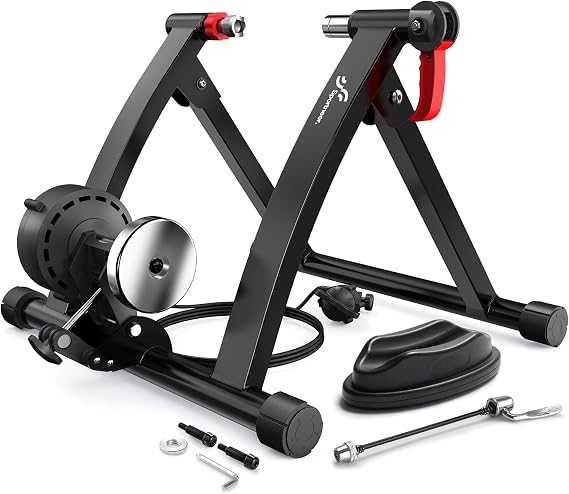
Six resistance levels adjustable via remote control make it simple to tailor workouts to your fitness level. Designed to fit most road and mountain bikes with 26–28 or 700C wheels, this indoor bike trainer suits cyclists who want to practice indoors and easily shift resistance without stopping.
Its strongest feature is quick, smooth resistance adjustment directly from the handlebars.
Setting up involves clamping the rear wheel using a press-down lever which holds your bike firmly while training. The quick-release skewer and included front wheel block speed up installation and removal.
The bar-mounted remote gives fast access to six magnetic resistance levels letting you switch between flat rides and steep climbs without dismounting. The wide base and adjustable feet keep the trainer stable on different floors.
Resistance feels consistent and mimics outdoor conditions well, though it relies on your tire type to keep noise low; slick tires work best. Built with a heavy iron frame and low center of gravity, it stays steady throughout tough sessions.
The most common complaint is that the noise level varies, growing louder with knobbly tires. Setup and clamp mechanism perform reliably and support quick transitions to outdoor riding.
Remote control resistance adjustment stands out as the easiest way to change workout intensity during a session. Noise depends heavily on tire choice and tread; slick tires produce the quietest rides while knobby tires make it louder than expected. The setup takes just minutes and stays stable, but how quiet it is varies bike to bike.
Athletes who want simple control over resistance and a fast switch between indoor and outdoor riding will appreciate this trainer. Those needing totally silent operation or who use thru axle setups without the adapter included may want to consider other models. It works best with road or mountain bikes using quick-release axles and smooth tires for quiet training.
Pros
- Six resistance levels controlled from handlebars
- Fits road and mountain bikes with standard axles
- Quick-release skewer for fast bike mounting
- Adjustable anti-slip feet keep the trainer stable
Cons
- Noise varies significantly with different tires
- Non-standard thru axle requires separate adapter
| Specification | Details |
|---|---|
| Compatible Wheel Sizes | 26–28″ or 700C |
| Resistance Levels | 6 (magnetic) |
| Bike Axle Compatibility | 4.92″–6.57″ rear axles |
| Weight | 19.3 pounds |
| Included Components | Bicycle Trainer Stand, Resistance Remote, Front Wheel Block, Skewer |
7. Wahoo KICKR V6 Smart Indoor Trainer

Serious indoor cyclists who want precise training data and a realistic feel will find the Wahoo KICKR V6 a reliable choice. Its standout feature is how closely it mimics outdoor cycling with side-to-side movement, perfect for intense sessions that demand accuracy and resistance.
Setting it up involves fitting the quick release skewer and selecting the right adapters for your bike. The Wi-Fi connection is stable and transfers data quickly to your device, which helps avoid interruptions during workouts.
The automatic calibration means you never have to worry about manual adjustments before every ride.
The direct-drive setup provides up to 2,200 watts of resistance with accuracy within one percent, meeting high power demands well. Its 22 kg weight and sturdy structure give a solid feel.
The most frequent praise is for the realistic ride feel boosted by the KICKR AXIS feet. Some note that the trainer’s weight makes it less portable.
The ride feel stands out due to the KICKR AXIS feet replicating side-to-side motion, offering realistic indoor cycling. Users often mention the stable Wi-Fi connection as a big plus, while the weight is the main downside limiting portability. Constant accurate data without recalibration is another highlight in daily routines.
Competitive cyclists and serious training enthusiasts who prioritize power accuracy and realistic ride experience will appreciate this trainer. Casual riders or those needing something lightweight and easy to move might consider a simpler trainer with less weight and fewer adapter needs.
Pros
- Stable 2.4 GHz Wi-Fi connection
- Accurate power and resistance up to 2,200 watts
- Side-to-side movement simulates outdoor ride feel
- Automatic calibration with no manual setup
Cons
- Heavy 22 kg makes moving it difficult
- Requires specific adapters for different bike frames
| Specification | Details |
|---|---|
| Resistance Power | Over 2,200 watts |
| Power Accuracy | Within +/- 1% |
| Weight | 22 kg |
| Connectivity | 2.4 GHz Wi-Fi |
| Included Components | Power adapter, skewer, brake spacer, cassette spacer, drive side adapters |
| Calibration | Automatic, calibration-free |
8. Saris Fluid2 Indoor Bike Trainer

Quiet operation combined with a natural road feel sets this indoor trainer apart. It’s ideal for cyclists who want to stay fit year-round without disturbing others. The standout feature is its fluid resistance that offers a wide range of effort levels, catering to both casual riders and intense workouts.
Setup is straightforward thanks to the wheel-on design, so the bike stays fully assembled. A folding frame helps with storage after use.
The included speed sensor easily syncs with popular apps like Zwift and Rouvy, which come with one month free to get started. Adjusting resistance feels smooth and matches outdoor sensations closely.
The trainer holds well during rides and gives a consistent, quiet feel at around 69 decibels at 20 mph. Its build feels solid, weighing 7.3 pounds with a reliable cooling system for longer sessions. Common praise highlights the quietness and road-like resistance curve, while a notable downside is that a separate adapter is necessary for thru axle bikes.
Quietness receives frequent praise, with riders appreciating the low noise during intense sessions. The broad resistance range feels like actual riding, helping with training variation. Some find the need for an extra thru axle adapter inconvenient if their bike requires it, adding cost and complexity.
Anyone wanting realistic road simulation and quiet sessions will find good value here, especially with quick setup. Those with thru axle bikes or who prefer lighter, direct drive trainers will want to consider alternatives more suited for their needs.
Pros
- Quiet fluid resistance reduces noise at high speed
- Wide resistance range simulates real road feel
- Easy wheel-on setup with folding frame for storage
- Included sensor connects well with multiple training apps
Cons
- Thru axle adapter must be purchased separately
- Heavier than some direct drive trainers
| Specification | Details |
|---|---|
| Item Weight | 7.3 pounds |
| Noise Level | 69 decibels at 20 mph |
| Trainer Type | Wheel-on fluid resistance |
| Compatibility | Quick release included, thru axle adapter sold separately |
| Included Components | Indoor Trainer, Speed or Cadence Sensor |
| Warranty | Limited Lifetime Warranty |
9. Wahoo KICKR CORE 2 Cassette

Wahoo KICKR CORE 2 Cassette is an indoor smart bike trainer built for cyclists who want a realistic, stable ride and fast setup. It fits well with structured training routines and delivers smooth resistance that closely mimics outdoor road feel.
Ideal for someone serious about indoor cycling sessions without complicated installation.
Setting up the KICKR CORE 2 is straightforward thanks to its faster WiFi pairing and automatic software updates over an active network. You won’t spend much time getting started or dealing with connectivity issues. Everyday use feels controlled and consistent, supported by the 11-speed cassette included, so you get a ready-to-ride experience right out of the box.
Performance-wise, the KICKR CORE 2 holds up to hard efforts without losing smoothness in resistance. The unit weighs 13.6 kg, giving it solid stability during rides. Most praise focuses on how close the ride experience feels to real road cycling.
On the downside, some have found the weight cumbersome for moving the trainer around. The setup includes a 1.8mm cassette spacer, which might confuse those unfamiliar with installation details.
Strongest praise highlights the smooth and realistic riding experience that handles intense sessions well. Most common complaint involves the trainer’s weight making it harder to move around and the need to understand cassette spacer installation before use.
Those wanting a reliable, sturdy trainer for consistent indoor training will appreciate this model. Cyclists who need a lightweight or more portable option might want to look at other trainers that weigh less and require less setup knowledge.
Pros
- Smooth, road-like resistance for serious training
- Fast WiFi pairing and automatic updates
- 11-speed cassette included for quick setup
- Stable and solid feel during hard efforts
Cons
- Heavy at 13.6 kg, not easily portable
- Cassette spacer setup may confuse beginners
| Specification | Details |
|---|---|
| Model Name | KICKR CORE 2 11 SPEED CASSETTE |
| Weight | 13.6 kg |
| Included Components | 11 Speed Cassette, AC Power Adapter, Cassette Spacer |
| Connectivity | Integrated WiFi for pairing and updates |
| Warranty | 1 year manufacturer |
10. CYCPLUS R200 Smart Bike Trainer

Indoor workouts can feel more like real rides with the CYCPLUS R200 Smart Bike Trainer. It fits cyclists who want precise power tracking and smooth resistance changes matching real hills. The standout feature is its 1% accurate power meter paired with a motor that simulates up to 19% incline, making indoor sessions realistic and challenging.
Setting up mostly involves attaching the trainer to your bike using the included adapters and tools. The dual BLE/ANT+ protocols connect easily to apps like Zwift for interactive training. The built-in cooling fan prevents overheating during long sessions, so performance stays consistent.
You’ll find the customizable workouts via its app practical for structured training at home.
Power output tops at 2200W and 80 N·m of torque, which handles steep simulated hills well. The overall build feels solid, with included accessories for different axle types and quick release setups.
Feedback shows power readings are reliable but some find virtual shifting requires an extra purchase and isn’t usable in every mode. The fan noise is minimal but noticeable in quiet rooms.
Power measurements are praised for their reliability and precision, which supports focused training. The added virtual shifting function improves gear transitions but needs a separate shifter that limits use in ERG mode. Noise from the cooling fan is low but can be heard in silent environments.
Cyclists who want accurate, interactive workouts with challenging resistance will appreciate this trainer. Those seeking quieter operation or fully integrated gear shifting without extra parts may want to look at other models. It suits riders focused on data accuracy and real-terrain feel over silent use.
Pros
- Accurate power meter with ±1% precision
- Simulates gradients up to 19% incline
- Compatible with major cycling apps
- Built-in cooling fan for long rides
Cons
- Virtual shifting requires separate purchase
- Virtual shifting disabled in ERG mode
| Specification | Details |
|---|---|
| Max Torque | 80 N·m |
| Peak Power | 2200W |
| Power Meter Accuracy | ±1% |
| Connectivity | Dual-mode BLE/ANT+ |
| Incline Simulation | Up to 19% |
| Warranty | 2 Year Manufacturer |
11. Wahoo KICKR V6 Smart Indoor Trainer

Perfect for serious cyclists wanting precise and powerful indoor training, it stands out with accurate resistance delivery and realistic ride feel. Hardware built for heavy use supports hard efforts up to 2,200 watts, making it reliable for strong riders who value data precision and smooth performance.
Setting up takes some time given the included adapters and spacers for different bike types but straightforward once familiar. WiFi connectivity delivers stable, immediate data transfer to apps like Zwift or your phone without constant recalibration. The KICKR AXIS feet let the trainer tilt slightly, closely mimicking outdoor road motion, which improves comfort during longer rides.
Resistance levels respond precisely to training programs, with power accuracy rated within 1%, so the effort you feel closely matches your target. The sturdy steel frame and 18 kg flywheel provide stability but make the unit quite heavy to move.
Excellent ride realism gets high praise; some users find the initial setup fiddly and note the weight makes storage a challenge.
Precise power readings and realistic ride movement get the most praise. The trainer’s substantial weight and complex setup cause the most frustration. Connections stay solid, reducing interruptions during workouts but moving or storing the device requires effort.
Serious cyclists wanting high resistance and precise data will appreciate its accuracy and feel. Those needing a portable or lightweight option might prefer simpler trainers that sacrifice a bit of precision for easier handling and setup. Strong riders focused on training performance should consider this model.
Pros
- Highly accurate power measurement within 1%
- KICKR AXIS feet allow realistic side-to-side movement
- Reliable Wi-Fi connection ensures continuous data streaming
- Supports very high resistance for intense training
Cons
- Heavy at 18 kg, difficult to move around
- Initial setup can be complicated due to many components
| Specification | Details |
|---|---|
| Resistance Power | Over 2,200 watts |
| Power Accuracy | Plus/minus 1% |
| Connectivity | 2.4 GHz Wi-Fi |
| Item Weight | 18 kg |
| Included Components | Zwift Click and Cog, AC Power Adapter, Quick Release Skewer, Disc Brake Spacer, Cassette Spacer, Drive Side Adapter |
12. COOSPO T10 Direct Drive Bike Trainer

Heavy-duty steel construction with a belt-driven direct drive system suits riders aiming for precise indoor training. It handles power output up to 2200W, making it suitable for serious cyclists focused on consistent power delivery and quiet operation during workouts.
Setting up the bike takes attention to the cassette type and axle compatibility, fitting quick-release or thru-axle frames with specific Shimano and SRAM compatibility. Connecting via Bluetooth or ANT+ works smoothly with popular cycling apps.
Daily use benefits from automatic ERG mode and a low center of gravity that keeps the trainer stable when simulating climbs or performing intervals.
Power accuracy within ±2% provides reliable data for structured rides and interval sessions. The solid enclosed housing prevents damage and reduces noise during use, although some note the need to keep pets and children away for safety. Most praise the direct and responsive resistance changes; a few mention the cassette is not included, requiring an additional purchase.
Strongest points involve the smooth and quiet operation during training sessions paired with precise power readings that hold steady through different workout intensities. The common drawback centers on cassette exclusion, meaning additional cost and setup time to get it ready. Some users emphasize the need for a safe setup location due to the trainer’s enclosed but exposed moving parts.
Ideal for cyclists wanting consistent power data and realistic grade simulation using popular virtual platforms. Those needing a complete setup without extra parts should look elsewhere, as cassette omission and specific frame compatibility may require preparation and additional purchases before the first ride.
Pros
- Quiet belt-driven system minimizes noise
- Accurate power measurement at ±2%
- Automatic ERG mode adjusts resistance
- Wide frame compatibility including thru-axle
Cons
- Cassette not included, sold separately
- Needs space, keep pets and children away
| Specification | Details |
|---|---|
| Maximum Power | 2200W |
| Power Accuracy | ±2% |
| Grade Simulation | Up to 15% |
| Weight | 16 kg |
| Frame Compatibility | 5×130/135 mm & 12×142/148 mm |
| Cassette Compatibility | Shimano 8–12 speed, SRAM 8–11 speed (cassette not included) |
Comparison of Top Indoor Smart Bike Trainers
| Product | Brand | Weight | Warranty | Included Components |
|---|---|---|---|---|
| ThinkRider X2Max Trainer | ThinkRider | 35.2 pounds | 1 year | X2Max 1 |
| Saris M2 Smart Trainer | Saris | 20 pounds | Limited Lifetime Warranty | SMART Indoor Trainer |
| ThinkRider XXPRO Trainer | ThinkRider | – | 1 year | Power adapter Power plug |
| Wahoo KICKR CORE 2 | Wahoo | 13.6 kg | 2 year manufacturer | KICKR CORE 2, AC Adapter |
| Smart Fluid Trainer Stand | CXWXC | – | – | BIKE TRAINER |
| Sportneer Magnetic Trainer | Sportneer | 19.3 pounds | 1 Year Warranty | Resistance Remote, Skewer |
| Wahoo KICKR V6 Trainer | Wahoo | 22 kg | 1 year manufactured | KICKR AC Power Adapter |
| Saris Fluid2 Trainer | Saris | 7.3 pounds | Limited Lifetime Warranty | Indoor Trainer, Sensor |
| Wahoo KICKR CORE 2 Cassette | Wahoo | 13.6 kg | 1 year manufacturer | 11 Speed Cassette, Adapter |
| CYCPLUS R200 Trainer | CYCPLUS | – | 2 Year Manufacturer | Allen key, AC Adapter |
| Wahoo KICKR V6 Trainer (dup) | Wahoo | 18 kg | 1 Year Manufacturer | Zwift Click and Cog |
| COOSPO T10 Direct Drive | CooSpo | 16 kg | 12 Months | COOSPO Smart Direct Drive |
- BrandThinkRider
- Weight35.2 pounds
- Warranty1 year
- Included ComponentsX2Max 1
- BrandSaris
- Weight20 pounds
- WarrantyLimited Lifetime Warranty
- Included ComponentsSMART Indoor Trainer
- BrandThinkRider
- Weight–
- Warranty1 year
- Included ComponentsPower adapter Power plug
- BrandWahoo
- Weight13.6 kg
- Warranty2 year manufacturer
- Included ComponentsKICKR CORE 2, AC Adapter
- BrandCXWXC
- Weight–
- Warranty–
- Included ComponentsBIKE TRAINER
- BrandSportneer
- Weight19.3 pounds
- Warranty1 Year Warranty
- Included ComponentsResistance Remote, Skewer
- BrandWahoo
- Weight22 kg
- Warranty1 year manufactured
- Included ComponentsKICKR AC Power Adapter
- BrandSaris
- Weight7.3 pounds
- WarrantyLimited Lifetime Warranty
- Included ComponentsIndoor Trainer, Sensor
- BrandWahoo
- Weight13.6 kg
- Warranty1 year manufacturer
- Included Components11 Speed Cassette, Adapter
- BrandCYCPLUS
- Weight–
- Warranty2 Year Manufacturer
- Included ComponentsAllen key, AC Adapter
- BrandWahoo
- Weight18 kg
- Warranty1 Year Manufacturer
- Included ComponentsZwift Click and Cog
- BrandCooSpo
- Weight16 kg
- Warranty12 Months
- Included ComponentsCOOSPO Smart Direct Drive
How to Choose the Right Indoor Smart Bike Trainer
Choosing an indoor smart bike trainer depends mostly on compatibility with your bike, the accuracy of resistance control, and noise level. Picking the right features upfront avoids returns and frustration, saving time and money while ensuring a better training experience.
Compatibility and Connectivity
Many trainers struggle with fitting a variety of bikes due to differing axle standards and frame sizes. Not all trainers support through-axles, which are common on modern road and mountain bikes, or quick-release skewers found in older models. A good trainer will accommodate at least 130mm and 142mm rear spacing, sometimes even 148mm Boost spacing, making it versatile enough to switch between bikes without extra adapters.
Riders often find themselves searching for spare parts or struggling with fits that affect stability and safety during intense sessions.
Connectivity also plays a big role in usability. Trainers offering both Bluetooth and ANT+ connections can pair with a wide range of devices like bike computers, smartphones, and tablets.
This flexibility allows for smooth integration with popular training apps such as Zwift, TrainerRoad, or Sufferfest. Missing out on dual-band connectivity means missing compatibility with certain apps or losing the option for multiple device connections, which complicates setting up and reduces convenience.
Resistance and Power Accuracy
One of the first things you notice during a long ride is how the resistance changes as you push harder or adjust your pace. Trainers with direct drive resistance often provide a smoother and more consistent feel because they eliminate tire slippage and deliver power more directly. Magnetic systems tend to be quieter and cheaper but sometimes lack the same level of precision in resistance changes.
A trainer offering a resistance range from around 400 to 2,000 watts allows realistic simulation of both casual and intense efforts, which can vary widely depending on your fitness level.
Power accuracy is critical; a variance over 3% can make a real difference in training plans or racing simulations. Several trainers measure power through built-in sensors calibrated for better accuracy. Those that maintain consistent power output readings without sudden jumps or drops help keep workouts reliable.
Advanced models simulate gradients up to around 20%, mimicking real-world hills to keep rides challenging. This feature feels noticeably different when riding and can add a crucial layer of realism to indoor sessions.
Noise Level and Riding Feel
Long training sessions in a shared apartment can quickly become a nuisance without a quiet setup. Trainers that run above 60 decibels start to interfere with conversations and TV volume, making the experience frustrating for everyone nearby.
Models with a belt drive or magnetic resistance often stay below 50 decibels, offering quiet operation that fits well in shared living spaces. Paying attention to noise ratings and checking for sound-dampening materials like rubber feet or noise-absorbing casing will make a noticeable difference.
Riding feel matters far beyond just noise. Trainers offering a smooth, progressive resistance that adjusts instantly keep workouts engaging and realistic.
Some use fluid or electromagnetic systems that mimic the variable tension felt on real roads. Stability during sprint intervals is another key point. A trainer shaking or sliding under your effort ruins focus and adds risk.
Wide, heavy bases or models with secure clamping systems tend to perform best here. Vibration can be minimized by solid construction and less metal-on-metal contact, providing a consistent experience even during high-intensity intervals.
Build Quality and Durability
Many riders notice frame creaks or unstable setups after a few months, especially during intense sessions. Trainers with a solid steel or aluminum frame avoid these issues by providing a stable platform that resists bending or shaking.
This matters every time you pedal hard or sprint because any wobbling can disrupt your balance and reduce workout effectiveness. Look for units with a minimum weight capacity of around 250 pounds to comfortably accommodate most riders, including heavier ones who often get overlooked. A sturdy base also keeps the setup steady on various floor types without needing extra mats or supports.
Frequent use exposes weak spots in the materials or joints, leading to squeaks or alignment problems that affect resistance accuracy and longevity. Durable welds and well-finished surfaces help resist rust and wear from sweat and moisture. Trainers designed with thick tubing and reinforced hinges maintain performance over hundreds of rides without parts loosening.
Prioritizing build quality in your choice pays off by saving time on repairs and ensuring consistent, reliable training sessions.
Ease of Setup and Storage
Setting up one of these trainers can take anywhere from 10 minutes to over an hour, depending on the model. Some require a full toolkit, Allen wrenches, screwdrivers, and even torque wrenches. Trainers with quickrelease mechanisms simplify this step drastically, often requiring no tools beyond what your bike already uses.
Missing this can lead to frustrating, repeated attempts at fitting the bike securely, wasting valuable time and causing unnecessary stress before a workout.
Storage and portability matter, especially if space is tight. Trainers weighing under 15 pounds with folding legs offer practical solutions. Folding reduces the footprint to roughly a 20 x 20-inch square, making it easy to tuck away in a closet or corner.
Models built with aluminum frames tend to be lighter and resist corrosion better than steel alternatives. Moving them between rooms isn’t just about weight either, a well-balanced design with rubber pads prevents slipping and protects floors during transport.
Optimizing Your Indoor Training Sessions for Maximum Performance
Maintaining consistent resistance levels during your workout helps simulate outdoor cycling conditions more accurately. Smart bike trainers typically connect to apps via Bluetooth or ANT+, allowing you to control resistance based on preset routes or workout plans. This connection also provides real-time data such as power output, cadence, and heart rate, which are essential for tracking progress and adjusting effort levels.
Placement matters as well. Position the trainer on a flat, stable surface to avoid wobbling and noise during intense sessions.
Using a mat underneath can protect floors and reduce vibration. Regularly checking tire pressure or ensuring the direct drive mechanism is clean keeps the system running smoothly.
Key tips for better training include:
- Set up a fan nearby to manage heat buildup during extended rides.
- Use a tablet or smartphone holder at eye level to follow training apps comfortably.
- Incorporate intervals to mimic varied outdoor terrain and improve endurance.
Essential Maintenance Tips to Prolong the Life of Your Smart Bike Trainer
Regular cleaning is key to keeping a smart bike trainer running smoothly. Sweat and dust can accumulate on the resistance unit and sensors, which may interfere with performance over time.
Use a soft cloth slightly dampened with water to wipe down these parts after each session.
Inspecting connections and bolts weekly helps prevent mechanical issues. Trainers often have several moving parts and electronic connections that can loosen with frequent use. Tighten any loose bolts and check that all cables are firmly attached.
Lubricate the trainer’s moving components occasionally, following the manufacturer’s guidelines. This keeps friction low and reduces wear on materials.
- Store the trainer in a dry, cool environment to avoid moisture damage and overheating.
- Avoid exposing it to direct sunlight, which can degrade plastics and displays.
- Update the firmware regularly via the trainer’s app to ensure compatibility with the latest cycling software and optimize functionality.
Comparing Smart Bike Trainers with Traditional Indoor Cycling Alternatives
Smart bike trainers bring an interactive experience to indoor cycling that traditional options can’t match. Unlike classic magnetic or fluid trainers, smart trainers connect to apps via Bluetooth or ANT+, allowing resistance to adjust dynamically based on the workout program. This makes it possible to simulate real-world terrains, such as hills or sprints, while tracking precise metrics like power output and cadence.
Traditional trainers tend to rely on manual resistance adjustments, which means you have to stop pedaling or reach down to change settings. They also lack data integration, so you won’t get instant performance feedback or structured training plans. Smart trainers usually come with direct-drive designs, replacing the rear wheel for quieter operation and less tire wear.
Traditional setups either clamp the rear wheel or use rollers, which can create more noise and require more setup time.
Key differences include:
- Automatic resistance adjustment vs manual
- Data tracking and app connectivity vs none
- Quieter, more stable ride vs more noise and tire wear
People Also Asked
How Do I Properly Set up an Indoor Smart Bike Trainer?
Properly setting up an indoor smart bike trainer involves securing your bike firmly in the trainer’s frame and aligning the rear wheel or cassette correctly. Make sure the trainer is on a level surface to keep it stable during rides. Double-check the connection with any app or device to ensure accurate performance tracking.
What Safety Tips Should I Follow While Using a Smart Trainer?
Always position your trainer on a stable, flat surface to prevent tipping during intense sessions. Keep a fan nearby for ventilation and avoid overheating. Use a sweat guard or towel to protect electronics and your bike’s components from moisture buildup.
Are Indoor Smart Bike Trainers Compatible with All Types of Bikes?
Most indoor smart bike trainers work with road and mountain bikes, but check compatibility with your bike’s axle type and wheel size before purchase. Some trainers require removing the rear wheel and attaching a cassette directly. Confirm these details to avoid surprises at setup.
How Do I Maintain and Care for My Smart Trainer?
Clean your trainer regularly using a damp cloth to remove sweat and dust, and avoid abrasive cleaners. Lubricate moving parts occasionally if the manufacturer recommends it. Store the trainer in a dry place to prevent corrosion, and check bolts periodically to keep everything tight.
What Are Common Problems with Indoor Smart Bike Trainers?
Common problems include connectivity issues with apps, strange noises from the resistance unit, and inaccurate power readings. Checking firmware updates and recalibrating the trainer often resolves these. Worn-out rollers or cassette can cause slipping, so inspect those parts if performance drops.
Conclusion
Choosing the right indoor smart bike trainer comes down to accuracy, noise level, and compatibility with your bike and training apps. Accuracy ensures your effort translates correctly into data. Quiet operation makes it easier to train without distracting others.
Compatibility means the trainer fits your bike and works well with the software you want to use.
Think about how much room you have, your budget, and how often you plan to train indoors before making a decision. That will help narrow down which model fits best. You can review the comparison table and product details above to find the trainer that suits your setup and goals.