
Top 12 Best RC Car LiPo Battery Charger You Can’t Miss!
Cheap or poorly made chargers often fail to properly manage the delicate balance required for LiPo batteries, leading to uneven charging or even damage. Users looking for the best rc car lipo battery charger know the frustration of batteries swelling, losing capacity quickly, or the charger overheating during use. Reliable chargers avoid these pitfalls by carefully controlling voltage and current throughout the charging cycle.
What sets a good rc car LiPo charger apart is accurate voltage regulation, usually around 3.7 volts per cell, and the ability to charge at adjustable current levels, commonly between 1 to 5 amps, to match the battery’s specifications. Safety features like temperature sensors and automatic shutoff prevent overcharging, which is a frequent cause of battery failure. Compact size and clear displays help make monitoring and storage more convenient for regular users.
Need a Quick Check?
| Image | Product | Price |
|---|---|---|
Our Top Picks 1  | LiPo Dual 10A Charger | Check Price |
Our Top Picks 2  | LiPo 150W 10A Charger | Check Price |
Our Top Picks 3  | Venom Pro Duo Charger | Check Price |
Our Selected Top 12 Rc Car Lipo Battery Charger Worth Buying
This list features carefully chosen RC car LiPo battery chargers, highlighting their performance, compatibility, and safety features. Each review describes who the charger is best suited for, along with its main advantages and potential drawbacks to help you make an informed decision.
1. LiPo Dual 10A Balance Battery Charger
LiPo Dual 10A Balance Battery Charger is built to charge two RC batteries at once, making it ideal for hobbyists juggling multiple packs. Its best feature is the ability to handle various battery types across dual channels, perfect for anyone serious about RC cars or drones needing reliable power management.
Setting it up is straightforward with AC or DC power options supporting 100-240V and 11-18V inputs. Charging two batteries simultaneously across two channels cuts down downtime significantly. Balance charging from 1S to 6S lithium batteries and accommodating other types like NiMH or lead acid adds convenience for mixed battery collections.
Performance-wise, it delivers consistent 10A output per channel, while the 10W discharge helps maintain battery health. The charger automatically stops when batteries are full, reducing overcharge risk.
Most praise centers on its wide battery compatibility and strong charging power. A common complaint is the user needing to avoid charging incompatible batteries on the same channel simultaneously.
This charger’s wide compatibility and dual charging channels allow quick turnaround for RC enthusiasts. Its automatic cutoff prevents overcharging, though users must be careful not to mix battery types on the same channel to avoid issues.
People with a variety of battery types and simultaneous charging needs will find this charger useful. Those who prefer single-channel simplicity or only work with one battery type might want to consider a simpler option.
Pros
- Charges two batteries at the same time
- Supports multiple battery chemistries
- Auto stop when battery is full
- Works with AC and DC inputs
Cons
- Cannot charge two different batteries on one channel simultaneously
- Requires careful matching of battery types per channel
| Specification | Details |
|---|---|
| Output Voltage | 22.2 volts |
| Input Voltage | 11 volts of direct current |
| Current Rating | 20 A |
| Amperage | 10 A per channel |
| Number of Ports | 2 |
2. LiPo 150W 10A Balance Battery Charger
Charging RC car batteries feels straightforward and quick with this charger, suited for hobbyists who need reliable, fast power for various battery types. Its biggest strength lies in delivering up to 150W output with flexible current control, allowing fast charging without compromising battery health.
Setup is simple with AC and DC inputs, supporting standard household voltage as well as portable DC power sources. It balances batteries between 1S and 6S configurations and comes with multiple connector types like TAMIYA and Deans, so compatibility with different RC cars and drones is never an issue.
The built-in cooling fan quietly manages heat during longer charges, and the USB output adds handy charging for other small devices.
Performance feels consistent and powerful, charging batteries efficiently across the supported voltage and amperage ranges. The fire-proof shell adds safety, giving confidence during frequent use.
Most praise highlights the balance between charging speed and safety features, while a common complaint notes that you must avoid using AC and DC power cables simultaneously, adding a small limitation to how it can be connected.
The charger’s most praised feature is its powerful and efficient charging ability with built-in fan cooling and safety materials. The frequent drawback comes from the requirement not to connect both AC and DC power at the same time, which can complicate some setups.
Those looking for a fast and versatile charger compatible with many battery types will find this a solid choice. Users needing multiple simultaneous charging ports or simpler power input options might consider alternatives better suited to those needs.
Pros
- High power output up to 150W
- Supports multiple battery types and voltages
- Built-in cooling fan for safer operation
- Includes 5V 2.1A USB output port
Cons
- Cannot use AC and DC inputs simultaneously
- Only one charging port available
| Specification | Details |
|---|---|
| Input Voltage | 240 volts |
| Current Rating | 10 A |
| Amperage | 10 A |
| Compatible Devices | RC Car, Drone |
| Connector Type Used on Cable | TAMIYA, TAMIYA mini, JST, T Plug, EC3, TRX, Deans |
| Number of Ports | 1 |
3. Venom Power Pro Duo LiPo Battery Charger
Great for anyone needing to charge two RC batteries at once, this dual-port charger handles multiple battery types and delivers a steady 160W total output. It works well for those looking to save time and avoid overheating worries during charging sessions.
Setup requires connecting to a standard 120V outlet, then selecting the right charging lead from the eight included options, such as EC5 or XT60. Switching between balance charge, fast charge, or storage mode happens easily without fuss. Saving up to five battery profiles makes daily use smoother when cycling through different packs.
Charging performance stays consistent thanks to two independent 80W circuits, which keeps each battery’s power steady without cross-interference. The build feels solid with a practical design, though some note the charger can get warm during heavy use.
Users appreciate the range of modes, but one downside is the lack of detailed screen information for more advanced monitoring.
The charger provides steady power through two independent circuits and handles various battery types smoothly, which users find very reliable. Most common complaint is that it tends to warm up noticeably during extended or fast charging sessions, which requires some supervision.
People with multiple RC batteries of different types will find this charger convenient and efficient. Those needing extensive real-time battery data or cooler operation might want to look for a more specialized charger with advanced displays and additional cooling features.
Pros
- Charges two batteries simultaneously
- Supports multiple battery types
- Eight different charging leads included
- Saves up to five battery profiles
Cons
- Can get warm during heavy charging
- Lacks detailed advanced monitoring screen
| Specification | Details |
|---|---|
| Output Voltage | 18 volts_of_direct_current |
| Input Voltage | 120 volts |
| Current Rating | 7 A |
| Amperage | 7 A |
| Number of Ports | 2 |
4. LiPo 80W 6A Balance Battery Charger

Fire-proof material encases a versatile charger designed for RC hobbyists needing a reliable balance charger. Suited for those handling multiple battery types, its single biggest strength lies in automatically adjusting voltage and current for safe, worry-free charging.
Setting up involves connecting to a DC power source between 11V-18V via a barrel jack, then choosing charge, discharge, or balance modes depending on your battery needs. The balance mode simplifies the process by managing voltage and current without manual adjustments. Using AC and DC cables simultaneously is not recommended, so paying attention to power connection is important in daily use.
Charge and balance functions operate at a solid 80W and 6A current, making it capable of quickly handling different batteries. It stops charging automatically to prevent overcharge.
The sturdy fire-proof shell provides extra safety, though some users mention the absence of an AC power option can limit convenience. It feels durable but could be bulkier compared to simpler chargers.
The automatic adjustment of voltage and current in balance mode is praised for making charging straightforward and safe. Many note the charger’s safety features, especially the fire-proof casing, while the lack of AC power cable integration is the most commonly mentioned downside.
Hobbyists handling different battery types and valuing safety features will appreciate this charger’s versatility. Those wanting a charger with a built-in AC power supply or simpler plug-and-play use might prefer a different model.
Pros
- Supports multiple battery chemistries
- Automatic charge stop for safety
- Fire-proof material on shell
- Adjustable charge and discharge modes
Cons
- No AC power cable use recommended
- No built-in AC power supply included
| Specification | Details |
|---|---|
| Output Voltage | 18 volts |
| Input Voltage | 11 volts |
| Current Rating | 6 A |
| Amperage | 6 A |
| Number of Ports | 2 |
5. OVONIC D15 Dual LiPo Charger

Dual charging capability stands out immediately, perfect for those juggling multiple LiPo batteries for RC cars. It suits hobbyists needing a reliable, efficient charger for 1S to 3S LiPo packs, with its main strength being the independent charging channels delivering consistent current.
Setup is straightforward with a standard AC power connector. Using the two 15W channels to charge batteries at 1.2A each means you can keep things moving by charging two packs at once without delay. The high accuracy balancing protects battery health day-to-day, and the abnormal battery detection adds another layer of safety when connecting your packs.
Charging performance matches its specs well, providing steady 4.2 volts output per channel and balancing to a tight 5‰ accuracy, which is better than most chargers that offer 10‰. The build is compact thanks to GaN technology, making it smaller and efficient.
Positive feedback highlights quick charging and safety features, while some mention the current rating limits charging larger batteries faster.
Charging two batteries simultaneously with precise balancing is praised for maintaining battery health, while some find the 1.2A current per channel less ideal for larger or faster charging needs. Safety features like abnormal battery detection are highlighted as a practical safeguard.
People running moderate 1S to 3S RC LiPo setups who value compactness and safety will appreciate this charger. Users needing higher current or support beyond 3S batteries might want to consider different chargers with higher amperage or more flexibility.
Pros
- Charges two LiPo batteries at the same time
- High accuracy balancing at 5‰
- Detects and alerts on abnormal batteries
- Compact size using GaN technology
Cons
- Limited to 1.2A charging current per channel
- Supports only 1S to 3S LiPo batteries
| Specification | Details |
|---|---|
| Output Voltage | 4.2 volts_of_direct_current |
| Input Voltage | 120 volts_of_alternating_current |
| Current Rating | 2.4 A total |
| Amperage | 1.2 A per channel |
| Number of Ports | 2 |
6. LiPo 80W 6A Balance Battery Charger
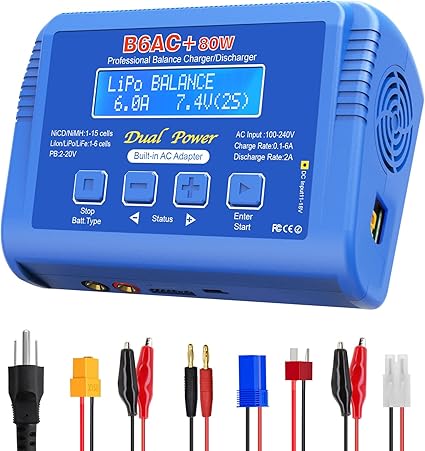
Perfect for anyone needing to charge a variety of RC batteries, this LiPo 80W 6A Balance Battery Charger stands out for its strong 80W output and versatile compatibility. It suits enthusiasts who want fast, reliable charging without juggling multiple chargers for different battery types.
Getting started is straightforward thanks to the individual-cell-voltage balancer, which ensures each cell charges evenly. You just connect your battery, select the right type and settings, and let it do its job. The charger supports multiple battery chemistries and sizes, making it easy and convenient to use with different RC vehicles regularly.
The charger delivers on speed and consistency, managing up to 6A current with ease. Its build feels solid and dependable, offering a stable charging experience.
Common praise highlights quick charging times while a frequent complaint involves the need for careful battery-type selection to avoid damage, which means paying close attention during setup.
Rapid charging capacity and versatility across battery chemistries receive high marks. At the same time, users must pay attention when choosing the battery type, as mistakes can damage the device. This balance charger isn’t foolproof in preventing user error during setup.
Those looking for a reliable charger compatible with many battery formats will find this a solid pick. People wanting a very simple plug-and-play model with minimal chance of error might want to explore other options with more automatic safeguards.
Pros
- Supports multiple battery types and voltages
- Fast charging with 80W output
- Individual-cell balancer for safety
- Can charge two batteries simultaneously
Cons
- Must carefully select battery type to avoid damage
- Limited to 6A max current
| Specification | Details |
|---|---|
| Output Voltage | 18 volts |
| Input Voltage | 120 volts |
| Current Rating | 6 A |
| Amperage | 6 A |
| Number of Ports | 2 |
7. B6 80W Mini LiPo Balance Charger

Charging RC car batteries without worrying about safety or compatibility is a priority for many hobbyists. Suited for those handling multiple battery types like Li-Po, NiMH, and NiCd, this compact charger offers reliable protection features that stand out. Its biggest strength lies in safeguarding batteries from potential damage during charging.
Setup is straightforward; just connect the battery using the right connector like XT60 or JST, then select the battery type before charging. The single-port design keeps things simple, handling various cells counts from 1 up to 15 depending on battery chemistry.
You don’t need to fumble through complicated settings since the charger’s built-in protections cover short circuits, overcurrent, and overheating.
Performance on charging is consistent with a solid 6A output and supports voltages up to 22.2V. The materials used feel durable, matching the quality of the internal components.
Most appreciate the safety features that prevent overcharging, while the common downside is the limitation of just one charging port, which can slow down multi-battery setups.
Strong safety features like overcharge and short-circuit protection are praised for preventing battery damage during charging. Many highlight the convenience of handling multiple battery chemistries but note that having a single charging port can slow down the workflow when managing several batteries.
Those focused on safety and a wide range of battery compatibility will appreciate the charger. People needing to charge multiple batteries at once or requiring international voltage support might want to consider other options.
Pros
- Wide battery compatibility across popular types
- Built-in safety protections prevent battery damage
- High amperage supports faster charging
- Simple, clear interface for easy use
Cons
- Only one charging port limits simultaneous charging
- Input voltage fixed to 110 volts may restrict use abroad
| Specification | Details |
|---|---|
| Output Voltage | 22.2 volts |
| Input Voltage | 110 volts |
| Amperage | 6 A |
| Compatible Batteries | Li-Po/Li-ion (1-6 cells), Li-Fe, NiMH (1-15 cells), NiCd (1-15 cells) |
| Connector Types | XT60, JST, T Connectors |
| Number of Ports | 1 |
8. H B6 80W 6A LiPo Balance Charger

Charging up to 6 amps with 80 watts of power makes it a solid choice for RC hobbyists working with various battery types. Perfect for those needing a charger that handles different LiPo cells and other battery chemistries without being bulky or pricey.
Setting it up involves plugging into a 110-volt outlet and connecting your battery via XT-60, JST, or Deans connectors. Switching between NiMH, LiPo, Li-ion, LiFePO4, or SLA batteries is straightforward as long as you select the right battery type.
Its lighter weight compared to similar models makes it easier to carry around at races or meet-ups.
Its balance charging ensures batteries are charged evenly, extending their lifespan. The built-in microprocessor manages the process reliably, giving confidence during everyday use.
Most appreciate how versatile and cost-effective it is, though some notes mention careful attention is needed to pick the correct battery type during charging to avoid risks or damage.
Balance charging works well and keeps batteries healthy, which many find reassuring. Careful selection of battery type during charging is critical to avoid problems, making attention to settings necessary daily.
Those using a range of batteries and wanting an affordable, portable charger will appreciate this model. Users needing higher input voltage compatibility or a more foolproof interface might want to explore different options.
Pros
- Supports multiple battery types and voltages
- Lightweight design for easy transport
- High-performance microprocessor for accurate charging
- Cost-effective compared to similar chargers
Cons
- Requires precise battery type selection
- Limited to 110 volts input
| Specification | Details |
|---|---|
| Output Voltage | 11 volts_of_direct_current |
| Input Voltage | 110 volts |
| Current Rating | 6 A |
| Amperage | 6 A |
| Connector Type Used on Cable | XT-60/JST/Deans |
9. OVONIC X1 Dual LiPo Battery Charger

RC hobbyists looking for a reliable charger for their LiPo and NiMH batteries will appreciate the OVONIC X1 Dual LiPo Battery Charger. Its biggest strength lies in quickly charging two batteries simultaneously with impressive conversion efficiency, saving valuable time at the track or in the workshop.
Setting it up involves plugging it into an AC source and connecting your batteries via XT60 connectors. Day-to-day use benefits from many useful features like temperature reading, safety timers, voltage checks, and the ability to auto-power off when charging completes.
Adjusting screen brightness and sound alerts makes monitoring easier in various environments.
Charging feels fast and steady thanks to high power output rated at 15A per port and efficient synchronous rectification technology that cuts down wait time significantly. The unit is solid with a straightforward interface. Most praise revolves around its speed and multiple functions, while some users find the fan noise noticeable during charging.
The fast charging speed with 15A output and various safety features make the unit highly functional and reliable. Fan noise is the most frequently mentioned drawback, which can be distracting in quiet spaces.
Anyone needing to charge multiple battery types quickly will find this charger fits well, especially those with a busy schedule around RC cars or drones. Casual hobbyists or those sensitive to noise might want to consider quieter, smaller alternatives.
Pros
- Dual port charging at 15A each
- Supports wide battery types (LiPo, LiFe, NiMH)
- Advanced safety features like temperature and resistance checks
- High conversion efficiency (98%) reduces charge time
Cons
- Fan noise can be loud during operation
- May feel bulky for casual users
| Specification | Details |
|---|---|
| Output Voltage | 30 volts_of_direct_current |
| Current Rating | 15 A |
| Amperage | 15 A |
| Input Voltage | 100 volts_of_alternating_current |
| Connector Type | XT60 |
| Number of Ports | 2 |
10. Dual 300W 16A LiPo Balance Charger

Dual Channel Battery Charger stands out by allowing you to charge two batteries at the same time, saving you valuable RC session time. It suits anyone who frequently needs to keep multiple LiPo batteries ready for action.
Its biggest strength lies in the powerful 16A current per channel, keeping charging efficient and reliable.
Setting it up is straightforward with the AC input supporting 100-240V, so it works almost anywhere. Day-to-day use is simple since you can hook up two batteries via XT60 connectors and monitor each channel separately. The ability to balance charge with a current up to 1600mA per channel ensures your packs stay healthy without extra fuss.
The charger handles a combined 300W max power from an AC source, delivering solid performance without overheating. The build feels sturdy and well put together, matching the heavy-duty specs. Strong praise highlights how it charges quickly and evenly, while the most common gripe is about not being able to charge two different batteries on the same channel simultaneously, which requires attention during charging.
Charging two batteries at once with stable current is what stands out most about this charger, making it handy for lengthy RC sessions. However, users need to be cautious not to plug different battery types into the same channel simultaneously, as it’s not supported and could cause charging issues.
Anyone managing multiple LiPo packs regularly will appreciate the efficiency of this charger. Those looking for a lightweight or portable unit with higher discharge power might want to look elsewhere, as this setup focuses on power and reliability over compactness or extra discharge features.
Pros
- Charges two batteries simultaneously
- Supports wide voltage range input 100-240V
- High charge current up to 16A per channel
- Balance current below 1600mA per channel
Cons
- Cannot charge different batteries on same channel simultaneously
- Discharge power limited to 10W
| Specification | Details |
|---|---|
| Input Voltage | 120 volts |
| Current Rating | 16 A |
| Connector Type Used on Cable | XT60 |
| Number of Ports | 2 |
| Charge Current | 0.1-16A*2 |
| AC Input Max Power | 300W (CH1+CH2=300W) |
11. 150W 10A LiPo AC/DC Balance Charger

SkyRC’s 150W 10A LiPo AC/DC Balance Charger suits anyone needing a fast and versatile charger for RC vehicles and drones. Its biggest strength lies in the powerful 10A output combined with wide battery compatibility, making it practical for multiple battery types without switching devices.
Setup involves plugging into AC or DC power with support for broad voltage inputs. The charger automatically detects lithium cells, which makes everyday charging safer and less hands-on. You can save up to 20 different memory profiles, helping with managing multiple battery packs.
A built-in cooling fan keeps the temperature down during longer sessions.
Charging stays consistent and reliable, whether you’re balancing cells or using storage mode. The casing feels solid and fireproof, which adds confidence when charging unattended.
Users commonly praise its charging speed and smart features, while a notable complaint surrounds its relatively heavy weight and size compared to simpler chargers.
The charger impresses with fast, accurate balancing and multiple charging modes. It also stands out for its sturdy, fireproof case but weighs more than expected, which can be inconvenient during transport.
Those who juggle various battery types and need fast turnaround times will appreciate this model. People focusing on portability or simple plug-and-charge use may prefer lighter, less complex units.
Pros
- High 10A current supports fast charging
- Wide compatibility: 1-6S LiPo and more
- Stores 20 memory profiles for convenience
- The fireproof shell improves safety
Cons
- Heavier and larger than basic chargers
- Not the simplest interface for beginners
| Specification | Details |
|---|---|
| Output Voltage | 22.2 volts |
| Input Voltage | 110 volts |
| Current Rating | 10 A |
| Compatible Devices | RC Car, Drone, Airplane, Helicopter, Boat |
| Connector Type Used on Cable | XT60, EC3, Banana Plugs |
| Number of Ports | 6 |
12. Venom Power Pro Quad LiPo Charger

Charging multiple RC car LiPo batteries quickly and safely can be tricky, but this one makes it straightforward. Best for hobbyists with several batteries, it stands out for letting you balance charge four at once without juggling cables or wait times.
Easy to handle and versatile, it suits those who want efficient charging in their RC setup.
Setup is pretty simple because it comes with all the common adapter cables, making it easy to connect to any popular battery type. It runs on a standard 5 volts input and charges four batteries independently with 7 amps each. A handy USB port lets you power compatible devices, which adds a bit of convenience on race day or working in the field.
Charging speed is solid, with each battery topping up in about an hour at 7 A. The build feels dependable and practical, designed to handle different battery chemistries without fuss. The strongest praise highlights how fast and simultaneous charging saves time, while some mention the tight fit of cables can be a little awkward during use.
Fast charging of up to four batteries simultaneously is what users appreciate the most, especially with the included cables for different connectors. Some find the cable connections a bit snug, which can make plugging and unplugging slightly fiddly over time.
Ideal for anyone with a range of RC batteries needing quick, multiple charges. Those wanting more flexible input voltage options or a looser cable fit might look at alternatives instead.
Pros
- Charges four batteries at once
- Includes all common charge lead adapters
- Supports multiple battery chemistries
- Has a USB charging port for devices
Cons
- Cable connections feel a bit tight
- Input voltage limited to 5 volts only
| Specification | Details |
|---|---|
| Output Voltage | 14.29 volts |
| Input Voltage | 5 volts |
| Battery Charge Time | 1 hours |
| Current Rating | 7 A |
| Number of Ports | 4 |
Best RC Car LiPo Battery Chargers Comparison Table
| Product | Output Voltage | Current Rating | Number of Ports | Compatible Devices |
|---|---|---|---|---|
| LiPo Dual 10A Charger | 22.2 volts | 20 A | 2 | RC cars, RC drones |
| LiPo 150W 10A Charger | – | 10 A | 1 | RC Car, Drone |
| Venom Pro Duo Charger | 18 volts | 7 A | – | RC cars, drones, batteries |
| LiPo 80W 6A Charger | 18 volts | 6 A | 2 | RC cars, drones, hobbyist |
| OVONIC D15 Charger | 4.2 volts | 2.4 A | 2 | LiPo RC Batteries |
| LiPo 80W 6A Charger II | 18 volts | 6 A | 2 | – |
| B6 80W Mini Charger | 22.2 volts | – | 1 | LiPo/Li-ion, NiMH, NiCd |
| H B6 80W 6A Charger | 11 volts | 6 A | – | – |
| OVONIC X1 Charger | 30 volts | 15 A | 2 | LiPo, LiHV, LiFe, NiMH |
| Dual 300W 16A Charger | – | 16 A | 2 | – |
| LiPo 150W AC/DC Charger | 22.2 volts | 10 A | 6 | RC Car, Drone, Airplane |
| Venom Pro Quad Charger | 14.29 volts | 7 A | 4 | Tablet |
- Output Voltage22.2 volts
- Current Rating20 A
- Number of Ports2
- Compatible DevicesRC cars, RC drones
- Output Voltage–
- Current Rating10 A
- Number of Ports1
- Compatible DevicesRC Car, Drone
- Output Voltage18 volts
- Current Rating7 A
- Number of Ports–
- Compatible DevicesRC cars, drones, batteries
- Output Voltage18 volts
- Current Rating6 A
- Number of Ports2
- Compatible DevicesRC cars, drones, hobbyist
- Output Voltage4.2 volts
- Current Rating2.4 A
- Number of Ports2
- Compatible DevicesLiPo RC Batteries
- Output Voltage18 volts
- Current Rating6 A
- Number of Ports2
- Compatible Devices–
- Output Voltage22.2 volts
- Current Rating–
- Number of Ports1
- Compatible DevicesLiPo/Li-ion, NiMH, NiCd
- Output Voltage11 volts
- Current Rating6 A
- Number of Ports–
- Compatible Devices–
- Output Voltage30 volts
- Current Rating15 A
- Number of Ports2
- Compatible DevicesLiPo, LiHV, LiFe, NiMH
- Output Voltage–
- Current Rating16 A
- Number of Ports2
- Compatible Devices–
- Output Voltage22.2 volts
- Current Rating10 A
- Number of Ports6
- Compatible DevicesRC Car, Drone, Airplane
- Output Voltage14.29 volts
- Current Rating7 A
- Number of Ports4
- Compatible DevicesTablet
How to Choose the Best RC Car LiPo Charger
Choosing a good RC car LiPo charger involves considering safety features, charging speed, and compatibility with your battery type. Getting these factors right helps prevent damage to your batteries and ensures efficient charging, ultimately saving money and avoiding potential hazards.
Charging Speed and Power Output
A charger that takes hours longer than necessary can ruin a weekend of RC fun, especially if you have multiple battery packs. A reliable unit should handle various battery sizes, from small 2S packs up to larger 6S or more, matching their voltage levels without overheating or overloading.
Adjusting the charging current based on battery capacity is crucial to keep cells healthy; typically, charging at 1C (one times the battery’s capacity in amps) is standard practice. For example, a 3000mAh pack should be charged around 3A to balance safety and speed. Chargers offering adjustable current settings make it easier to work with diverse packs safely.
A charger unable to properly manage power output risks damaging batteries or extending downtime waiting for a full charge.
Safety Features
Leaving a charger unattended is common when preparing multiple batteries, so strong safety measures are vital. Key protections include automatic cutoff when the battery reaches full charge to prevent overcharging, and sensors to detect overheating that can shut the device down before damage occurs.
Balance charging ensures each cell within the pack charges evenly, which prevents weaker cells from swelling or failing prematurely. Short circuit protection safeguards against faulty connections that could cause fires or damage. A good charger will also alert the user through sound or display warnings if anything unusual happens, preventing costly mistakes.
Compatibility and Versatility
Some RC enthusiasts work with battery types besides LiPo, such as LiFe or NiMH, so a charger supporting multiple chemistries can serve several needs. Connector compatibility impacts how quickly new batteries can be hooked up without extra adapters; common connectors like XT60, Deans, or Tamiya should ideally be supported or adaptable.
Chargers that handle both small 7.4V packs for nimble racing cars and larger 22.2V heavy-duty packs reduce the need for multiple charging units. Versatility saves space and cost while minimizing setup time before getting back on the track.
User Interface and Indicators
A backlit LCD screen or clear LED lights improve visibility while setting up the charger, especially outdoors or in low light. Simple buttons or dials for mode selection make the process straightforward without needing a manual every time.
Watching real-time updates on voltage, charging current, and elapsed time helps catch errors before they become problems, plus it confirms the battery is charging as expected. Confusing displays or missing status indicators can lead to unfinished charging or damaged batteries, so clarity directly improves user confidence and safety.
Build Quality and Portability
Chargers crafted with sturdy plastic or metal housings stand up better against drops, dust, and heat generated during prolonged use. Compact and lightweight designs ease transport to race tracks or fields where bulky chargers would be inconvenient.
Durable cables with reinforced ends prevent breaks and signal loss, which keeps the charging process steady without interruptions. Since these units often travel with you, a balance between solid build quality and manageable size ensures reliable operation over many charging cycles.
Proper Maintenance Practices to Extend the Lifespan of RC Car LiPo Batteries
Consistently balancing the charge on LiPo batteries can prevent uneven cell wear and prolong overall battery life. Avoid fully discharging the battery during use; stopping around 20% capacity helps maintain cell health. Store LiPo batteries at a storage voltage, not fully charged or completely drained, especially if they won’t be used for several weeks.
Monitor the temperature during charging and discharging; excessive heat can damage the cells and reduce cycle life.
Additional tips for maintaining LiPo batteries:
- Use a charger with an integrated balance function to ensure equal cell voltage.
- Inspect batteries regularly for any physical damage or swelling and set aside any with deformities.
- Charge in a fireproof container or LiPo safety bag to limit risks during potential failures.
- Avoid exposing batteries to extreme temperatures when not in use.
Implementing these practices can keep RC car LiPo batteries safer and extend their usable cycles.
Common Safety Precautions When Charging and Handling LiPo Batteries
Charging LiPo batteries on a non-flammable surface away from flammable materials reduces fire risks. Always use a charger designed specifically for LiPo batteries since incorrect charging can cause overheating or swelling. Never leave batteries unattended during charging; monitoring ensures prompt action if something goes wrong.
Important safety steps to keep in mind:
- Check the battery for swelling or damage before every charge.
- Use a balance charger to prevent overcharging individual cells.
- Keep a fire extinguisher or lithium-ion battery fire safety bag nearby.
- Do not puncture, crush, or expose the batteries to water.
- Disconnect the battery from the charger as soon as charging completes to avoid overcharging.
Strict adherence to these precautions significantly reduces hazards associated with LiPo battery charging and handling.
Comparing Smart Chargers Versus Traditional Chargers for LiPo Batteries
Smart chargers have built-in circuitry that automatically detects battery cell count, voltage, and adjusts charge rates. This helps protect LiPo cells from overcharging and balances voltage across cells during the process. Traditional chargers usually require manual settings and don’t balance cells, increasing the risk of uneven charging and battery damage.
Comparing the two:
- Smart chargers provide safety features like over-voltage and temperature protection.
- They often include multiple charging modes for different battery types and capacities.
- Traditional chargers are simpler, sometimes cheaper, but demand careful user monitoring and correct settings.
- Smart chargers deliver more consistent charge and better maintain battery health over time.
The added control and protection in smart chargers make them a practical choice for LiPo batteries used in RC cars, especially if preserving battery life is a priority.
People Also Asked
How Do I Safely Charge My RC Car LiPo Battery?
Use a charger designed for LiPo batteries and always charge in a fireproof container. Check the battery’s voltage and capacity before starting, and never leave it unattended while charging.
What Size Charger Is Compatible with My LiPo Battery?
Match the charger’s output current to the battery’s capacity, usually charging at 1C rate, meaning the charger provides an amp equal to the battery capacity in Ah. Using a higher or lower charger can lead to inefficient or unsafe charging.
How Long Does a Typical LiPo Battery Charger Last?
A well-maintained LiPo charger can last several years. Keep it clean, avoid dropping it, and store it in a dry place to prolong its life.
Can Overcharging Damage My RC Car’s LiPo Battery?
Overcharging a LiPo battery can cause swelling, reduced capacity, and potentially fire hazards. Using a charger with an automatic cutoff feature helps prevent this risk.
What Are Common Problems When Using LiPo Battery Chargers?
Common issues include connecting the charger with reversed polarity, using an incompatible charger, or charging damaged batteries. Always double-check connections before charging and inspect batteries for any puffing or damage.
Conclusion
Choosing the right LiPo battery charger for your RC car comes down to safety features, charging speed, and compatibility with your battery type. A charger that prevents overcharging and balances cells properly will keep your batteries healthy. Also, look for one that offers clear indicators or a display to monitor the charging progress easily.
Consider how much space you have for the charger and how often you plan to charge your batteries. A compact model fits better in small work areas, while a more durable charger might be worth the investment if you charge frequently. Take another look at the comparison table and the options listed above to find the charger that fits your needs best.