How Much Does A Ducati Weigh – Exact Amounts
Ducati weight depends on the model you choose. You’ll see a Panigale V4 at about 191 kg wet, a Panigale V4 S around 187 kg wet, and a V4 R near 186.5 kg wet.
Stock dry weight is around 172 kg. The Superleggera V4 is the lightest at roughly 152.2 kg dry with its race kit, or about 159 kg road-ready.
Fuel, trim, and parts can shift the figures. The details get more specific from here.
Ducati Weight By Model

Ducati’s weight varies noticeably by model, and the Panigale lineup shows the spread clearly.
The Panigale V4 S is listed at about 187 kg wet, the standard V4 at roughly 191 kg wet, and the track-focused Panigale V4 R at around 186.5 kg wet, or about 172 kg dry. With a race exhaust and kit, it drops to roughly 167 kg.
The Panigale V4 S weighs about 187 kg wet, while the V4 R sits around 186.5 kg wet.
You’ll see the Superleggera V4 sit much lower, at about 159 kg road-ready, and 152.2 kg dry with the race package.
The Streetfighter V4 S is near 189 kg wet, while the Diavel V4 climbs to about 223 kg.
These weight figures matter because the Desmosedici Stradale V4’s output affects the power-to-weight ratio.
Compare wet weight and dry weight to judge real-world performance.
Panigale V4 Weight Specs
You’ll find that the Panigale V4’s wet weight depends on the specific trim. The standard model is often listed around 191 kg, while the V4 S is typically cited at about 187 kg.
That said, these numbers can vary a little from model year to model year and depending on how the weight is measured, so it’s worth double-checking the published specs for your exact bike.
On the performance side, the 1103 cc Desmosedici Stradale V4 helps the V4 S deliver a strong power-to-weight punch, pairing its lower weight with roughly 214–216 hp.
Panigale V4 Wet Weight
Panigale V4 wet weight figures vary by trim and by how the manufacturer defines “wet,” so it’s worth checking the exact spec sheet before comparing models.
Your Ducati Panigale V4 may show about 191 kg wet, while the Panigale V4 S is often listed at 187 kg wet, excluding fuel in Ducati’s wording.
Wet vs dry matters too.
Ducati quotes the V4 S at 175 kg dry, so you can’t compare it directly to wet figures.
The Desmosedici Stradale V4 package also offers aerodynamic updates.
These can cut drag about 4% and trim roughly 2 kg versus the prior generation.
For lighter variants like the Superleggera V4, specs can shift again.
V4 S Weight Specs
The Panigale V4 S weighs in at 187 kg wet. Ducati lists its dry weight at 175 kg, so keep the measurement basis straight when comparing specs.
For the Ducati Panigale V4 S, that wet weight puts it about 4 kg lighter than the standard V4. Ducati’s 175 kg dry figure reflects the bike without fluids, so don’t treat it as road-ready mass.
The 1103 cc Desmosedici Stradale V4 makes roughly 214 hp. That gives you a very strong power-to-weight ratio for the class.
Weight savings come from chassis updates, lighter brake and engine parts, and carbon components. Recent aerodynamic changes also trimmed mass.
If you’re comparing performance numbers, the 187 kg spec is the one that matters most.
Panigale V4 R Weight And Power
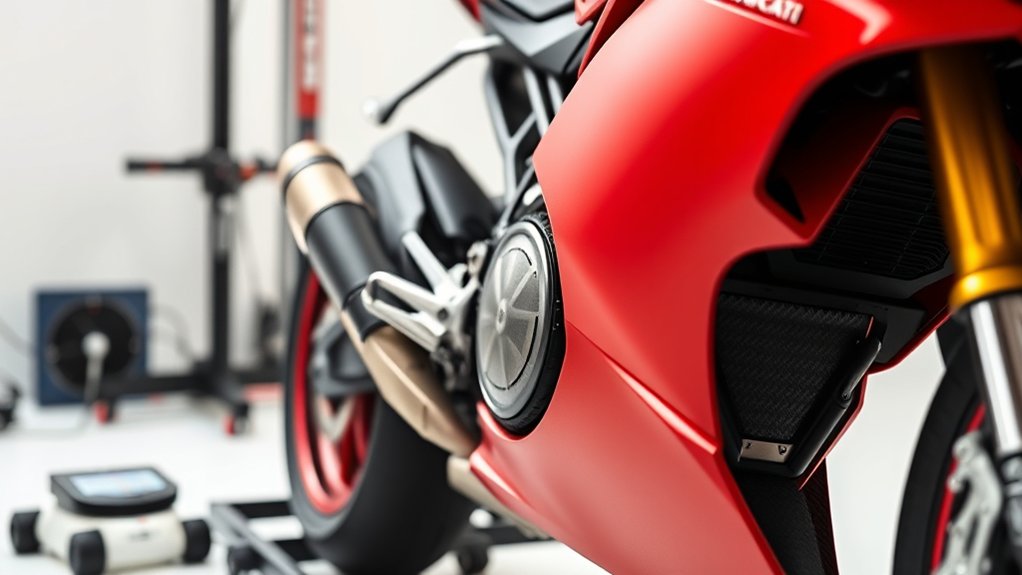
You’re looking at a Panigale V4 R wet weight of about 186.5 kg and a dry weight near 172 kg—and if you factor in race kits, it comes down to roughly 167 kg.
Ducati pairs that weight with around 218 hp in standard trim. And once you start getting into race exhaust and tuning, it’s pretty realistic to push power past 240 hp, which is a big reason the V4 R feels so close to WorldSBK-ready performance.
V4 R Weight Specs
Ducati’s Panigale V4 R is built for homologation, so its weight and output specs skew hard toward track use.
You get a Ducati Panigale V4 R with a quoted dry weight of 172 kg and a wet weight near 186.5 kg.
That’s thanks to its 998 cc V4 R engine and lightweight race hardware.
In race trim, a race kit can cut about 5 kg.
That brings dry weight close to 167 kg.
It’s a meaningful reduction when you’re chasing lap time and sharper direction changes.
- Dry weight: 172 kg stock
- Wet weight: about 186.5 kg
- Race kit dry weight: about 167 kg
The stock package also pairs this mass with power 218 hp.
That gives you a strong power-to-weight base without extra street-focused bulk.
V4 R Power Output
Punching out 218 hp in stock form, the Panigale V4 R pairs its 998 cc homologation engine with a dry weight of about 172 kg.
That works out to roughly 186.5 kg wet, giving it a strong power-to-weight base right away.
You get Ducati V4 R performance from a race-focused Desmosedici Stradale V4 tuned for track use, not touring comfort.
Add a race kit, and power output can climb past 230 hp, with full exhaust and lighter parts pushing it toward 240+ hp.
At the same time, wet weight and dry weight can fall.
Some setups can come in near 167 kg dry, sharpening the power-to-weight ratio.
That’s why this homologation machine feels so aggressive on track.
It also explains why every horsepower (hp) counts.
Superleggera V4 Dry Vs Wet Weight
Although figures vary by source and fuel level, the Superleggera V4’s dry weight is commonly quoted at about 159 kg (350.5 lb) in road-ready trim.
The full racing kit with the titanium Akrapovic exhaust can reduce it to roughly 152.2 kg (335.5 lb).
You’ll also see the Ducati Superleggera V4 listed with a wet weight that’s typically 6–12 kg higher.
That depends on fuel and equipment.
Its carbon fiber chassis, subframe, swingarm, and wheels, plus titanium and magnesium parts, drive this weight reduction.
It’s the Desmosedici Stradale V4 platform behind those numbers.
- Dry weight reflects the lightest published spec.
- Wet weight includes fluids and standard road components.
- The racing kit improves the power-to-weight ratio.
How Fuel And Trim Change Ducati Weight

Fuel and trim can push Ducati weights around more than many riders expect.
On a Ducati Panigale V4, the gap between dry weight and wet weight depends on fuel level and fitted parts.
The V4 S lists 187 kg wet, while the standard V4 sits near 191 kg wet.
| Setup | Reported weight | Notes |
|---|---|---|
| Superleggera V4 | 159 kg | road-ready |
| Superleggera V4 + race kit | 152.2 kg | reduced fuel |
| V4 R + race parts | 167 kg | weight savings |
Trim accessories, like sliders and rearsets, can add several kilograms.
A measured street-ready bike reached 357 lb with oil and parts installed.
Always check whether Ducati quotes dry, wet, or fuel-specific figures.
The number changes fast.
Why Ducati Uses Carbon Fiber Parts
Ducati uses carbon fiber to cut mass without giving up stiffness, and that’s why the Superleggera V4 can drop to about 152–159 kg dry. Other V4 variants are closer to 172–187 kg. You get a lighter bike without sacrificing torsional rigidity or response.
- Carbon fiber bodywork, frame parts, and a full carbon chassis help reduce weight while keeping structural precision.
- Carbon wheels and titanium exhausts trim rotating and unsprung mass, which makes acceleration, braking, and throttle response feel sharper.
- The Superleggera V4 also uses carbon surfaces for aerodynamic downforce, and the material lets Ducati shape limited-run parts for performance exclusivity.
That combination is what supports extreme dry weight figures and race-ready handling.
Ducati Weight Differences By Family
That carbon-focused engineering shows up differently across Ducati’s families, and you can see it clearly in the weight figures.
On the Ducati Panigale V4, you get about 191 kg wet. The Panigale V4 S drops to roughly 187 kg wet.
With the Desmosedici Stradale V4, the Superleggera V4 goes further, using a carbon fiber frame and lightweight parts. It reaches about 159 kg road-ready, or 152.2 kg dry with a race kit.
The Streetfighter V4 sits in the middle. The V4 S is around 189 kg wet, and other versions vary by trim.
These weight differences come from fairings, electronics, and chassis hardware, not just engine output. You’ll also see heavier V4 families elsewhere, so Ducati’s lineup spans broad mass targets.
Which Ducati Is The Lightest?
When you ask which Ducati is the lightest, the answer is the Superleggera V4.
The lightest Ducati is the Superleggera V4.
It’s the lightest production Ducati, with a quoted dry weight as low as 152.2 kg (335.5 lb) with the racing kit and titanium Akrapovič exhaust.
In road-ready form, it’s roughly 159–166.6 kg wet.
You get a carbon fiber chassis and bodywork, plus the Desmosedici Stradale V4 tuned for minimum mass.
- The Panigale V4 R is next, at about 172 kg dry weight.
- The Panigale V4 S sits around 175 kg dry and 187 kg wet.
- Race kit parts can trim more weight, but they don’t beat the Superleggera V4.
Frequently Asked Questions
How Does Rider Weight Affect a Ducati’s Performance?
Your weight affects how your Ducati accelerates, brakes, corners, and wears tires.
With more mass, your power-to-weight ratio drops, so launches feel slower and stops take longer.
Extra weight also compresses the suspension more.
That can mean you’ll need higher preload or stiffer springs for the same feel.
In turns, added mass can change how the bike leans and steers.
It may also trigger electronics sooner, depending on your riding and traction.
You’ll usually see faster rear tire wear.
To keep grip consistent, you may also need slightly higher tire pressures.
What Is the Difference Between Dry and Curb Weight?
Dry weight is the bike’s mass without fluids. Curb weight is the bike’s mass with fluids, and sometimes fuel.
You’ll see dry figures for the chassis, engine, and components. Curb figures include oil, coolant, brake fluid, and a specified fuel load.
You should compare specs carefully, because manufacturers don’t always use the same definition. For Ducati, that difference can shift the number by several kilograms, and it affects handling, braking, and acceleration.
Do Aftermarket Exhausts Reduce Ducati Weight?
Yes, you can cut Ducati weight with an aftermarket exhaust.
If you fit a titanium slip-on or full racing system, you’ll usually save about 3–10 kg, depending on the model and whether you replace the headers too.
You’ll also reduce unsprung and rotating mass, which can improve throttle response and handling.
Keep in mind that noise, emissions, warranty, and ECU mapping requirements can change too.
How Much Does a Ducati Battery Add to Total Weight?
A Ducati battery usually adds 3–5 kg (6.6–11 lb) to your bike.
A lithium upgrade can cut that to about 0.7–1.8 kg (1.5–4 lb).
You’ll see the biggest change with lead-acid units.
You’ll see less with modern lithium packs.
If you swap batteries, you can trim 2–4 kg overall.
You’ll slightly improve your power-to-weight ratio and real-world wet weight.
Does Ducati Weight Change With Passenger Luggage?
Yes, Ducati weight changes when you add a passenger or luggage.
You’ll typically add 70–90 kg with a passenger.
Luggage can add another 2–25+ kg depending on bags and cases.
That extra mass changes total loaded weight, weight distribution, suspension sag, and tire load.
You should check preload and tire pressures before riding.
Ducati curb weights don’t include passengers or luggage, so always calculate your real loaded weight.
Conclusion
So, how much does a Ducati weigh? If you’ve heard that every Ducati is built to be featherlight, that’s only partly true. In practice, weight depends on the model, fuel load, and trim.
A Panigale V4 is lighter than many road bikes. A Superleggera V4 is even more extreme thanks to carbon fiber.
You can’t judge a Ducati by name alone. You’ve got to check the exact spec sheet.