How To Jump Start A Motorcycle – The Right Way
To jump start your motorcycle the right way, use a fully charged portable lithium jump pack rated 400–600 peak amps. Connect the red clamp to the battery’s positive terminal and the black to a solid frame ground. Then power on the pack before starting.
Avoid jump-starting if the battery is fully dead or on scooters and automatics. If you’re using another vehicle, make sure to match voltages and connect cables carefully to prevent damage.
Following these steps guarantees safety and protects your bike’s electrical system. Learn how to choose the best method and avoid common risks next.
When to Safely Bump Start Your Motorcycle

Knowing when to safely bump start your motorcycle is essential for avoiding damage or injury. Only attempt a bump start if the battery shows some life. Check if the dash or warning lights and headlight dimly illuminate, indicating an electrical fault rather than a mechanical or starter/solenoid issue.
Never try bump starting on scooters, bikes with automatic or DCT transmissions, or if the battery is completely dead with no lights on. Before you bump start, confirm the ignition is on, the kill switch and sidestand are correctly positioned, and select second gear (or a high first on some sportbikes) with the clutch pulled in.
Use bump starting strictly as a last resort. If unsuccessful or if the bike stalls repeatedly, stop and seek alternative methods to avoid damage or injury.
Choosing a Safe Spot for Bump Starting
Always pick a quiet, level stretch of road at least 50 meters long with clear pavement ahead when bump starting your motorcycle. This ensures enough distance for your bike to gain momentum safely.
Avoid busy roads, blind corners, and intersections to reduce risk.
Focus on these key factors when choosing your spot:
- Select firm, dry pavement with good traction to prevent slipping during the push and clutch engagement.
- Prefer a gentle downhill slope to ease acceleration; if unavailable, get one or two helpers to push the bike.
- Steer clear of hazards like gravel, oil patches, potholes, curbs, and roadside obstacles that could cause loss of control if the bike stalls.
Making certain these conditions maximizes safety and control for a successful bump start.
Preparing Your Motorcycle for a Bump Start
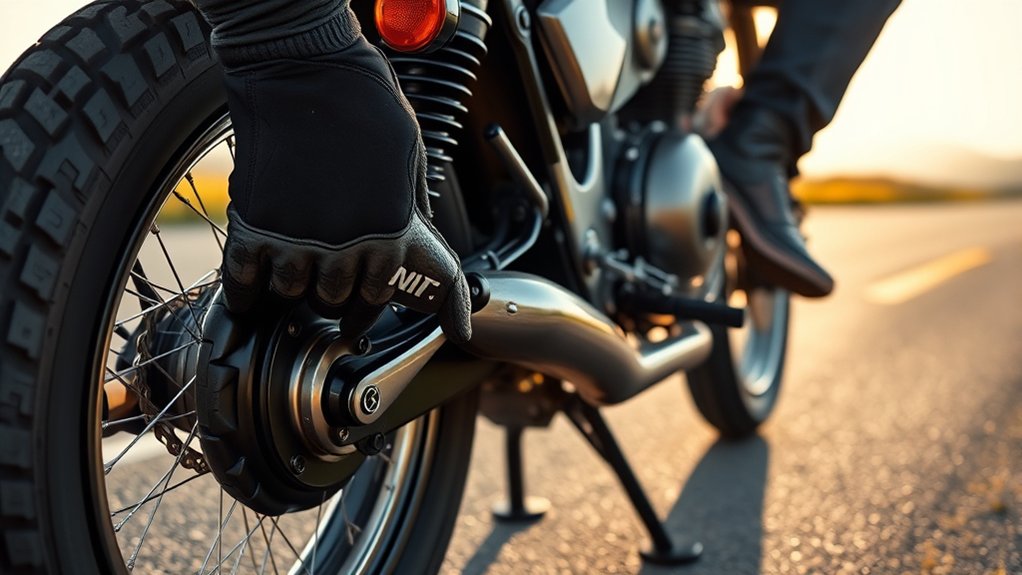
Start by switching your ignition to ON, setting the kill switch to RUN, and raising the sidestand.
Begin by turning the ignition on, setting the kill switch to run, and lifting the sidestand.
Next, confirm the battery has some charge; headlights and dash lights should illuminate because a dead battery will stop ignition and fuel systems.
Set the choke to the cold-start position if your bike has one, and turn off all accessories to conserve electrical power.
Shift the gearbox into second gear (or a high first on sportbikes) while you pull the clutch back firmly.
If clutch drag is heavy, briefly leave the bike in neutral to mount and engage the gear quickly for a smooth clutch release.
Position yourself or helpers to accelerate the bike safely over about 50 meters of clear road before attempting the bump start.
Bump Starting Solo: Step-by-Step Guide
Prepare your motorcycle by ensuring the ignition is on, the kill switch is off, the sidestand is up, and the bike is in second gear (or a high first on sportbikes). Confirm the battery shows some charge via dash lights.
Next, push the bike to a brisk sprint speed, ideally 8–15 km/h (5–9 mph) or faster depending on gearing.
- Push the bike to top speed on a clear, safe stretch.
- Place your left foot on the peg, smoothly mount, and sharply release the clutch while giving one or two short throttle blips.
- Once the engine fires, immediately pull the clutch back in, apply light throttle, and use choke if necessary.
Avoid over-revving and stop if multiple attempts fail.
Bump Starting With Assistance

When you’ve got one or two helpers, you can get the bike rolling by having them push it until you reach a brisk walking or jogging pace, around 8–12 km/h (5–8 mph), or use a gentle downhill to build momentum.
First, make sure the ignition is on, kill switch set to run, sidestand up, and the bike is in second gear (or high first on sportsbikes). Confirm the battery shows some charge via lights or warning lamps.
Hold the clutch lever in and place your left foot on the peg. As the bike gains speed, mount smoothly and release the clutch sharply while applying slight throttle to engage the engine.
If it fires, pull the clutch back in briefly to prevent runaway, let the engine stabilize at idle, then ride to a safe area for charging or diagnosis.
Essential Safety Tips for Bump Starting
Although bump starting can be a quick solution, you should only attempt it if the battery shows some life, confirmed by illuminated lights or dash indicators. Never try it on scooters or bikes with automatic or DCT gearboxes. Safety is critical when performing a clutch drop to start the engine.
Only attempt bump starting if the battery shows life; avoid automatic or DCT gearboxes for safety.
Follow these essential safety tips:
- Select a traffic-free area with at least 50 meters of clear road or a downhill slope. Avoid busy streets to reduce risk.
- Confirm the kill switch is off, sidestand is up, ignition on, gearbox in second (or high first on sportbikes), and clutch fully pulled in before beginning the run.
- Reach running speed with assistance or slope, mount smoothly with your left foot on the peg, then release the clutch sharply. Avoid feathering to maximize rear-wheel traction and engine ignition.
After startup, pull the clutch back in immediately and stabilize idle.
Jump Starting Your Motorcycle With a Portable Pack
Using a portable lithium jump pack rated between 400 and 600 peak amps provides a reliable method to jump start your motorcycle. Make sure the jump pack is fully charged before use.
With the ignition off and all accessories switched off, connect the red clamp to the battery’s positive terminal. Attach the black clamp to the negative terminal or a solid frame ground, avoiding moving parts.
Power on the jump pack and wait a few seconds to stabilize before attempting to start the engine. If the motorcycle fires, let it idle for several minutes to recharge the battery via the alternator.
When finished, disconnect the black clamp first, then the red clamp, power down the jump pack, and stow it safely. Avoid repeated attempts if the bike won’t start; diagnose electrical issues instead.
Jump Starting Your Motorcycle From Another Vehicle
If you don’t have a portable jump pack on hand, you can jump start your motorcycle using another vehicle with a 12-volt negative-ground system. First, put the bike key in the ON/Run position and make sure both vehicles’ accessories are off. Follow these steps:
Without a portable jump pack, safely jump start your motorcycle using another 12-volt negative-ground vehicle.
- Connect the positive (red) cable to the motorcycle’s positive terminal, then to the donor vehicle’s positive terminal.
- Attach the negative (black) cable to the donor’s negative terminal, then clamp the other end to a solid metal ground on the motorcycle frame (not the battery) to minimize sparks.
- Start the donor vehicle and let it idle for 2–5 minutes to raise the voltage. Then start the motorcycle.
Once it’s running, leave both engines on for a few minutes, then remove the cables in reverse order.
Avoid high revs and prolonged cranking to protect electrical components.
When Bump Starting Isn’t the Best Idea (And What to Do Instead)
If your battery is completely dead, or you think there might be a problem with the starter or immobilizer, bump starting isn’t the best move—it can actually cause damage and probably won’t work anyway. Also, avoid push-starting scooters, automatics, or bikes with DCT gearboxes. Instead, try using a portable jump starter or call for a tow.
When you’re unsure or dealing with tricky situations, it’s smarter to go with a jump pack or get professional help. This way, you protect your bike’s electrical system and keep things safe for yourself.
Risks Of Bump Starting
Understanding the risks involved with bump starting helps you decide when it’s not the best option.
If your bike in neutral shows no lights or ignition power, bump starting won’t work and compromises safety due to poor visibility.
Also, avoid bump starting scooters or bikes with automatic or DCT gearboxes, as clutch drag or transmission design can cause damage.
Finally, bump starting requires a clear road of around 50 meters or a downhill slope to gain enough speed safely.
- Complete battery failure disables ignition and lighting, making bump starting unsafe.
- Automatic and DCT gearbox bikes risk transmission damage or unpredictable engagement.
- Insufficient clear road space increases collision and control loss risks.
Use safer alternatives when these conditions apply.
Alternative Starting Methods
When bump starting isn’t safe or viable, you’ll want to rely on alternative methods that protect your bike’s electrical system while getting it going. Using a portable lithium jump pack is the safest choice. Clip red to positive and black to negative, power for seconds, then start the bike.
If you don’t have one, you can carefully jump-start from a car with matching voltage. Just avoid long cranking to prevent overload. A compact charger offers slow, controlled charging, which reduces hard work and stress on the starter.
When the battery or starter is dead, skip bumping and seek professional help or use these tools.
| Method | Pros | Cons |
|---|---|---|
| Lithium Jump Pack | Fast, safe, protects system | Requires charged pack |
| Car Jump Start | Accessible, effective | Risk of electrical overload |
| Battery Charger | Gentle, restores charge | Slow, needs time |
| Professional Help | Diagnoses, prevents damage | May cost, involves wait |
Frequently Asked Questions
How Often Should I Check My Motorcycle Battery Health?
You should perform monthly checks on your motorcycle battery to make certain it holds a healthy voltage, ideally between 12.6 and 12.8 volts at rest.
Regular monthly checks help you spot voltage drops early, preventing unexpected failures.
Along with monthly checks, inspect terminals and wiring every 3–6 months for corrosion or looseness.
This routine maintenance keeps your battery reliable and extends its lifespan, especially if you ride infrequently or store the bike for long periods.
Can a Dead Motorcycle Battery Be Recharged Without Jump Starting?
You absolutely can’t just wave a magic wand to recharge a dead motorcycle battery. But using a Battery Tender, you come pretty close.
Connect the Battery Tender properly, matching positive to positive and negative to negative, then let it slowly restore your battery’s charge without jump starting.
This gentle, controlled charging prevents damage, especially for delicate lithium or AGM batteries.
Just make sure you follow the charger’s instructions and charge in a well-ventilated area for safety.
What Type of Gloves Are Best for Motorcycle Jump Starting?
For motorcycle jump starting, avoid insulated gauntlets because they’re bulky and reduce dexterity.
Instead, choose snug-fitting gloves with thin fingertips (3–5 mm), made of nitrile-coated leather or similar materials. These offer protection against battery acid and sharp edges.
Look for gloves with dielectric properties and textured palms for grip, ensuring secure clamp attachment.
If you need cold protection, layer thin insulated gloves beneath removable outer gloves to maintain control and safety.
How Do I Properly Dispose of an Old Motorcycle Battery?
You should never toss your old motorcycle battery in household trash. Instead, take it to a designated battery recycling center, automotive parts store, or scrap yard that accepts lead-acid or lithium batteries.
Seal the terminals and keep the battery upright in a sturdy container to avoid leaks. Many retailers offer core return programs and may refund a core charge.
Always check local regulations to make certain proper battery recycling and avoid fines.
Are There Specific Jumper Pack Brands Recommended for Motorcycles?
You’ll want to choose compact powerpacks like the NOCO Boost GB series or Schumacher models, both highly recommended for motorcycles. These brands offer portable, lightweight units delivering 400–800 peak amps, perfect for high-compression engines.
They include safety features like reverse-polarity protection and spark-free clamps, which are vital when handling exposed terminals. Plus, their built-in USB ports add utility, making them practical for riders who need reliable, efficient jump-start solutions on the go.
Conclusion
Knowing how to jump start your motorcycle can save you time and hassle, especially since nearly 60% of riders experience battery issues annually. Whether you’re bump starting solo or using a portable pack, following the right steps guarantees safety and success.
Remember to choose a safe spot, prepare your bike properly, and never ignore warning signs. Mastering these techniques keeps you riding confidently and avoids unnecessary towing or repairs.
Stay prepared and ride smart.