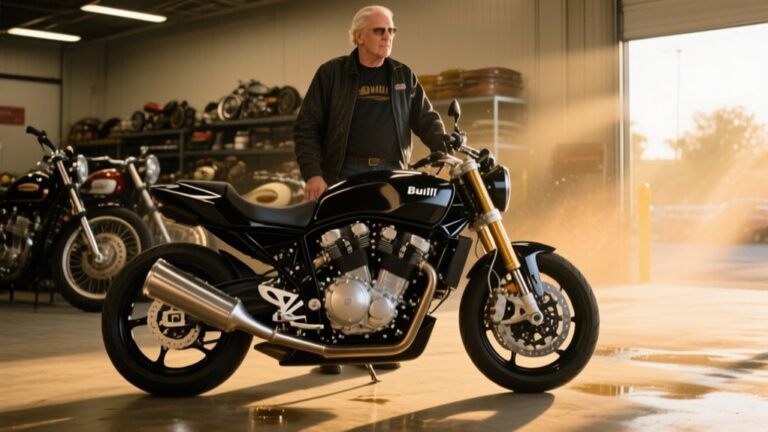
What Happened To Buell Motorcycles – Where Things Stand
Buell motorcycles were shut down by Harley-Davidson in 2009. After that, the brand split into a messy afterlife of bankruptcies, asset sales, and restart attempts.
You’ll still see Erik Buell’s engineering legacy through EBR and later brand revivals. Ownership hasn’t fully settled, though, and the business has stayed unstable.
Dealers kept supporting owners through Harley channels for a while. The brand has only recently re-entered select markets like the UK, with supply and service still key questions.
What Happened to Buell Motorcycles?

Buell Motorcycles began in 1983, when Erik Buell launched the company.
It went on to build more than 135,000 bikes, but its trajectory changed sharply after Harley-Davidson first took a stake in the brand in the 1990s and later assumed full ownership by 2003.
You watched Buell Motorcycles shift from an independent performance brand to a Harley-controlled line.
Then you saw production end when Harley completed the last Buell on October 30, 2009.
After that, Erik Buell formed EBR and kept the engineering legacy moving.
But bankruptcies, asset sales, and ownership shifts kept the Buell name in flux.
Warranty and dealer support for earlier bikes did continue in some form.
Still, the brand’s manufacturing future stayed unstable through the 2010s and early 2020s.
Why Did Harley-Davidson End Buell?
Harley-Davidson ended the Buell line in October 2009. It was refocusing on its core business as global economic conditions worsened and sales and earnings slipped.
Harley-Davidson ended the Buell line in October 2009, refocusing on its core business as conditions worsened.
You can read that decision as a strategic retreat from non-core bets. It wasn’t a judgment on Buell motorcycles alone.
Management wanted to concentrate capital, engineering, and dealer attention on Harley’s main brand. At the same time, niche Buell investments no longer fit the plan.
The shutdown also reversed earlier expansion into specialty and international assets. This included MV Agusta.
Analysts noted that Buell’s integrated production ties and dealer network complexity made a sale or spin-off harder. They also pointed to tax and accounting issues.
Harley said the wind-down would cost about $125 million. However, it kept warranty coverage and dealer support in place.
Buell’s Shutdown Timeline

On October 15, 2009, Harley-Davidson announced it would discontinue the Buell product line. The last Harley-built Buell rolled off the line on October 30, 2009.
You then watched Buell move from factory shutdown to company closure in 2010. At that point, the brand’s future became tied to Erik Buell’s next step.
He launched Erik Buell Racing, but that venture entered receivership in April 2015. Liquid Asset Partners bought EBR’s assets in January 2016.
They restarted motorcycle production on March 1, 2016. Then they shipped its first new model on March 17, 2016.
After that, Buell-related ownership kept shifting through court-supervised sales and restructuring in 2016–2017. As a result, the timeline became fragmented and the revival remained uncertain.
What Happened to Buell Dealers and Owners?
When Harley-Davidson shut down Buell in October 2009, it kept Harley dealerships responsible for servicing Buell motorcycles, supplying parts, and honoring existing warranties during the wind-down. For you, that meant the Buell Motorcycle Company didn’t vanish overnight.
But dealer uncertainty grew fast. Many stores were stuck with floor inventory and near-finished bikes, and support questions piled up quickly.
- You could still get warranty work through Harley networks.
- Parts access depended on dealer supply chains and leftover OEM stock.
- Dealer confidence weakened after later shutdowns and asset sales.
That strain hit owners, too. You faced mixed service availability, and dealers worried about workforce losses, customer support, and whether they should keep stocking the brand.
Even after ownership changes, after-sales obligations stayed tied to Harley dealer channels for years.
What Went Wrong With the EBR Restart?

You can see why the EBR restart lost momentum. First, the company ended up in receivership, then it went through a piecemeal asset sale, and the repeated auction failures left it without a clean, realistic route back to production.
As a result, finished bikes were left unfinished, creditor claims kept piling up, and court oversight made it hard to restart quickly. And because EBR didn’t have stable capital, dependable supplier support, or cohesive leadership, it simply couldn’t rebuild a reliable manufacturing chain.
Restart Hopes Fade
Restart hopes faded as Erik Buell Racing’s financial and legal problems kept undercutting every attempted comeback. You could see the pattern: receivership hit in April 2015. Then about 850 creditors pressed for payment, and the auction clock kept running.
- A mid-December court-ordered sale drew no credible bid for a real restart.
- Liquid Asset Partners’ $1.6 million piecemeal offer got rejected on procedural grounds.
- Bruce Belfer’s two $2.25 million attempts, plus Demetri Melekos’s scaled-back interest, never turned into production.
You also had finished or near-finished bikes sitting unfinished. But no buyer would fund full-scale manufacturing. Erik Buell said he was ready to restart fast if a team formed. Yet his legal limits and poor response rate kept the revival from gaining traction.
Auction Dead End
The auction ran into a dead end. A mid-December court-ordered sale failed to draw a viable bid to restart Erik Buell Racing. As a result, equipment and assets went unsold, and the immediate revival plan died.
You can trace the collapse to a series of missed exits. Liquid Asset Partners LLC’s $1.6 million piecemeal offer got rejected after the judge ruled objectors hadn’t had enough time to respond.
Bruce Belfer’s $2.25 million bid for equipment and accounts receivable also fell apart twice. He missed closing deadlines both times.
With roughly 850 creditors in the Walworth County case, Judge Phillip Koss faced a tangled bankruptcy record. The failed auction forced a Jan. 14 hearing to decide the company’s fate, even as Erik Buell said he’d try again.
Support Risks Mount
With the auction stalled and no bidder stepping in, EBR’s comeback hit support risks that went beyond financing.
You had a motorcycle operation stuck in receivership, with Judge Phillip Koss overseeing Walworth County proceedings and about 850 creditors pressing claims. As a result, you couldn’t move assets cleanly, and buyers backed away.
- Finished and near-finished motorcycles sat in storage, waiting for final assembly.
- Warranty, parts, and dealer support stayed unresolved.
- Rejected or missed bids, including Liquid Asset Partners’ $1.6 million offer and Bruce Belfer’s $2.25 million bid, broke production continuity.
Erik Buell said he could restart quickly, but without clear control of the assets, the plan stayed fragmented.
Where Is the Buell Brand Now?
You’re looking at a brand that’s still active, but its status has shifted a lot since Harley-Davidson shut it down in 2009 and later exited the asset base. Buell’s return hasn’t been steady either—there have been short production restarts, new revival claims in 2021, and reports that it was officially back in the UK market by May 2025.
For you, the big questions are pretty simple: can this relaunch actually scale, and can Buell rebuild real confidence in terms of dealers, parts, and long-term support?
Current Brand Status
Although Buell’s name is back on motorcycles in the 2020s, the brand isn’t under a single, stable owner or operating structure.
You’re looking at a fragmented revival shaped by shutdowns, receivership, and asset sales, including Liquid Asset Partners.
Since Harley-Davidson closed the original operation in 2009, Buell-related businesses have changed hands repeatedly.
Those shifts still affect branding, support, and production control.
- Ownership has moved through EBR, LAP, and other buyers.
- Asset sales and legal proceedings have split operations.
- Dealer and parts support still depends on the latest arrangement.
Erik Buell remains tied to the story, but you can’t treat the brand as fully settled yet.
Its current status is active, but unstable.
Market Return Plans
Buell has rolled back into the UK market as of May 22, 2025. The brand has confirmed its re-entry and named the first models set for import.
You’re seeing this revival build on existing dealer networks. That should help speed distribution and improve service coverage.
Because the brand has shifted hands and restarted before, rollout plans will likely depend on current production capacity. It will also hinge on dealer agreements and after-sales support.
Buell’s past wind-downs left some finished or near-finished bikes in storage. The company may move faster once assembly is fully staffed.
Still, Harley-Davidson-era dealer ties remain a separate issue. Broader global expansion will depend on how well the new owner can sustain supply, parts, and customer support.
Frequently Asked Questions
What Made Buell Motorcycles Unique From Harley-Davidson Models?
You’d notice Buell bikes stood apart because they used Harley-Davidson V-twins in a far more performance-focused package. You got aluminum perimeter frames, fuel stored in the frame, swingarm-mounted intake parts, and underslung brakes that centralized mass and sharpened handling.
Later Buells went even further with liquid-cooled Rotax-derived and EBR-developed V-twins. They added DOHC, fuel injection, and sportbike geometry, which differed from Harley’s heavier cruiser-first designs.
Which Buell Models Remain Most Collectible Today?
You’ll find the most collectible Buells are the early XB-series bikes. Especially the 2002–2008 XB9 and XB12 Firebolt, Lightning, and S models.
You should also watch the 1125R and 1190 variants. Limited editions like the 1125CR prototypes, Black Lightning specials, and 1190RS examples tend to draw extra attention too.
In collector circles, original paint, OEM parts, and service records can send values soaring like rocket fuel.
Did Buell Ever Return to Mass Production?
No, you won’t find Buell back in true mass production.
Harley-Davidson shut the original line in 2009, and later EBR runs stayed limited and low-volume.
You might see brief restarts under new owners, but they never reached the old factory scale.
As of 2025, Buell remains a niche brand with sporadic builds, not a sustained, high-output manufacturer.
If you’re tracking availability, expect scarcity, not broad dealer supply.
How Did Buell’s Racing Success Affect Its Reputation?
Buell’s racing success gave you instant credibility, especially after Danny Eslick won the 2009 AMA Daytona Sportbike championship.
That result helped you see Buell as a serious performance brand, not just a niche cruiser alternative.
Its race-proven engineering and track-focused models backed up the image.
So you could trust its handling claims.
Even with modest sales, those wins strengthened dealer confidence.
They also gave the brand a sharper, enthusiast-focused identity.
Are Original Buell Parts Still Available for Owners?
Yes—many original Buell parts are still available for you, especially common OEM items through Harley-Davidson dealers and remaining dealer networks.
Warranties stayed valid after the wind-down, and dealers continued supporting service and parts sales.
That said, you may run into shortages on rare or discontinued components.
Some tooling and inventory were sold off.
For older bikes, you’ll often rely on remaining stock, aftermarket suppliers, and used parts.
Conclusion
If you’ve followed Buell’s rise and fall, you know the story wasn’t one bad decision.
It was a chain of market pressures, Harley-Davidson’s strategic shift, and EBR’s later funding challenges.
You can still see Buell’s legacy in performance-focused design and loyal riders.
But the brand never fully regained its footing.
As the saying goes, the proof is in the pudding.
And Buell’s journey shows how hard it is to rebuild momentum once a brand loses its base.