Is Ktm Kawasaki – Fact Check
You should know KTM and Kawasaki are entirely separate motorcycle manufacturers with no ownership ties or partnerships. Kawasaki, rooted in Japan since the 1960s U.S. market entry, focuses on durable, versatile bikes, while Austria’s KTM specializes in high-performance racing and off-road models.
Similarities in design and competitive presence cause confusion, but their technologies, operations, and strategies differ sharply. KTM faces quality and financial challenges, contrasted by Kawasaki’s reliability.
Understanding their distinct paths reveals deeper insights about their evolving market roles. It’s clear they each have their own unique strengths and challenges.
What Is the Real Relationship Between KTM and Kawasaki?
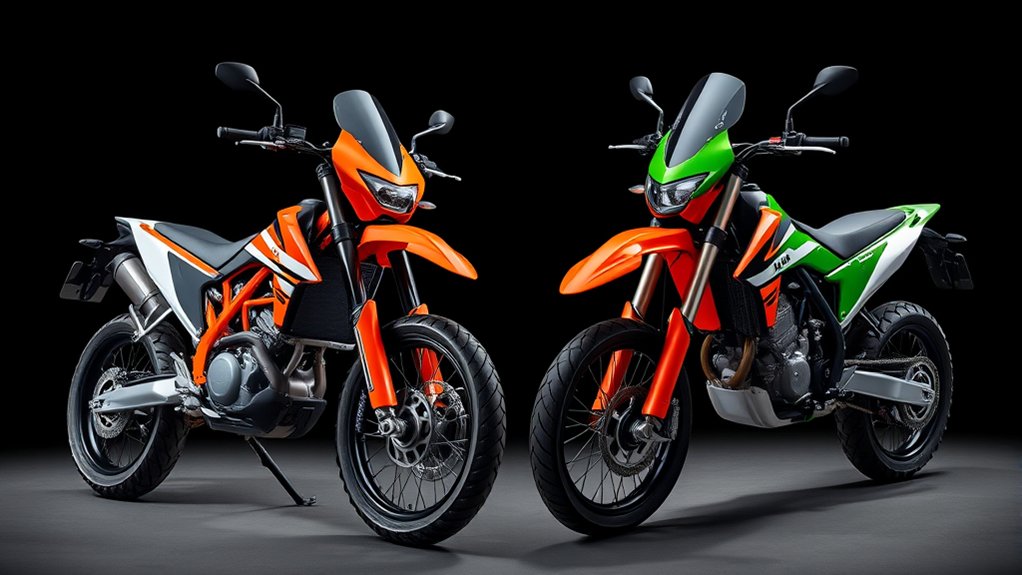
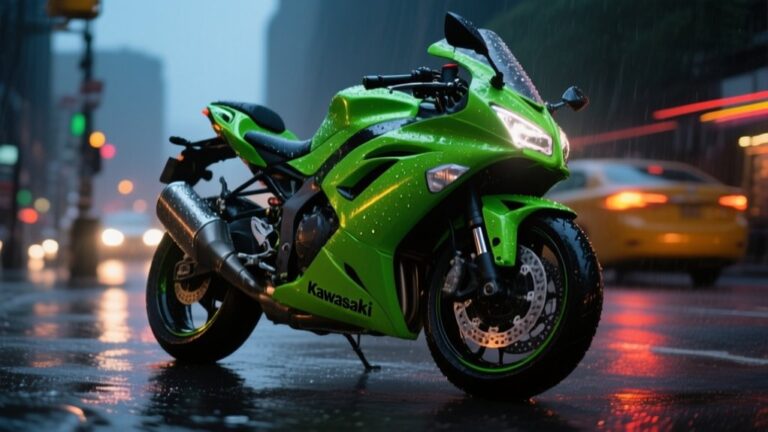
Although KTM and Kawasaki often appear alongside each other in the motorcycle market, they operate as entirely separate entities without any corporate ownership or direct partnership. You should understand that Kawasaki® motorcycles have established a distinct manufacturing and branding presence, especially since entering the U.S. market in the 1960s.
KTM, with its European origins, has developed independently, focusing on specialized racing lines and strategic partnerships with companies like CFMoto and Bajaj. There’s no formal collaboration or joint ventures linking KTM and Kawasaki.
When analyzing their market positions, you’ll see they compete globally but maintain separate product development, technology, and operational structures. Consequently, any perceived connection between KTM and Kawasaki® motorcycles is unfounded and stems solely from their competitive coexistence rather than any factual corporate relationship.
Why Do People Often Mix Up KTM and Kawasaki?
Why do so many riders and enthusiasts mix up KTM and Kawasaki despite their distinct identities? Both motorcycle brands excel in high-performance machines and dominate competitive racing such as Dakar and MotoGP. This creates overlapping reputations that can be confusing.
Kawasaki’s long-standing presence in the U.S. dates back to the 1960s, while KTM’s rise came later. Yet, both have cultivated strong global followings.
Their focus on sport and adventure motorcycles leads to design and functional similarities, which can easily confuse casual observers.
KTM’s aggressive marketing, highlighted by its signature orange, sometimes clashes visually with Kawasaki’s iconic green. This is especially true for new riders who haven’t yet formed clear brand associations.
Additionally, both brands emphasize performance and durability, reinforcing a perception that they’re alike.
Understanding these factors helps explain why KTM and Kawasaki often get mixed up, even though they’ve unique histories and separate corporate structures.
How Did KTM and Kawasaki Get Their Start in Motorcycles?
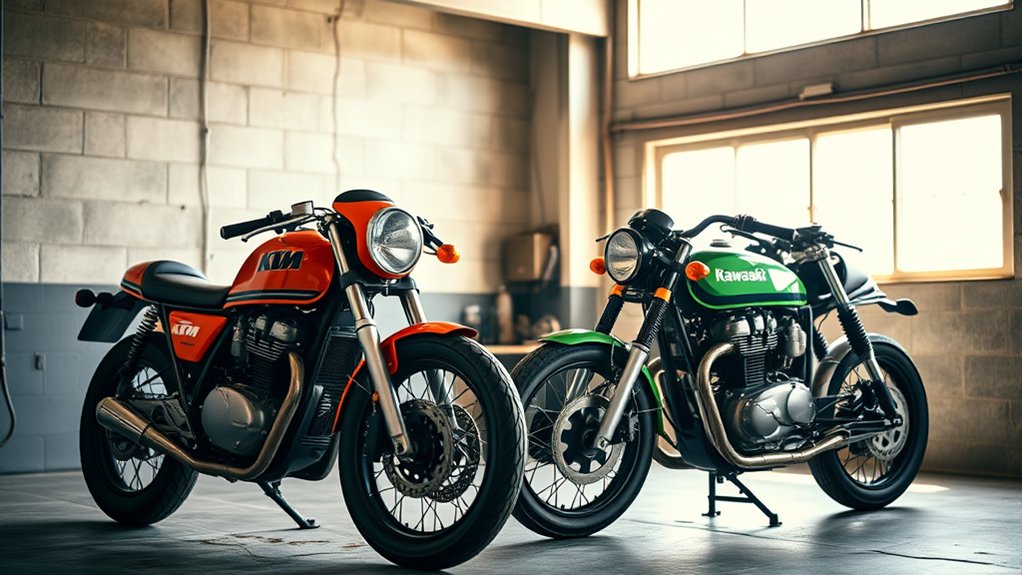
Since its establishment in the 1960s, Kawasaki quickly entered the U.S. motorcycle market by setting up a factory in Chicago. They initially sold two-stroke motorcycles under the Omega brand before shifting to the Kawasaki name. Kawasaki focused on durable, powerful bikes like the Samurai and Avenger to meet American demand for heavier motorcycles.
Meanwhile, KTM began in 1934 in Austria as an electrical equipment manufacturer. They shifted to motorcycles in the 1950s and gained international off-road success by the 1960s.
| Company | Origin Year | Initial Focus |
|---|---|---|
| Kawasaki | 1960s | Two-stroke motorcycles, U.S. market |
| KTM | 1934 | Electrical equipment, shifted to motorcycles in 1950s |
| KTM | 1960s | Off-road and racing motorcycles |
Why Are KTM and Kawasaki’s Brands So Different?
Kawasaki and KTM have developed distinctly different brand identities shaped by their unique histories and market approaches. You’ll notice their brand reputation diverges sharply due to these factors:
- Kawasaki emphasizes durability and reliability, with a wide product range appealing to mainstream consumers.
- KTM targets high-performance racing and adventure enthusiasts seeking premium, race-inspired motorcycles.
- Kawasaki’s decades-long U.S. presence has built consistent global trust, whereas KTM’s brand leans heavily on racing success and a younger demographic.
- Recent quality issues have challenged KTM’s brand reputation, contrasting Kawasaki’s established dependability.
Understanding these distinctions helps clarify why Kawasaki is seen as a dependable, versatile brand. Meanwhile, KTM appeals mostly to thrill-seeking riders who value cutting-edge performance.
How Did Kawasaki Earn Its Reputation for Reliable Motorcycles?
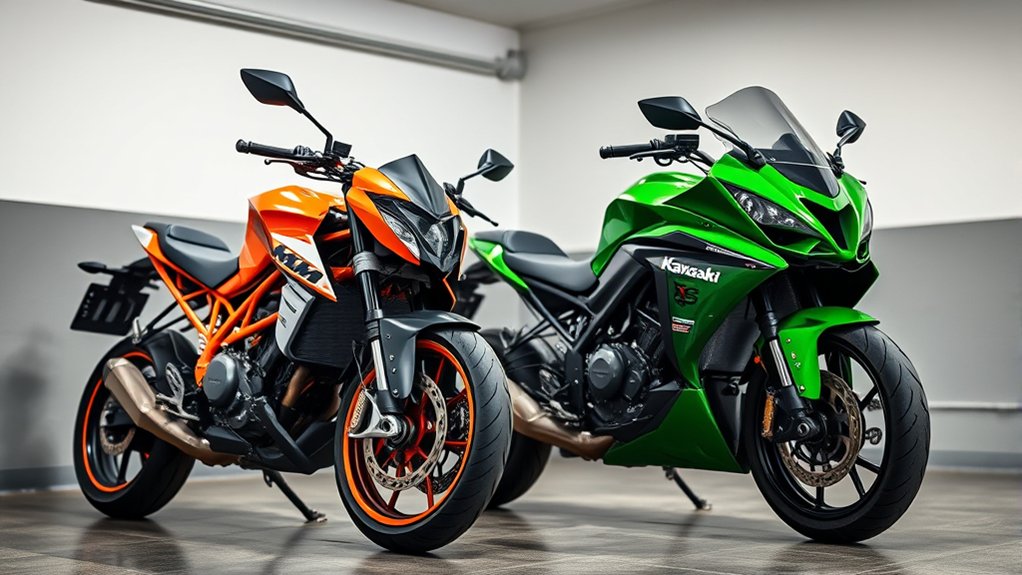
When you examine the foundation of Kawasaki’s reputation for reliability, you’ll find it rooted in the company’s commitment to engineering sturdy motorcycles designed to endure demanding conditions.
Kawasaki responded to American demand by focusing on heavier, more powerful bikes that required robust construction and dependable components.
Early models like the Mach III set high standards for performance and durability, reinforcing reliability as a core brand value.
Early Mach III models established Kawasaki’s reputation for unmatched performance and lasting durability.
The company invested heavily in quality manufacturing processes and implemented rigorous testing protocols, ensuring each motorcycle could withstand harsh riding environments.
By prioritizing engineering excellence and consistent customer satisfaction, Kawasaki built long-term trust in the market.
When you choose Kawasaki, you rely on a legacy of precision craftsmanship and proven durability that defines their motorcycles’ reliability.
What Quality and Financial Challenges Has KTM Faced?
You’re dealing with a serious financial downturn right now. KTM posted a €172 million loss in the first half of 2024, and their net debt has shot up to over €1.4 billion. This is largely because of market instability and disruptions in the supply chain.
On top of that, quality control has been a big headache. Almost 90% of warranty claims are tied to models that were assembled during the pandemic, which points to some deep-rooted reliability issues.
To tackle these problems, KTM has decided to cut production by 25%. They’ve also started laying off staff, all in an effort to stabilize operations and boost product quality moving forward.
Financial Struggles Overview
Although KTM showed promising profits in mid-2023, the company has since faced significant financial and quality challenges that have severely impacted its performance. You need to understand how these issues contributed to KTM’s downturn:
- Financial struggles worsened as KTM reported a €172 million loss in H1 2024, reversing prior gains.
- Market instability and supply chain issues caused net debt to surge 89%, exceeding €1.4 billion.
- Sales plummeted with a 27% decline in motorcycles and 36% in bicycles, stressing revenue streams.
- Quality problems from pandemic overproduction triggered elevated warranty claims, increasing costs and customer dissatisfaction.
To stabilize, KTM plans a 25% production cut and layoffs. They’re also pivoting towards premium segments. These financial struggles really show how fragile KTM’s position is amid ongoing market pressures.
Quality Control Issues
Because KTM ramped up production aggressively during the pandemic despite ongoing supply chain disruptions, you’re now seeing widespread quality control failures that have severely undermined the brand’s reliability.
Nearly 90% of warranty claims stem from units produced in this period, highlighting systemic issues. Models like the KTM 790R, 1290SA, and 350 6-Days suffered from camshaft failures, electronics malfunctions, and oil feed tube misalignments.
These defects have led to costly repairs, eroding customer trust and damaging KTM’s market position. The quality control lapses correlate directly with overproduction and component shortages, which compromised assembly precision.
As a result, KTM faces recalls, declining sales, and reputational harm. To recover, the company must strengthen quality control protocols and stabilize its supply chain to restore consumer confidence and guarantee consistent product reliability.
It’s clear that without these changes, KTM’s challenges will only deepen.
How Are KTM’s Partnerships Shaping Its Motorcycle Brand and Market?
You’ll notice that KTM’s partnerships with CFMoto and Bajaj are all about expanding their small to medium displacement motorcycle production.
At the same time, they make sure their bigger bikes—those over 990cc—keep that authentic Austrian design. This helps protect the brand’s integrity.
By doing this, KTM manages to maintain its “Ready to Race” identity and stay strong in the premium market, even as global manufacturing partnerships become more common.
Strategic Collaborations Overview
How do KTM’s strategic partnerships shape its motorcycle brand and market presence? KTM leverages strategic collaborations with CFMoto and Bajaj to expand its global footprint while maintaining core brand values. These partnerships mainly target small to medium displacement bikes.
Models over 990cc remain Austria-designed and produced to uphold quality and heritage.
- Expand production and market reach through international alliances
- Preserve flagship model design and manufacturing in Austria
- Implement strict quality control in Chinese manufacturing partnerships
- Balance global growth with KTM’s “Ready to Race” identity
Through these strategic collaborations, KTM guarantees its racing pedigree and premium reputation remain intact, even as it scales production internationally.
You see, KTM treats these partnerships as an evolution strategy, not a compromise on brand integrity.
Brand Integrity Protection
KTM’s strategic collaborations extend beyond market expansion to actively safeguard its brand integrity. By partnering with CFMoto and Bajaj for small and medium displacement models, KTM guarantees that all motorcycles over 990cc, its high-performance segment, are designed and manufactured exclusively in Austria.
This approach preserves KTM’s “Ready to Race” identity and counters negative perceptions tied to Chinese manufacturing.
You’ll see KTM enforcing rigorous quality control and transparent communication to address past production and quality challenges. These efforts reinforce its premium reputation.
It’s clear KTM is committed to brand integrity by balancing global market reach with the preservation of its core technical standards and racing-centric heritage.
The company’s partnerships strategically support growth without diluting the high-performance image vital to KTM’s market standing.
Market Positioning Impact
What impact do strategic partnerships have on KTM’s market positioning? These collaborations shape KTM’s global footprint while protecting its premium brand identity. You’ll notice:
- Partnerships with CFMoto and Bajaj expand KTM’s reach in small to medium displacement markets without diluting its high-performance focus.
- Retaining development of models over 990cc in Austria ensures KTM’s market positioning remains anchored in exclusivity and racing heritage.
- Collaborations with Chinese manufacturers are managed to prevent brand dilution, emphasizing quality control and upholding KTM’s “Ready to Race” ethos.
- Differentiating KTM, Husqvarna, and GasGas strategically targets distinct market segments, reinforcing KTM’s competitive positioning through heritage and innovation.
What’s Next for KTM and Kawasaki Motorcycles?
Although both KTM and Kawasaki face distinct challenges, their paths forward reveal focused strategies that will shape the motorcycle industry’s future. You’ll see KTM addressing financial strains by restructuring operations, cutting production, and enhancing quality control to restore its “Ready to Race” ethos.
At the same time, KTM is diversifying into premium bicycles and watercraft, which helps reduce their reliance on motorcycle sales alone.
On the other hand, Kawasaki Motorcycle leverages its legacy of durable, high-performance machines to deepen market presence.
You can expect Kawasaki to keep innovating across street and off-road segments while expanding into outdoor recreation markets. Both brands are adapting to evolving consumer demands.
But Kawasaki’s established reputation as a leading superbike manufacturer gives it a strategic advantage in sustaining growth and reinforcing its competitive position.
Frequently asked questions
What Are the Most Popular KTM Motorcycle Models?
You’ll find the most popular KTM models include the Duke series, especially the 390, 490, and 890. These bikes are loved for their lightweight build and sporty performance.
The RC series, like the RC 390 and RC 8C, really stand out with their track-ready features.
When it comes to touring, the 1290 and 390 Adventure models offer great versatility.
Don’t overlook the 790 Duke, which is famous for its nimble handling.
And if you’re into off-road riding, the EXC and SX series are built for durability and high performance.
Which Kawasaki Motorcycle Is Best for Beginners?
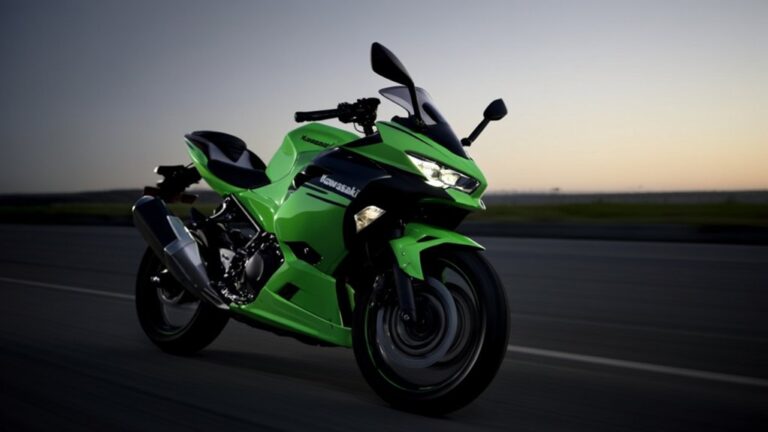
The Kawasaki Ninja 400 stands out as the best beginner motorcycle, thanks to its lightweight frame and smooth power delivery that won’t overwhelm you.
If you prefer off-road learning, the KLX 140 series offers manageable power and size.
For urban riders seeking easy handling and a lower seat height, the Z125 Pro is ideal.
Each model features user-friendly ergonomics and safety tech like ABS, ensuring you gain confidence while riding safely.
How Do KTM and Kawasaki Motorcycles Compare in Price?
When you compare KTM and Kawasaki prices, think of them like rival chess players, each making strategic moves. Kawasaki usually offers more affordable options, especially for beginners, with models like the Ninja 400 around $5,000.
KTM’s machines, such as the RC 390 and Duke 790, start higher, often exceeding $5,500.
You’ll find Kawasaki delivers competitive value in entry and mid-range bikes, while KTM positions itself as a premium brand with pricier, performance-focused models.
What Types of Engines Do KTM Motorcycles Use?
You’ll find KTM motorcycles primarily use single-cylinder and twin-cylinder engines, including both 2-stroke and 4-stroke variants. Their signature LC8 V-twin powers many street and adventure models.
Smaller off-road bikes rely on lightweight single-cylinders.
The advanced 790 and 890 series feature twin-cylinder, 4-stroke engines designed for high performance and durability. KTM focuses on competitive racing standards, making sure their engines deliver exceptional power and reliability across diverse riding disciplines.
Where Can I Test Ride a Kawasaki Motorcycle?
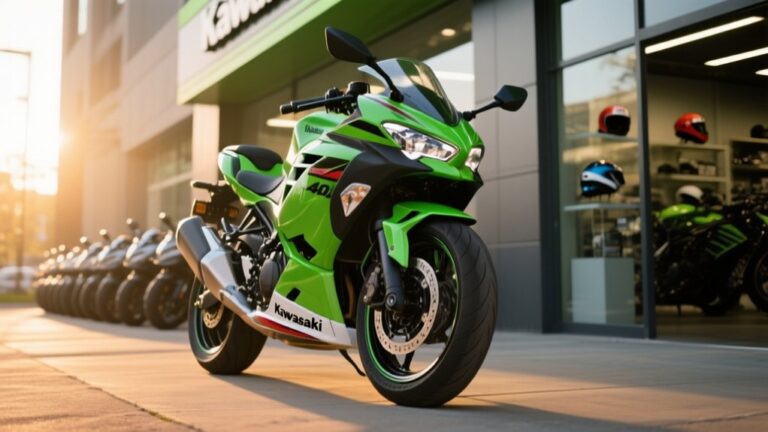
When it comes to testing Kawasaki motorcycles, you’ll want to hit the ground running at authorized Kawasaki dealerships. They offer test rides, though some might require you to book an appointment in advance.
Keep an eye out for Kawasaki demo days or motorcycle expos, which often showcase multiple models.
Don’t forget your motorcycle license and proper safety gear to guarantee a smooth, compliant ride. That way, you can really evaluate engine performance, handling, and ergonomics firsthand.
Final Thought
You might see KTM and Kawasaki as two engines revving in the same race, but their paths run distinct tracks. KTM’s adventurous spirit and strategic alliances fuel its rise, while Kawasaki’s legacy of precision and reliability anchors its stronghold.
Understanding their unique trajectories helps you navigate the motorcycle landscape with clarity. Like parallel circuits powering different machines, both brands deliver performance, yet their core identities remain unmistakably separate.