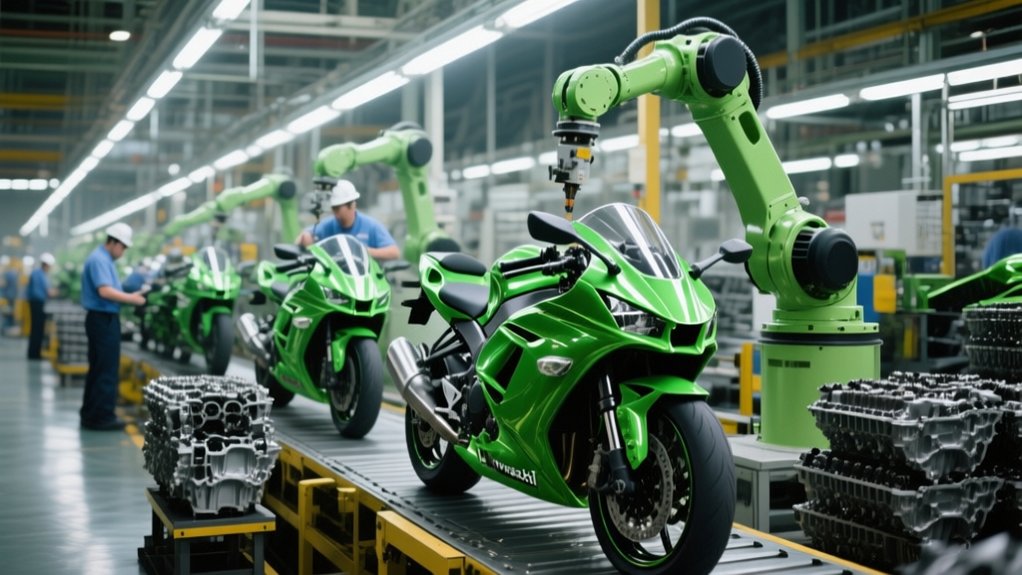
What Does Kawasaki Make – The Full Story
You interact with Kawasaki’s engineering every day, from massive ship engines powering colossal vessels to high-speed trains connecting cities at 200 mph. They design advanced jet engine components, cutting-edge robotics, and reliable helicopters.
Kawasaki also shapes landmark infrastructure like the Akashi-Kaikyo Bridge and champions motorsports innovation through dedicated testing facilities. Their diverse expertise spans maritime, aerospace, transportation, and industrial automation.
Keep exploring to uncover how their legacy drives technology across industries worldwide. It’s pretty amazing how much they touch our lives, isn’t it?
Kawasaki’s Massive Ship and Industrial Engines
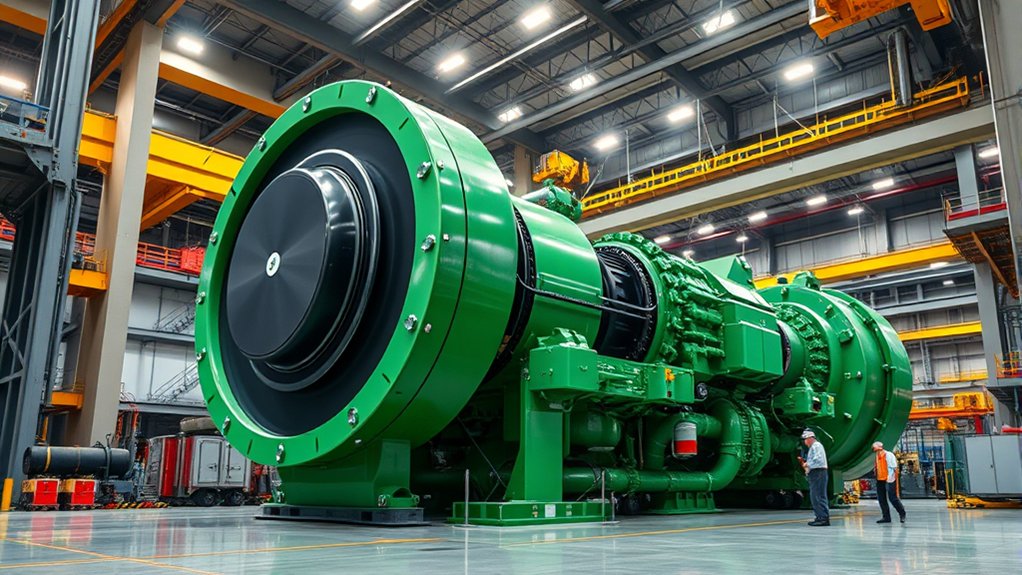
How does Kawasaki power some of the world’s largest ships? You rely on their massive six-cylinder, two-stroke diesel ship engines producing around 10,000 horsepower at just 150 rpm. These industrial engines aren’t small. They boast enormous pistons and crankshafts, each undergoing rigorous quality control to guarantee reliability and strength.
When you consider vessels like the Orient Phoenix bulk carrier, measuring over 118 feet wide and 623 feet long, it’s clear these engines need serious muscle.
At Kawasaki’s Kobe Works shipyard, the engine assembly includes pre-assembly and extensive test runs. This way, you know the engines perform flawlessly before installation.
Whether for civilian or military ships, offshore structures, or maritime infrastructure, Kawasaki’s industrial engines are the backbone. They deliver power and durability in demanding marine environments.
Kawasaki’s Aerospace Innovations and Jet Engines
Where do cutting-edge aerospace technologies and powerful jet engines meet? Right at Kawasaki’s aerospace division. You’ll find them designing and manufacturing key components for Pratt & Whitney’s PW4000 turbofan engines, which power Boeing 747-400 aircraft.
Kawasaki also supports Rolls-Royce jet engines across civilian and military aviation, showcasing their versatility. At their Akashi Works, they focus on aerospace research and development, pushing advances in turbine technology and composite materials.
You’ll be impressed by their work on the Boeing 787 Dreamliner’s forward fuselage, where they use advanced matrix composites to reduce weight and boost performance.
When it comes to jet engines and aerospace innovation, Kawasaki blends engineering expertise with cutting-edge materials to keep aircraft flying efficiently and reliably.
Kawasaki’s High-Speed Trains and Helicopters
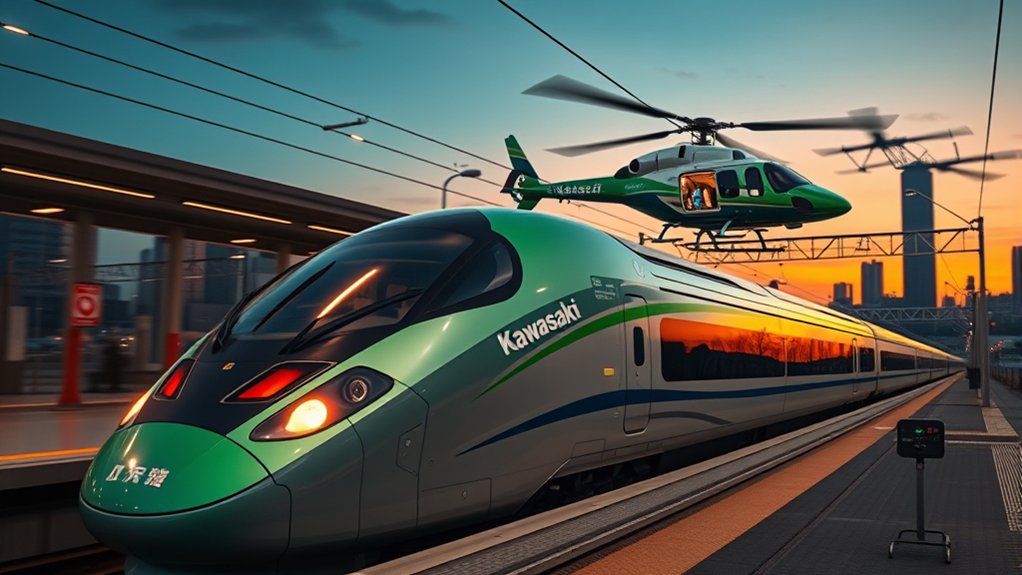
What powers Japan’s swiftest trains and reliable helicopters? Kawasaki’s engineering expertise drives both. Their Series 700 Hikari Rail Star high-speed trains reach speeds up to 200 mph, combining advanced aerodynamics with cutting-edge safety systems.
These trains play a paramount role in Japan’s railway network, offering fast and secure travel.
On the rotorcraft front, Kawasaki developed Japan’s first domestically produced helicopter, the BK117. These helicopters serve indispensable roles in emergency services, transportation, and industrial tasks globally.
Kawasaki’s mastery in both rail and rotorcraft engineering places it at the forefront of high-speed transportation technology. When you think of high-speed trains and helicopters, Kawasaki’s innovation guarantees performance, reliability, and safety.
That’s why they’re a trusted name in both industries.
Robotics and Automation Driving Kawasaki’s Innovation
You’ll see Kawasaki leads the way with advanced robotic systems that set new standards in automation technology. Their cutting-edge innovations come from a sprawling 121-acre research hub dedicated to pushing robotics forward.
And the best part? These breakthroughs don’t just stay in the lab—they actually transform industries from aerospace to shipbuilding. It’s clear that Kawasaki’s automation expertise is driving real-world progress.
Advanced Robotic Systems
Although many companies dabble in automation, Kawasaki truly leads the way with its advanced robotic systems that power innovation across industries. When you explore Kawasaki’s offerings, you’ll find robotic arms and automated manufacturing equipment designed for aerospace, automotive, and industrial uses.
These robotic systems deliver high precision and programmability, enabling complex assembly and material handling tasks that boost productivity. You’ll also see how Kawasaki integrates sensors, control systems, and AI into their automation solutions to optimize manufacturing efficiency.
Their commitment shows in the 121-acre Akashi Works facility dedicated solely to robotics research and development. By choosing Kawasaki’s advanced robotic systems, you’re tapping into proven technology that drives industry-leading automation and continuous innovation.
Automation Technology Leadership
Kawasaki’s leadership in advanced robotic systems naturally extends to its broader role as a pioneer in automation technology. You’ll find their expertise deeply embedded at the Akashi Works, where over 121 acres focus on robotics and aerospace manufacturing.
Kawasaki’s robotic systems streamline complex tasks like aircraft assembly, shipbuilding, and industrial machinery production. They’re essential in high-precision processes such as composite material autoclave manufacturing and high-speed rail component assembly.
When you consider large-scale infrastructure projects like tunnel-boring machines, Kawasaki’s automation technology really takes center stage, enhancing efficiency and reliability.
Landmark Civil Engineering and Infrastructure Projects
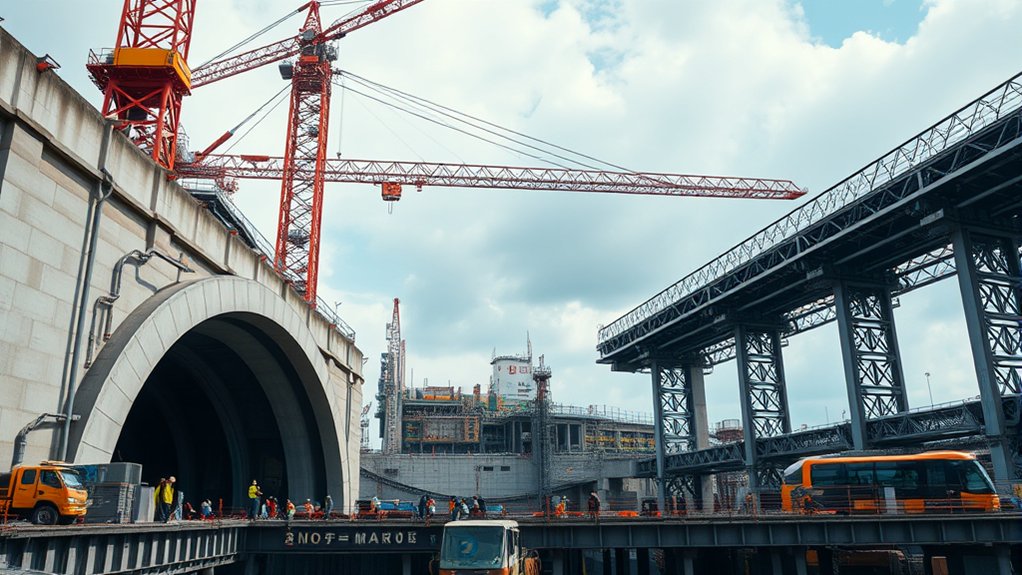
When you look at some of Japan’s most impressive infrastructure feats, Kawasaki’s engineering expertise stands out clearly. Their role in civil engineering is exemplified by the Akashi-Kaikyo Bridge, the world’s longest suspension bridge. Kawasaki designed and built its critical support tower on Awaji Island, showcasing unmatched precision and strength.
Remarkably, the bridge withstood the 1995 Kobe earthquake, with its span extending by one meter. That really proves Kawasaki’s resilient engineering.
Beyond bridges, Kawasaki’s structural designs shape many Japanese skyscrapers, underlining their broad influence in urban infrastructure.
Their infrastructure division consistently drives large-scale civil engineering projects nationwide, combining innovation with durability. When you consider Kawasaki’s contributions, it’s clear their expertise forms the backbone of Japan’s landmark infrastructure and civil engineering achievements.
How Kawasaki Builds World-Class Marine and Heavy Machinery
The strength and precision Kawasaki applies to towering bridges and skyscrapers also define their approach to marine and heavy machinery. At Kobe Works, they build massive vessels like the Orient Phoenix bulk carrier, boasting a 55,500-ton cargo capacity.
Their marine engineering expertise extends to producing colossal six-cylinder, two-stroke diesel engines delivering 10,000 horsepower at 150 rpm. You’ll find that parts like pistons and crankshafts undergo rigorous quality control to ensure reliability.
Before installation, Kawasaki pre-assembles and tests engines extensively. They also design military and civilian ships, submarines, and offshore structures, showcasing their heavy machinery mastery.
| Aspect | Details |
|---|---|
| Vessel Size | 118 ft wide, 623 ft long |
| Engine Power | 10,000 hp at 150 rpm |
| Quality Control | Rigorous testing & pre-assembly |
Kawasaki’s Motorsports Heritage and Testing Facilities
Although you might know Kawasaki for their heavy machinery and marine vessels, their passion for high-speed performance shines just as brightly in the world of motorsports. Kawasaki’s motorsports heritage runs deep, supporting racing teams across motorcycle, auto, and superbike competitions.
Central to this commitment is Autopolis, their official R&D and testing facility built during Japan’s economic bubble. You’ll find this track hosting major events like the Japanese Superbike Championship, which really shows Kawasaki’s active role in competitive racing.
These advanced testing facilities enable Kawasaki to refine high-performance engineering, pushing the limits of speed and reliability. By blending their rich motorsports heritage with state-of-the-art testing, Kawasaki guarantees every machine delivers excellence on and off the track.
Kawasaki’s Cultural Legacy and Museums
You’ll find Kawasaki’s rich motorsports heritage celebrated at the Kawasaki Good Times World Museum. Here, historic motorcycles and racing machines really take center stage.
But the museum isn’t just about racing—it also highlights Kawasaki’s innovations beyond that, including wind, solar, and biomass power technologies.
Visiting this cultural landmark gives you a clear view of how Kawasaki evolved from a 19th-century shipyard into a global industrial powerhouse. It’s a fascinating journey to explore!
Kawasaki Good Times
When you step into the Kawasaki Good Times World Museum, you immerse yourself in a vibrant tapestry of innovation, engineering, and cultural impact that defines Kawasaki’s legacy. The museum showcases Kawasaki motorcycles, from historic models to iconic racing machines, giving you a front-row seat to the brand’s evolution.
You’ll also discover Kawasaki’s groundbreaking work beyond motorcycles, including wind, solar, and biomass power technologies. Exhibits highlight the company’s role in monumental engineering projects like the Akashi-Kaikyo Bridge, illustrating its broad industrial influence.
The Kawasaki Good Times World Museum offers an all-encompassing look at how Kawasaki’s engineering prowess and cultural contributions have shaped Japanese industry. Visiting here, you gain a deeper appreciation for Kawasaki’s multifaceted legacy and the spirit behind its innovative journey.
Motorsports Heritage
Beyond its engineering feats and cultural exhibits, Kawasaki has built a dynamic motorsports heritage that fuels both innovation and passion. You’ll find this legacy on full display at the Kawasaki Good Times World Museum, where historic racing motorcycles illustrate the brand’s deep-rooted involvement in global motorcycle competitions.
Kawasaki’s racing machines have secured impressive victories in the Japanese Superbike Championship and international circuits, showcasing their competitive edge. You can witness the company’s dedication through factory-supported teams and the creation of high-performance bikes crafted specifically for racing.
Moreover, Autopolis, Kawasaki’s official motorsports testing facility, serves as a crucial hub for R&D and racing events.
Immersing yourself in Kawasaki’s motorsports heritage reveals a commitment to pushing boundaries while honoring its storied past.
Frequently asked questions
What Materials Does Kawasaki Use in Their Manufacturing Processes?
You’ll find Kawasaki uses advanced materials like carbon fiber-reinforced plastics to build strong, lightweight aerospace parts. They also rely on high-strength alloys such as titanium and specialized steels for turbines and heavy machinery.
Kawasaki’s manufacturing involves curing composites in large autoclaves for durability.
Plus, they handle hyperbaric chamber-grade metals and composites in innovative products. They use smart inventory systems to manage raw materials efficiently throughout their complex processes. It’s all about making sure everything runs smoothly from start to finish.
How Does Kawasaki Ensure Environmental Sustainability in Production?
You might think high-tech manufacturing can’t be eco-friendly, but Kawasaki proves otherwise. They guarantee environmental sustainability by using energy-efficient autoclaves for composites and investing in renewable energy like solar and wind.
You’ll find their low-emission engines and strict waste recycling protocols reduce their footprint. Plus, Kawasaki supports sustainable infrastructure projects, so when you choose their products, you’re also backing a greener future.
What Are Kawasaki’s Main Markets and Global Distribution Areas?
You’ll find Kawasaki’s main markets span Japan, North America, Europe, and Asia. It has a strong presence in both industrial and consumer sectors.
Their motorcycles dominate in North America, Southeast Asia, and Europe. Meanwhile, their aerospace, heavy machinery, and industrial equipment serve clients worldwide, including airlines and manufacturers.
Plus, Kawasaki’s infrastructure projects link them deeply with Japan and international markets. This ensures broad global distribution and influence.
How Does Kawasaki Support Employee Training and Development?
Imagine sharpening your skills like a rider tuning their bike on Kawasaki’s Autopolis track. You’ll benefit from hands-on training in specialized facilities, plus continuous learning through partnerships with top technical schools.
Kawasaki keeps you up-to-date with industry advances and safety protocols. They foster innovation through regular workshops.
Their internal knowledge-sharing system guarantees you grow professionally.
This way, every challenge becomes an opportunity to ride higher in your career.
What Partnerships Does Kawasaki Have With Other Technology Companies?
You’ll find Kawasaki teams up with top tech firms like Pratt & Whitney and Rolls-Royce to build advanced jet engines. They also partner with civil engineering companies on massive projects, like suspension bridges.
Kawasaki collaborates with robotics companies to integrate cutting-edge automation and works closely with automotive and motorcycle manufacturers to develop high-performance parts.
Plus, they engage in joint research with universities to push aerospace and composite material innovations further.
Final Thought
You see, Kawasaki doesn’t just build machines. They craft innovation that moves the world. From the depths of oceans with massive ships to the skies with jet engines and helicopters, their reach is vast.
They’re also on the tracks with high-speed trains. Robotics hum, engines roar, and history lives on in museums. Kawasaki’s legacy is a symphony of engineering marvels.
It proves that with precision and passion, they shape not just products, but the future itself.