
Top 12 Best Circular Saw for Concrete You Can’t Miss!
Cutting through concrete without the right tool slows down the job and can ruin both the material and the saw blade. Many who try using a standard circular saw quickly learn that it just isn’t built for the abrasive nature of concrete. The best circular saw for concrete tackles these challenges, offering durability and precision where other saws fail.
The main differences lie in blade quality, motor power, and cooling features. A suitable saw uses diamond-tipped blades that resist wear better than regular steel ones. Motors usually run between 12 to 15 amps to handle the tough cuts, while water cooling or dust management systems help prevent overheating and extend the tool’s life.
Size and weight also matter, with a balance that allows control without excessive fatigue.
Need a Quick Check?
| Image | Product | Price |
|---|---|---|
Our Top Picks 1  | VEVOR 16 Inch Concrete Saw | Check Price |
Our Top Picks 2  | SKILSAW SPT79-00 Concrete Saw | Check Price |
Our Top Picks 3  | XtremepowerUS 16 Inch Concrete Saw | Check Price |
Our Selected Top 12 Circular Saw for Concrete You Can Trust
This list features top circular saws designed for cutting concrete, each evaluated for performance, suitability, strengths, and weaknesses. You will learn which tools are best for various skill levels and specific tasks, helping you choose the right saw for your concrete cutting needs.
1. VEVOR Electric Concrete Saw 16 Inch
VEVOR Electric Concrete Saw 16 Inch excels at cutting concrete with strong power and easy wet cutting. Ideal for anyone needing a reliable, corded electric saw that handles tough jobs while keeping debris controlled and safety in focus with its built-in water spray feature.
Setup involves fitting the round blade and connecting it to a standard 120-volt power source. The wet-cutting attachment is handy, delivering water directly where cutting happens, so no extra watering tool is needed. At 3600 rpm, it runs fast and keeps things stable for straight, precise cuts without much fuss during daily use.
Operating with a 3500-watt pure copper motor, the saw handles concrete cutting smoothly and resists overheating. The bevel capability makes angled cuts possible too.
The most praised aspect is the wet-cutting attachment reducing mess and improving safety. Some users note the saw’s corded design limits mobility on larger sites or remote areas.
The saw’s wet-cutting attachment stands out, making cutting cleaner and safer by controlling dust and debris effectively. The main downside comes from the corded electric design, which some find limits their ability to move freely around bigger jobs or far from outlets.
Those working on fixed locations with good access to power will appreciate its steady performance and safety features. Anyone needing high portability or working in remote areas might look for a battery-powered or cordless alternative instead.
Pros
- Direct water spray for cleaner, safer cutting
- Strong 3500-watt copper motor resists burnout
- Bevel capability allows angled cuts
- Fast 3600 rpm speed for efficient slotting
Cons
- Power cord limits movement on large sites
- Not battery operated, needs constant power supply
| Specification | Details |
|---|---|
| Power Source | Corded Electric |
| Voltage | 120 volts |
| Speed | 3600 rpm |
| Wattage | 3500 watts |
| Blade Shape | Round |
| Number of Teeth | 24 |
2. SKILSAW SPT79-00 7 Inch Worm Drive Concrete Saw
Kicking off with a smooth motion across concrete, this saw suits anyone who needs reliable and strong cutting power for heavy-duty tasks. Its main strength is how well it glides while maintaining stability, thanks to the rolling foot plate with rubber wheels, making tough cuts feel manageable.
Setting up is straightforward with the cut-ready adjustable plunge lock and a retractable front pointer that guides your cut line clearly. Moving the saw along concrete feels steady thanks to the integrated rolling foot plate. Managing dust stays cleaner with the wet/dry dust system, helping keep the workspace tidier and safer during use.
It handles concrete cuts smoothly, powered by an 1800-watt motor and backed by a sturdy worm drive gearing system. The brushless design means less upkeep on the motor itself. Most people highlight how reliable the cutting power is, while some mention the saw’s weight as a drawback during longer jobs.
Reliable and powerful cutting shows up as the biggest plus with smooth handling from the rolling foot plate. Weight is a common issue, making it less comfortable for longer cutting sessions. The wet/dry dust feature helps maintain cleaner cuts, which reduces cleanup time after the job.
Those doing heavy concrete cutting with access to electrical outlets will appreciate its power and accuracy. People looking for a lighter tool or cordless convenience might want to explore other options better suited for mobility and portability.
Pros
- Smooth movement across concrete surfaces
- Wet/dry dust management keeps cuts cleaner
- Brushless motor reduces maintenance needs
- Adjustable plunge lock for precise cutting
Cons
- Heavier than some other concrete saws
- Requires 120 volts connection to operate
| Specification | Details |
|---|---|
| Power Source | Corded Electric |
| Wattage | 1800 watts |
| Voltage | 120 volts |
| Number of Teeth | 24 |
| Blade Shape | Round |
| Current Rating | 15 A |
3. XtremepowerUS Electric 16 Inch Concrete Saw
XtremepowerUS Electric 16 Inch Concrete Saw is a solid option for anyone needing a powerful but manageable tool to cut through concrete. Its combination of light weight and strong motor suits professionals who want control without the bulk.
The standout feature here is the low vibration, which really makes longer jobs easier on your arms.
Setting up is straightforward thanks to its design geared toward daily use, including a built-in water line to keep the blade cool. The D-shaped ergonomic handle offers a steady grip, which helps during precise cuts or when you’re working for extended periods.
Its corded electric power keeps it running consistently, without the weight of batteries.
When cutting, the brushless motor runs smoothly at 4700 rpm, delivering plenty of power for tough concrete jobs. The saw is built for durability, yet stays light enough to maneuver well.
Many find the double protection switch a reassuring safety feature. Some users mention the cord length limits movement slightly, but the overall build quality gets high marks.
The lowest vibration and built-in water line stand out for making continuous cutting less tiring and keeping the blade in good shape. The double protection switch also offers important safety, though some find the cord length restricts where they can work easily.
Those handling frequent, heavy-duty concrete cutting will appreciate the endurance and control offered. Those needing cordless freedom or a very lightweight saw might find other options better suited to their needs.
Pros
- Lightweight design reduces user fatigue
- Built-in water line cools the blade during cutting
- Double protection switch improves safety
- Brushless motor provides reliable power
Cons
- Cord length limits range of movement
- Heavier than smaller concrete saw models
| Specification | Details |
|---|---|
| Power Source | Corded Electric |
| Blade Size | 16 Inch |
| Speed | 4700 rpm |
| Wattage | 3200 watts |
| Voltage | 115 volts |
4. Cordless 60V 9 Inch Cut off Saw

Built with a powerful 60V battery and a durable 9-inch round blade, this cordless cut off saw is great for anyone needing a solid tool for concrete cutting without the hassle of cords. Its biggest strength lies in the brushless motor, offering efficient and consistent cutting power.
Setting it up is straightforward since there are no cords to manage. The brushless motor helps keep maintenance low while providing reliable speed at 6600 rpm.
Being battery powered means greater mobility on job sites. Voltage options of 110 and 220 volts offer flexibility depending on your power source needs. Weight and handling are mindful for balance given its power.
Cutting through concrete goes smoothly thanks to the consistent 60 watts of power behind the blade. Build quality feels sturdy which helps with durability over time. Positive comments highlight its solid cutting ability without bogging down, while some note that battery life could be improved for longer uninterrupted use.
Strong cutting performance and efficient brushless motor are praised, but the battery life is frequently mentioned as a downside for longer work sessions. The saw handles concrete with solid power but may require charging breaks.
Those needing a cordless, powerful saw for moderate concrete cutting will find this suitable. Heavy-duty users aiming for extended cut times or very thick materials might want to consider models with higher wattage or battery capacity.
Pros
- Brushless motor for efficiency and durability
- Battery powered for cordless convenience
- High blade speed of 6600 rpm
- Versatile voltage options of 110 and 220 volts
Cons
- Battery life may not last long on heavy jobs
- Wattage at 60 watts might limit very thick cuts
| Specification | Details |
|---|---|
| Power Source | Battery Powered |
| Voltage | 110 volts, 220 volts |
| Speed | 6600 rpm |
| Wattage | 60 watts |
| Blade Shape | Round |
| Brushless Motor | Yes |
5. XtremepowerUS Electric 16 Inch Concrete Cut off Saw
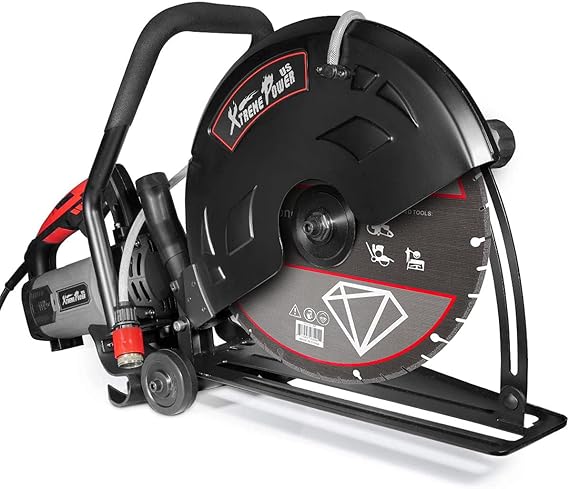
Power stands out most when cutting through tough materials like reinforced concrete or granite with this 16-inch concrete cut off saw. It suits anyone needing a reliable, heavy-duty tool for serious concrete work without feeling overly heavy or cumbersome.
Setting it up is straightforward with its corded electric design. The water line attachment helps keep dust down and extends blade life, so cleanup is less of a pain.
The double protection switch adds a layer of safety by preventing accidental starts. It strikes a good balance between power and manageable weight during daily use.
The 3200W motor handles cutting through stone materials quickly and steadily, keeping cuts flat and stable. The build feels solid, with low vibrations that reduce fatigue.
Most praise goes to its strong cutting efficiency and effective dust control. Some find the corded power limits mobility compared to cordless options.
Cutting power and dust suppression receive consistent praise, making it effective for demanding jobs. The main complaint involves limited mobility due to the power cord, which can be inconvenient in large or awkward work areas.
Ideal for users needing a powerful tool for heavy concrete cutting in controlled environments. Those requiring more portable or cordless options might look for alternatives better suited to mobile or smaller scale tasks.
Pros
- Strong 3200W motor for tough materials
- Water line attachment reduces dust buildup
- The double protection switch boosts safety.
- Handles long cuts with low vibration
Cons
- Corded design limits movement on site
- Blade replacement can be bulky and tricky
| Specification | Details |
|---|---|
| Power Source | Corded Electric |
| Blade Diameter | 16 inches |
| Motor Power | 3200 watts |
| Speed | 4700 rpm |
| Voltage | 115 volts |
| Current Rating | 20 A |
6. DEWALT DWC860W 4-3/8 Inch Wet Tile Saw

Powerful enough to cut through granite, porcelain, and concrete, this saw suits anyone needing a reliable blade for tough stone materials. Its biggest strength is the 10.8 amp motor paired with a diamond blade that handles wet or dry cuts with ease.
Setup involves connecting the 12′ water line to keep dust down and blade life longer during wet cuts. The lightweight and compact design at 6.6 lbs makes it easy to maneuver on job sites or workshops.
The lock-on button helps reduce hand fatigue during longer cutting sessions, and beveling up to 45 degrees offers precise angle cuts without extra tools.
Cutting performance is solid thanks to the 13,000 rpm no-load speed and adjustable depth-of-cut for various materials and thicknesses. The build feels sturdy while staying portable. Positive notes often mention the smooth angle adjustments, but some find the water setup tricky to manage during quick switches between wet and dry cuts.
The saw receives high praise for smooth angle cuts and durable power to slice through hard stone without slowing down. Complaints often focus on managing the water feed, which can be awkward to adjust and clean during workflow changes.
Those needing precise, angled cuts in stone will appreciate its versatility and power. It suits work where wet cutting is preferred. Users wanting very deep cuts or simpler dry-only operations might look for alternative saws better suited to their needs.
Pros
- Powerful 10.8 amp motor for tough materials
- Lightweight and compact at 6.6 lbs
- Wet cutting reduces dust and extends blade life
- Bevel capability up to 45 degrees
Cons
- Water line setup can be cumbersome
- Blade depth limited to 1 3/8 inches
| Specification | Details |
|---|---|
| Power Source | Corded Electric |
| Voltage | 120 volts |
| Wattage | 1300 watts |
| Speed | 4500 rpm |
| Cutting Angle | 45 degrees |
7. Electric 6 Inch Concrete Saw

Cutting clean grooves in concrete can be tough without the right tool. Designed for serious DIYers or professionals working on wall projects, this electric saw handles heavy-duty concrete cutting with its powerful motor and sharp blade.
Its standout feature is the ability to cut deeply in one pass, saving time and effort on tough surfaces.
Setting it up involves hooking up a water hose for dust control, which is surprisingly easy with the included 16.4ft hose. The water pump reduces dust while cutting, keeping the work area cleaner and the blade cooler. It runs on standard 110 volts and reaches speeds of 7000rpm, which feels quick but manageable when guiding the saw along the wall.
It delivers solid performance with a maximum grooving depth of 2.05 inches, cutting through concrete evenly and precisely. The heavy-duty motor handles extended use well, thanks to the heat dissipation ports that keep it from overheating.
The saw’s build feels sturdy with a sharp 6.3-inch blade, though some users note the weight can make longer jobs tiring.
The saw is praised for its powerful motor and effective dust reduction thanks to the integrated water pump, which helps maintain blade temperature and visibility. However, the weight makes it less comfortable to use over extended periods without breaks.
People needing deep, clean cuts in concrete walls with some water hookup are likely satisfied with this tool. Those looking for something lighter or cordless might want to consider alternate options.
Pros
- High power with 3000W copper motor
- Dust-free slotting with water pump
- Deep cutting up to 2.05 inches
- Two heat dissipation ports for long use
Cons
- Heavier weight can cause user fatigue
- Requires water setup for dust control
| Specification | Details |
|---|---|
| Power Source | Electric |
| Voltage | 110 volts |
| Speed | 7000 rpm |
| Wattage | 3000 watts |
| Blade Diameter | 6.3 inches |
8. Evolution R14DCT 14 Inch Electric Concrete Saw

Powerful 20A motor delivers gas-like cutting strength in an electric concrete saw, ideal for heavy-duty jobs. Suits anyone needing deep cuts in concrete, brick, or stone. Its biggest strength is managing tough materials without the mess or maintenance of gas models.
Setup requires a 20A outlet since it won’t run on typical 15A plugs. The integrated water system controls dust automatically, which really helps keep things clean on indoor or outdoor jobs.
The 14” diamond blade cuts deep at over 5 inches, and the blade guard rotates to five positions, so you can adjust based on the cut needed. The overload protection gives real-time feedback, helping avoid tool wear.
Cutting performance is consistent and strong with its high torque and premium blade loaded with 35% more diamond for longer life. The saw stands up well to repeated use, built tough and with thoughtful safety features.
The most common complaint is the need for a 20A outlet, limiting flexibility on some jobsites.
The saw’s ability to cut through concrete, brick, and stone effectively stands out as its main asset, with a premium diamond blade designed to last longer. The restriction to a 20A outlet is the most frequent downside, often limiting use where such power options aren’t available.
Anyone working on concrete and masonry who can access a suitable power source will appreciate the saw’s power and dust control. Those needing cordless convenience or working where only 15A outlets exist should consider other models.
Pros
- Strong 20A motor matches gas saw power
- Automatic dust suppression system built-in
- Heavy-duty 14” diamond blade lasts long
- 5-position rotating blade guard for versatility
Cons
- Requires 20A outlet, not compatible with 15A
- Heavier and less portable than smaller saws
| Specification | Details |
|---|---|
| Power Source | Corded Electric |
| Voltage | 120 volts_of_alternating_current |
| Amperage | 20A |
| Blade Size | 14 Inches |
| Cut Depth | 5-1/8 Inches |
| Speed | 3500 rpm |
9. XtremepowerUS 9 Inch Electric Concrete Saw

Ideal for contractors and serious DIYers working with concrete and masonry, the 9 Inch Electric Concrete Saw from XtremepowerUS offers solid cutting power with its 1800W motor. Its biggest strength lies in reliable performance without the need for gasoline, making it convenient for prolonged projects.
Setup involves attaching the included 9-inch segmented diamond blade, suitable for tough materials like brick and stone. The saw runs on a 115-volt corded electric source, so you need access to power.
Day-to-day use benefits from the ergonomic design and built-in guide roller, which help with control during both wet and dry cutting jobs.
Cutting speed holds steady at 5400 rpm, allowing for efficient work on dense concrete. The saw is sturdily built but not overly heavy, balancing power and handling. Reviewers commonly praise its dependable motor and cutting efficiency.
Some mention the corded design limits mobility, which can get inconvenient on larger sites.
Dependable cutting power stands out, making it solid for consistent work on concrete and masonry. The corded design limits movement on larger jobs, which some find inconvenient. Its motor delivers steady speed and force without refueling hassles.
Great for those with access to power outlets and who need reliable performance on dense materials. People needing lightweight, portable saws for remote sites might want to look into cordless options instead.
Pros
- Powerful 1800W motor for tough materials
- Includes 9-inch segmented diamond blade
- Supports both wet and dry cutting
- Ergonomic design with built-in guide roller
Cons
- Requires corded power, reducing mobility
- Heavier than some handheld alternatives
| Specification | Details |
|---|---|
| Power Source | Corded Electric |
| Voltage | 115 volts |
| Wattage | 1800 watts |
| Blade Shape | Round |
| Speed | 5400 rpm |
| Number of Teeth | 24 |
10. Electric 16 Inch Concrete Ring Cutting Saw

Ideal for heavy-duty concrete cutting, this saw stands out with its 13.8-inch cutting depth, perfect for thick slabs and foundations. Best suited for serious home projects or professional jobs, it delivers clean and precise results while handling tough materials like reinforced concrete and asphalt.
Setup is simple due to the included dual blades, letting you switch between them depending on the material you’re working on. The ergonomic handle makes long cuts less tiring, and running it on a standard 110-volt outlet means it fits most work sites.
The corded electric design guarantees steady power throughout use.
It tackles concrete with power and precision, making single-pass cuts on thick surfaces. Built solid, it feels durable and reliable, with the main praise focusing on its cutting depth and blade versatility.
Some mention the saw’s weight, which can make extended use more demanding.
Its ability to cut deeply and adapt to different materials with the included blades is highly praised, delivering professional-quality cuts. Most common complaint revolves around the saw’s weight, which can affect comfort during extended cutting sessions.
Those handling heavy concrete work will find this saw exceptionally capable and reliable. Anyone needing a lighter tool or working far from power outlets might want to look for a portable or battery-powered alternative.
Pros
- Deep 13.8-inch cutting capacity
- Two blades for different materials
- Ergonomic handle for better grip
- Powerful 8980-watt motor
Cons
- Heavier than some alternative saws
- Requires 110-volt outlet access
| Specification | Details |
|---|---|
| Power Source | Corded Electric |
| Voltage | 110 volts |
| Wattage | 8980 watts |
| Cutting Depth | 13.8 inches |
| Blade Shape | Round |
| Speed | 3600 |
11. Electric 16 Inch Concrete Cutter

Electric 16 Inch Concrete Cutter delivers powerful cutting for tough materials like reinforced concrete and stone. Suited for contractors and renovators needing a reliable saw for floor, wall, and ceiling tasks, its main strength lies in the brushless motor that keeps power steady without spark or brush replacements.
Setup involves plugging into a 110V power source, with a 16-inch blade ready to go. Switching between three diamond blades takes seconds without tools, perfect for quick adjustments on site. Water fed dust suppression keeps the work area cleaner, making daily use less messy.
The cutter handles rebar cutting while allowing 90-degree angle cuts.
Performance-wise, it manages deep cuts up to 50cm and cuts through 2 meters of concrete in about three minutes. The build feels sturdy with a pure copper brushless motor and dual blades.
Praise focuses on its heavy-duty power and precision 90° corner cuts. A common complaint is its weight, which can make long jobs tiring.
The strongest praise highlights its efficiency in making clean, deep cuts with minimal blade switching hassle and reliable motor performance. The most common complaint centers on the saw’s weight, which can be challenging during prolonged cutting sessions.
Those needing powerful concrete cutting with quick adaptability on job sites will appreciate this saw. Users prioritizing portability or cordless operation might want to consider lighter or battery-powered alternatives.
Pros
- Quick blade switching without tools
- Deep cutting up to 50cm
- Sparks-free, efficient brushless motor
- Water fed dust suppression system
Cons
- Heavy for extended use
- Requires constant corded power supply
| Specification | Details |
|---|---|
| Power Source | Corded Electric |
| Voltage | 110 volts |
| Wattage | 12000 watts |
| Blade Capacity | 16 Inch |
| Speed | 4300 rpm |
| Cutting Angle | 90 degrees |
12. Stark USA Electric 16 Inch Concrete Saw

Feels surprisingly light for its size, making it a good match when tackling concrete cutting jobs that require both power and control. Suited for anyone needing a strong electric saw that minimizes vibration and strain over longer periods. Its standout feature is the ergonomic D-shaped handle that holds comfortably in hand.
Setting up involves attaching the water line to keep the blade cool, which helps reduce dust and extend blade life during cutting. The depth adjustment feature lets you dial in precise cuts easily, while the dual-switch safety system prevents accidental starts so you can focus on the task safely. Daily use feels stable with minimal vibration, helping you maintain control even on demanding jobs.
Performance-wise, the 3200-watt motor runs the 16-inch blade at 4700 rpm, slicing through concrete effectively without bogging down. It’s built with metal and ABS plastic parts, balancing durability with manageable weight at 39 pounds.
Reviews often highlight how powerful and comfortable it is to operate, though some mention it could be heavy for extended use in awkward positions.
Power and comfort stand out with low vibrations and a strong grip, making extended cutting more manageable. The most frequent drawback is the weight, which some find cumbersome for longer or overhead jobs.
Anyone needing a steady and powerful concrete saw for fixed or semi-mobile work will find this model reliable. Those needing a lighter, cordless option or working mainly in tight spaces might prefer a different tool.
Pros
- Powerful 3200-watt motor for tough cuts
- Lightweight design at 39 pounds
- Ergonomic D-shaped handle grants better grip
- Dual-switch safety reduces accidental starts
Cons
- Can feel heavy during awkward or prolonged use
- Requires corded power, limiting mobility
| Specification | Details |
|---|---|
| Blade Length | 16 inches |
| Power Source | Corded-electric |
| Wattage | 3200 watts |
| Speed | 4700 rpm |
| Weight | 39 pounds |
| Voltage | 115 volts |
Comparison of Top Circular Saws for Concrete
| Product | Power Source | Blade Size | Wattage | Special Feature |
|---|---|---|---|---|
| VEVOR 16 Inch Concrete Saw | Corded Electric | 16 Inch | 3500 watts | Bevel Capability |
| SKILSAW SPT79-00 Concrete Saw | Corded Electric | – | 1800 watts | Brushless |
| XtremepowerUS 16 Inch Concrete Saw | Corded Electric | 16 Inch | 3200 watts | Brushless, Water Line |
| Cordless 60V 9 Inch Cut | Battery Powered | 9 Inch | 60 watts | Brushless |
| XtremepowerUS 16 Inch Cut Off | Corded Electric | 16 Inch | 3200 watts | Water Line Attachment |
| DEWALT DWC860W Wet Tile Saw | Corded Electric | – | 1300 watts | Bevel Capability |
| 6 Inch Electric Concrete Saw | Electric | 6 Inch | 3000 watts | Dust-free Slotting |
| Evolution R14DCT 14 Inch Saw | Corded Electric | 14 Inch | – | Dust Suppression |
| XtremepowerUS 9 Inch Concrete Saw | Corded Electric | 9 Inch | 1800 watts | Guide Roller |
| 16 Inch Concrete Ring Saw | Corded Electric | 16 Inch | 8980 watts | Ergonomic Handle |
| 16 Inch Electric Concrete Cutter | Corded Electric | 16 Inch | 12000 watts | Dual Blade Included |
| Stark USA 16 Inch Concrete | Corded Electric | 16 Inch | 3200 watts | – |
- Power SourceCorded Electric
- Blade Size16 Inch
- Wattage3500 watts
- Special FeatureBevel Capability
- Power SourceCorded Electric
- Blade Size–
- Wattage1800 watts
- Special FeatureBrushless
- Power SourceCorded Electric
- Blade Size16 Inch
- Wattage3200 watts
- Special FeatureBrushless, Water Line
- Power SourceBattery Powered
- Blade Size9 Inch
- Wattage60 watts
- Special FeatureBrushless
- Power SourceCorded Electric
- Blade Size16 Inch
- Wattage3200 watts
- Special FeatureWater Line Attachment
- Power SourceCorded Electric
- Blade Size–
- Wattage1300 watts
- Special FeatureBevel Capability
- Power SourceElectric
- Blade Size6 Inch
- Wattage3000 watts
- Special FeatureDust-free Slotting
- Power SourceCorded Electric
- Blade Size14 Inch
- Wattage–
- Special FeatureDust Suppression
- Power SourceCorded Electric
- Blade Size9 Inch
- Wattage1800 watts
- Special FeatureGuide Roller
- Power SourceCorded Electric
- Blade Size16 Inch
- Wattage8980 watts
- Special FeatureErgonomic Handle
- Power SourceCorded Electric
- Blade Size16 Inch
- Wattage12000 watts
- Special FeatureDual Blade Included
- Power SourceCorded Electric
- Blade Size16 Inch
- Wattage3200 watts
- Special Feature–
How to Choose the Right Concrete Circular Saw
Choosing the right circular saw for concrete depends on blade quality, power, and safety features since these factors affect cutting efficiency and durability. Getting them right reduces wear and tear, prevents accidents, and ensures smooth, precise cuts, ultimately saving money and avoiding repair hassles.
Power and Motor Type
Trying to cut through thick concrete slabs becomes a chore if the saw lacks enough power. Motors rated around 15 amps or higher on corded models provide consistent torque, which keeps cutting smooth even in dense materials. Lighter motors often struggle, causing the blade to slow and bind up mid-cut.
Brushless motors are common in newer cordless models and offer longer life and less maintenance compared to brushed motors that tend to wear out faster under heavy use.
Reliable power delivery means the saw maintains its speed under load, preventing stalling and uneven cuts. Strong motors paired with good electronic controllers enable the blade to spin consistently without lag, which directly affects precision and finishing.
Pay attention to amps for corded saws and volt ratings for cordless options to know if a tool matches the work intensity.
Blade Quality and Size
The blade size makes a big difference in cutting depth and control. Blades between 7 and 10 inches are standard for concrete, providing a good balance between cutting capacity and maneuverability.
Smaller blades limit depth, which can slow progress, while very large blades add weight and require stronger motors.
Diamond-tipped blades are the norm because they handle abrasion well and wear evenly over time, which reduces the need for frequent replacements. Look for blades labeled specifically for concrete or masonry, as they have a grit and bonding material suited to those materials. Compatibility with standard arbor sizes is crucial too, so choosing a saw that fits a range of diamond or abrasive discs means more flexibility on site.
Dust Management and Safety Features
Cutting concrete generates a lot of dust that clouds visibility and can be harmful to breathe. Built-in dust ports that connect to a vacuum help contain debris, making cleanup easier and the work area safer.
Without a dust management system, dust settles everywhere, impacting health and making it tougher to see the cut line precisely.
Safety features matter close up, with blade guards minimizing accidental contact, and safety switches preventing the saw from starting unintentionally. Ergonomics influence comfort too: balanced grips and vibration reduction reduce strain during long cuts, letting you maintain control without fatigue setting in quickly.
Portability and Power Source
Job sites vary widely, and cordless models offer freedom but depend heavily on battery life. High-voltage batteries (around 18-20V or higher) can provide enough runtime for typical cutting tasks, but heavy users often prefer corded saws to avoid downtime.
Cordless saws also weigh less but can feel front-heavy depending on battery placement.
Weight affects how steady and precise the cuts are, especially when making plunge cuts or working overhead. Lighter saws generally allow easier movement but might sacrifice some power. Tool-free blade changes speed up swaps between different types of blades, which is handy when switching from rough cuts to precision tasks in the same project.
Build Quality and Durability
Concrete workwear is demanding on tools, so the saw’s housing made from metal alloys or reinforced plastics resists impact and abrasion better than basic plastic shells. Dust and water resistance, often marked with IP ratings like IP54 or higher, mean the tool can handle dusty sites and occasional water exposure without damage.
Warranty coverage reveals how confident manufacturers are in their product’s durability. Longer warranty terms and readily available replacement parts like brushes, blades, or motors simplify repairs and extend the saw’s lifecycle, saving money and downtime in the long run.
Proper Techniques for Cutting Concrete with a Circular Saw
Cutting concrete with a circular saw requires the right blade and steady technique. Use a diamond blade designed specifically for concrete to avoid dulling and overheating. Position the saw with the shoe flat against the surface and make a shallow first pass to create a guide groove.
This helps keep the saw from wandering off course. Gradually deepen the cut by making multiple passes instead of trying to cut through in one go.
Maintaining a consistent speed avoids blade bogging and reduces heat buildup. Keep the saw straight and avoid forcing it, which can cause damage to both the tool and the material.
Wet cutting can reduce dust and heat, but check that your saw supports water before attempting this. Let the saw’s weight and power do the work rather than applying extra pressure.
Essential Safety Precautions When Using Circular Saws on Concrete
Concrete cutting generates a lot of dust and debris, so protective gear is essential. Always wear a dust mask or respirator to prevent inhaling silica particles, which can cause serious lung issues.
Eye protection like goggles or a face shield guards against flying chips. Sturdy gloves and hearing protection are also necessary due to the saw’s vibration and noise.
- Check that the blade guard is functioning properly and never remove it.
- Secure the concrete piece firmly to prevent movement during cutting.
- Keep hands clear of the blade path and maintain a balanced stance.
- Avoid loose clothing that could get caught in the saw.
- Plan your cutting area to avoid bystanders being exposed to dust or debris.
Electrical saws used in wet conditions must be plugged into a GFCI outlet to reduce shock risk.
Comparing Circular Saws and Angle Grinders for Concrete Projects
Circular saws and angle grinders both cut concrete but suit different tasks. Circular saws excel at making long, straight cuts due to their depth capacity and stability. They are typically heavier but provide consistent cutting depth controls.
Angle grinders are more compact and maneuverable, better for detailed grinding, shaping, or short cuts.
Angle grinders can accommodate a variety of blade sizes and disc types, offering versatility, but their shallow cut depth limits their use on thick slabs. Circular saws usually have larger diameters to penetrate deeper but are bulkier to handle. Consider the project size and precision needed; for large slabs, a circular saw may save time and effort, while for touch-ups or edging, an angle grinder offers better control.
Both tools require diamond blades for concrete, but maintenance and wear differ due to cutting style and tool speed.
People Also Asked
How Do I Safely Use a Circular Saw for Cutting Concrete?
Always wear protective gear including goggles, gloves, and a dust mask when cutting concrete with a circular saw. Keep the blade wet to reduce dust and prevent the blade from overheating. Secure the material firmly to avoid kickback or slipping during the cut.
What Size Blade Is Ideal for Cutting Concrete with a Circular Saw?
A 7-inch blade is generally ideal for cutting concrete with a circular saw, balancing depth and maneuverability. Larger blades can cut deeper but may require more powerful saws and produce more dust, so consider your tool’s capabilities.
How Long Does a Concrete Circular Saw Blade Typically Last?
Concrete circular saw blades typically last between 20 to 50 hours of cutting, depending on the blade quality and cutting conditions. Using water to cool the blade can significantly extend its life by reducing heat and wear.
Can I Use a Regular Circular Saw Blade on Concrete?
Regular circular saw blades are not suitable for cutting concrete because they lack the necessary diamond-tipped edge for grinding through tough materials. Using the correct blade reduces wear on the saw and ensures cleaner cuts.
What Are Common Problems When Using a Circular Saw on Concrete?
Common problems include blade overheating, excessive dust, and poor cut quality due to the blade not being appropriate for concrete. Keeping the blade wet and using the right diamond blade helps avoid most issues and improves cutting performance.
Conclusion
Choosing a circular saw for cutting concrete comes down to its power, blade type, and durability. A motor strong enough to handle dense material, a diamond blade for effective cutting, and a model built to withstand tough job site conditions are the key points. Also, consider the saw’s water attachment if you need to reduce dust during use.
Think about how often you will use the saw and where you’ll store it. Buying a unit that fits your budget and workspace can save trouble later. Take another look at the comparison table and read through the detailed picks above to find a saw that fits your specific needs without overspending or buying unnecessary features.