
Top 12 Best Spin Bike Computer That Will Transform Your Ride
Using a low-quality spin bike computer often means inaccurate data, poor visibility, or clunky controls that interfere with your workout flow. The best spin bike computer delivers reliable speed, distance, and calorie readings without constant glitches or the need for calibration after every ride, which anyone serious about training can appreciate.
A good spin bike computer should have a clear, easy-to-read display around 2 to 3 inches wide, making it visible at a glance during intense sessions. It typically runs on long-lasting batteries, like CR2032 cells, to avoid frequent replacements. Accurate sensors that track cadence and heart rate, paired with simple mounting options, ensure it fits securely and stays functional without extra fuss or the risk of slipping mid-ride.
Need a Quick Check?
| Image | Product | Price |
|---|---|---|
Our Top Picks 1  | Cateye Wired Computer | Check Price |
Our Top Picks 2  | CYCPLUS M1 GPS | Check Price |
Our Top Picks 3  | Cateye Padrone Wireless | Check Price |
Our Selected Top 12 Spin Bike Computer Worth Buying
This list includes several spin bike computers made to track your performance and improve workouts. Each review covers how the device functions, who it is best suited for, and highlights its main advantages and disadvantages to help you make an informed choice.
1. CATEYE Wired Bike Computer
Perfect for beginners looking for clear, basic ride stats without fuss, this wired bike computer offers dependable tracking in a simple package. Its biggest strength lies in automatically pausing time and speed measurements during stops, making your ride data more accurate and straightforward.
Setup involves mounting on the handlebar and aligning the speed sensor, which takes only a few minutes. Day-to-day use is straightforward, with buttons to toggle through current, max, and average speed, distance, and time. The LCD screen is easy to read at 2.17 inches, showing all the stats you need without clutter.
Performance stays reliable thanks to a wired speed sensor that reduces signal drops. Solid battery life of up to three years means less hassle changing batteries.
The build is basic but effective, focusing on function over style. Most praise revolves around its accuracy and simplicity, while the main drawback noted is the lack of wireless connectivity, limiting placement options.
Many praise the unit’s accuracy and how it intelligently stops counting when the bike is at a standstill, keeping ride data clean and useful. The most commonly mentioned downside is the wired connection, which can be less convenient than wireless setups and restricts sensor positioning options.
Those new to cycling and wanting simple, reliable data will appreciate its straightforward design and long battery life. Riders seeking advanced functions or more flexible sensor placement might consider other models with wireless tech and extra features.
Pros
- Automatically pauses timing during stops
- Long battery life up to 3 years
- Clear LCD display with all essential stats
- Easy handlebar installation
Cons
- Wired connectivity limits sensor placement
- Basic design without advanced features
| Specification | Details |
|---|---|
| Display Size | 2.17 inches |
| Display | LCD |
| Battery Average Life | 3 years |
| Sensor Type | Speed Sensor |
| Connectivity Technology | Wired |
| Mounting Type | Handlebar Mount |
2. CYCPLUS M1 GPS Bike Computer
Compact design with a clear 2.9-inch LCD screen makes it well-suited for cyclists wanting reliable GPS tracking and easy-to-read data outdoors. Its main strength lies in accurate GPS positioning, enhanced by an imported Swiss chip that quickly locks onto signals for precise route mapping.
Setup involves mounting the device on the handlebar and pairing it over Bluetooth with a smartphone, which syncs your ride data automatically to an app. The screen adjusts brightness based on daylight and is glare-free, so checking speed, cadence, or route details remains easy irrespective of sun position. Controls use simple buttons, making navigation straightforward without touchscreen distractions.
Tracking speed and cadence works smoothly thanks to integrated sensors, and the GPS accuracy gets frequent praise for detailed route recording. Build quality is solid with tempered glass to resist scratches from nails or debris.
Users appreciate the 60-hour battery life, although some note the button interface can feel a bit clunky at times compared to modern touch options.
Precise GPS mapping receives consistent praise, helping cyclists track routes accurately. A common complaint focuses on the button-based control system, which lacks the ease and fluidity of modern touchscreens, sometimes complicating navigation through settings.
Enthusiasts who value clarity in display and dependable GPS during rides will find this a dependable companion. Riders seeking a larger display or a more modern interface might prefer alternative models with touchscreen features or bigger screens.
Pros
- Highly accurate and fast GPS positioning
- Glare-free backlit LCD screen for all lighting
- Long 60-hour battery life on a single charge
- Durable tempered glass screen resists scratches
Cons
- Button controls can feel outdated and less intuitive
- Screen size limited to 2.9 inches may feel small to some
| Specification | Details |
|---|---|
| Display Size | 2.9 inches |
| Display | LCD |
| Battery Average Life | 60 hours |
| Sensor Type | Speed/cadence Sensor; Gps sensor |
| Connectivity Technology | ANT, Bluetooth |
| Mounting Type | Handlebar Mount |
3. CATEYE Padrone Wireless Bike Computer
Compact and straightforward, this bike computer suits riders who want essential stats without fuss. Its biggest strength lies in delivering core metrics like speed and distance without any GPS or extra sensors complicating the process.
Setup involves attaching the wireless speed sensor to the front wheel and mounting the compact 5.5 cm LCD display on the handlebar. No pairing is required thanks to the 70cm wireless transmission range, so it starts working instantly. Navigation is simple with a single button press toggling through data points, letting you focus on cycling rather than menu options.
Speed readings come through clearly and quickly with an analog wireless sensor designed for front wheel use only. The lightweight design and battery life averaging one year mean it keeps up without much attention. Users appreciate the straightforward functionality most, while the lack of GPS or heart rate monitoring is a downside for those wanting more comprehensive tracking.
Many appreciate how the speed sensor connects wirelessly without pairing and delivers real-time data quickly. A common complaint centers on the absence of GPS or heart rate monitoring, which some riders might miss for more detailed fitness tracking.
This device suits cyclists who want basic speed, distance, and time stats with easy setup. Riders seeking integrated GPS navigation or heart rate data should look at other options offering those features.
Pros
- Instant speed measurement with no pairing needed
- Simple single-button toggling through metrics
- Long battery life of about one year
- Clear LCD display sized at 5.5 cm
Cons
- No GPS or heart rate functionality included
- Sensor only works with front wheel
| Specification | Details |
|---|---|
| Display Size | 5.5 centimeters |
| Display | LCD |
| Battery Average Life | 1 years |
| Sensor Type | Analog Wireless |
| Mounting Type | Handlebar Mount |
| Connectivity Technology | Analog Wireless |
4. iGPSPORT BSC500 GPS Bike Computer

Ideal for serious cyclists who want precise location tracking, the iGPSPORT BSC500 stands out with its dual-band satellite positioning that sharply improves navigation accuracy. It fits riders looking for a detailed yet clear display to follow multiple cycling metrics on every ride.
Setting it up is straightforward, connecting to the iGPSPORT app to load routes directly onto the bike computer. The 3.3” touchscreen combined with physical buttons makes controlling the device easy whether you’re pedaling hard or adjusting settings mid-ride. Support for multiple global satellite systems means reliable tracking wherever you cycle.
It delivers strong performance in mapping and tracking thanks to simultaneous L1 and L5 satellite signals. The build is solid, with a responsive touchscreen that shows up to 12 data points per page for quick glances. Praise often highlights the accuracy of its navigation, while some mention a learning curve with the touchscreen sensitivity and button layout.
Navigation accuracy across various satellite systems receives strong approval, making it reliable for precise tracking. The touchscreen can sometimes feel unresponsive or tricky, which users often note as a drawback during rides requiring quick adjustments while moving.
Cyclists needing dependable GPS data and rich metrics will find this especially useful. Those prioritizing simple plug-and-play computers or who dislike touchscreen controls might want to explore alternatives better suited to straightforward operation.
Pros
- Large 3.3″ screen shows multiple cycling metrics
- Supports five major global satellite systems
- Combines touchscreen with physical buttons
- Route uploading through dedicated app
Cons
- Touchscreen sensitivity can be inconsistent
- Navigation features require app setup
| Specification | Details |
|---|---|
| Display Size | 3.3 inches |
| Sensor Type | Cadence Sensor |
| Battery Type | Lithium Ion |
| Human Interface Input | Buttons, Touchscreen |
| Satellite Positioning | Dual-Band L1 & L5, GPS+Beidou+GLONASS+GALILEO+QZSS |
5. CYCPLUS G1 Wireless GPS Bike Computer
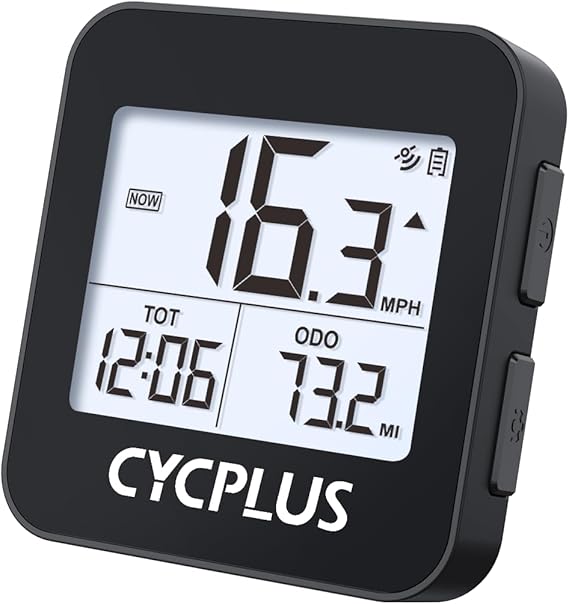
Tracking your route and ride stats without dealing with tangled cables or poor visibility can be tricky. Perfect for cyclists who want accurate GPS data and clear readings in all light conditions, it shines brightest for its precision in positioning and ride tracking.
Setting it up is straightforward thanks to its wireless design and handlebar mount. The screen’s backlight automatically adjusts so you can see numbers clearly whether the sun is blazing or it’s dark out.
Buttons on the device let you scroll through time, distance, altitude, and more without fumbling. The device resists rain, so weather doesn’t interrupt your ride.
Accuracy in GPS tracking sets this computer apart; it consistently shows detailed ride info including total mileage and altitude. The screen protects well against scratches, thanks to tempered glass. Some mention the buttons can feel stiff at times, which slows quick data checks.
The battery life stretches long, lasting through many hours of use.
The GPS tracking here is notably precise and reliable, making it straightforward to monitor your rides without fussing over cables or visibility problems. Many find the device durable thanks to the tempered glass screen, while some point out the buttons require firm presses which can slow access to data.
Cyclists wanting a clear display, long battery life, and weather-proof device will appreciate this bike computer. Those needing a larger screen or more sensitive button controls might look for alternatives. It fits well for riders focused on clean data delivery and real-time GPS tracking.
Pros
- High GPS sensitivity and accuracy
- Automatic backlit screen for all lighting
- Long battery life of 50 hours
- Waterproof and wireless design
Cons
- Buttons can feel stiff
- Screen size limited to 2 inches
| Specification | Details |
|---|---|
| Display Size | 2 inches |
| Connectivity Technology | Wireless |
| Battery Average Life | 50 hours |
| Display | LED |
| Waterproof Rating | IPX6 |
| Mounting Type | Handlebar Mount |
6. Magene Speed and Cadence Sensor

Single-mode operation makes it clear and simple to get accurate speed or cadence data from one sensor at a time. Great for cyclists who want reliable tracking with minimal fuss. Switching modes only requires a quick battery re-install to pick speed or cadence, so it suits those who want straightforward performance without extra gear.
Setup involves removing the battery’s insulating sheet and then pairing through a phone app’s sensor search, since the phone’s Bluetooth list won’t find it. Everyday use slows down only when swapping between speed and cadence modes, requiring two separate sensors for full data. Connections differ by protocol: Bluetooth links just one device at once, while ANT+ allows multiple devices to connect simultaneously.
Mounting options make it easy to place on either the stem or handlebar.
Performance is solid for either speed or cadence, with a clear LCD display and button controls for interface input. It offers reliable Bluetooth and ANT+ connectivity depending on your setup.
Build quality holds up well, but the need for two sensors to get both data types can feel limiting. Most praise goes to its accuracy and simplicity; the main gripe focuses on not being able to have speed and cadence from a single sensor simultaneously.
Accuracy and ease of use receive steady praise, while needing two separate sensors to track both speed and cadence is the most common limitation noted. The single-mode focus simplifies operation but splits data collection across devices.
Those wanting straightforward speed or cadence tracking with reliable connectivity will appreciate this sensor. Buyers needing simultaneous speed and cadence from one unit are better off looking elsewhere.
Pros
- Clear LCD display for easy data reading
- Simple mode switching via battery re-install
- ANT+ supports multiple device connections
- Mounts on stem or handlebar
Cons
- One sensor supports only speed or cadence at a time
- Must use the app’s sensor search to connect
| Specification | Details |
|---|---|
| Display | LCD |
| Sensor Type | Cadence Sensor, Speed Sensor |
| Battery Type | Lithium Manganese Dioxide |
| Connectivity Technology | Bluetooth |
| Mounting Type | Stem Mount, Handlebar Mount |
| Human Interface Input | Buttons |
7. CATEYE Urban Wireless Bike Computer

People who enjoy casual to moderate cycling will find the CatEye Urban Wireless Bike Computer fits perfectly. Its biggest strength lies in showing a broad range of essential stats that keep rides informative without being overwhelming.
Setting it up is straightforward with the FlexTight Bracket, so positioning it on the handlebar takes just seconds. The unit runs on an analog wireless speed sensor, avoiding messy wires.
Daily rides benefit from the automatic pause feature, which freezes time and speed tracking during stops like red lights or coffee breaks, keeping your data accurate naturally.
Performance meets expectations with clear LCD readings of current, max, and average speed, plus distance and calories burned. The build feels sturdy and practical. Most users appreciate how the odometer saves your total mileage even when changing batteries.
On occasion, the analog wireless sensor may face interference, which some found annoying.
Many users praise how accurately the computer tracks speed and stops during pauses to give a realistic riding profile. A common issue arises from analog wireless interference, which can occasionally disrupt data signals.
People wanting simple, reliable cycling stats without complicated setup will appreciate this computer. Those needing advanced features or more stable wireless tech might want to look for alternatives.
Pros
- Displays a full range of stats including calorie consumption
- FlexTight Bracket allows quick, tool-free mounting
- Automatic stop detection for accurate time and speed
- Odometer memory even when changing batteries
Cons
- Analog wireless sensor can experience interference issues
- Single-year battery life requires yearly replacements
| Specification | Details |
|---|---|
| Display | LCD |
| Battery Average Life | 1 years |
| Sensor Type | Speed Sensor |
| Connectivity Technology | Analog Wireless |
| Mounting Type | Handlebar Mount |
| Human Interface Input | Buttons |
8. Digital Exercise Bike Monitor Console

Designed specifically for stationary spin bikes with JST ports, this digital monitor stands out by offering a simple timer and cadence tracking rather than exact data on speed or distance. Perfect for those wanting a basic readout during workouts without expecting precise measurements.
Installation involves connecting the wired JST connector to your bike, which usually fits most models with compatible ports. The small 1.5-inch LCD screen displays your cadence, heart rate, and time, all controlled by easy-to-use buttons. It’s straightforward to set up and ideal for keeping track of how long you’ve been pedaling rather than focusing on exact stats.
The build is compact and fits smoothly on the bike surface. It’s clear from users that the strongest point is its simplicity and reliable timer function. On the downside, the accuracy of speed and distance is not real but rather an estimate based on pedal RPM, which sometimes frustrates those wanting exact numbers.
The monitor is valued mainly for its reliable timer and straightforward display, which makes tracking workout duration simple. Many users note that the speed and distance figures are only approximations based on pedal RPM, which can feel misleading for those seeking exact data.
People focusing on tracking time and heart rate during spin sessions will appreciate this monitor. Those needing precise speed or distance readings are better off exploring other devices designed for real measurement accuracy. The wired setup suits bikes with JST ports but may not work well elsewhere.
Pros
- Simple timer and cadence display
- Compatible with most JST port spin bikes
- Clear LCD shows heart rate and time
- Easy button controls for quick use
Cons
- Speed and distance are estimated, not precise
- Wired connection may limit placement options
| Specification | Details |
|---|---|
| Display Size | 1.5 inches |
| Display | LCD Digital Display |
| Sensor Type | Heart Rate |
| Connectivity Technology | JST Connector, Wired |
| Mounting Type | Surface Mount |
9. GPS Bike Computer with Altitude and Gradient

Garmin’s GPS Bike Computer with Altitude and Gradient is designed for cyclists who want detailed ride data alongside elevation tracking. Its biggest strength lies in showing real-time altitude, gradient, and accumulated ascent, making it especially useful for mountain bikers and road riders who care about climbing stats.
Setting up the device is simple because it uses built-in GPS and doesn’t require a wheel sensor or spoke magnet. The 2.4-inch LCD display has a straightforward layout that’s easy to read while riding, with an automatic backlight that adjusts to different lighting conditions. Daily rides reveal useful metrics like current and max speed, distance, and temperature, all accessible through simple button controls on the handlebar mount.
Performance-wise, the GPS and barometric altimeter provide reliable tracking of elevation changes and gradients, supporting a richer cycling experience. The unit feels solidly built, with a clear display that holds up well to various weather conditions.
Some users note that the screen size can feel a bit small for quick glances, which is the most common drawback mentioned.
Strong praise focuses on its accurate elevation tracking and the convenience of GPS setup without extra sensors. The most common complaint highlights the small screen size, which some find challenging for fast glances on the bike.
Cyclists who want detailed ride and climbing data with a durable, no-fuss device will find it fitting well. Riders preferring larger displays or touchscreen control might want to explore other options.
Pros
- Tracks altitude, gradient, and accumulated ascent well
- Built-in GPS requires no external sensors
- Automatic backlight adapts to lighting conditions
- Long 28-hour battery life
Cons
- Screen size may be too small for quick data checks
- No touchscreen, relies on button controls
| Specification | Details |
|---|---|
| Display Size | 2.4 inches |
| Display Type | LCD |
| Battery Average Life | 28 hours |
| Sensor Type | GPS Sensor, Motion Sensor, Barometric Altimeter, Speed Sensor |
| Mounting Type | Handlebar Mount |
| Human Interface Input | Buttons |
10. Wired Bike Speedometer and Odometer

Using this wired bike speedometer makes tracking your rides straightforward and reliable. It suits anyone serious about cycling stats and fitness, with its clear display and precise data. Its biggest strength is the range of useful metrics it provides, all accessible from the handlebar at a glance.
Setup involves mounting the speed sensor and computer on the handlebar, then pairing them via the wired connection. Day-to-day use is simple: buttons allow you to check speed, distance, and calories burned.
The backlight works well for early morning or night rides, turning on manually with a button combo. The small size keeps it out of the way while you cycle.
It delivers accurate speed, average, and max measurements consistently. The waterproof design holds up through wet rides without issue. Most praise highlights how clear and easy to read the LCD screen is, especially with the night backlight.
A few users mention the wired setup as less convenient than wireless options and the backlight requires manual activation.
Clear LCD display and backlight are often praised for making stats easy to read any time of day. Common complaints center on the wired design limiting bike setup flexibility and the manual backlight activation that some find inconvenient during sudden darkness.
Fitness enthusiasts and serious cyclists who want detailed ride data will find this speedometer practical and dependable. People who want wireless gadgets without complications or automatic night lighting might want to consider other options.
Pros
- Measures multiple key stats including calories and temperature
- Day and night backlight with clear, eye-friendly brightness
- Waterproof design suitable for all weather conditions
- Compact, easy to mount and operate while cycling
Cons
- Wired connection can feel restrictive compared to wireless
- Backlight must be manually turned on for visibility in dark
| Specification | Details |
|---|---|
| Display | LCD |
| Sensor Type | Speed Sensor |
| Battery Type | Lithium Polymer |
| Connectivity Technology | Wired |
| Mounting Type | Handlebar Mount |
| Human Interface Input | Buttons |
11. CATEYE Velo Wireless Bike Computer

Great for riders wanting a solid set of stats without fuss, this bike computer keeps you updated with speed, distance, and calories burned. Its biggest strength lies in accurately pausing the timer during stops, so your ride data stays clean and reliable.
Setting it up is straightforward thanks to the included zip-tie bracket for a firm handlebar fit. Day to day, it feels dependable, showing current, max, and average speeds alongside trip distance and elapsed time.
The clear LCD helps glance at your pace arrow and clock. Not worrying about resetting the odometer each battery change adds a nice touch of convenience.
Performance focuses on delivering accurate speed and distance tracking through a proprietary wireless sensor. The build is solid, with the bracket securing it tightly to the handlebars.
Most users praise how the automatic stop detection works during pauses, while a common gripe mentions the display is smaller than some would like for quick reading.
The automatic stop feature receives high praise because it keeps ride stats precise, especially during traffic or breaks. However, the smaller than expected display is the most frequent drawback, making quick glances a bit challenging in motion. The secure zip-tie mount prevents any wobbling or risk of loss.
Those wanting straightforward speed and distance tracking with basic wireless setup will find this useful. Riders who need larger displays or multifunction smart connectivity might want to consider other options that fit their preferences better.
Pros
- Accurate speed and distance tracking
- Automatically pauses during stops
- Secure handlebar mounting bracket included
- Manually set odometer to retain mileage
Cons
- Display size may be small for some riders
- No connectivity beyond proprietary wireless
| Specification | Details |
|---|---|
| Display Size | 10 centimeters |
| Display | LCD, LED |
| Sensor Type | Speed Sensor |
| Connectivity Technology | Proprietary Wireless |
| Mounting Type | Handlebar Mount |
| Human Interface Input | Buttons |
12. Wahoo ELEMNT BOLT V3 GPS Bike Computer

Crafted with a compact 2.3-inch LCD display and a sturdy handlebar mount, this bike computer suits riders who value clear navigation without bulky gadgets. Its strongest feature lies in on-device turn-by-turn navigation that works with various route file types and popular apps, making it a solid choice for route-focused cyclists.
Getting it started is pretty straightforward. Syncing with apps like Strava or Komoot means routes download automatically, saving time and effort. Top LEDs and sound alerts help track next turns or notify if you stray off-course, keeping focus on riding rather than constant screen checks.
Buttons provide easy interaction without complicated touch controls.
It performs reliably with heart rate, cadence, and speed sensors all built-in. The battery lasts around 20 hours, suiting long days on the road.
Most users praise how well the navigation works and the wireless syncing ease, though some find the non-touch LCD a bit restrictive compared to newer interfaces.
Clear route guidance with LED cues and wireless syncing impresses most users, proving reliable for tracking rides automatically. Some miss a touch screen and find the display less intuitive compared to newer devices with more interactive interfaces.
Riders who want straightforward navigation and easy app integration will appreciate its simplicity and battery life. Those looking for a feature-rich touch display or advanced onboard maps might consider other options better suited to complex data needs.
Pros
- Automatic route downloads from multiple apps
- Clear turn-by-turn navigation with LED and sounds
- Long 20-hour battery life
- Includes heart rate, cadence, and speed sensors
Cons
- Non-touch LCD limits quick interaction
- Navigation may feel basic for advanced users
| Specification | Details |
|---|---|
| Display Size | 2.3 inches |
| Display | LCD |
| Battery Average Life | 20 hours |
| Sensor Type | Heart Rate Sensor, Cadence Sensor, Speed Sensor |
| Connectivity Technology | Bluetooth, USB, Wi-Fi |
| Mounting Type | Handlebar Mount |
Best Spin Bike Computers Comparison Table
| Product | Display Size | Battery Life | Sensor Type | Connectivity |
|---|---|---|---|---|
| Cateye Wired Computer | 2.17 inches | 3 years | Speed Sensor | Wired |
| CYCPLUS M1 GPS | 2.9 inches | 60 hours | Speed/cadence, GPS | ANT, Bluetooth |
| Cateye Padrone Wireless | 5.5 cm | 1 year | Analog Wireless | Analog Wireless |
| iGPSPORT BSC500 GPS | 3.3 inches | – | Cadence Sensor | – |
| CYCPLUS G1 Wireless GPS | 2 inches | 50 hours | – | Wireless |
| Magene Speed Cadence Sensor | – | – | Cadence, Speed | Bluetooth |
| Cateye Urban Wireless | – | 1 year | Speed Sensor | Analog Wireless |
| Digital Exercise Console | 1.5 inches | – | Heart Rate | Wired |
| GPS Altitude Gradient | 2.4 inches | 28 hours | GPS, Altimeter | – |
| Wired Speedometer Odometer | – | – | Speed Sensor | Wired |
| Cateye Velo Wireless | 10 cm | – | Speed Sensor | Proprietary Wireless |
| Wahoo ELEMNT BOLT V3 | 2.3 inches | 20 hours | Heart Rate, Cadence | Bluetooth, USB, Wi-Fi |
- Display Size2.17 inches
- Battery Life3 years
- Sensor TypeSpeed Sensor
- ConnectivityWired
- Display Size2.9 inches
- Battery Life60 hours
- Sensor TypeSpeed/cadence, GPS
- ConnectivityANT, Bluetooth
- Display Size5.5 cm
- Battery Life1 year
- Sensor TypeAnalog Wireless
- ConnectivityAnalog Wireless
- Display Size3.3 inches
- Battery Life–
- Sensor TypeCadence Sensor
- Connectivity–
- Display Size2 inches
- Battery Life50 hours
- Sensor Type–
- ConnectivityWireless
- Display Size–
- Battery Life–
- Sensor TypeCadence, Speed
- ConnectivityBluetooth
- Display Size–
- Battery Life1 year
- Sensor TypeSpeed Sensor
- ConnectivityAnalog Wireless
- Display Size1.5 inches
- Battery Life–
- Sensor TypeHeart Rate
- ConnectivityWired
- Display Size2.4 inches
- Battery Life28 hours
- Sensor TypeGPS, Altimeter
- Connectivity–
- Display Size–
- Battery Life–
- Sensor TypeSpeed Sensor
- ConnectivityWired
- Display Size10 cm
- Battery Life–
- Sensor TypeSpeed Sensor
- ConnectivityProprietary Wireless
- Display Size2.3 inches
- Battery Life20 hours
- Sensor TypeHeart Rate, Cadence
- ConnectivityBluetooth, USB, Wi-Fi
How to Choose the Right Spin Bike Computer
Look for accuracy in tracking speed, distance, and calories, as these help monitor your progress effectively. Easy-to-read displays and durable design ensure long-term use without frustration. Choosing the right features avoids unnecessary expenses and ensures the device meets your personal training needs.
Display and Readability
Small screens on training computers often cause frustration as users struggle to quickly read data mid-workout. A screen size of around 2.5 to 3 inches offers a good balance between compactness and readability. Clarity is just as important; displays with high contrast and sharp text make it easier to check metrics without losing focus.
Backlighting is crucial when riding in dim rooms or near windows with changing light throughout the day.
Customizable display options significantly improve daily use. Being able to prioritize metrics like cadence, heart rate, or power output on the main screen lets you keep vital stats front and center.
Models that allow switching between different data layouts prevent screen clutter and make workouts more efficient and less distracting.
Compatibility and Connectivity
Spin computers that don’t pair well with existing bike sensors or heart rate monitors limit their usefulness. Models supporting both ANT+ and Bluetooth protocols offer the broadest compatibility with devices like chest straps or smart trainers.
Wireless connections remove the hassle of cords, making setups tidier and reducing signal interference during exercise.
Syncing with popular fitness apps or online training platforms is key for tracking progress over time and accessing structured workouts. Computers that offer automatic syncing save time by transferring ride data without manual uploads.
This feature helps keep motivation up by making it easier to follow training plans and analyze performance on familiar apps.
Data Tracking and Metrics
The range and quality of tracked data directly impact the training experience. Basic setups show speed and distance, but more useful units accurately capture cadence, calories burned, and sometimes power output.
Reliable sensors respond quickly to changes, providing real-time feedback that’s important during interval training.
Advanced features like interval timers and preloaded workout programs make structured sessions more manageable, especially for users following specific goals. Power output readings help cyclists gauge effort more precisely than speed alone.
Choosing a computer with these metrics built-in can turn casual workouts into focused training sessions.
Power and Battery Life
Battery life varies widely across training computers, with some using standard AA batteries that last several months under normal use. Rechargeable units typically provide a few hours of continuous runtime before needing a boost.
Easy access to the battery compartment or USB charging helps keep the device ready without hassle.
Models designed for energy efficiency reduce the frequency of charges or replacements. Automatic sleep modes or dimming the screen when inactive extend battery life substantially.
For anyone training multiple times per week, these power-saving features reduce interruption and ongoing costs.
Mounting and Durability
Mounting security affects everyday confidence in the device. Adjustable brackets that fit a range of spin bike models and handlebar sizes mean the computer can be positioned where it is most visible.
Rigid mounts prevent shaking or slipping even during intense pedal strokes.
Durability matters since sweat and vibration wear down cheaper units quickly. Look for devices with solid plastic or metal casings rated for moisture resistance.
Sweat-proof designs help prevent corrosion or screen damage, ensuring reliable performance over months or years of use.
Optimizing Your Spin Bike Computer for Enhanced Training Results
Adjusting the settings on your spin bike computer to fit your specific workout goals makes tracking your sessions much more effective. Most models let you input details like weight, age, and fitness level, which help the device give more accurate calorie counts and workout intensity data.
Setting up interval training programs on the computer can keep workouts structured without needing extra timers or apps. Many spin bike computers also allow you to customize display screens so you can monitor key stats like RPM, speed, distance, and heart rate all at once. Using the built-in resistance levels alongside these metrics helps track progress objectively.
Some units support Bluetooth connections for syncing with popular cycling apps, which lets you review detailed performance data later. This kind of setup encourages consistent improvements by showing clear patterns in your endurance and speed over time.
Proper Maintenance and Care for Prolonged Spin Bike Computer Lifespan
Keeping your spin bike computer in good shape increases its accuracy and extends its lifespan. Start by regularly wiping the screen and buttons with a soft, damp cloth to remove sweat and dust, avoiding harsh chemicals that could damage the display. Check the battery status often, and replace batteries as soon as the device shows signs of dimming or lagging response.
Avoid exposing the computer to extreme temperatures or moisture during storage, which can corrode internal components. Securely attaching the computer ensures stable readings and prevents accidental drops.
Periodically inspect for loose wires or connections if the unit uses sensors that link to the bike’s frame. Performing these simple care steps keeps the spin bike computer working smoothly and prevents interruptions during workouts that rely on consistent data tracking.
Comparing Spin Bike Computers with Fitness Trackers and Smartwatches
Spin bike computers differ from fitness trackers and smartwatches mainly in the kind of data they collect and how they display it. While spin bike computers focus on cycling-specific stats like cadence, power output, and distance on the bike, fitness trackers and smartwatches gather more general health information such as steps taken, sleep patterns, and overall activity levels. The display on a spin bike computer is usually larger and designed to be readable during intense indoor cycling sessions.
Smartwatches and trackers offer more versatility with apps and notifications but often require a Bluetooth connection to provide detailed spin workout metrics. For riders who want in-depth cycling data and quick glance readability, a dedicated spin bike computer is more practical.
Fitness trackers serve broader health monitoring, whereas smartwatches combine fitness tracking with other smartphone features.
People Also Asked
How Do I Set up a Spin Bike Computer Correctly?
Attach the computer sensor and mount to your spin bike as per the manual, then sync it with your bike’s flywheel if needed. Make sure the sensor aligns closely with the magnet on the wheel for accurate data capture. Calibrate settings like wheel size or resistance based on the manual to get precise workout metrics.
What Is the Average Lifespan of a Spin Bike Computer?
A spin bike computer usually lasts around 3 to 5 years, depending on usage and care. Batteries often need replacement every year or so, and keeping the device clean helps prevent malfunction. Avoid exposure to moisture or extreme temperatures to preserve its electronics.
Are Spin Bike Computers Compatible with All Smartphone Apps?
Spin bike computers are not always compatible with every smartphone app. Some units support popular fitness platforms like Zwift or Strava, while others use proprietary apps. Confirm app compatibility before purchase if tracking workouts on your phone is important.
How Do I Troubleshoot Common Issues with My Spin Bike Computer?
Common problems like no display or inaccurate readings can often be fixed by checking battery power and sensor alignment. Resetting the device or re-pairing it with your phone often resolves syncing issues. Consult the manual for error codes or troubleshooting steps specific to your model.
What Safety Features Should I Look for in a Spin Bike Computer?
Look for features such as emergency stop compatibility, clear display visibility, and sturdy mounting. Some computers include alerts for heart rate zones or fatigue levels which can add a layer of workout safety. Reliable build quality ensures the computer stays secure during intense sessions.
Conclusion
Choosing a spin bike computer mainly comes down to accuracy, ease of use, and the type of data it provides during your workouts. Being able to track key metrics like speed, distance, and heart rate can make a real difference in staying motivated and monitoring progress.
The display should be clear and easily readable from your riding position, with controls that don’t interrupt your flow.
Think about where you’ll place the computer and how often you’ll use it so you don’t end up with unnecessary features or a device that’s harder to set up. Sticking to your budget while covering your basic needs will usually serve you best.
Check the comparison table and read through the options above to find the balance that fits your routine and space.