Can You Get Your Motorcycle License Online – Is It Safe?
You can complete some steps like applications, fee payments, and scheduling tests online, and take the MSF Basic eCourse for foundational knowledge. However, fully getting your motorcycle license online isn’t widely allowed or safe, since essential hands-on training and in-person tests are required to develop practical skills and guarantee safety.
Many states mandate live skills courses before issuing endorsements. If you want to understand why hands-on practice matters and how to find approved courses, keep exploring further.
What Parts of the Motorcycle License Process Can You Complete Online?
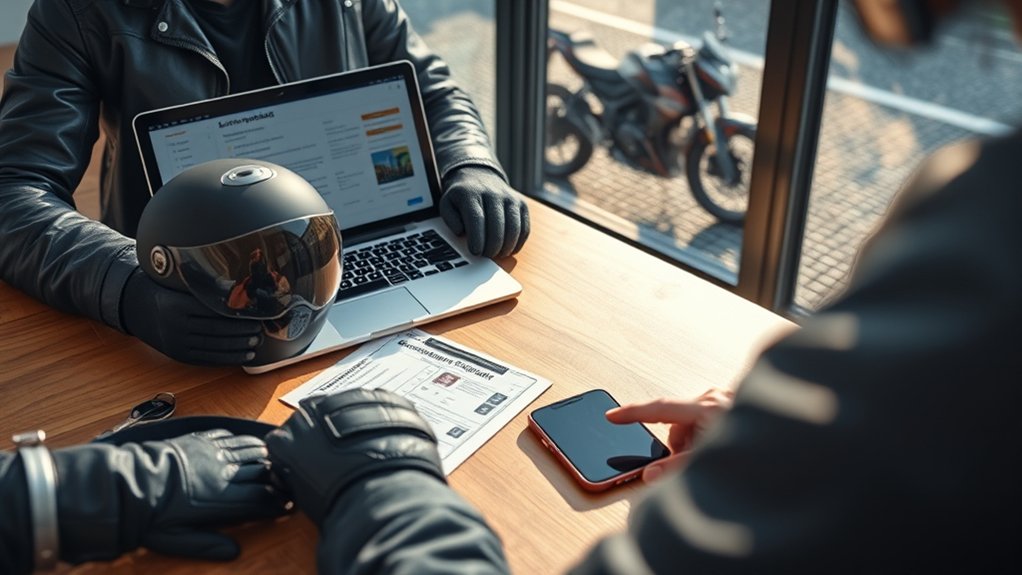
When it comes to getting your motorcycle license, you can handle several steps online, but some critical parts still require in-person attention. You can complete the MSF Basic eCourse online in about three hours. It serves as a useful introduction but doesn’t replace the in-person MSF Basic RiderCourse or grant you an endorsement.
Many state DMVs let you submit applications, pay fees, and schedule written or road test appointments online. However, vision tests, road skills evaluations, and endorsement issuancementtypically need to be done in person. While some states accept certificates from approved online training to waive certain tests, you must confirm this with your DMV.
Renewals and updates can often be done online, but adding a motorcycle endorsement usually requires proof of motorcycle training or passing tests live.
Why Hands-On Motorcycle Training Is Essential
Mastering motorcycle riding demands more than just reading or watching tutorials. You need hands-on training to build essential skills that online courses can’t fully provide.
Mastering motorcycle riding requires hands-on training beyond tutorials to develop essential, practical skills.
A motorcycle safety course offers supervised on-bike exercises where instructors correct your posture, throttle control, and emergency braking techniques in real time. These muscle-memory skills, like slow-speed balance and counter-steering, are critical for safe riding and can’t be developed through online modules alone.
Plus, in-person training ensures you meet state standards required for a motorcycle endorsement, often exempting you from further testing. Certified instructors also simulate real-world hazards and teach proper protective gear use, helping you shift safely from off-road to street riding.
Without this practical experience, you risk developing dangerous habits and missing crucial safety knowledge.
What State Rules Mean for Your Online Motorcycle License
Although online courses can jumpstart your motorcycle education, state rules strongly influence whether they count toward your license. Most states require an in-person skills course to complement online training before issuing a motorcycle endorsement or permit.
You’ll need to check with your local DMV since motor vehicles laws vary widely. This affects how your driver’s license process unfolds.
| State | Online Course Accepted? | In-Person Skills Required? |
|---|---|---|
| California | Yes (knowledge only) | Yes |
| Texas | Limited acceptance | Yes |
| New York | No | Yes |
What the MSF Basic eCourse Covers: And What It Doesn’t
Understanding what the Motorcycle Safety Foundation (MSF) Basic eCourse offers helps clarify how online training fits into your rider education.
This fully online, interactive three-hour program introduces new motorcycle riders to essential topics like motorcycle controls, personal protective gear, roadway positioning, hazard recognition, braking fundamentals, and collision avoidance strategies.
It uses videos, animations, and quizzes to build foundational riding knowledge and risk management skills.
However, the MSF Basic eCourse doesn’t replace hands-on training. It lacks coached skills practice, on-bike maneuver instruction, and in-person feedback.
Completing the eCourse grants a certificate needed for the in-person MSF Basic RiderCourse but not a permit or license.
While it’s a valuable knowledge primer, you’ll still need practical riding experience to demonstrate true competence and safety on the road.
How to Practice Motorcycle Skills Beyond Online Training

You can’t just depend on online training to really get good at riding a motorcycle—hands-on practice is key.
Try to find local riding workshops where you can practice different maneuvers safely, with experts right there to guide you and give you instant feedback.
And don’t forget to always wear the proper safety gear; it keeps you protected while you’re gaining confidence on the bike.
Hands-On Riding Practice
Mastering motorcycle skills requires more than just online training; it demands consistent, hands-on practice in controlled environments. Once you obtain a motorcycle, start practicing slow-speed maneuvers like figure-eights and U-turns in an empty parking lot to build balance and throttle control.
Focus on 10–15 focused 10-minute drills per session. Drill emergency braking from 20–30 mph while wearing full gear to develop proper body positioning and stopping technique. Set up a cone course with 10–15 feet spacing to refine throttle control, countersteering, and line selection.
Practice with one hand off the bars and keep your eyes up to improve clutch modulation and situational awareness. By dedicating time to these exercises on your motorcycle, you develop the skills that online courses alone can’t provide.
Local Riding Workshops
Attending local riding workshops gives you a crucial opportunity to practice motorcycle skills under expert guidance beyond what online courses offer.
These workshops provide the new knowledge needed to refine techniques and build real-world confidence.
You’ll move past theory and get hands-on experience in controlled environments, essential for safe riding.
Consider these key practices in local workshops:
- Slow-speed maneuvers like figure-eights and clutch control in empty lots for balance and throttle finesse
- Cone drills spaced 20–30 feet apart to master turning, lane changes, and obstacle avoidance
- Supervised rides with certified instructors offering personalized feedback on positioning and hazard scanning
- Emergency braking practice on dry and wet surfaces to handle traction loss calmly
Safety Gear Importance
Practicing motorcycle skills safely means gearing up properly before you hit the lot or road. To operate a motorcycle confidently and reduce injury risk by over 70%, you must wear a DOT-approved full-face helmet, CE-rated gloves, certified armored jacket and pants, plus over-the-ankle boots.
As you prepare to get your license, remember that mastering slow-speed maneuvers and emergency braking requires repeated, focused drills in a safe environment. Structured practice sessions paired with video feedback or instructor guidance accelerate your learning.
While online courses help with theory, they don’t replace hands-on training or the essential use of proper safety gear when you practice. Never skip this step if you want to operate a motorcycle responsibly and protect yourself during real-world riding.
Where to Find State-Approved In-Person Motorcycle Courses Near You
To track down state-approved in-person motorcycle courses near you, start by checking the South Carolina DMV website or calling local offices to confirm which training options meet state requirements. Many offerings, including the Motorcycle Safety Foundation (MSF) Basic RiderCourse, are available at multiple locations, with some generated by AI tools to streamline new account registrations.
Before enrolling, verify course duration, cost, instructor credentials, and whether completion grants permit waivers or insurance discounts.
Consider these tips to find the best fit:
- Search by zip code to locate nearby training centers and dealerships
- Look for specialized classes like women-only or one-on-one coaching
- Confirm availability of loaner motorcycles and gear for beginners
- Use quick quizzes or direct contact to match your skill level and schedule
This cautious approach guarantees you select a legitimate, effective course.
Frequently Asked Questions
How Long Does It Take to Get a Motorcycle License Online?
The processing time to get your motorcycle license online varies widely due to eligibility limits set by your state. While you can complete an online course quickly, you’ll still need in-person riding sessions and tests to qualify.
This means total time ranges from a few days to several weeks or months, depending on course availability and DMV scheduling. So, don’t expect a fully online license without completing those essential hands-on requirements first.
Are Online Motorcycle Courses Cheaper Than In-Person Classes?
Yes, online motorcycle courses typically cost less than in-person classes, offering a clear cost comparison advantage. You’ll find enrollment incentives like free access or discounted rates through partnerships, making them budget-friendly.
However, keep in mind these courses usually cover only theory, so you’ll still need hands-on training to meet licensing requirements. So, while online courses save money upfront, factor in the full cost of practical sessions to complete your certification.
Can You Retake the Online Motorcycle Knowledge Test if You Fail?
You can usually retake the online motorcycle knowledge test if you fail, but the retake policy and testing limits depend on your state’s DMV rules.
Many states cap the number of attempts and require waiting periods between tries, so you’ll want to check those specifics carefully.
Some states also charge fees for each retake.
Staying informed about these policies helps you plan your preparation and avoid surprises during the licensing process.
Do Online Motorcycle Courses Provide a Completion Certificate?
Think of the completion certificate as your digital trophy, a symbol of your commitment and progress.
Yes, online motorcycle courses provide course verification in the form of a digital badge or certificate.
This document typically includes your name, course details, and completion date.
However, keep in mind that while it proves you’ve finished the course, it often doesn’t replace in-person skills training required for full licensing or endorsement by your state.
Is Insurance Affected by Completing Online Motorcycle Training?
Completing online motorcycle training alone usually won’t lower your insurance premiums because insurers prefer proof of hands-on skills.
Without an approved in-person course certificate, you might face policy exclusions or miss out on discounts.
To protect your coverage and save money, always check if your insurer requires a classroom-plus-skills course.
Bringing a valid completion certificate from an approved in-person course can help you avoid exclusions and reduce premiums confidently.
Conclusion
Getting your motorcycle license online can be a helpful first step, but it’s not the whole journey. Think of online courses as the map. You still need to ride the road through hands-on training to truly master your skills.
State rules mean you’ll likely need in-person practice to stay safe and legal. So, while the digital path is convenient, don’t skip the real-world experience that keeps you protected on every twist and turn.