How To Get Motorcycle License In Illinois – Full Guide
To get your motorcycle license in Illinois, you must be at least 16 and complete driver’s education if you’re under 18. Pass the vision and written tests, then get a permit that requires supervised riding.
Complete the Cycle Rider Safety Training Program or pass the riding skills test unless you’re 18 or older and have completed the IDOT course. Choose Class M for motorcycles 150cc or larger, or Class L for smaller bikes.
You’ll also need proper ID, documents, and insurance coverage. Explore the steps ahead to understand all the requirements and options.
Illinois Motorcycle License Types and Eligibility Requirements

When you’re ready to ride in Illinois, you need to understand the different motorcycle license types and their eligibility requirements. The Class M license is essential if you want to operate any motorcycle or motor-driven cycle with an engine of 150cc or larger.
Understanding Illinois motorcycle license types is key to legally riding bikes with engines 150cc or larger.
Applicants aged 16–17 can get a Motor-Driven Cycle permit after completing driver’s education and passing vision and written tests. This permit lasts 24 months and requires supervision by a licensed rider 21 or older with at least one year of experience.
For those 18 and older, getting a motorcycle permit involves passing vision and written tests. It’s valid for 12 months and has similar supervision rules.
To earn a Class M license, you’ll take a riding test unless you complete an IDOT Motorcycle Rider Course, which waives this requirement.
Choosing Between Class M and Class L Licenses
When you’re deciding between a Class M and a Class L license, the first thing to think about is your motorcycle’s engine size.
Class L is for motor-driven cycles under 150cc, while Class M is needed if your bike is 150cc or bigger.
This choice isn’t just about what you can legally ride—it also impacts your insurance and liability coverage.
Engine Size Criteria
Two distinct license classes, Class L and Class M, depend primarily on your motorcycle’s engine displacement. For a motorcycle license in Illinois, if your motor-driven cycle has an engine displacement under 150cc, you must choose Class L. This class specifically covers motor-driven cycles below 150cc.
Conversely, if your motorcycle’s engine displacement is 150cc or greater, you need a Class M license. This license authorizes operation of any motorcycle regardless of size.
Before applying, verify your vehicle’s engine size using the manufacturer’s specifications to make certain you select the correct class. Remember, riders aged 16–17 may start with a Class L permit, while those 18 and older can use an IDOT course completion card to waive some testing for Class M licensure. But engine size still dictates your license class.
License Privileges Comparison
Although both Class L and Class M licenses allow you to operate motor-driven cycles, your choice markedly affects the types of motorcycles you can legally ride and the licensing requirements you’ll face. Class L covers motor-driven cycles under 150cc, while Class M lets you ride any motorcycle, including those with engines 150cc or larger. Your age and experience also determine permit eligibility and testing obligations.
Consider these key points when choosing between licenses:
- Class L is available for 16–17-year-olds with driver’s education and requires supervised riding.
- Class M is for applicants 18+, with options to waive road testing via an IDOT Motorcycle Rider Course.
- Class M offers broader motorcycle coverage, including larger engines.
- Class L involves more restrictions and limited engine capacity.
Choosing Class M signals thorough training and wider riding privileges.
Age and Education Requirements for Riders
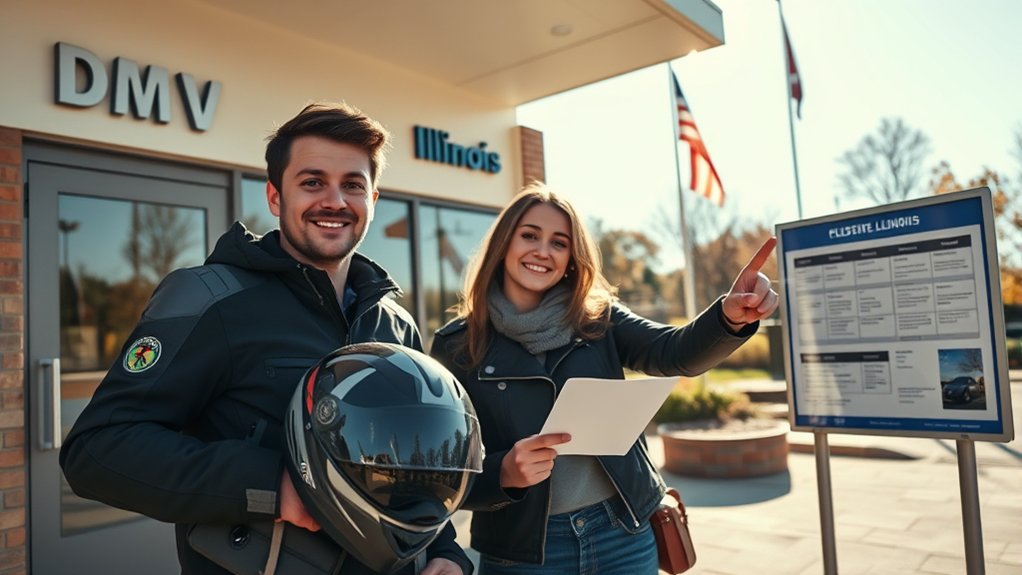
To get a motorcycle license in Illinois, you must meet specific age and education requirements designed to guarantee rider safety and competence. You need to be at least 16 years old to apply.
If you’re 16 or 17, you must complete driver’s education, pass vision and written motorcycle tests, and obtain a Motor-Driven Cycle permit valid for 24 months.
Minors must also complete a motorcycle safety class and pass an on-motorcycle driving exam to get a Class M license.
If you’re 18 or older, you can get a Motorcycle permit after passing vision and written tests. Completing the IDOT Motorcycle Rider Course waives the on-bike driving test for adults.
All permits require supervised riding with a licensed rider aged 21 or older with one year’s experience, emphasizing motorcycle safety throughout.
Enrolling in the Free Cycle Rider Safety Training Program
To enroll in the Free Cycle Rider Safety Training Program, you need to be at least 16 years old and have a valid driver’s license. If you’re under 18, you’ll also need parental consent.
The program offers several course options. There’s the Basic Rider Course, which is required for minors, and then there are advanced classes for more experienced riders.
When you’re ready to register, just reach out to the program via email or check your local listings. Don’t forget to bring your valid ID and any necessary documents to the class. It’s pretty straightforward!
Eligibility Requirements Overview
When you enroll in Illinois’ free Cycle Rider Safety Training Program, you must be at least 16 years old and either hold a valid Illinois driver’s license or motorcycle permit.
If you’re under 18, written parental or guardian consent is required before starting.
This program is essential for anyone pursuing an Illinois motorcycle license, as it offers a pathway to waive the on-motorcycle driving test if you’re 18 or older.
Key eligibility requirements include:
- Being an Illinois resident aged 16 or older
- Holding a valid Illinois driver’s license or motorcycle permit at enrollment
- Obtaining written consent if under 18
- Completing the safety training to receive the IDOT Motorcycle Rider Course Student Completion Card
Meeting these guarantees you’re prepared and qualified for the licensing process.
Course Options Available
Completing the eligibility requirements sets the stage for enrolling in Illinois’ free Cycle Rider Safety Training Program. You can choose from several course options tailored to different skill levels and needs.
The program offers the Basic Rider Course, Basic Rider Course 2, 3-Wheel Basic Rider Course, and Advanced Rider Course. If you’re under 18, you’ll need written parental or guardian consent before enrolling.
Illinois residents aged 16 and older with a valid driver’s license or motorcycle permit qualify to participate. Successfully completing an IDOT Motorcycle Rider Course within the Cycle Rider Safety Training Program earns you a Student Completion Card.
This card waives the on-motorcycle driving exam if you’re 18 or older. For further details and course materials, contact DOT.Motorcycles@illinois.gov or DOT.PIE@illinois.gov.
Enrollment Process Steps
Although enrolling in Illinois’ free Cycle Rider Safety Training Program requires meeting certain eligibility criteria, the process itself is straightforward.
To get started with the IDOT Motorcycle Rider Course, make certain you:
- Are 16 or older with a valid driver’s license or motorcycle permit; under 18s need written parental consent.
- Register early through the official portal or contact DOT.Motorcycles@illinois.gov to confirm course availability.
- Complete the full Basic Rider Course curriculum to earn the IDOT Motorcycle Rider Course Student Completion Card, which waives the on-motorcycle license test.
- Bring your valid license or permit and required gear, like a helmet and jacket, to every class session.
If you’re under 18, make certain you complete the 24-month instructional permit phase after driver education before proceeding.
Using the Illinois Motorcycle Operator Manual
By consulting the Illinois Motorcycle Operator Manual, you gain access to all-encompassing guidance on everything from ride preparation to collision avoidance. This official handbook, published by the Illinois Department of Transportation, covers essential topics like using mirrors, performing hand checks, signaling, and ensuring motorists see you.
It details collision avoidance techniques, intersection handling, and spotting hazardous road surfaces to enhance your safety. The manual also guides you through mechanical and operational checks, carrying passengers and cargo, and pre-ride inspections.
Importantly, it links licensing requirements with practical riding knowledge, helping you understand both the test content and real-world expectations. Using the Illinois Motorcycle Operator Manual alongside practice tests markedly boosts your readiness for the written motorcycle exam and safe riding practices.
How to Pass the Written Motorcycle Knowledge Test

Mastering the written motorcycle knowledge test starts with thorough study of the Illinois Motorcycle Operator Manual and taking official practice tests. You’ll need to pass this written motorcycle test, along with a vision test if you’re a first-time applicant, to get your permit.
Thoroughly study the Illinois Motorcycle Manual and pass the written and vision tests to earn your permit.
Focus on key topics to guarantee success:
- Ride preparation essentials, including proper gear and bike checks
- Signaling, mirrors, and lane positioning techniques
- Collision avoidance strategies and hazard recognition
- Rules on carrying passengers and performing hand checks
If you’re 16–17, completing driver’s education is mandatory before taking the test. For adults 18 and older, passing the written test or completing the IDOT Motorcycle Rider Course sets you up to safely advance. Prepare well, and you’ll confidently pass the written motorcycle test on your first attempt.
Schedule and Pass the Motorcycle Riding Test
To obtain your Class M motorcycle license in Illinois, you’ll need to schedule and pass the on-motorcycle riding test at a Secretary of State facility unless you’ve completed the IDOT Motorcycle Rider Course. This course waives the test requirement for applicants 18 and older.
You must bring your own motorcycle and proper riding gear. The test evaluates your ability to perform basic maneuvers, maintain control, and conduct safety checks.
If you’re under 18, completing a 24-month instructional permit and passing this riding test is mandatory. To schedule your test, bring required identification, proof of fee payment, and a completion card if you finished a rider safety training program.
Make certain your motorcycle meets Illinois safety and insurance standards before the test for a smooth licensing process.
Required Documents and Application Steps
If you want to apply for your motorcycle license, you’ll need to bring some important documents with you. Make sure you have valid identification handy. Also, if you’ve completed a motorcycle safety course, don’t forget to bring proof of that too.
Knowing the steps ahead of time can really make the process easier. It helps you avoid any unnecessary hold-ups. So, before you head to the DMV, double-check that you have all the required paperwork ready. This way, your application will go through smoothly without any hiccups.
Identification Requirements
Although the process of obtaining a motorcycle license in Illinois involves several steps, starting with the right identification documents is essential.
You must present acceptable ID and proof of residency to apply for your license or permit. Here’s what you need to bring:
- Valid primary ID, such as a birth certificate or passport
- Social Security number
- Two residency documents proving Illinois address
- For applicants under 18, completion proof of a driver education program and the IDOT Motorcycle Rider Course Student Completion Card
All applicants must pass a vision screening and written knowledge test unless you hold a qualifying Illinois license.
Application Process Overview
Since obtaining your motorcycle license involves several key steps, you’ll need to prepare specific documents and complete required tests at the DMV.
First-time applicants must pass a vision test and the written motorcycle knowledge exam, presenting proper ID and paying fees.
If you’re 16 or 17, complete driver’s education to qualify for a Motor-Driven Cycle permit, valid 24 months with supervised riding.
Those 18 and older get a Motorcycle permit valid 12 months under similar supervision rules.
Completing the IDOT Cycle Rider Safety Training waives the on-motorcycle skills test for adults, but riders under 18 still must take it.
Decide between Class L or Class M licenses based on engine size, bring your own bike and gear for the skills test unless waived, and provide your safety course completion card at the DMV.
Document Preparation Tips
While preparing your application for a motorcycle permit or license in Illinois, you’ll need to gather specific documents and meet particular requirements. Ensuring you have the right paperwork and meet all criteria will streamline your process.
Provide proof of identity and residency as required by the Illinois Secretary of State. If you’re under 18, bring the IDOT Motorcycle Rider Course Student Completion Card or proof of approved driver education along with the 24-month instructional permit.
Present your current driver’s license or acceptable ID for written and vision tests, and be ready to take the motorcycle knowledge exam and vision screening. If you’re waiving the on-motorcycle test (18+), bring your IDOT Motorcycle Rider Course completion card.
Otherwise, supply your own street-legal motorcycle and proper riding gear for the road test.
Prepare thoroughly to avoid delays in obtaining your motorcycle license.
Illinois Motorcycle Insurance Requirements
When you ride a motorcycle on Illinois public roads, you must carry liability insurance that meets the state’s minimum coverage requirements: $25,000 for bodily injury per person, $50,000 per accident, and $25,000 for property damage. Illinois law requires proof of insurance during registration and may ask for it during stops.
Not carrying the required insurance leads to fines, registration suspension, and penalties. While these minimums satisfy legal requirements, consider higher coverage or additional protection like collision or uninsured motorist insurance for better financial security.
| Coverage Type | Illinois Minimum | Recommended Coverage |
|---|---|---|
| Bodily Injury (Per Person) | $25,000 | $50,000+ |
| Bodily Injury (Per Accident) | $50,000 | $100,000+ |
| Property Damage | $25,000 | $50,000+ |
How to Choose the Right Motorcycle in Illinois
If you want to choose the right motorcycle in Illinois, start by considering the engine size to match your licensing needs. Class L covers bikes under 150cc, while Class M applies to motorcycles 150cc or larger.
Prioritize safety by selecting a bike that fits your skill level. Beginners should opt for lighter, lower-displacement models under 500cc for better control.
Make certain the motorcycle meets IDOT testing requirements and that you have all necessary riding gear for the on-motorcycle exam or course practice. Also, factor in insurance costs since Illinois mandates minimum liability coverage, which varies by engine size and bike value.
Keep these points in mind:
- Match engine size to license class for proper coverage
- Choose manageable bikes to enhance safety and confidence
- Confirm bike compliance with IDOT test standards
- Consider insurance premiums based on bike specifications
Frequently Asked Questions
Can I Transfer My Out-Of-State Motorcycle License to Illinois?
Yes, you can transfer your out-of-state motorcycle license to Illinois. License transferability means you surrender your current license, pass vision and ID verification, and pay fees at a Secretary of State office.
If you’re 18 or older and have completed an approved safety course, you may skip the riding test. Minors must meet Illinois’s requirements.
Make sure to carry proper insurance and provide your own motorcycle and gear if a riding test is required.
Are There Any Motorcycle License Restrictions for Medical Conditions?
If you have medical restrictions like uncontrolled seizures, severe vision loss, or conditions causing sudden unconsciousness, you must disclose them.
Illinois enforces medical restrictions to guarantee safety, requiring physician documentation or periodic reports.
You might face limitations such as no nighttime riding or restricted license classes, or need to prove fitness through medical evaluations.
Failing to report can lead to suspension, fines, or legal trouble, so always be upfront about your condition.
How Often Do I Need to Renew My Illinois Motorcycle License?
You need to renew your Illinois motorcycle license according to the same license renewal frequency as your regular driver’s license, typically every four years.
Keep in mind, completing an IDOT Motorcycle Rider Course can waive the riding test but won’t affect this renewal schedule. Always make sure your insurance and required documentation are current before renewal.
Staying on top of the license renewal frequency helps you avoid lapses and keeps you legally riding.
Are Motorcycle Helmets Mandatory Under Illinois Law?
Wearing motorcycle helmets in Illinois is mandatory for riders and passengers under 18, like a shield protecting a knight in battle.
If you’re 18 or older, helmets aren’t legally required, but they’re strongly recommended for safety.
Mandatory helmets greatly reduce head injuries and fatalities in crashes.
Even if not required for adults, many safety courses and insurance policies encourage or require you to wear one, so it’s wise to always gear up.
Can I Get a Motorcycle License if I Have a Suspended Regular Driver’s License?
You can’t get a motorcycle license in Illinois if your regular driver’s license is suspended. Suspension exceptions don’t apply here; you must clear all suspensions first.
That means paying fines, completing court or reinstatement requirements, and meeting financial responsibility rules. Finishing a rider safety course won’t override your suspension.
Check your suspension status with the Secretary of State to know exactly what you need to resolve before applying for a motorcycle license.
Conclusion
Now that you know the essential steps, from choosing your license type to passing the riding test and securing insurance, you’re just moments away from hitting Illinois roads on two wheels. But remember, the real challenge isn’t getting the license. It’s mastering the ride and staying safe every mile.
Are you ready to take that leap? Your journey to freedom and responsibility starts the moment you decide to ride smart and prepared.