How To Measure Head For Motorcycle Helmet – Pro Tips
Wrap a soft cloth tape or string around the widest part of your head.
Measure about 1 inch above your eyebrows and across the occipital bone, keeping it level all the way around.
Measure 2–3 times, then use the largest consistent number in your helmet brand’s size chart.
If you’re between sizes, try the smaller shell first.
A helmet should sit level, feel snug, and not shift when you shake your head.
There’s more to get right, so keep going.
Why Helmet Size Matters

Getting the right helmet size matters because a helmet only protects you when it stays securely in place during a crash. If it shifts or comes off, your head is exposed when you need coverage most.
A helmet only protects you if it stays securely in place during a crash.
A helmet that doesn’t fit properly can create pressure points, cause headaches, and make you skip riding with it. You should choose sizing by head circumference and match that measurement to the manufacturer’s chart, since brands don’t use identical labels.
Even then, head shape affects comfort, so you may need an adjustable fit system or padding inserts to fine-tune the snugness. Don’t rely on a generic “Medium.”
Replace your helmet after any crash. Also replace it when the padding, straps, or age reduce its protection.
How to Measure Your Head
To measure your head correctly, wrap a soft measuring tape (or a string you’ll later measure with a ruler) around the widest part of your head. Position it about 1 inch (2.5 cm) above your eyebrows and across the occipital bone, keeping it level with the floor.
Pull it snug against your skin, but don’t compress your hair. Record the circumference in both centimeters and inches, then repeat the process two or three times to confirm accuracy.
If you wear a ponytail or thick braids, measure your head in your usual riding style. Account for any extra bulk, so the fit matches how you wear your hair.
Next, compare your number with the brand’s helmet size chart, not a generic label. If you’re between sizes, try the smaller one first, since padding compresses. Make sure it feels snug without painful pressure points.
What Tools You Need
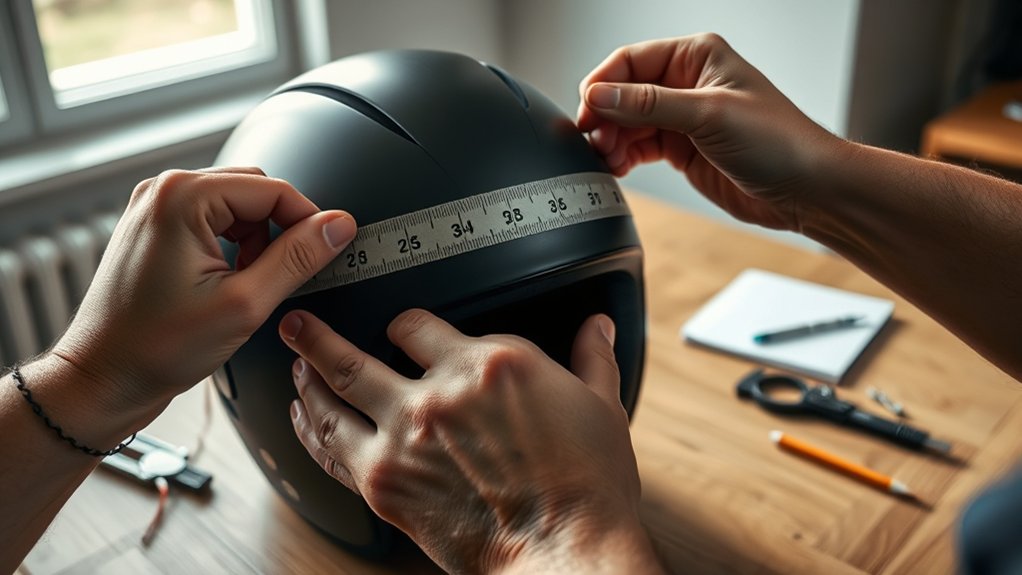
For an accurate helmet fit, you’ll want a flexible cloth or tailor’s measuring tape. A rigid ruler won’t follow the curve of your head.
Keep a mirror nearby, or ask a helper, so the tape stays level. Measure about 1 inch above your eyebrows and over the occipital bone.
Pull the tape snug against your skin, but don’t compress your hair. If you wear a ponytail or braid, measure with it in your normal riding position or account for the added thickness.
Write the measurement in both centimeters and inches, then repeat it 2–3 times. Use the largest consistent value for Size.
If you don’t have a measuring tape, use string and then compare it with a ruler. Keep pen and paper ready for notes.
How to Read Motorcycle Helmet Size Charts
You should match your head measurement to each brand’s size chart, because labels like Small, Medium, and Large don’t stay consistent across manufacturers. If you land between two sizes, follow the brand’s guidance—and see whether the helmet includes adjustable fit pads or extra liners.
Also, double-check the chart itself: confirm the measurement method, the units used, and any head-shape notes. That way, you’ll choose a fit that actually works for you.
Read Brand Size Charts
How do you make sense of a motorcycle helmet size chart?
Start with your exact head circumference, then compare it to the helmet brand’s chart, not a generic one.
Measure at the widest point, about 1 inch above your eyebrows, and over the occipital bone.
Use that same value in centimeters or inches.
For example, one helmet brand may list 51–55 cm as Small, 54–61 cm as Medium, and 61–65 cm as Large.
If you land on a boundary, check both helmet sizes or choose the smaller size first, since padding can compress.
Also, read notes on head shape, such as round, oval, or intermediate.
Look for guidance on hair, liners, and how snug the helmet should sit.
Match Measurement To Fit
Once you’ve measured your head, match that exact centimeter or inch value to the helmet brand’s size chart. Don’t rely on a generic M or L label, since sizing varies a lot between manufacturers.
Use the brand’s chart to find the closest fit. Also consider head shape, because round, oval, or intermediate profiles can change how the helmet feels.
If you’re between sizes, try the smaller one first. Choose the larger size only if the smaller option creates painful pressure points.
Check the chart’s range overlap too. The same head measurement can map to different labels depending on the brand.
Confirm the fit with a quick check. You should have 1–2 fingers above your eyebrows, snug cheek pads, and no shifting when you shake your head.
How to Check Helmet Fit at Home

After you measure your head circumference, try the helmet on. Check that it sits level, about 1–2 fingers above your eyebrows, with no forward or backward tilt.
Buckle it, then shake your head side to side and up and down. You want your skin to move slightly, but the shell shouldn’t shift or lift.
Next, check the cheek pads. They should contact your cheeks snugly, without pain, and the chin strap should allow only one finger beneath it.
For the right fit, wear the helmet for 10–15 minutes. Watch for pressure points, dizziness, or redness.
Also make sure your peripheral vision stays clear. Your sightline shouldn’t be blocked.
If the helmet rocks when you open your mouth, adjust the interior padding or try a different size.
Signs Your Helmet Is Too Tight or Too Loose
A helmet can look right at first but still fit badly once you ride.
If you feel persistent pressure on your forehead, temples, ears, or jaw, it’s too tight.
Persistent pressure on your forehead, temples, ears, or jaw usually means the helmet is too tight.
Red marks, headaches, dizziness, or numbness after a few minutes also signal an ill-fitting helmet.
If it shifts when you shake your head, lifts at the chin bar, or tilts enough to block your road view or gauges, it’s too loose.
Check the chin strap too.
You should fit only one finger between the strap and your chin.
More space means the helmet is loose.
Pinching means it’s too tight.
- Pain or red marks = too tight
- Movement or rubbing = too loose
- Strap test = one finger only
- Vision blocked = poor fit
How Head Shape Affects Helmet Fit
Your head shape affects how the helmet actually sits against your skull, so a “round” fit usually won’t feel right on an oval head. On the flip side, an oval fit can leave noticeable gaps on a round head.
A quick way to tell: if you feel pressure around your temples, or if you can see space at your forehead or toward the back of your head (occiput), the shape match isn’t right. Measure your head circumference, look at the brand’s round/oval fit chart, and pick the shell shape that matches your contour first.
Round Vs Oval Fit
Head shape matters just as much as circumference when you’re choosing a motorcycle helmet. The shell and padding are built for different profiles, so the fit depends on more than size alone.
A round fit suits heads with similar front-to-back and side-to-side measurements. An oval fit works better when your head is longer front-to-back than side-to-side.
Measure your circumference, then check your forehead-to-back length to judge your shape. Manufacturers may label these profiles differently, so follow their guidance, not just the size chart.
Round: equal dimensions.
Oval: longer front-to-back.
Match your shape before you make any size tweaks. Use pads to fine-tune the fit.
If you’re between sizes, pick the shell that matches your head form first. Then adjust snugness with cheek pads or liners, since padding changes more easily than the shell.
Shape Impacts Pressure Points
Helmet fit isn’t just about circumference. Your head shape decides where pressure builds inside the shell.
If you have a round, intermediate oval, or long egg-shaped head, the same helmet can touch you very differently. On an oval head, a round-fit shell often pinches at the temples.
On a round head, an oval shell can press the forehead and base of the skull. During a 15-minute wear test, feel for hot spots at the widest part, forehead, temples, and occipital area.
Check manufacturer fit labels like Round, Oval, or Intermediate Oval, and match them to your profile. Adjustable liners and cheek pads can fine-tune comfort.
But they won’t fix a fundamentally wrong shell. If you’re between sizes, pick the shape that matches your longer front-to-back measurement.
Why a Dealer Fitting Helps
A dealer fitting takes the guesswork out of helmet selection.
They measure your head with a soft tape, check its shape, and match you to the right size and fit system.
You get a fit that feels secure, not just close. The fitter can try several brands, adjust pads, and spot issues you might miss at home.
- Check round, oval, or intermediate shapes
- Test comfort for 10–15 minutes
- Confirm no shift when you shake your head
- Set chin strap and eyebrow position correctly
That hands-on process helps you choose the right size if you’re between charts. It also helps prevent pressure points, cheek gaps, or vision issues.
You’ll leave with practical guidance and a helmet that fits better from the start.
When to Replace Your Motorcycle Helmet
Once you’ve found a helmet that fits well, knowing when to replace it matters just as much. Replace yours right after any crash or hard impact, even if your head sees no visible damage. Hidden EPS crush can weaken protection.
Also, swap it every 3–5 years since foam, liners, and straps age.
| Trigger | Action | Why it matters |
|---|---|---|
| Crash/impact | Replace now | Hidden damage |
| 3–5 years | Replace soon | Material aging |
| Wear signs | Replace sooner | Fit declines |
Check for cracks, dents, frayed straps, flat padding, dizziness, or pressure points. If it no longer sits 1–2 fingers above your eyebrows, it’s not the right fit. After severe drops, mods, or missing parts, follow the maker’s guidance and replace it.
Frequently Asked Questions
How Often Should I Remeasure My Head for a Helmet?
You should remeasure your head before every new helmet purchase, whenever you switch brands, and after any major weight, hairstyle, or jawline change.
Check it at least once a year, since your fit can drift over time.
Remeasure right after any crash or impact.
Also, measure again if you replace padding or add liners.
If your helmet feels different, trust that signal and measure again.
Can Hair Volume Change My Helmet Size Choice?
Yes, hair volume can change your helmet size choice.
If you ride with buns, ponytails, braids, or thick hair, measure with that hairstyle on.
It can add 1–3 cm and make a helmet feel too tight.
If you usually ride with short or thin hair, use your bare-head measurement.
When you’re between sizes, choose the fit that stays snug without pressure points.
Then recheck the size on the helmet.
Should I Measure Over a Balaclava or Hat?
Measure over a balaclava if that’s what you normally ride in.
It adds a little bulk and helps you get the right fit.
Don’t measure over a thick hat or winter cap.
It can lead you to choose a helmet that’s too big.
If you sometimes wear headwear and sometimes don’t, take both measurements.
Then size for the larger one.
Finally, check the brand’s size chart before you buy.
Do Different Helmet Brands Fit the Same Size Differently?
Yes, different helmet brands can fit the same labeled size differently.
One brand’s Medium may feel tight, while another’s feels roomy.
That’s because shell shape, liner thickness, and cheek-pad design can vary.
So the “same size” doesn’t always mean the same fit.
Measure your head circumference and compare it to each brand’s size chart.
If you’re between sizes, try both.
Whenever possible, buy from a seller with easy returns.
How Do I Measure if I Have Asymmetrical Head Shape?
You measure it by taking three circumference readings: the widest point about 1 inch above your eyebrows, then 1–2 cm higher and lower.
Use the largest consistent number.
Next, check temple-to-temple and forehead-to-occiput distances to spot side-to-side differences.
As the saying goes, measure twice, cut once.
If you’re between sizes, choose the smaller one and rely on adjustable padding or a fitter for a secure, even fit.
Conclusion
Now you know how to measure your head and choose the right motorcycle helmet size.
Take your measurements carefully, compare them with the brand’s chart, and check the fit at home before you ride.
A helmet should feel secure, not painful.
It should match your head shape as well as your size.
Think of the right helmet as your armor on the road.
When it fits well, you ride with more comfort, confidence, and safety.