What Does Ducati Mean – Quick Answer
Ducati doesn’t mean a common Italian word. It’s the plural surname of the Cavalieri Ducati family, who founded the company in Bologna in 1926.
So when you see Ducati, you’re seeing a proper name tied to its origin, not a dictionary term. Over time, the name came to signal Italian engineering, racing pedigree, and high-performance motorcycles. There’s more behind that badge if you want the full story.
Ducati’s Name and Founding Story

Ducati takes its name from the Cavalieri Ducati family—Adriano, Marcello, and Bruno—who founded the company in Bologna, Italy, in 1926.
You should note that the firm began as Società Scientifica Radio Brevetti Ducati. Early work centered on radios and electrical components.
In 1946, Ducati introduced the 48-cc Cucciolo, its first motorized product. It pushed the company toward two-wheeled engineering.
By 1950, it had launched its first sporting motorcycle with a 175-cc four-stroke engine. This set the technical foundation for Ducati motorcycles.
In 1996, Ducati Motor Holding S.p.A. reorganized the motorcycle business. This helps track its global manufacturing and brand expansion.
What Ducati Means in Italian
In Italian, the name refers to the Ducati family surname—Adriano, Marcello, and Bruno Cavalieri Ducati—rather than to a separate dictionary word.
In Italian, Ducati refers to the family surname, not a separate dictionary word.
You don’t get a direct English translation because Ducati functions as a proper noun, specifically the plural form of a surname from Bologna.
When you see it in historical context, you’re seeing a family identifier tied to the company’s 1926 founding name, Società Scientifica Radio Brevetti Ducati.
For you, that means the term’s meaning is mainly historical and brand-based, not lexical.
Today, Ducati suggests Italian engineering, prestige, and high-performance motorcycles.
Ducati’s Racing Heritage

You can trace Ducati’s identity back to its racing roots, starting in 1951, when the brand began turning track competition into a core engineering focus. And that impact is easy to see: factory wins in World Superbike, MotoGP, and landmark events like Imola and the Isle of Man TT didn’t just build prestige—they pushed development forward, including desmodromic valvetrains, L-twin evolution, and later the V4 platform.
Then, when you look at Ducati’s lineup today, that same track-to-street transfer shows up clearly in race-derived models like the 750SS Imola Desmo and the 900SS Superlight, as well as in modern favorites like the Panigale and Streetfighter V4.
Racing Roots
From 1951 onward, Ducati’s racing program steadily shaped both its engineering and its brand identity. You can trace that influence through wins in World Superbike and MotoGP. Competition pushed development to move faster.
You can also point to Paul Smart’s 1972 Imola victory and Mike Hailwood’s 1978 Isle of Man TT win on a 900 desmo. Those results boosted Ducati’s international reputation.
On the technical side, race-derived solutions include the desmodromic valve system, L-twin and V4 layouts, and stiff chassis parts. These changes improved control and reliability.
Ducati then applied those lessons to road machines like the Panigale and Streetfighter. Limited models such as the 750SS Imola Desmo and Superleggera V4 preserve the brand’s competition DNA in restricted production runs.
Track-To-Street Legacy
Ducati’s racing heritage didn’t stay on the track.
It shaped the bikes you can buy today.
You get race-derived engineering in desmodromic valves, tuned L-Twin and V4 engines, and chassis geometry refined through racing.
Ducati’s 1951 debut, plus wins by Paul Smart and Mike Hailwood, built a reputation that fed directly into production.
You can see that transfer in Brembo brakes, advanced suspension, carbon parts, traction control, and ride-by-wire systems.
World Superbike and MotoGP success keeps pushing limited-edition road models, from the 750SS Imola Desmo to Panigale V4 variants.
Ducati’s “born to race” strategy means your street bike isn’t just styled like a racer.
It carries track-tested performance, handling, and electronics into everyday riding.
Ducati’s Signature Design Language
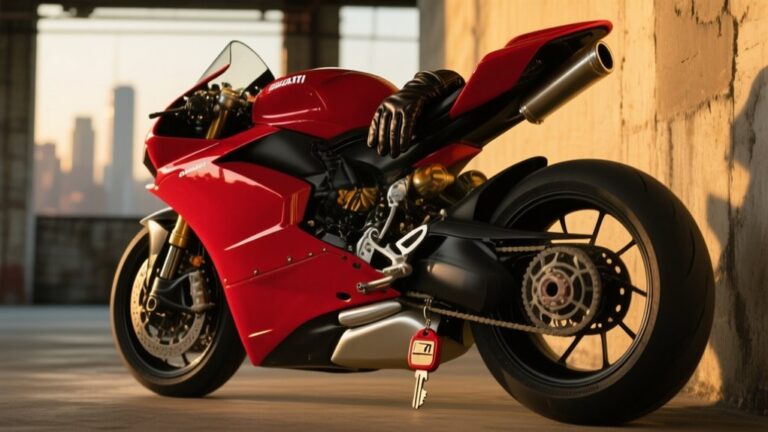
You’ll notice Ducati’s signature look right away: the iconic red bodywork, sharp aerodynamic lines, and an aggressive stance all say “performance” before the engine even starts.
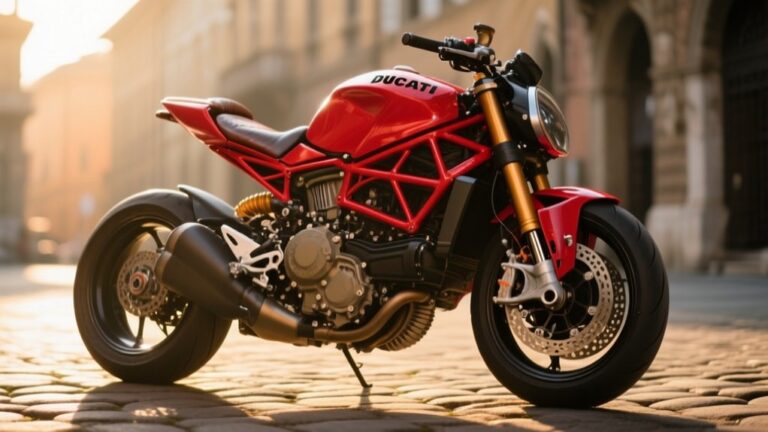
And the exposed trellis frame? That isn’t just structural—it’s a visual signature that boosts chassis stiffness while reinforcing Ducati’s technical identity.
Then there’s the single-sided swingarm, which really completes the silhouette.
It also helps with maintenance access, but it mainly delivers that unmistakable Ducati profile you can recognize at a glance.
Iconic Red Styling
Ducati Red is more than a paint choice; it’s a visual shorthand for the brand’s performance identity.
You see it on Ducati racing-inspired flagships like the 916, Panigale, and Monster.
The color signals speed, pedigree, and intent.
Ducati’s styling pairs this red with aerodynamic surfaces and a ready-to-attack stance.
- Sharp fairings reduce visual bulk.
- Sculpted tanks emphasize control.
- Undercut seats sharpen the silhouette.
- Red lacquer, LED lighting, and carbon details reinforce the premium race-derived look.
You’ll notice how Italian craftsmanship makes the design feel precise, not decorative.
Every line supports form-meets-function, so the bike looks engineered for motion before you even start it.
Trellis Frame Design
The trellis frame is Ducati’s welded steel lattice: a network of thin tubes joined in triangular sections.
It keeps weight down while maintaining high torsional rigidity.
You get a chassis that blends stiffness with controlled flex.
So the bike turns in predictably and gives clear feedback at the bars.
Ducati popularized this layout on road bikes in the 1970s and 1980s.
You still see it on icons like the 916.
Thin-diameter, high-strength tubes and careful node geometry reflect Italian engineering focused on performance and feel.
Even as some models move to aluminum or carbon fiber, the trellis remains Ducati’s signature design language.
You still see it on machines like the Monster and Hypermotard.
Single-Sided Swingarm
Another hallmark of Ducati’s chassis philosophy is the single-sided swingarm. It’s a rear suspension setup that leaves one side of the wheel exposed for a distinctly Italian look.
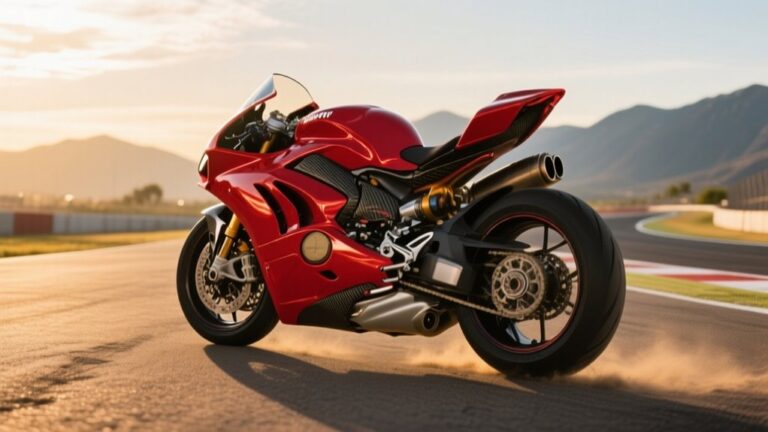
You’ll see it on icons like the 916, 999, and Panigale. Ducati uses the single-sided swingarm to blend style with serviceability.
It helps you remove the rear wheel faster for tire changes and track prep. Ducati also pairs it with a single-sided exhaust and hub for cleaner visual balance.
Though it can weigh a bit more than a double-sided design, engineers tune the structure for stiffness. That means reduced flex and sharp handling.
- Faster wheel removal
- Strong visual identity
- Precise chassis feel
- Strong resale appeal
How Ducati Engineering Sets It Apart
What really sets Ducati apart is how deeply its engineering serves performance. The desmodromic valve system mechanically closes valves instead of using springs. That lets engines rev higher with tighter valve control.
The brand’s L-twin and V4 layouts also help with compact packaging and a strong torque curve. You get a machine shaped by racing-derived engineering. Mapping, aerodynamics, and chassis geometry keep evolving from MotoGP and WSBK data.
Ducati also pairs trellis frames, single-sided swingarms, and carbon components. Together, these boost the stiffness-to-weight ratio and sharpen handling. Then it adds ride-by-wire, traction control, ABS, cornering electronics, DVT, and electronic suspension.
With those systems, you can tune delivery for road or track with precision. That engineering focus gives you measurable performance, not just style.
Ducati’s Most Iconic Models

You can really trace Ducati’s identity through classic legends like the 750SS and the 916, because they combine V-twin performance with race-winning engineering and that unmistakable design.
And if you look at where Ducati goes next, you’ll also see how modern icons like the Monster, Panigale V4, and Multistrada broaden the lineup—moving beyond naked-bike simplicity into superbike thrills and sport-touring comfort.
Taken together, these models show how Ducati manages to balance heritage and innovation, while still delivering performance you can feel in the real world.
Classic Ducati Legends
Ducati’s classic legends track the brand’s evolution from sporting innovation to superbike dominance. You can see Ducati’s racing heritage in four landmark machines.
- 1973 GT750 Sport Desmo — Ducati’s first limited-edition high-performance 750cc model. It had an adjustable front fork, Brembo brakes, and only 500 built.
- 750SS/750 Super Sport — Launched in 1975, it delivered versatile large-capacity performance. It also strengthened Ducati’s sportbike credibility.
- 916 — Introduced in 1994, it featured underseat exhausts and a single-sided swingarm. Powered by a 916cc L-twin, it helped Ducati win multiple World Superbike titles.
- 998/999R — These race-derived successors extended desmodromic engineering. They sharpened chassis dynamics and carried Ducati’s competition DNA into the 2000s.
Modern Iconic Models
Modern Ducati icons didn’t just sell well. They reshaped whole motorcycle categories.
When you look at the Ducati 916, you see the 1990s sportbike template. That means under-seat exhausts, a single-sided swingarm, and a race-derived 916cc L-twin.
The Monster, introduced in 1993, gave you the modern naked-bike formula. It features an exposed trellis frame and delivered huge global sales.
Then the Panigale line, starting with the 1199 in 2011, pushed Ducati Motor Holding S.p.A. engineering forward. It uses an aluminum monocoque chassis and later added V4 power.
The Multistrada adds real-world versatility with rider aids and comfort. It also keeps evolving with different engine layouts.
If you want the extreme end, the 2019 Superleggera V4 shows Ducati’s track-first mindset. It pairs titanium and magnesium with exceptional power-to-weight.
How Ducati Became a Global Brand
Ducati grew from an Italian motorcycle maker into a global performance brand by combining early international expansion, racing credibility, and product innovation.
You can trace its rise through:
- A 1968 New York branch that gave Ducati an early U.S. foothold.
- Racing success, highlighted by wins in World Superbike and MotoGP and historic victories like Mike Hailwood’s 1978 Isle of Man TT, boosted global brand recognition and demand for sport bikes.
- Product evolution from the 1946 Cucciolo to L-Twin and V4 engines, plus desmodromic valve control and race-derived editions, sharpened its premium image.
- Ducati Motor Holding S.p.A. in 1996 and Thailand assembly in 2010 improved worldwide operations and sales.
Media exposure and Italian styling helped you see it exceed 200,000 motorcycles sold by 2015.
Why Ducati Owners Stay Loyal
Often, Ducati owners stay loyal because the brand keeps delivering what they value most: race-proven engineering, sharp handling, and unmistakable Italian style.
You get a machine shaped by racing pedigree, with World Superbike and MotoGP success feeding road-bike tech like desmodromic valves and L-Twin or V4 engines.
That transfer gives you precise throttle response, strong midrange, and confident cornering.
Ducati also strengthens attachment through design cues such as the trellis frame, single-sided swingarm, and red bodywork.
You’ll find loyalty reinforced by advanced electronics, lightweight materials, and limited-edition models that stay desirable.
Dealer support, scheduled maintenance, and official accessories help you preserve performance.
Owners Clubs and World Ducati Week add community, so you’re not just buying a bike.
You’re joining a focused, performance-driven network.
Ducati in Pop Culture and Media
Beyond the garage and racetrack, Ducati shows up as a visual shorthand for speed, style, and Italian engineering in film, anime, racing media, and lifestyle coverage. You’ll spot it in films like Troy and in anime-inspired designs that echo the 916, giving motorcycle manufacturers a benchmark for recognition.
- Film and anime: Ducati models signal high-performance intent instantly.
- Racing media: World Superbike and MotoGP coverage frames Ducati as a technical frontrunner.
- Lifestyle placement: Celebrity riders and product shots link the brand to luxury and Italian design.
- Brand imagery: Red livery, trellis frames, and single-sided swingarms drive ads, games, and merch.
That media presence turns Ducati into a cultural reference point, not just a machine.
Why Ducati Still Matters Today
What keeps Ducati relevant is that it keeps winning, and those racing gains don’t stay on the track for long. You see it in the brand’s engineering excellence, from MotoGP and World Superbike wins to tech that filters into road bikes.
Ducati still pushes desmodromic valve control, L-twin and V4 architectures, and DVT to sharpen power delivery and efficiency.
On the street, you get ride-by-wire, traction control, ABS, and electronic suspension. That gives safer, configurable performance on models like the Multistrada and Panigale.
You also have a culture that sustains demand. Owners Clubs, World Ducati Week, and global sales keep the brand visible.
Finally, Ducati keeps adapting fast to emissions rules and EV pressure. Lightweight materials, carbon fiber, and electric prototypes show it’s moving with the times.
Frequently Asked Questions
What Countries Are Ducati Motorcycles Made In?
Ducati motorcycles are made mainly in Italy, especially in Bologna and Borgo Panigale.
That’s where you’ll find the company’s headquarters, R&D, engine production, and flagship assembly.
You’ll also see some regional assembly in Thailand for ASEAN markets.
Ducati sources parts globally from European and international suppliers, but its core engineering and high-performance manufacturing stay centered in Italy.
Does Ducati Make Scooters or Only Motorcycles?
Ducati makes motorcycles, not mainstream scooters. You’ll find sportbikes, naked bikes, adventure-tourers, cruisers, and high-performance electric concepts in its lineup, but no dedicated scooter range like Piaggio or Honda.
Ducati’s roots include small motorized bicycle engines, such as the 1946 Cucciolo, yet those weren’t scooters. If you’re shopping for a Ducati, you’re buying a motorcycle focused on performance, electronics, and engine character, not urban scooter practicality.
Are Ducati Bikes Good for Beginners?
Yes, you can start on a Ducati, but you should choose carefully.
You’ll do better with beginner-friendly models like the Scrambler 400/800 or Monster 797/821, since they’re smoother and less intimidating than a Panigale V4 or Streetfighter V4.
You’ll also want to bear in mind ABS, traction control, and higher maintenance costs.
If you’re new, take a training course first and budget for premium ownership.
How Much Does a Ducati Cost on Average?
You’ll usually pay about $12,000 to $20,000 for a new Ducati. Though entry models can start near $8,000, and superbikes can top $35,000.
Don’t assume Ducati always means “too expensive.” Used bikes often drop to $5,000 to $15,000, and older midrange models can save you money.
Your final cost depends on trim, electronics, and condition. So compare model-specific pricing before you buy.
What Does the Ducati Logo Represent?
The Ducati logo represents speed, passion, and Italian racing heritage.
You’ll see a stylized shield with a slanted red field that signals motion and performance.
The white band and wordmark add clarity and precision.
The red color reflects Ducati Red, tied to passion and success.
The clean typeface and sharp geometry reinforce modern engineering.
It also highlights sporty design and a high-performance brand identity you can recognize worldwide.
Conclusion
So, what does Ducati mean? In simple terms, it’s a family name from Bologna, now synonymous with Italian performance, racing pedigree, and sharp engineering.
If you’re drawn to Ducati, you’re not just buying a motorcycle. You’re choosing a machine built to feel purposeful, precise, and iconic.
Like a red line on a tachometer, Ducati keeps pulling you forward. That’s why it still matters. It doesn’t just move you. It defines the ride.