Who Owns Ducati – The Answer
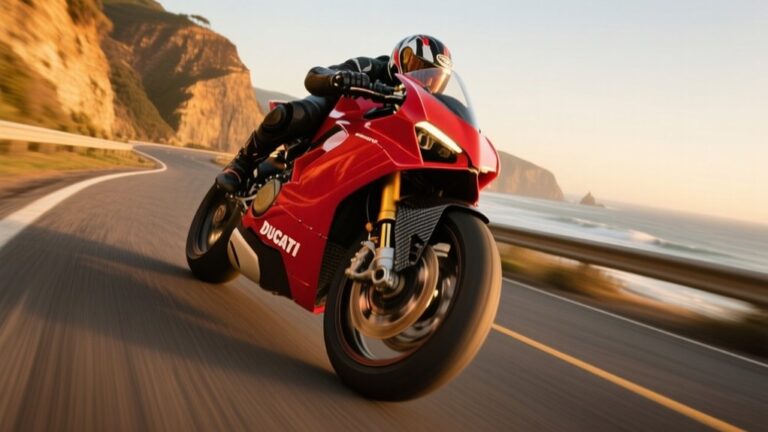
You’re looking at Ducati’s current owner: Audi AG, which sits inside Volkswagen Group.
VW acquired Ducati in April 2012 through Audi for about €860 million, and the brand stays based in Bologna, Italy, under Claudio Domenicali’s operational leadership.
Audi’s oversight helps fund R&D, automation, and factory racing, especially MotoGP and WorldSBK.
That structure protects Ducati’s premium pricing and performance focus, and the ownership story gets more interesting from here.
Who Owns Ducati Today?
Today, Ducati is owned by Audi AG, which has been a subsidiary of the Volkswagen Group since 2012. That places the Italian motorcycle maker inside one of the world’s largest automotive conglomerates.
Today, Ducati is owned by Audi, placing the Italian motorcycle brand within Volkswagen’s global automotive empire.
You can trace the Ducati brand through Audi and the broader Volkswagen corporate family, with its legal home in Bologna, Italy. This structure gives you a premium motorcycle business backed by deep capital, global scale, and engineering resources.
Since 2013, CEO Claudio Domenicali has led operations and product development. That helps you see continuity in strategy under current ownership.
The setup supports financial stability, sustains Ducati’s high-end market position, and underpins racing investment. In industry terms, you’re looking at a manufacturer that combines Italian identity with German corporate backing and disciplined execution.
How VW Acquired Ducati
Volkswagen Group acquired Ducati in April 2012. Audi agreed to buy the Italian motorcycle maker from Investindustrial and CEO Luigi Parodi for a reported €860 million.
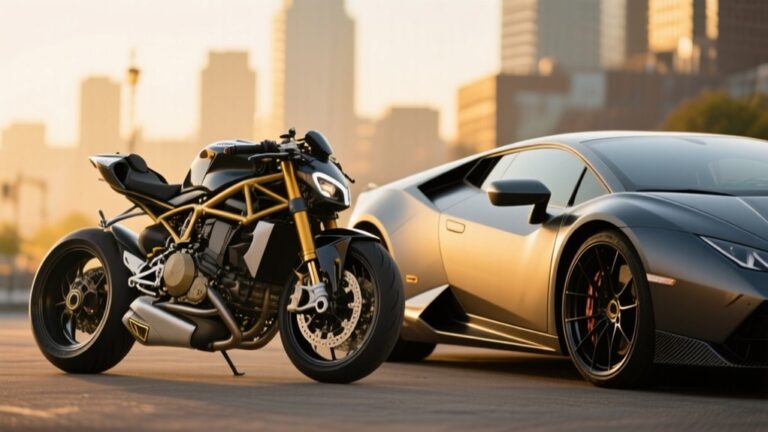
You can view the deal as a strategic move within the Volkswagen Group ownership chain: Ducati → Lamborghini → Audi → Volkswagen Group. It added a high-margin, premium motorcycle brand to Audi’s luxury and performance mix. It also supported product development and motorsport funding.
| Deal element | Impact |
|---|---|
| Purchase price | €860 million |
| Buyer | Audi for Volkswagen Group |
| Seller | Investindustrial and Luigi Parodi |
| Outcome | Ducati entered a premium portfolio |
Claudio Domenicali became CEO in 2013. He preserved operational continuity. You’re looking at a transaction designed to strengthen brand appeal, not just balance sheets.
Why Audi Oversees Ducati for VW
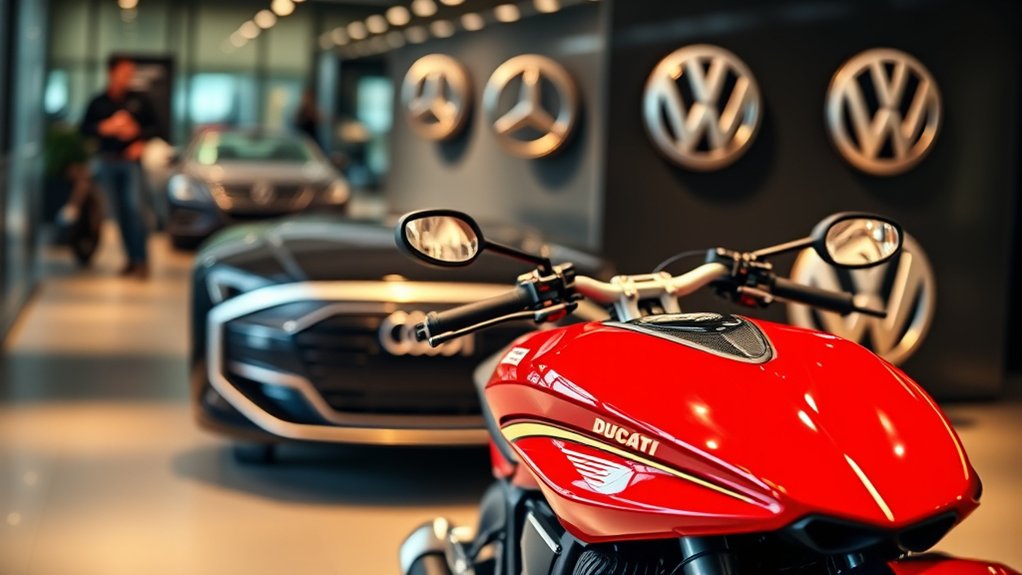
Audi oversees Ducati because Volkswagen Group deliberately placed the brand inside its premium performance structure. Ducati is legally owned by Lamborghini, Lamborghini is owned by Audi, and Audi sits within VW’s broader corporate hierarchy.
That’s the logic: Audi manages Ducati to align brand strategy, capital allocation, and global scale with VW’s luxury-performance portfolio. This setup gives Ducati stable funding, fewer short-term market pressures, and direct access to Audi’s resources.
Claudio Domenicali runs day-to-day operations, but he does so inside Audi’s oversight framework.
- Premium-brand fit
- Shared engineering discipline
- Stronger financial backing
- Clearer corporate reporting
What VW and Audi Invest in at Ducati
You can see VW’s capital flowing into Ducati as a strategic asset—helping fund stability, global expansion, and product development within the Group’s premium-brand portfolio.
At the same time, Audi supports that direction with motorsport investment, which helps sustain Ducati’s MotoGP presence.
VW Capital and Strategy
Since 2012, Ducati has operated under Volkswagen Group ownership, with Audi serving as the acquisition vehicle. The backing has been less about simple control than about capital discipline and strategic fit. As a Ducati observer, you can see the parent company’s playbook in steady funding, not quick flips. VW’s capital helps Ducati sustain R&D, racing engineering, and premium model planning over multi-year cycles.
It also lets Ducati protect exclusivity while broadening reach through lifestyle lines and high-performance flagships.
- Stable financing reduces market volatility risk
- Long-horizon R&D improves product depth
- Premium positioning supports pricing power
- Brand halo can lift showroom appeal
Audi’s Racing Investment
Powering Ducati’s racing edge, VW and Audi have funneled capital into the areas that matter most.
That includes factory development, production automation, and the long-cycle engineering behind MotoGP and World Superbike success.
You can see Audi’s impact in the numbers and the structure behind them.
| Investment area | Effect | Outcome |
|---|---|---|
| R&D | More testing | Faster upgrades |
| Automation | Higher output | Tighter quality |
| Racing programs | Stable funding | Better race pace |
| Retail expansion | Global reach | Stronger sales |
| Brand strategy | Premium focus | Preserved exclusivity |
That capital supports Ducati’s multi-year engine and chassis cycles.
Meanwhile, Claudio Domenicali manages execution within the VW and Audi chain.
Audi-backed funding helps keep Panigale development aggressive.
It also supports Scrambler growth commercially, without diluting the performance-first identity that wins races and protects margins.
How Ducati Ownership Affects Racing
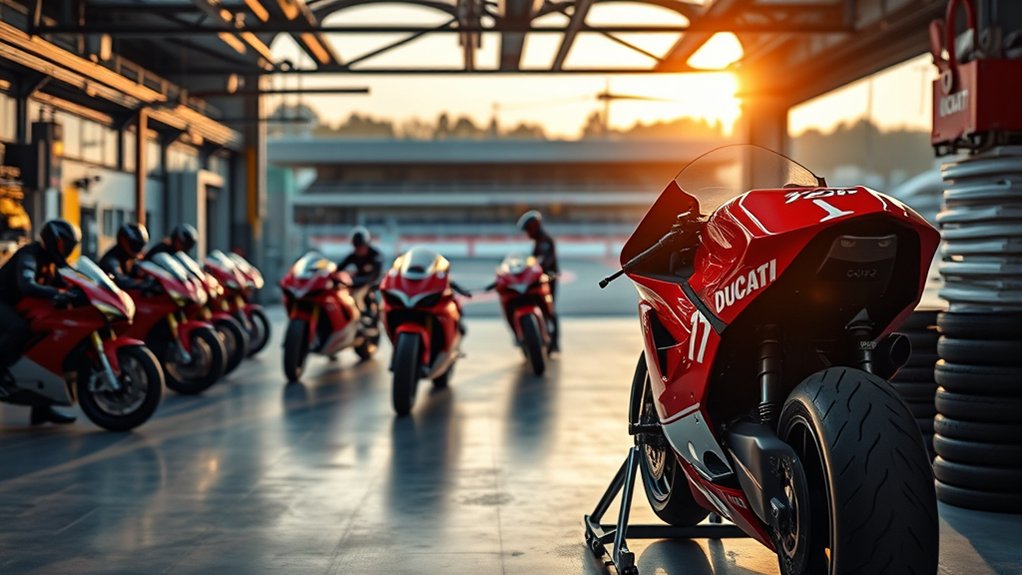
Ducati’s racing program is tightly linked to its ownership structure.
As part of Volkswagen Group through Lamborghini and Audi, it has multi-year capital behind it to fund MotoGP and WorldSBK at a factory level.
Volkswagen Group backing gives Ducati factory-level capital to sustain MotoGP and WorldSBK programs.
When you track the numbers, that backing lets Domenicali protect R&D.
It also helps test parts faster and keeps factory riders competitive across long development cycles.
You get stable multi-season budgets.
You see faster engineering iteration.
You benefit from track-to-road technology transfer.
You support the brand premium through results.
That matters because MotoGP isn’t cheap.
It demands sustained spend and operational depth.
With VW resources, Ducati can treat racing as a core business function.
It’s not a discretionary expense.
If ownership ever shifts to a less committed buyer, you’d likely see tighter spend and weaker factory support.
And that would directly hit performance.
Could Ducati Be Sold Again?
That stable factory backing is one reason Ducati has stayed competitive. It also raises the question of whether Volkswagen would ever cash out. You can’t rule it out.
Ducati has changed hands before. Texas Pacific Group rescued it, then an IPO followed, and Audi bought it in 2012. That history proves the brand is saleable.
Media chatter still points to Volkswagen reviewing non-core assets. Ducati fits that profile on paper.
Analysts have floated Chinese industrial groups, private equity, and other strategic buyers. But no formal process has surfaced.
If a sale ever appears, you’d watch one issue first. Whether the new owner can preserve Ducati’s premium positioning while funding R&D and MotoGP at a level the market expects.
What Could Change Under New Ownership
If Ducati changes hands, you could see the new owner trim MotoGP spending and redirect capital toward road-bike programs, since those can start generating revenue faster.
You’d also want to watch for brand-risk tradeoffs, because a non-Italian or state-linked buyer could push against Ducati’s premium identity and loyalty economics. In that scenario, don’t be surprised to see a sharper focus on volume, pricing, and younger-rider models—rather than pure exclusivity.
MotoGP Budget Cuts
Any new owner would quickly face a hard math problem in MotoGP. Ducati’s factory program runs on multi-year engineering cycles and Volkswagen-scale backing, so even modest budget trims could hit performance fast.
If you want Ducati to remain competitive, you can’t just cut and wait for savings. ROI pressure could push you toward leaner operations, like fewer engineers, shorter development loops, less wind-tunnel time, and reduced prototype testing.
That matters because MotoGP gains compound over seasons, not weeks. If you trim electronics, aero, or engine refinement now, you’ll feel the drag later on race pace and reliability.
A profit-first owner might even redirect capital to road-bike margins or exit racing entirely. If you keep the program, though, you’ll likely need to maintain factory support, satellite capacity, and technical partnerships to preserve Ducati’s on-track footprint.
Brand Identity Risks
A change in ownership could reshape Ducati’s brand faster than its product line.
That’s especially true if control moves from Volkswagen Group/Audi to a private equity, Chinese, or Indian industrial owner.
You’d likely see pressure to treat Ducati as a portfolio asset, not an Italian institution anchored in Bologna and Borgo Panigale.
That shift can weaken perceived authenticity.
It may also show up if cost discipline trims bespoke engineering, limited-run bikes, or the artisan supplier base that supports premium pricing.
If a buyer chases scale or lower-price segments, you risk commoditizing a badge built on scarcity and lifestyle appeal.
Market data also suggests identity backlash matters.
Many Ducatisti would read non-European ownership as brand dilution, which can hit loyalty, dealer confidence, and long-term pricing power.
Road Bike Priorities
Under Volkswagen and Audi, Ducati’s road-bike strategy has stayed tightly focused on the £12k–£25k aspirational segment.
Premium margins matter more than volume, and that discipline has been backed by deep capital for MotoGP, V2/V4 engine development, and halo models such as the Panigale 1299 S.
If new owners chase cost cuts, you could see slower R&D, thinner racing spend, and fewer technologies moving into road bikes.
If they want scale, you may get cheaper, high-volume platforms that lift motorcycle sales but dilute exclusivity.
Faster entry models could widen demand.
Used-bike accessibility might attract younger riders.
Badge-engineered products could weaken differentiation.
Premium halo bikes may lose budget priority.
Frequently Asked Questions
Is Ducati Still an Italian Company?
Yes, Ducati is still an Italian company.
You’re looking at Ducati Motor Holding S.p.A., headquartered in Borgo Panigale, Bologna, with design, engineering, and much of its manufacturing based in Italy.
Since 2012, you’ve seen it owned through Volkswagen Group via Audi and Lamborghini.
However, that foreign ownership doesn’t change its corporate nationality.
You’ll still find Ducati marketing itself around Italian heritage, style, performance, and engineering.
When Did Volkswagen Buy Ducati?
Volkswagen bought Ducati in April 2012, and you can see why the deal mattered.
Audi later paid about €860 million for the Italian motorcycle maker.
You’re looking at a strategic acquisition that brought Ducati under Volkswagen Group control by year-end 2012.
That move gave Ducati financial stability and stronger global reach.
Meanwhile, Audi kept its premium brand positioning intact.
Claudio Domenicali became CEO in 2013.
Does Audi Directly Manage Ducati Operations?
No, you won’t see Audi directly running Ducati’s daily operations.
Ducati has its own CEO, Claudio Domenicali, and executive team overseeing production, racing, R&D, and commercial decisions.
Audi, through Lamborghini and the Volkswagen Group, provides strategic oversight.
It also approves major capital commitments and sets governance.
That means you’re looking at centralized ownership with decentralized execution.
This is a common structure across premium automotive groups.
How Has Ownership Affected Ducati Pricing?
Ownership has helped Ducati keep its pricing premium and disciplined approach.
It targets the £12k–£25k aspirational segment, not entry-level bikes, so average transaction prices stay well above mainstream rivals.
Deep-pocketed owners like VW and Audi can fund MotoGP, R&D, and lifestyle branding.
That support helps maintain high margins and boosts accessory sales.
With that backing, Ducati can keep charging more.
Still, rising costs and fewer affluent buyers could put pressure on future pricing.
What Happened to Ducati After the Acquisition?
After the acquisition, Ducati gained financial stability, broadened its R&D investment, and built stronger global support.
The brand kept its racing focus while expanding into premium lifestyle models like the Scrambler. It also refined flagship bikes such as the Panigale.
You also saw sales grow and dealer networks strengthen.
Product planning shifted toward long-term value instead of short-term pressure. That helped Ducati protect its exclusivity while still reaching younger riders.
Conclusion
So, who owns Ducati today? You’ve seen the chain: Volkswagen controls it, Audi oversees it, and Ducati keeps delivering results under that structure. That matters because ownership shapes capital, strategy, and racing priorities.
But the next move is the one to watch. If VW ever reshuffles its portfolio, Ducati could change hands again. And that could reset everything from investment to MotoGP focus.
For now, the brand’s future looks stable, but not untouchable.