What Is A M8 Harley – Quick Answer
You ride a Harley powered by the M8 engine, a 1746cc V-twin introduced in 2017 that boosts torque by 10% and improves airflow with four valves per cylinder. It also cuts vibration by 75% compared to the Twin Cam.
It features advanced cooling and dual spark plugs for smoother, quieter rides. The M8’s design upgrades make your bike more reliable and responsive.
Keep exploring to discover how it changes your Harley experience.
What the M8 Harley Engine Is and Why Riders Care
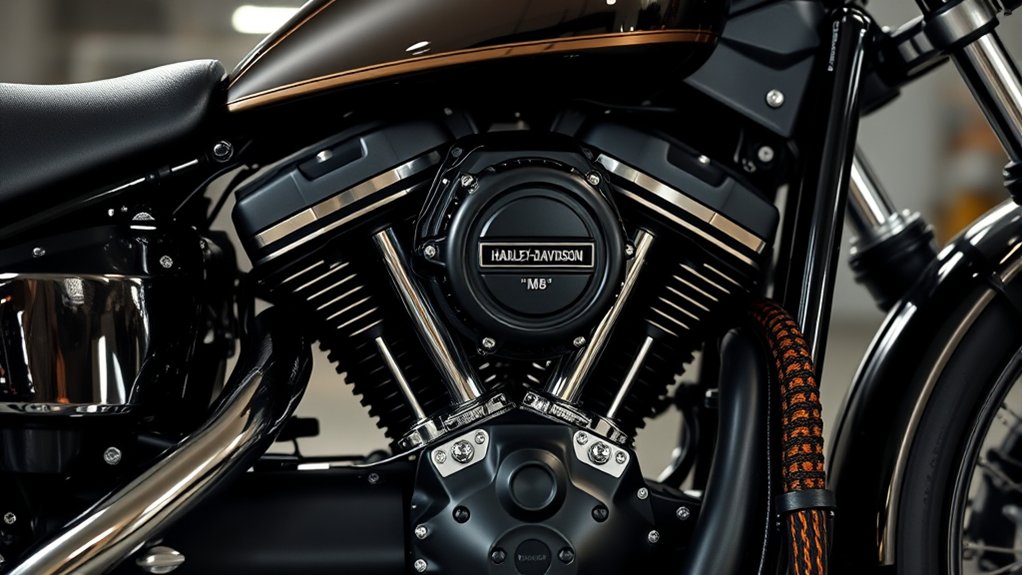
What makes the M8 Harley engine stand out for riders? The Harley-Davidson Milwaukee-Eight Engine, introduced in 2017, is a 1746cc V-twin with a single camshaft and four valves per cylinder.
Compared to the older Twin Cam, it delivers 10% more torque, giving you stronger, smoother power.
You’ll notice faster acceleration and a quieter ride that suits both long-distance touring and city commutes.
One key improvement is its advanced heat management. Combining air and oil cooling helps reduce engine temperatures, boosting reliability and comfort on the road.
This means you get better airflow and less overheating, even during extended rides.
How the M8 Differs From Twin Cam Engines
You’ll notice the M8’s single camshaft and four valves per cylinder give it a clear edge over the Twin Cam’s setup. This upgrade boosts airflow and power, making a real difference.
Because of that, you get stronger torque and quicker acceleration that you can actually feel when you’re riding.
On top of that, the M8’s improved oil and liquid cooling systems help it handle heat much better. So, your engine keeps running smoothly even when things get intense on the road.
Valvetrain Architecture Differences
How does the Milwaukee-Eight (M8) engine’s valvetrain architecture set it apart from the Twin Cam design? Unlike the Twin Cam’s two camshafts, one for intake valves and one for exhaust, the M8 uses a single, chain-driven camshaft. This simplifies the valvetrain, cutting down on complexity and maintenance.
The M8 also doubles the number of valves per cylinder from two to four, which markedly improves airflow and combustion efficiency. With more valves and a streamlined camshaft setup, the M8 delivers 50% more airflow than the Twin Cam.
You’ll notice smoother operation and more precise valve timing thanks to this design.
In short, the M8’s valvetrain architecture offers a cleaner, more efficient approach compared to the Twin Cam’s dual camshaft pushrod system. It’s a smarter design that really boosts performance and reliability.
Torque And Acceleration Gains
Because the Milwaukee-Eight engine delivers roughly 10% more torque than the Twin Cam, you’ll feel a noticeable boost in acceleration and pulling power.
The M8’s four valves per cylinder and single camshaft design improve airflow, giving you faster throttle response and quicker acceleration. This enhanced airflow and combustion efficiency translate to stronger mid-range torque, making hill climbs and overtaking smoother and more powerful.
Compared to the Twin Cam, the Milwaukee-Eight engine reacts faster to your input, providing a more engaging and responsive ride. You’ll experience quicker takeoffs and a more robust performance overall.
If you want a Harley that delivers sharper acceleration and greater torque, the M8’s improvements make a clear difference you can feel every time you twist the throttle.
Heat Management Enhancements
Alongside the M8’s torque and acceleration improvements, its advanced heat management really sets it apart from the Twin Cam engine. The Milwaukee-Eight features oil-cooled cylinder heads that dramatically lower overall engine temperature, keeping things cooler for you. It also relocates catalytic converters to cooler spots, reducing heat buildup near your legs and seat.
Improved airflow and heat dissipation in the M8 result in about a 100°F drop in exhaust gas temperatures compared to Twin Cam models.
Plus, liquid cooling elements and smart engine placement ensure consistent performance even under heavy load. These heat management enhancements make long rides and hot-weather cruising much more comfortable.
M8 Harley Engine Performance Benefits
While many riders seek raw power, the M8 Harley engine delivers more than just strength. It offers a 10% boost in torque and enhanced airflow with eight valves per cylinder, giving you quicker acceleration and improved fuel efficiency.
These performance benefits come from the engine’s advanced design, which optimizes airflow and combustion. You’ll also appreciate the heat reduction thanks to the upgraded cooling system, which lowers engine temperature by up to 100°F. That makes long rides way more comfortable.
The tighter tolerances and redesigned oil pump ensure smoother operation and reliable power delivery. Overall, the M8 Harley engine balances power and efficiency, providing better mid-range responsiveness and a cooler, more enjoyable ride every time you hit the road.
Common Myths About the M8 Harley Engine
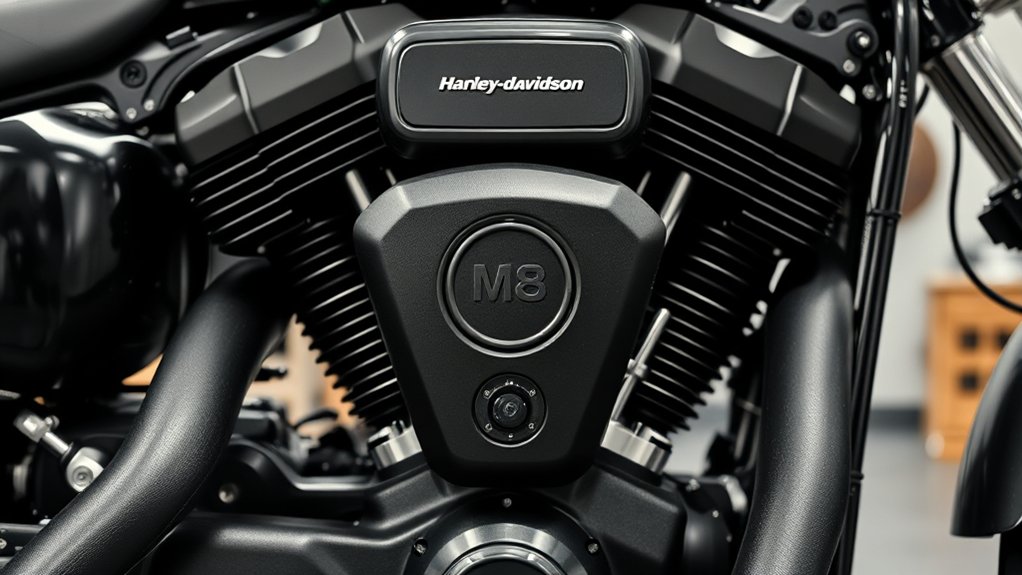
Although the M8 Harley engine has earned praise for its advanced design and performance, several myths still surround it. You might’ve encountered some common misconceptions that cloud its true capabilities.
Here are four myths debunked:
- The “M8” name refers to the engine series, not the 88 cubic inch displacement.
- It’s not just a rebranded Twin Cam; it includes technical upgrades like improved airflow and heat management.
- Despite rumors, the M8 offers excellent reliability when properly maintained.
- Contrary to belief, the M8 produces 75% less vibration than the Twin Cam, ensuring a smoother ride.
Understanding these facts helps you appreciate the M8’s innovation without falling for misleading myths. It’s always good to know the real story behind the engine’s performance and design.
That way, you can enjoy your ride without any doubts.
Which Harley Models Use the M8 Harley Engine
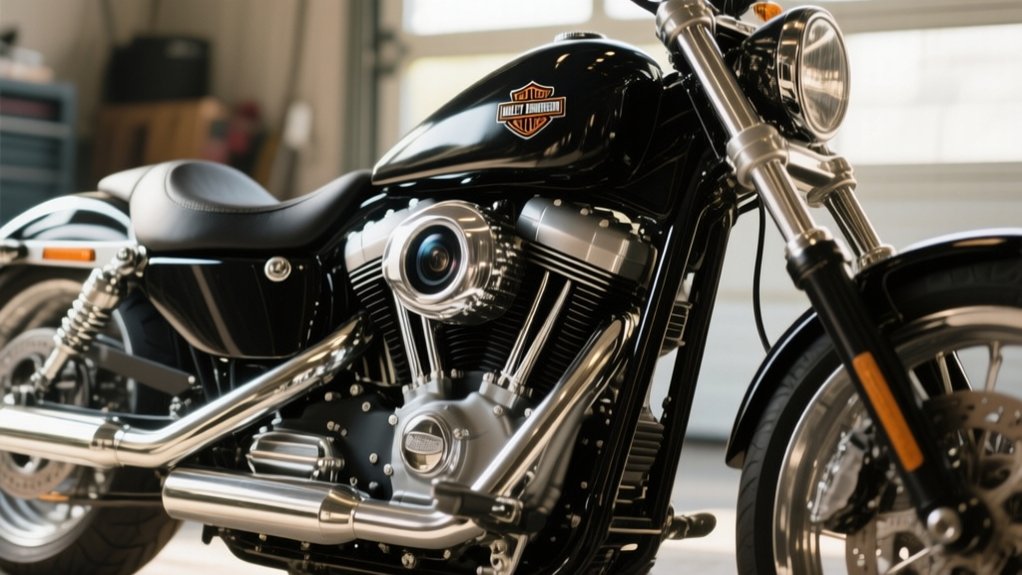
You’ll find the M8 engine powering a wide range of Harley models, from Touring and Softail to Trike and CVO lines.
Popular bikes like the Street Glide, Road King, and Fat Boy all carry different M8 engine variants tailored to their style and performance needs.
Models Featuring M8
If you’re exploring Harley-Davidson’s lineup, you’ll find the Milwaukee-Eight (M8) engine powers a wide range of models starting from 2017. This engine brings improved performance and reliability across several key Harley lines.
Here are some popular models featuring the M8 engine:
- Softail – Includes favorites like the Fat Boy, Heritage Classic, and Slim, all benefiting from the modern Milwaukee-Eight powerplant.
- Touring bikes – Models such as the Street Glide, Road King, Electra Glide, and Ultra Limited use the M8 for smooth long-distance rides.
- CVO – Harley’s Custom Vehicle Operations lineup, including CVO Street Glide and CVO Limited, boasts larger 117 or 121 cu in M8 engines.
- Trike – The Tri Glide Ultra Classic also features the Milwaukee-Eight engine for stability and power.
These models really showcase the versatility and strength of the M8 engine across Harley’s range. It’s a solid choice if you want power and reliability in one package.
Engine Variants By Model
Now that you know which Harley models feature the M8 engine, it’s helpful to understand the specific engine variants each model uses. The Milwaukee-Eight engine comes in several sizes tailored to different Harley styles.
Standard Touring models like the Street Glide and Road King use the 107 cu in (1,750 cc) variant, balancing power and efficiency.
For more torque, select Touring and Softail models sport the 114 cu in (1,870 cc) engine.
If you want top-tier performance, CVO models come with the 117 cu in (1,920 cc) Milwaukee-Eight engine as standard.
Limited-edition CVO models take it further, featuring the exclusive 121 cu in (1,980 cc) variant with variable-valve timing.
Understanding these engine variants helps you pick the right M8 Harley to match your riding style. It’s all about finding the perfect balance between power and feel for your ride.
How to Identify an M8 Harley Engine on Your Bike
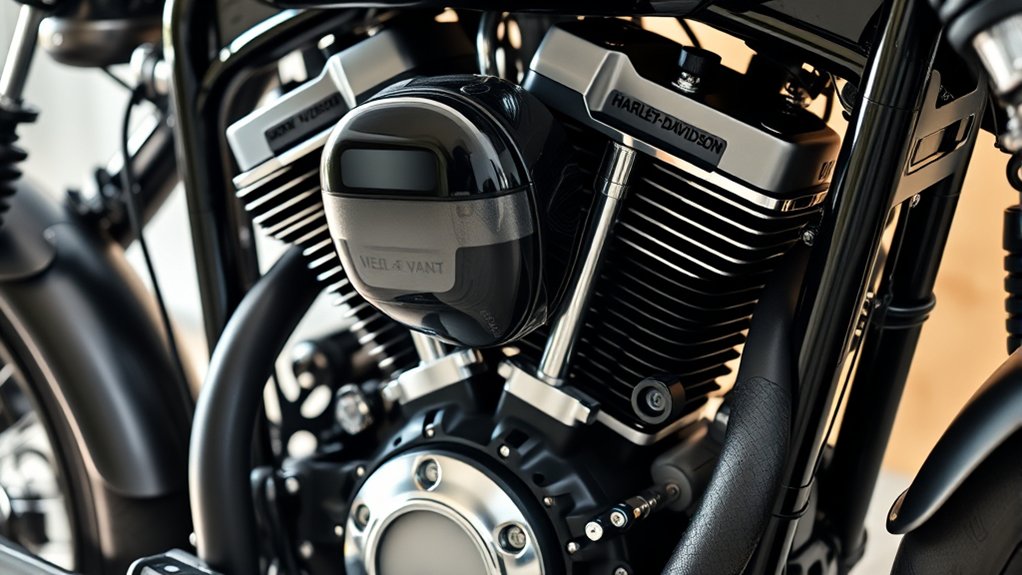
Wondering how to spot an M8 Harley engine on your bike? Here’s how to nail the engine identification quickly and accurately.
1. Check the engine model code: Look for a stamp starting with “Milwaukee-Eight” or “M8” on the engine casing.
2. Inspect the engine cover: It often displays “Milwaukee-Eight” branding, which is a clear sign of the M8 engine.
3. Note the engine specs: The M8 is a 1746cc V-twin with a 45° V-angle, four valves per cylinder, and dual spark plugs.
These are unique features compared to older models.
4. Use the VIN number: It can confirm the engine type, especially on Harleys made from 2017 onward when M8 engines replaced Twin Cam engines.
Follow these steps, and you’ll confidently identify the M8 engine on your Harley.
Frequently asked questions
What Is the Recommended Oil Type for M8 Harley Engines?
You should use a high-quality, API SN or newer, 20W-50 viscosity motor oil for your M8 Harley engine.
Harley-Davidson recommends oils meeting JASO MA or MA2 standards to guarantee your clutch performs smoothly.
Synthetic oils work best since they handle heat better and protect your engine longer.
Don’t forget to change the oil regularly.
If you want, try Harley’s own branded oils made specifically for Milwaukee-Eight engines for top performance.
Can I Upgrade My M8 Engine With Aftermarket Parts?
You can upgrade your M8 engine with aftermarket parts, turning a smooth cruiser into a powerful beast. While stock setups offer reliability, performance cams, exhausts, and air intakes can boost your power and torque considerably.
Just remember, not all parts play well with the M8’s ECU and cooling system. To avoid headaches, make sure you get professional installation and tuning.
That way, your upgrade feels seamless and keeps your engine running strong.
How Often Should I Service the M8 Harley Engine?
You should service your M8 Harley engine every 10,000 miles or at least once a year, whichever comes first. Don’t forget to change the oil every 5,000 miles to keep it running smoothly.
Check and replace the air filter as needed, usually around 10,000 miles.
Also, plan for valve adjustments every 20,000 miles.
Make sure to inspect spark plugs and fluids regularly to maintain peak performance and longevity.
Staying on top of these will help your bike run great for years to come.
Are There Known Common Mechanical Issues With M8 Engines?
Yes, the M8 engine has some known issues you should watch for. Early models (2017-2019) sometimes experience oil sumping, which can cause overheating.
You might also encounter camshaft or rocker arm wear, and occasional fuel injector or sensor glitches that affect performance.
Most problems are covered under warranty or recalls, so staying on top of maintenance helps you avoid major headaches and keeps your ride smooth and reliable.
Just keep an eye on things, and you should be good to go!
What Fuel Octane Rating Is Best for M8 Harley Engines?
Think of your M8 Harley like a finely tuned symphony. It needs the right fuel octane to hit every note perfectly. You should use fuel with at least a 91 octane rating to keep your engine running smooth and strong.
Higher octane fuel, like 93 or 94, acts like a conductor, preventing knocking and boosting efficiency.
Following this ensures your ride stays powerful and reliable. It also helps avoid any harsh mechanical dissonance.
Final Thought
Now that you know what an M8 Harley engine is and why it matters, you can really appreciate its performance and design upgrades. Imagine cruising on a 2018 Street Glide with that smooth M8 power. It’s noticeably quieter, more efficient, and way more responsive compared to older Twin Cam models.
Whether you’re shopping for a new ride or tuning your current bike, spotting the M8 engine helps you understand exactly what you’re getting. It’s a real game-changer for Harley enthusiasts like you.