Who Makes Kawasaki Motorcycles – The Answer
You get Kawasaki motorcycles from Kawasaki Motors Corporation, a subsidiary of Kawasaki Heavy Industries, with deep roots dating back to 1878. They build bikes using advanced robotics and precise craftsmanship across plants in Japan, the U.S., and Thailand.
These factories apply stringent quality control and exhaustive testing to guarantee top durability and performance. Premium materials and innovative processes set Kawasaki apart.
Keep exploring to understand their manufacturing mastery and workforce expertise behind each model.
Who Owns Kawasaki Motorcycles?
Although you may associate Kawasaki motorcycles primarily with high-performance bikes, it’s important to know that Kawasaki Motors Corporation, the manufacturer behind these machines, operates as a subsidiary of Kawasaki Heavy Industries Ltd.
This ownership structure places Kawasaki Motors Corporation under the umbrella of Kawasaki Heavy Industries, a diversified industrial giant founded in 1878.
Originally a shipbuilding firm, Kawasaki Heavy Industries expanded into aerospace, transportation, and motorcycle manufacturing, overseeing global operations.
Kawasaki Motors Corporation manages motorcycle manufacturing through plants in Japan, the United States, and Thailand, ensuring consistent quality and innovation.
Kawasaki Heavy Industries directs the brand’s global production, distribution, and development strategies, maintaining strict control over the manufacturing process.
Understanding this hierarchical ownership clarifies how Kawasaki maintains its engineering standards and market presence worldwide.
The History and Evolution of Kawasaki Motorcycle Production
Kawasaki Motors Corporation’s position within Kawasaki Heavy Industries sets the stage for a rich history of motorcycle production that dates back to the early 20th century. You’ll find Kawasaki’s manufacturing roots intertwined with Meguro Manufacturing, beginning in 1935.
Their focused motorcycle production kicked off with the B8 model in 1962, followed by a pivotal merger in 1963 that unified the brand’s manufacturing efforts.
Kawasaki’s history is marked by continuous innovation, which you can see in models like the Z1 and Ninja series. Some key milestones include collaboration with Meguro Manufacturing, which initiated production in Japan, and the launch of the B8, Kawasaki’s first dedicated motorcycle.
The merger with Meguro helped consolidate manufacturing under Kawasaki. Over time, Kawasaki developed iconic, innovative models that really shaped its legacy.
This technical evolution highlights Kawasaki’s leadership in motorcycle manufacturing and innovation.
Where Are Kawasaki Motorcycles Made Today?
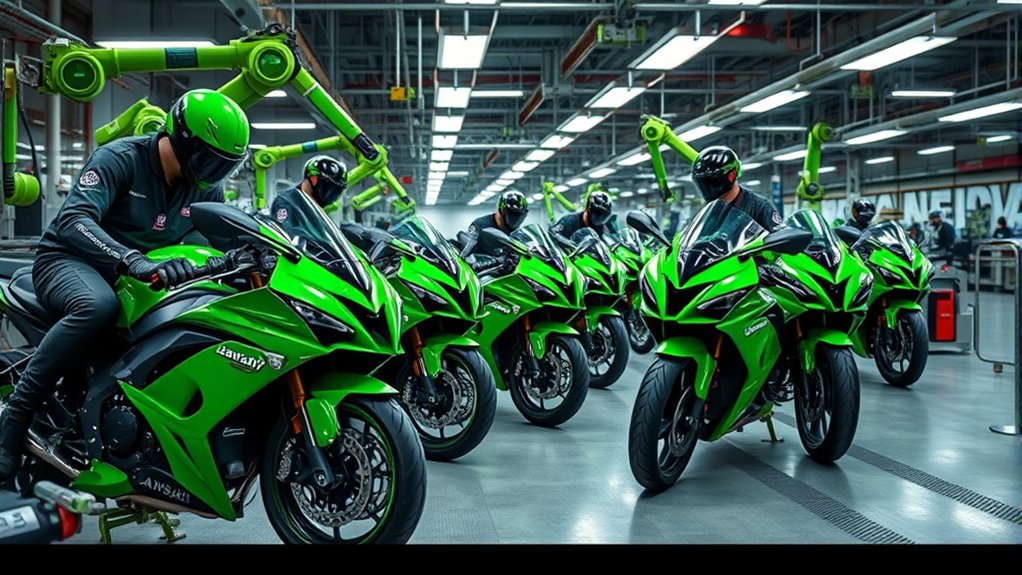
While many motorcycle enthusiasts associate Kawasaki with its Japanese heritage, you’ll find its production facilities span multiple continents to meet global demand. Kawasaki motorcycles are primarily manufactured in Japan, where stringent quality control guarantees exceptional standards.
Beyond Japan, Kawasaki operates manufacturing plants in Lincoln, Nebraska, and Rayong, Thailand. These production facilities enable Kawasaki to localize manufacturing, reduce lead times, and efficiently serve regional markets across the Americas and Asia.
Each plant adheres to rigorous protocols to maintain consistency in durability and performance. By strategically distributing manufacturing, Kawasaki balances heritage craftsmanship with global accessibility, reinforcing its reputation worldwide.
When you choose Kawasaki motorcycles, you’re benefiting from a meticulously coordinated network of production facilities designed to uphold the brand’s technical excellence and reliability across diverse markets.
How Do Kawasaki’s Factories Maintain Quality and Performance?
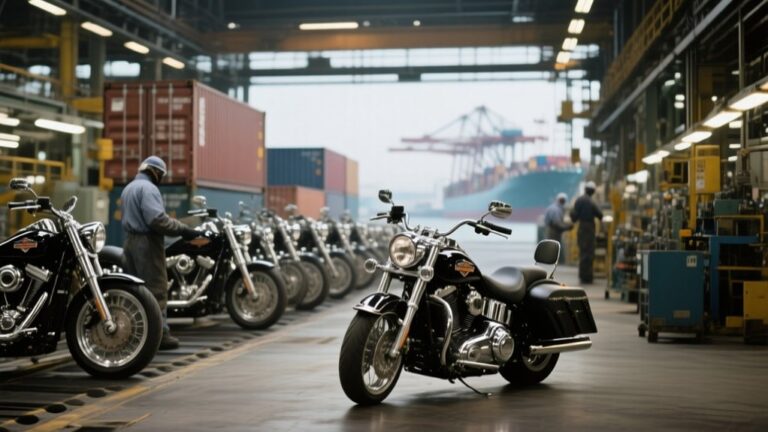
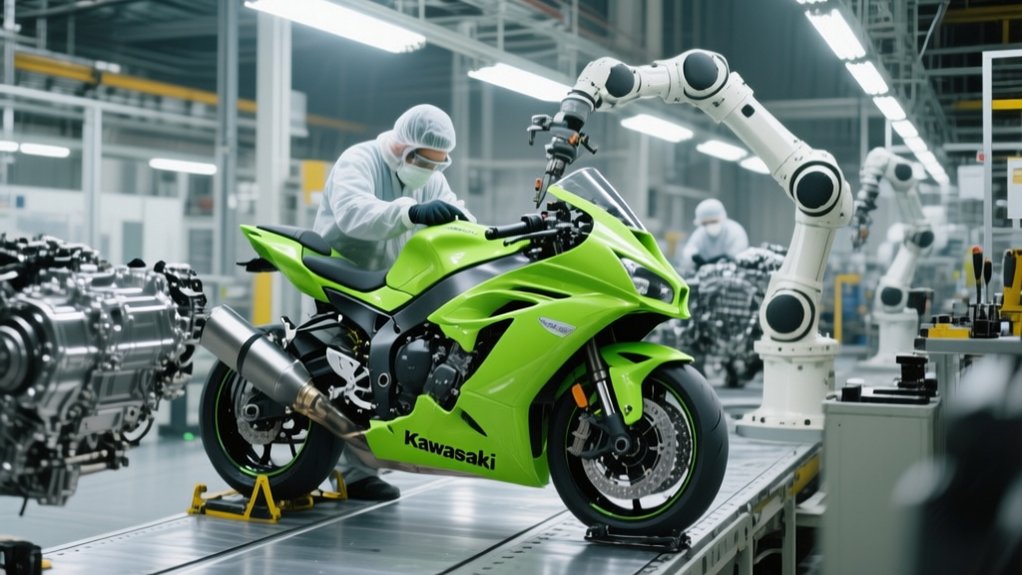
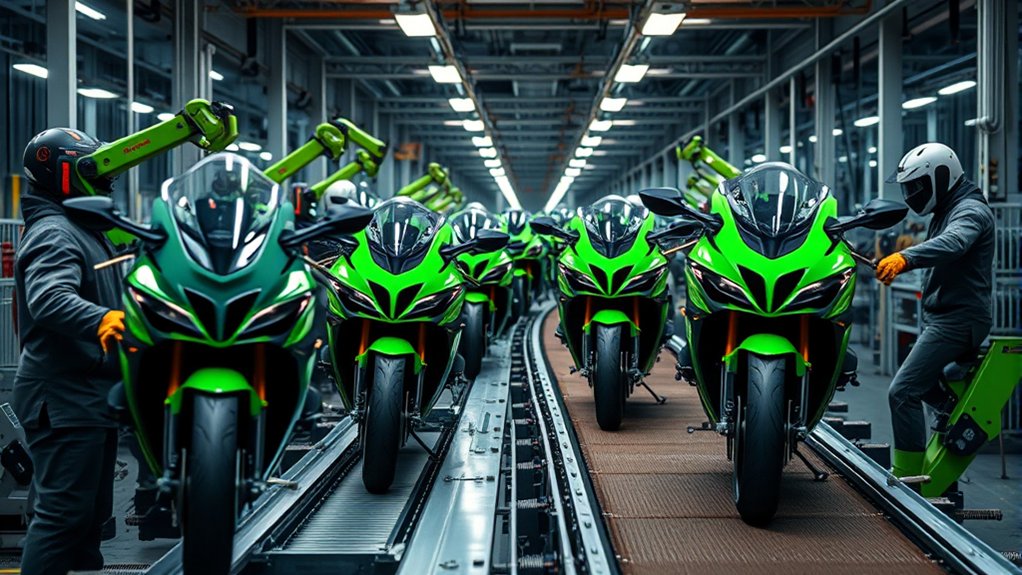
Maintaining exceptional quality and performance across multiple manufacturing sites requires rigorous processes and advanced technology. Kawasaki integrates cutting-edge manufacturing technology and robotics to guarantee precision and consistency throughout assembly.
You’ll see strict quality control protocols, involving thorough testing and inspections at various production stages, assuring every component meets high standards.
Skilled craftsmanship is continuously honed through regular staff training, preserving reliability and performance. Kawasaki also prioritizes using premium raw materials to enhance durability and functionality.
Key methods include:
- Employing advanced manufacturing technology for exact assembly
- Enforcing strict quality control at each production phase
- Emphasizing skilled craftsmanship via ongoing employee training
- Selecting superior raw materials for long-lasting performance
These combined efforts ensure Kawasaki motorcycles consistently deliver top-tier quality and performance.
What Makes Kawasaki’s Manufacturing Process Stand Out?
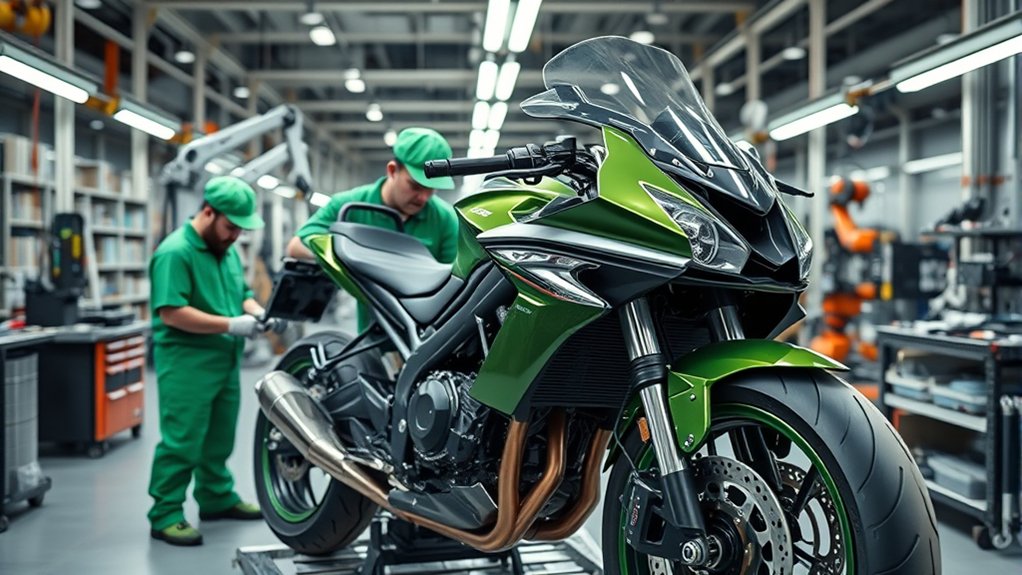
You’ll notice Kawasaki’s manufacturing process really stands out because it blends precision craftsmanship with cutting-edge technology. This combo makes sure each motorcycle meets some pretty exacting standards.
Plus, their global quality assurance system is impressive—it coordinates tough testing across facilities in Japan, the U.S., and Thailand. This helps maintain consistent performance and durability no matter where the bike is made.
Precision Craftsmanship Techniques
Because Kawasaki combines advanced robotic automation with expert craftsmanship, their manufacturing process achieves unmatched precision and quality. You’ll notice how every motorcycle benefits from a seamless integration of technology and human skill.
Kawasaki’s approach includes robotic automation that guarantees exact assembly tolerances and repeatability. Skilled craftsmanship refines details that machines alone can’t perfect.
Plus, rigorous quality control at each production stage helps prevent defects early.
They also use advanced surface treatment techniques to enhance durability and finish, resisting wear and corrosion. This blend of high-tech and hands-on methods means you get motorcycles built with superior structural integrity and aesthetic precision.
Kawasaki’s meticulous process is supported by digital design tools, which guarantees each bike meets strict performance and finish standards. All of this comes together to elevate your riding experience through consistent reliability and visual excellence.
Global Quality Assurance
Although Kawasaki’s manufacturing facilities span Japan, the United States, and Thailand, each plant adheres to a unified standard of excellence through advanced technologies and skilled craftsmanship. You’ll find that Kawasaki integrates cutting-edge manufacturing processes with rigorous quality assurance protocols to maintain consistency across all locations.
Each facility employs modern equipment to conduct exhaustive testing, including durability, safety, and performance assessments. This ensures every motorcycle meets stringent global standards. The Japanese plants focus on precision control, while U.S. and Thai plants emphasize robust validation techniques.
This global quality assurance framework guarantees that every Kawasaki motorcycle delivers reliability and high performance. It truly reflects the company’s dedication to exceeding international manufacturing benchmarks.
How Does Kawasaki Support Technician Training and Industry Growth?
You’ll find that Kawasaki’s K-Tech program, launched back in 1989 with UTI, really sets the standard for specialized technician training in motorcycles, ATVs, and watercraft. It’s a hands-on curriculum that equips you with advanced diagnostic and repair skills, which are crucial for keeping Kawasaki’s global service network running smoothly.
K-Tech Training Program
How does Kawasaki guarantee its technicians meet the highest standards of expertise? Through the K-Tech program, established in 1989 in partnership with Universal Technical Institute, Kawasaki delivers specialized technician training tailored for Kawasaki motorcycles and other vehicles.
This thorough program equips you with essential skills to uphold industry standards and provides hands-on experience in maintenance and repair. The K-Tech program focuses on:
- In-depth coursework in diagnostics, repairs, and Kawasaki-specific technology
- Practical training on motorcycles, ATVs, and watercraft
- Development of industry-ready technicians aligned with evolving standards
- Accessibility for both aspiring and current technicians worldwide
It’s designed to help you build real-world skills and keep up with the latest in Kawasaki technology. Whether you’re just starting out or already working in the field, K-Tech offers the training you need to succeed.
Workforce Development Initiatives
Why does Kawasaki invest heavily in workforce development initiatives? Because maintaining a skilled technician base is essential for delivering top-tier service and fostering industry growth.
Through the K-Tech program, launched in 1989 with UTI, Kawasaki provides specialized technician training focused on maintenance, repair, and diagnostics for motorcycles, ATVs, and watercraft. This program emphasizes hands-on experience and prepares you for industry certifications that align with global service standards.
Kawasaki actively partners with technical schools and industry stakeholders to guarantee continuous workforce development, ensuring a steady influx of qualified service professionals.
Frequently asked questions
What Are the Most Popular Kawasaki Motorcycle Models?
The most popular Kawasaki motorcycle models you’ll want to contemplate include the Ninja series, especially the Ninja 400 and ZX-10R. These bikes are known for their high performance and aerodynamic design.
The Z series, like the Z900 and Z650, offers a versatile naked bike experience. They’re great if you want something sporty but a bit more relaxed.
If you prefer cruisers, the Vulcan S stands out with comfort and customization. It’s perfect for those who like a laid-back ride.
For adventure or touring, the Versys 650 and 1000 provide excellent long-distance capability and reliability. They’re built to handle whatever the road throws at you.
How Fuel-Efficient Are Kawasaki Motorcycles?
Kawasaki motorcycles typically deliver fuel efficiency between 30 and 60 miles per gallon, depending on the model and engine size.
If you ride a smaller bike like the Ninja 400, expect around 50-55 mpg, which is pretty efficient for a sportbike.
Larger models, such as the Ninja ZX-14, average closer to 30-40 mpg because of their powerful engines.
Your actual mileage will vary based on your riding style, how well you maintain the bike, and any modifications you might make.
What Is the Typical Warranty on a Kawasaki Motorcycle?
Think of Kawasaki’s warranty like a trusted sidekick on your ride. It typically covers 12 months or 12,000 miles, whichever comes first.
This warranty protects you against manufacturing defects and faulty parts but excludes wear and tear or aftermarket mods.
Some dealers might extend coverage up to 24 months, depending on your location.
To keep this shield active, you’ll want to register your bike and stick to the recommended maintenance schedule.
Are Kawasaki Motorcycles Suitable for Beginners?
Yes, Kawasaki motorcycles are suitable for beginners. Models like the Ninja 400 and Z400 offer manageable power and lightweight frames. This helps you develop control without feeling overwhelmed.
Kawasaki’s low seat heights enhance stability. Plus, the ergonomics and user-friendly controls reduce fatigue during learning. It really makes the riding experience more comfortable.
Also, Kawasaki supports new riders with thorough training programs. This ensures you gain confidence and technical skills safely and effectively from the start. It’s a great way to get going on the right foot.
How Does Kawasaki Incorporate Technology in Their Bikes?
Kawasaki consistently crafts cutting-edge components to create competitive cycles. You’ll find ride-by-wire throttles and digital fuel injection delivering dynamic drive control.
They blend lightweight, durable materials like aluminum and carbon fiber to boost balance and briskness.
Advanced aids, including Kawasaki Quick Shifter, Traction Control, and ABS, actively assist your safety and stability.
Plus, innovative interfaces with TFT displays and Bluetooth bring brilliant, seamless connectivity to your riding experience. It’s all about making your ride smoother and more connected.
Final Thought
You can count on Kawasaki’s commitment to craftsmanship and cutting-edge technology to create motorcycles that masterfully marry performance with precision. Their factories foster flawless fabrication, fueling fierce focus on quality control.
By backing bold technician training and bolstering industry breakthroughs, Kawasaki consistently crafts cycles that captivate riders worldwide. When you choose Kawasaki, you’re stepping into a sphere of skill, strength, and steadfast standards that set their motorcycles miles ahead in the market.