When Did Kawasaki Start Making Motorcycles – Here’s When
Kawasaki started making motorcycles in the early 1960s, officially entering the market after merging with Meguro Manufacturing in 1963. Their first model, the B8, launched in 1962, featured a reliable single-cylinder two-stroke engine. This set the stage for future innovations.
By the late ’60s, models like the H1 Mach III pushed performance boundaries with a powerful 500cc engine. Over time, Kawasaki’s engineering and racing success shaped iconic motorcycles. These are definitely worth exploring further.
When Did Kawasaki Start Making Motorcycles?
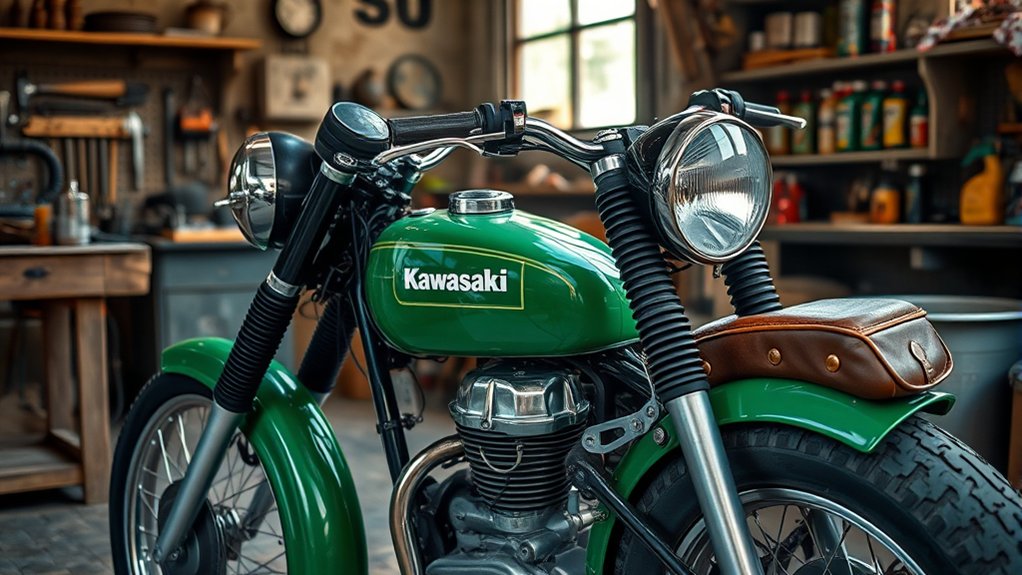
Although Kawasaki had been involved in heavy industries for decades, it didn’t start making motorcycles until the early 1960s. You’ll find that Kawasaki’s official entry into motorcycle production began in 1962 with the launch of the first Kawasaki motorcycle, the B8. This model featured a single-cylinder, two-stroke engine and marked a significant step in Kawasaki’s motorcycle history.
The early 1960s also saw a pivotal Kawasaki merger with Meguro Manufacturing, a company that had been producing bikes since 1935. This merger in 1963 helped establish Kawasaki’s motorcycle division, allowing the company to expand its lineup throughout the decade.
How Early Kawasaki Models Built the Brand’s Reputation
You’ll see how Kawasaki’s early models, like the 1962 B8 and B8M, really set the bar for reliable two-stroke performance.
Then, by 1967, the A1 250cc street bike came along, showing off some serious engineering improvements that helped push the brand into racing circles.
After that, with the arrival of the 1969 H1 Mach III and the 1972 Z1 900, Kawasaki made it clear they were a major player in the world of high-performance motorcycles.
Iconic Early Models
How did Kawasaki transform from a newcomer to a powerhouse in the motorcycle world? It all began with the Kawasaki B8 in 1962, a single-cylinder two-stroke that set the foundation. The early models, including the B8M motocross bike dubbed the “Red Tank Kawasaki,” earned respect in off-road racing.
By 1967, Kawasaki introduced the A1 250cc, an air-cooled, two-stroke parallel twin that attracted street riders seeking performance motorcycles. The 1969 H1 Mach III raised the stakes with its 500cc engine and impressive power-to-price ratio, cementing Kawasaki’s reputation for speed.
Finally, the 1972 Z1 marked a milestone in motorcycle history as the first air-cooled, DOHC inline four-cylinder outside Japan. This firmly established Kawasaki’s early models as icons in performance and engineering.
It’s pretty clear how these bikes set the stage for Kawasaki’s legacy.
Engineering Breakthroughs
What made Kawasaki’s early motorcycles stand out in a crowded market? Kawasaki engineering breakthroughs began with the 1962 B8, featuring a reliable single-cylinder, two-stroke engine.
By 1969, the Kawasaki H1 Mach III brought high-performance motorcycles into focus with its powerful 500cc two-stroke engine.
The real game-changer came in 1972 with the Kawasaki Z1 900, the first air-cooled, DOHC inline-four outside Japan, showcasing advanced four-stroke engine technology. This motorcycle innovation set new standards for speed and reliability.
The 1971 Kawasaki H2R, a three-cylinder machine, further demonstrated Kawasaki’s commitment to performance engineering.
Building on these advances, the Ninja series later epitomized Kawasaki’s leadership in high-performance motorcycles. It cemented a legacy of cutting-edge engineering that still influences the brand today.
Racing Influence
Although Kawasaki began as a manufacturer focused on engineering breakthroughs, its early racing successes quickly elevated the brand’s reputation. You’ll see Kawasaki racing really took off with the 1969 AMA Motocross titles, where the Kawasaki KX series proved its dominance.
In 1971, Kawasaki introduced the H2R, a 748 cc three-cylinder bike that churned out over 100 hp. This marked a significant milestone in motorcycle racing.
Then, in 1972, the Kawasaki Z1 900 launched as the first Japanese four-cylinder motorcycle, further cementing the brand’s high-performance status.
From 1978 to 1982, Kawasaki dominated the 250 cc and 350 cc Grand Prix classes, which really boosted its engineering reputation.
Success kept rolling in with multiple AMA Superbike Championships and World Superbike titles. All of this helped build Kawasaki’s enduring racing legacy.
Kawasaki’s Motorcycle Manufacturing History
Since Kawasaki began developing motorcycle engines in 1949, it has steadily built a legacy in motorcycle manufacturing. You’ll see that in the early 1960s, after merging with Meguro Manufacturing, Kawasaki officially entered motorcycle production.
Kawasaki’s motorcycle journey began in 1949, officially launching production after merging with Meguro in the 1960s.
In 1962, they released their first model, the B8, featuring a single-cylinder, two-stroke engine. This marked a key step in Kawasaki’s motorcycle history.
By 1972, Kawasaki introduced the Z1 900, the first air-cooled DOHC inline four-cylinder motorcycle sold outside Japan, showcasing advanced engineering.
To support growing demand, Kawasaki opened its first U.S. factory in Lincoln, Nebraska, in 1974, expanding motorcycle manufacturing capacity.
Kawasaki’s progressive development from two-stroke singles to powerful inline fours highlights its evolving expertise in motorcycle production and solidifies its place in the industry. It’s clear they’ve come a long way and continue to push the boundaries of motorcycle design.
Kawasaki’s Motorcycle Milestones by Decade
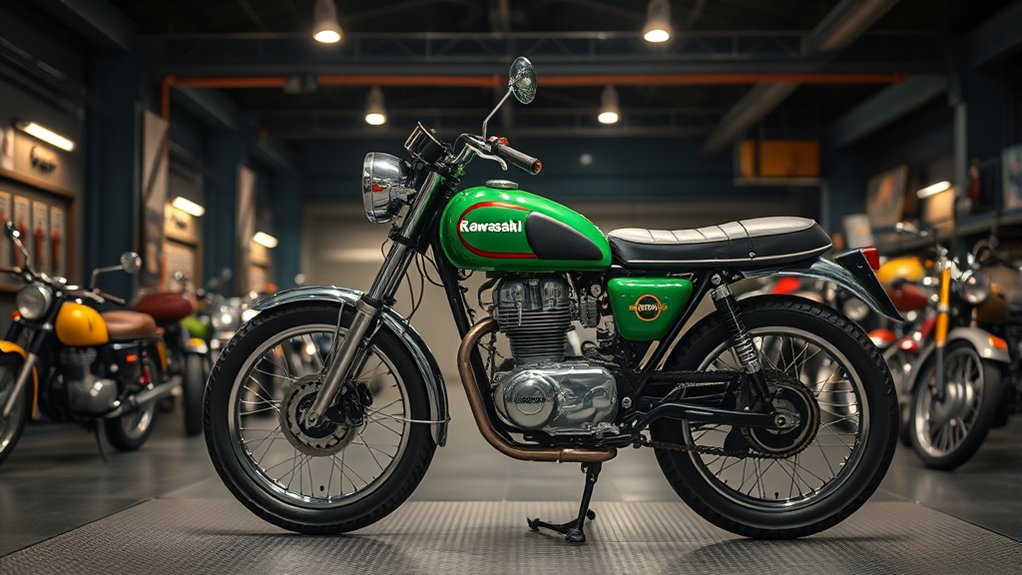
When you explore Kawasaki’s motorcycle milestones by decade, you’ll see a clear evolution of innovation and performance. Kawasaki began motorcycle manufacturing in the 1960s after merging with Meguro, launching the B8 in 1962. The decade ended with the powerful H1 Mach III in 1969, marking Kawasaki’s entry into high-performance bikes.
The 1970s brought the groundbreaking Z1 in 1972, featuring the first air-cooled, DOHC inline-four engine outside Japan. Kawasaki’s innovation continued into the 1980s with the launch of the Ninja series, starting with the acclaimed GPz900R in 1984.
Moving into the 2000s, model launches like the ZX-6R, ZX-10R, and supercharged H2R kept Kawasaki motorcycles at the forefront of performance.
- 1960s: B8 launch and H1 Mach III introduction
- 1972: Z1’s revolutionary engine
- 1984: Ninja series debut with GPz900R
- 2000s: Advanced ZX-6R and ZX-10R models
- Supercharged H2R highlights ongoing innovation
How Kawasaki’s Racing Heritage Drove Innovation
You’ve probably noticed how Kawasaki’s early victories in AMA motocross and Grand Prix racing really kicked off some major breakthroughs. These wins helped shape their high-performance bikes, like the Z1 and Ninja series.
And as their riders started dominating the World Superbike Championships, cool innovations like the Ram Air System and lightweight chassis made their way from the racetrack to street models.
It’s this kind of competitive engineering that kept pushing Kawasaki to constantly refine their technology. In the end, both racers and everyday riders get to benefit from all those advancements.
Racing Success Impact
Although Kawasaki began its racing journey with a landmark victory in the 1969 125cc World Championship, it’s the continuous success in high-profile series like MotoGP and the Superbike World Championship that has truly driven the brand’s innovation.
You’ll see how Kawasaki’s racing heritage fueled technological innovation, shaping their high-performance models.
The Kawasaki Racing Team’s triumphs in Superbike championships from 2015 to 2020 pushed advancements in engine power and performance technology. This success inspired breakthroughs in the Ninja series, including the supercharged Ninja H2R.
Key impacts include:
- Early 125cc title kickstarting racing-driven innovation
- Dominance in Superbike World Championship enhancing aerodynamics
- MotoGP involvement refining handling and power delivery
- Development of the ZX-10R as a race-bred superbike
- Introduction of cutting-edge tech in high-performance models
Technology Transfer Benefits
Kawasaki’s racing achievements didn’t just earn trophies, they sparked a continuous flow of technological breakthroughs that shaped their production motorcycles. Starting with the 1969 125cc World Championship, Kawasaki’s racing heritage drove early technology transfer, honing high-performance engine design and aerodynamics.
By the time the ZX-11 introduced the ram air system, these innovations clearly enhanced motorcycle performance beyond the track. Ongoing MotoGP and Superbike participation pushed Kawasaki to refine chassis technology and incorporate lightweight materials. This improved handling and durability in their bikes.
Advanced electronics developed for racing soon found their way into street models, further elevating ride quality. This relentless pursuit of innovation, born from competition, ensured Kawasaki’s production motorcycles consistently benefited from cutting-edge engineering.
Technology transfer became a cornerstone of their success and a direct result of their racing heritage.
Competitive Engineering Advances
Since clinching the 1969 125cc World Championship, Kawasaki has transformed its racing victories into engineering milestones that directly shaped its commercial motorcycles. You’ll see how their racing heritage fueled technological breakthroughs, driving performance innovations year after year.
Starting with the Z1 900 in 1972, Kawasaki applied advanced engine tuning and aerodynamics from the track to the street. Their success in MotoGP and Superbike World Championships pushed engineering excellence further with electronic rider aids and the Ram Air System, boosting motorcycle speed and handling.
Key advances include:
- High-performance engine tuning for power and reliability
- Aerodynamic designs enhancing stability and speed
- Electronic rider aids improving control and safety
- Ram Air System increasing engine efficiency
- Continuous racing success inspiring cutting-edge innovations
Performance and Design Innovations of Kawasaki’s First Motorcycles
When Kawasaki launched its first motorcycle, the B8, in 1962, it marked the start of a journey defined by performance and design innovation. The B8’s single-cylinder, two-stroke engine showcased Kawasaki’s early motorcycle engineering skills.
By 1969, Kawasaki introduced the H1 Mach III with a three-cylinder engine emphasizing performance innovations through its impressive power-to-weight ratio.
The 1972 Kawasaki Z1 set a new benchmark as the first air-cooled inline four with DOHC, revolutionizing engine development and sportbike design.
Later, Kawasaki integrated liquid cooling and multi-valve technology, enhancing speed and reliability.
High-performance technology continued evolving with aerodynamic fairings in the Ninja series during the 1980s. This solidified Kawasaki’s reputation for cutting-edge design advancements and engineering excellence that shaped modern motorcycles.
Frequently asked questions
What Are Kawasaki’s Most Popular Current Motorcycle Models?
You’ll find Kawasaki’s most popular motorcycles include the Ninja ZX-10R, known for its superbike performance and street agility.
The Z650 offers a great balance of power and affordability for everyday riding.
If you prefer cruisers, the Vulcan S gives you comfort and customization options.
For motocross, the KX series dominates.
The Versys 650 and 1000 serve adventure-touring riders with versatility and comfort.
How Does Kawasaki Compare to Other Japanese Motorcycle Brands?
Think of Kawasaki as the daring racer in a lineup of skilled riders. Unlike Honda, which’s your dependable all-rounder, or Yamaha, known for versatility, Kawasaki pushes the limits with high-performance sportbikes and innovative engineering.
From the legendary Z1 to the Ninja series, it’s built a reputation for speed and racing success. You’ll find Kawasaki’s focus on cutting-edge tech and racing heritage sets it apart from other Japanese brands.
What Safety Features Are Standard on Kawasaki Motorcycles Today?
You get several standard safety features on Kawasaki motorcycles today. Most models come with ABS to prevent wheel lock during sudden stops.
Many include Kawasaki’s Traction Control System (KTRC) to maintain grip on various surfaces.
Higher-performance bikes offer the Kawasaki Intelligent anti-lock Brake System (KIBS) for enhanced control.
You’ll also find LED lighting for better visibility and a slipper clutch to reduce rear-wheel hop during aggressive downshifting.
It’s all designed to keep you safer on the road.
Does Kawasaki Produce Electric Motorcycles?
Yes, Kawasaki produces electric motorcycles, blending their traditional power with modern electric innovation. They started testing electric models in the early 2010s and revealed the Kawasaki J concept in 2019.
By 2022, they launched the Ninja e-1, an electric version of their popular Ninja series. You can expect Kawasaki to keep expanding their electric lineup, improving battery tech and range.
Where Are Kawasaki Motorcycles Manufactured Globally?
You’ll find Kawasaki motorcycles manufactured in several global locations. Their main plant is in Akashi, Japan, using advanced assembly tech.
Since 1974, Kawasaki’s Lincoln, Nebraska factory has served North America.
They also produce bikes in Thailand, focusing on Southeast Asian markets. This strategic spread lets Kawasaki meet regional demand quickly and cut shipping costs.
Final Thought
Kawasaki’s journey into motorcycles is like a finely tuned engine, starting in 196. Kawasaki began crafting machines that quickly built a reputation for power and innovation. From early models to racing triumphs, each decade fueled advancements that defined the brand.
You can see how Kawasaki’s commitment to performance and design laid the groundwork for its lasting legacy. Understanding this timeline helps you appreciate how Kawasaki transformed from a newcomer to a motorcycle legend.