What Is A Stator On A Motorcycle – Straight Answer
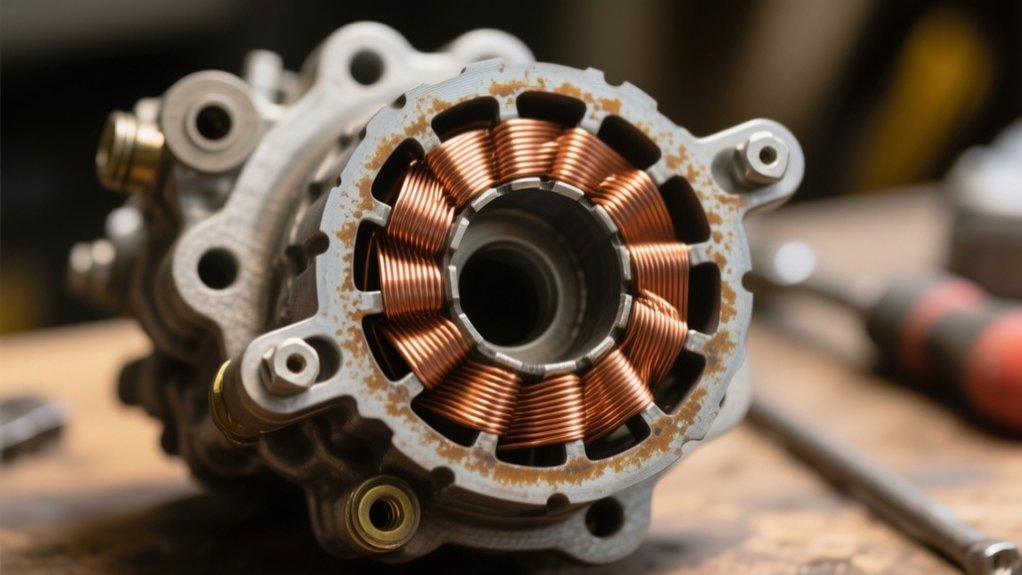
A stator on a motorcycle is a stationary ring of copper coils inside the engine case that generates alternating current (AC) as the rotor’s magnets spin nearby. You rely on it to power your bike’s electrical systems and charge the battery by sending AC to the rectifier/regulator. This device converts it to regulated DC voltage.
If you want to understand how it fits into the entire charging system and how to spot issues, keep exploring its function and diagnostics.
What Is a Stator on a Motorcycle and What Does It Do?
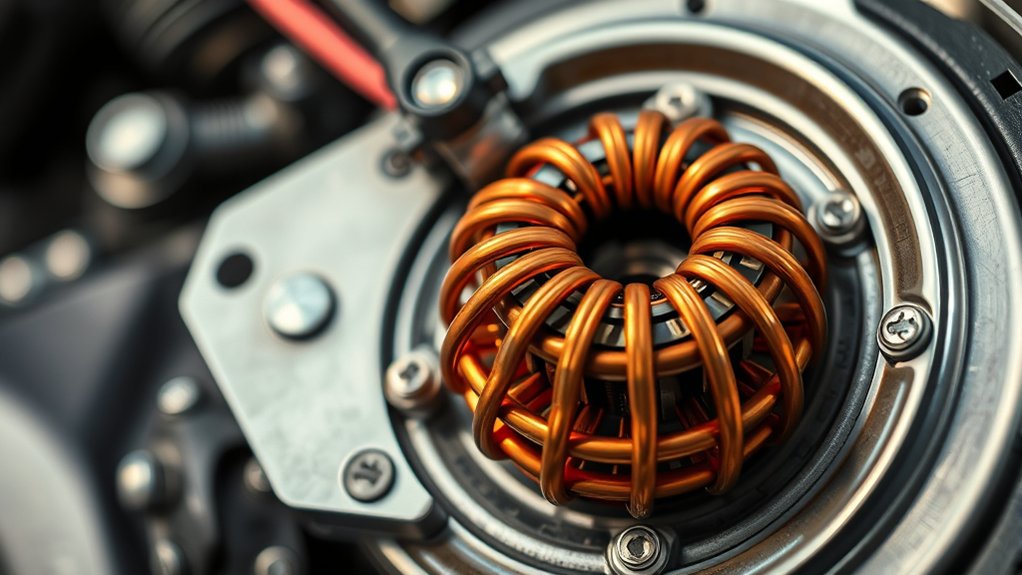
Think of the stator on your motorcycle as the engine’s electrical heart, fixed securely inside the crankcase where it forms a stationary ring of copper windings.
This stator, combined with a permanent-magnet rotor, functions as a compact alternator that generates AC electricity through electromagnetic induction.
As the rotor spins, it induces an alternating current in the stator windings.
You’ll find the AC output routed via heavy-gauge wires to an external rectifier/regulator, which converts it to DC and regulates voltage for battery charging and powering your bike’s electrical systems.
Unlike automotive alternators with electromagnet rotors, the permanent-magnet rotor setup simplifies packaging on the crankshaft.
If you notice dimming lights or a battery that won’t charge while running, the stator or its wiring may need inspection or replacement.
How Does a Motorcycle Stator Generate Electricity?
You generate electricity in your motorcycle stator through electromagnetic induction. Basically, the rotor has spinning magnets that create a changing magnetic field around the stationary copper coils.
As the rotor spins, this changing magnetic flux causes an alternating current to flow in the stator windings. So, it’s this interaction between the rotor and the coils that powers your bike’s electrical system.
Understanding this makes it easier to see how your motorcycle keeps everything running smoothly.
Electromagnetic Induction Process
Through electromagnetic induction, a motorcycle stator generates electricity by using stationary copper coils positioned around the engine’s rotor. As the rotor (flywheel) with permanent magnets spins, it creates a changing magnetic field through the stator’s three-phase coils.
This changing flux induces an alternating current (AC) voltage in each coil proportional to the rotor’s speed. The three-phase coil arrangement guarantees smoother, higher-output AC with reduced ripple.
The stator’s AC output travels via heavy-gauge wires to the rectifier/regulator, which converts it to regulated DC voltage essential for battery charging and powering the motorcycle’s electrical systems.
You can verify stator function by measuring the AC voltage across phases with a multimeter. Note that voltage rises consistently with engine RPM and remains balanced among coils.
Rotor And Coil Interaction
A motorcycle stator generates electricity by harnessing the interaction between its stationary copper coils and the rotating magnetic field of the rotor. The rotor, usually a flywheel embedded with permanent magnets, spins with the engine’s crankshaft. This causes its magnetic flux to pass over each stator coil.
This movement induces alternating current (AC) in the coils based on Faraday’s law of electromagnetic induction. Most stators use a three-phase coil arrangement spaced evenly around the rotor’s circumference. This creates staggered AC waveforms that combine for smoother, higher-capacity output.
The generated raw AC flows to the rectifier/regulator, where diodes convert it to direct current (DC), and voltage is stabilized to safely charge the battery and power electrical components. Any damage to the rotor magnets or coils reduces electrical output efficiency.
How Are Motorcycle Stators Different From Car Alternators?
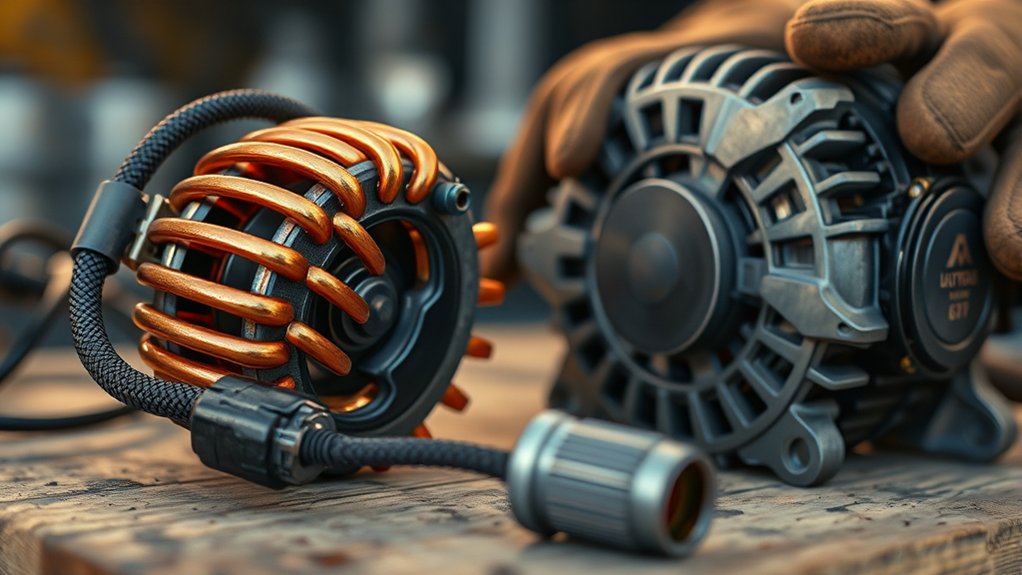
Although both motorcycle stators and car alternators serve to generate electrical power, they differ markedly in design and operation. Motorcycle stators are stationary coils mounted inside the engine case that produce AC as a permanent-magnet rotor spins around them.
In contrast, car alternators are external, belt-driven units with an electromagnet rotor. They generate AC that’s internally converted to DC by built-in rectifier/regulator components.
Motorcycle stators rely on permanent magnets, providing effective output primarily at higher RPMs but weaker low-rpm charging compared to automotive alternators, which electrically boost their field strength.
Stators are compact and integrated into the engine case, requiring cover removal for service, whereas alternators are removable without engine disassembly. Moreover, motorcycles route AC from the stator to a separate rectifier/regulator, while car alternators house this circuitry internally, supporting higher continuous output and wider RPM regulation.
How a Motorcycle Stator Fits Into the Charging System
You’ll find the stator is basically the heart of your motorcycle’s charging system. It generates AC power as the engine runs.
Then, this AC power flows to the rectifier/regulator. That part converts and controls the voltage to keep your 12V battery charged and the electrical system stable.
When you understand how these components work together, it’s easier to diagnose issues and keep your bike’s power delivery reliable.
Stator Role Explained
Think of the stator as the heart of your motorcycle’s charging system. It’s a stationary coil assembly housed inside the engine case that works with the rotating magnet (rotor) to produce AC electricity through electromagnetic induction.
This AC output flows to the rectifier/regulator, which converts it to steady DC voltage for battery charging and powering your bike’s electrical components. Unlike car alternators, the stator is embedded inside the engine, making it integral to your motorcycle’s charging system.
Here’s how the stator functions:
- Mounted inside the engine case as part of the alternator
- Generates AC electricity as the rotor spins
- Delivers varying voltage based on engine RPM
- Feeds AC to the rectifier/regulator for DC conversion
- Supports steady battery charging and electrical system power
Understanding this role helps you troubleshoot charging issues effectively.
Charging System Components
The stator works in concert with several components to keep your motorcycle’s electrical system running smoothly. Acting as the stationary part of the alternator, the stator’s windings generate AC voltage when the rotor’s magnets spin around it.
This AC output travels through heavy leads to the rectifier/regulator, which converts the alternating current into stable DC voltage. The rectifier/regulator guarantees DC charging voltage stays within 13.5 to 14.8 volts, protecting the battery and powering your bike’s electrical loads.
Modern stators often include multiple windings to supply different circuits and optimize output across RPM ranges. When diagnosing charging issues, measuring AC voltage at the stator connector helps identify faults.
Understanding how the stator, alternator, rectifier/regulator, and battery interact clarifies the charging system’s function and maintenance.
Common Signs of a Failing Motorcycle Stator
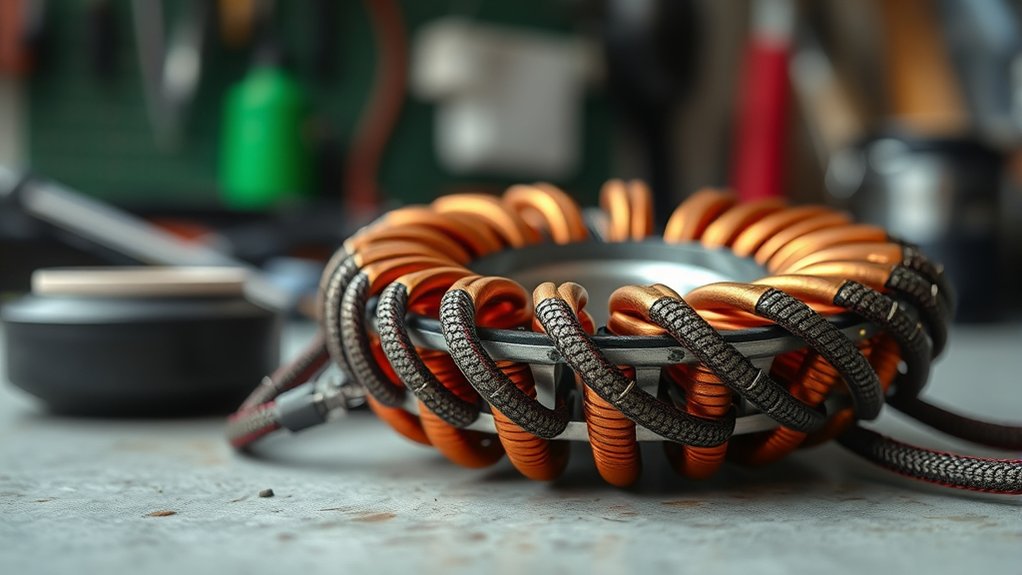
Frequently, a failing motorcycle stator reveals itself through electrical symptoms like dim or flickering headlights and dashboard lights at idle. These lights brighten as engine RPMs increase, which indicates the stator isn’t producing sufficient AC voltage.
You might also notice:
- Battery drain despite a healthy battery, showing the charging system isn’t replenishing power.
- Intermittent engine stalling or the bike dying under load due to inconsistent alternator output.
- Burnt smells or visible damage on the stator after removing the cover.
- Uneven AC voltage across stator phases indicating winding issues.
- Open or short circuits found during resistance tests confirming stator failure.
Recognizing these symptoms early helps you address charging system problems before they escalate. This guarantees your motorcycle runs reliably.
How to Test a Motorcycle Stator for Problems
You should always start testing a motorcycle stator by measuring the AC voltage output with the engine running around 3,000 RPM. Disconnect the stator connector and measure AC voltage between each pair of the three yellow wires. These three-phase outputs should show roughly 20 to 70 VAC and be nearly equal.
If any leg reads markedly lower or zero, the stator likely has a shorted or open winding and needs replacement.
Next, perform a resistance test with the engine off. Check resistance between each pair for low, equal values and from each lead to ground for infinite resistance.
Any continuity to ground indicates a short.
Finally, verify battery charging by measuring DC voltage at the battery with the engine running. A reading between 13.5 and 14.5 volts means the rectifier/regulator is working properly.
Why Understanding the Motorcycle Stator Helps Technicians
Getting to grips with the motorcycle stator lets you diagnose charging system issues more efficiently, saving time and preventing unnecessary part replacements. As part of the alternator, the stator generates AC output that the rectifier/regulator converts to DC, charging the battery. Understanding this flow helps you isolate faults precisely.
You’ll also appreciate the stator’s location inside the engine case, which aids in planning removal.
Key benefits include:
- Measuring phase-to-phase volts at specified RPMs to verify stator function
- Identifying signs of stator failure like burned windings or oil contamination
- Comparing AC output against service manual specs for accurate diagnosis
- Distinguishing faults between stator, rectifier/regulator, or battery
- Estimating labor time based on stator’s engine case mounting
This knowledge optimizes troubleshooting within the charging system.
Training for a Career in Motorcycle Electrical Systems
Mastering the motorcycle stator’s function and diagnosis lays a strong foundation for anyone pursuing a career in motorcycle electrical systems.
Motorcycle electrical training programs cover the alternator’s stator and rotor theory, emphasizing AC/DC output and charging system operation.
You’ll learn regulator/rectifier roles and perform battery diagnosis before testing stator output at the harness.
Hands-on labs teach stator removal, installation, and multimeter testing at different RPMs, plus interpreting OEM voltage and resistance specs.
Safety practices include correct torque on fasteners, gasket replacement, and wiring insulation.
Training prepares you to bench test parts, read service manuals, and explain warranties and failure modes.
This precise, practical knowledge equips you to troubleshoot charging system faults efficiently and confidently in professional settings.
Frequently Asked Questions
How Long Does a Motorcycle Stator Typically Last?
You can expect the average lifespan of a motorcycle stator to be between 8 to 15 years or about 20,000 to 60,000 miles. Proper maintenance intervals and monitoring charging reliability help prevent early failure.
Riding conditions materially affect this. Excessive heat damage from high RPMs or poor ventilation shortens life. Watch for replacement signs like dim lights or battery issues. Staying proactive with checks extends mileage estimates and keeps your stator functioning at its best.
Can I Replace a Stator Myself or Need a Professional?
You can replace a stator yourself if you have the right tools needed, like metric sockets, a torque wrench, and a flywheel puller, plus a well-organized garage setup. Make sure to follow safety precautions, such as disconnecting the battery.
Use wiring diagrams and torque specs from the service manual to guide you step-by-step. Also, source quality parts beforehand to avoid delays.
If you’re unsure about electrical diagnostics or engine disassembly, it’s a good idea to consider hiring a professional to avoid costly mistakes.
What Are the Costs Involved in Stator Replacement?
You’ll typically spend between $210 and $900 on stator replacement, with parts pricing ranging from $60 for aftermarket units to $400+ for OEM.
Labor estimates often run $150–$500, depending on complexity.
Don’t forget diagnostic fees, shipping costs, and potential recycling fees for old parts.
Warranty coverage varies. OEM parts usually offer limited warranties, while aftermarket options might be cheaper but less reliable.
Planning for these helps avoid surprises.
Do Stators Vary by Motorcycle Brand or Model?
Yes, stators vary markedly by motorcycle brand and model due to engineered tolerances, connector types, magnet strength, coil layouts, wiring harnesses, mounting patterns, and sensor integration.
You need to match these precisely for proper fit and function.
Differences in magnet strength affect charging performance, while coil layouts and sensor setups impact electrical output and compatibility.
Always use a stator designed specifically for your bike’s make, model, and year to avoid issues.
Can a Faulty Stator Damage Other Electrical Components?
Yes, a faulty stator can cause battery drain by undercharging, leading to repeated deep discharges.
It may also trigger regulator failure, causing overvoltage that overheats components.
Wiring corrosion and insulation damage can result from excessive heat, creating shorts.
You might notice ignition disruption and lighting flicker due to inconsistent power.
Voltage spikes can cause ECU interference, damaging sensitive electronics.
Conclusion
You might overlook the stator because it’s hidden and silent, but without it, your motorcycle won’t spark to life. While it’s not as flashy as the engine or brakes, the stator’s role in generating electricity is vital.
Understanding how it works and recognizing its signs of failure keeps you ahead of costly breakdowns. Mastering this component sharpens your technical skills, making you a more effective motorcycle technician.