Where Is Kawasaki Made – Origin Story
You’ll find Kawasaki motorcycles rooted in Tokyo, where the company began in 1961 by applying aerospace precision to motorcycle design. Kawasaki’s heritage in shipbuilding and heavy machinery shapes its durable manufacturing approach. Production spans Japan, the U.S., and Thailand, blending Japanese craftsmanship with lean, global manufacturing systems.
This guarantees consistent high quality and innovation worldwide. Understanding these origins reveals how Kawasaki balances tradition with cutting-edge production across its international facilities.
Kawasaki Motorcycles’ Beginnings in Tokyo
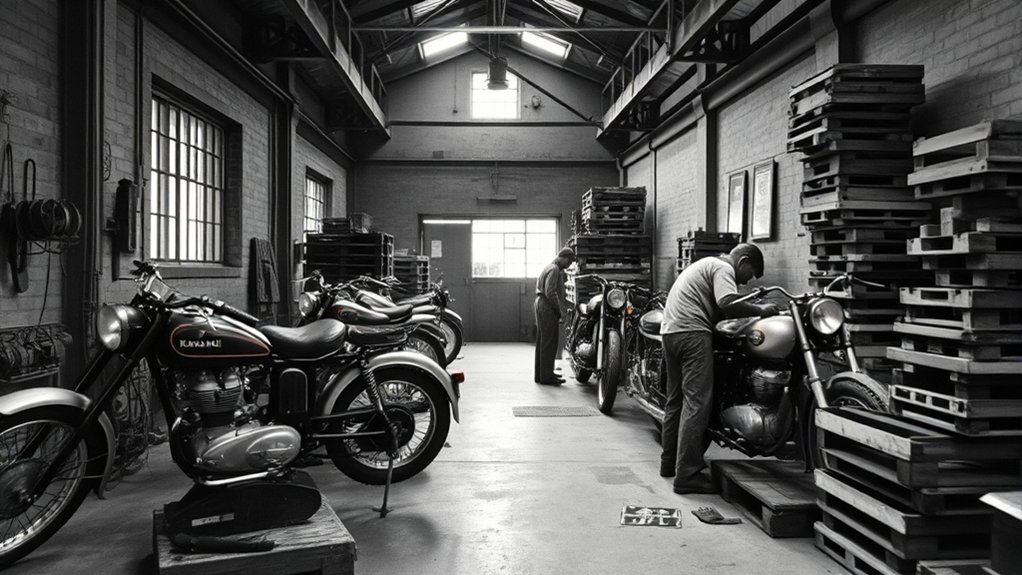
Although Kawasaki is now renowned worldwide for its high-performance motorcycles, its journey began in Tokyo in 1961 when Kawasaki Aircraft Corporation expanded into motorcycle production. You’ll find that in these early years, Kawasaki’s industrial origins played a pivotal role in its approach to manufacturing motorcycles.
Operating from Tokyo-based production facilities, the company leveraged aerospace technology to innovate bike design. The introduction of Kawasaki’s first model, the B8, in 1962 marked a significant milestone, setting the stage for the company’s entry into the motorcycle industry.
This Tokyo manufacturing hub laid the groundwork for Kawasaki’s reputation, blending industrial precision with motorcycle craftsmanship. Understanding these beginnings reveals how Kawasaki’s Tokyo roots shaped its trajectory from aircraft engineering to motorcycle manufacturing excellence.
How Kawasaki’s Industrial Heritage Shapes Manufacturing
Because Kawasaki’s roots extend deep into shipbuilding, heavy machinery, and aerospace since the late 19th century, its manufacturing approach reflects a unique blend of precision engineering and innovation. This rich industrial heritage shapes how Kawasaki designs and produces motorcycles, integrating craftsmanship with advanced production systems.
You can appreciate Kawasaki’s manufacturing strength through:
- Mastery of steel structures and heavy machinery engineering, ensuring durability and performance.
- The Kawasaki Production System, which enhances efficiency while preserving meticulous craftsmanship.
- A culture of continuous innovation, driven by decades of experience in complex industrial manufacturing.
This fusion of precision and industrial expertise allows Kawasaki to deliver motorcycles that embody both robust engineering and innovative design. It’s a direct outcome of its deep-seated manufacturing legacy.
The Evolution of Kawasaki Motorcycle Production Since the 1960s
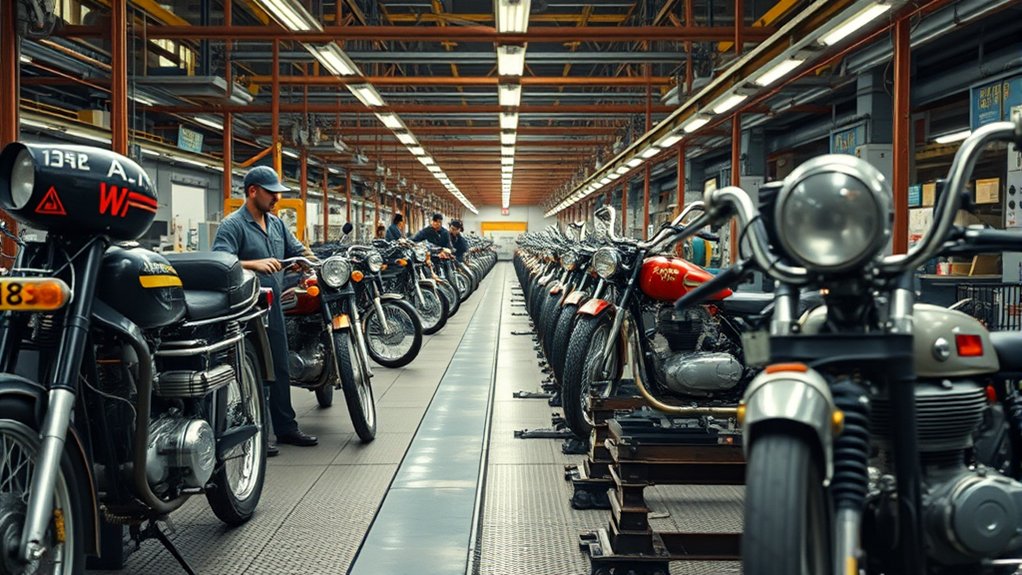
Kawasaki’s deep industrial expertise laid the groundwork for its motorcycle production, which began in earnest in 1962 with the B8 model. This bike was powered by a single-cylinder, two-stroke engine.
By 1964, Kawasaki expanded into U.S. factories, opening its first manufacturing plant in Lincoln, Nebraska. This move marked a pivotal shift in global manufacturing and the motorcycle industry.
Over time, Kawasaki scaled its Lincoln plant and added a second U.S. factory in Maryville, Missouri, focused on engine production. Today, Kawasaki motorcycles are primarily produced in Japan, the U.S., and Thailand. This reflects a strategic evolution in manufacturing plants that supports its global market reach.
| Year | Location | Significance |
|---|---|---|
| 1962 | Japan | B8 model launch |
| 1964 | Lincoln, Nebraska | First U.S. manufacturing plant |
| 1989 | Maryville, Missouri | Engine production for U.S. market |
Kawasaki’s Global Motorcycle Manufacturing Expansion
Where does Kawasaki manufacture its motorcycles to meet diverse global demands? Kawasaki’s global expansion in motorcycle manufacturing focuses on strategic locations that help serve international markets effectively.
The U.S. plant in Lincoln, Nebraska, established in 1974, is a key part of Kawasaki’s production outside Japan. It covers nearly 1.3 million square feet and produces motorcycles, engines, and light rail vehicles.
In Thailand, Kawasaki’s facilities concentrate on Southeast Asia. They assemble motorcycles locally to meet regional demand quickly and efficiently.
Japan still holds the core manufacturing role. It upholds Kawasaki’s high-quality standards and drives innovation across all sites.
This global network helps Kawasaki deliver reliable, high-performance motorcycles worldwide. They balance quality and innovation in every step of manufacturing.
Japan’s Role in Kawasaki Motorcycle Manufacturing
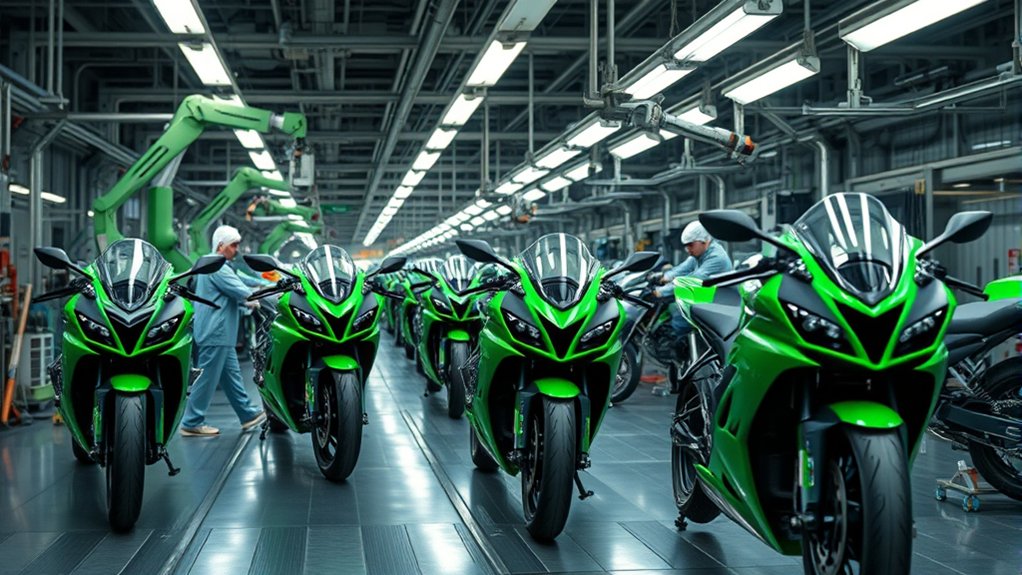
You’ll find that Kawasaki’s manufacturing roots run deep in Japan. That’s where the company set up its key production facilities. These plants really set the standard for quality and innovation.
They’ve been driving the development of flagship models and advanced engines. When you understand Japan’s role, it’s clear how Kawasaki keeps its reputation for excellence and technological leadership.
Historic Manufacturing Origins
Although initially focused on shipbuilding and aerospace, Kawasaki Aircraft Co., Ltd. made a pivotal shift in 1961 by producing its first motorcycle in Japan. This marked Kawasaki’s entry into motorcycle manufacturing, leveraging expertise from its aerospace and shipbuilding background.
You’ll find Kawasaki’s Japanese factories have always been central to motorcycle design, engineering, and assembly. These production facilities under Kawasaki Heavy Industries maintain rigorous quality control and innovation standards.
Here’s why this history matters to you: it highlights Kawasaki’s deep roots in Japan’s industrial evolution. It also shows how diversified expertise strengthened motorcycle manufacturing.
Plus, it reflects a commitment to precision and performance from the very start.
Understanding this foundation clarifies why Kawasaki motorcycles embody advanced engineering and reliability.
Japanese Production Excellence
Building on Kawasaki’s strong industrial roots in Japan, the company continues to uphold its reputation through manufacturing excellence at its domestic facilities. You’ll find Kawasaki’s Japanese manufacturing centers rigorously apply advanced production standards and strict quality control. This guarantees each motorcycle meets the highest expectations.
By utilizing the Kawasaki Production System, a lean manufacturing method, these manufacturing facilities optimize efficiency while maintaining precision and innovation. This approach directly supports Kawasaki’s hallmark engineering qualities: durability and reliability. It ensures motorcycles withstand rigorous use globally.
Japan’s role goes beyond assembly; it drives technological innovation and meticulous craftsmanship. This reinforces Kawasaki’s global brand reputation. When you consider durability and reliability, it’s clear that Kawasaki’s Japanese manufacturing foundation is pivotal to delivering cutting-edge motorcycles that perform consistently at the highest level.
Key Facilities In Japan
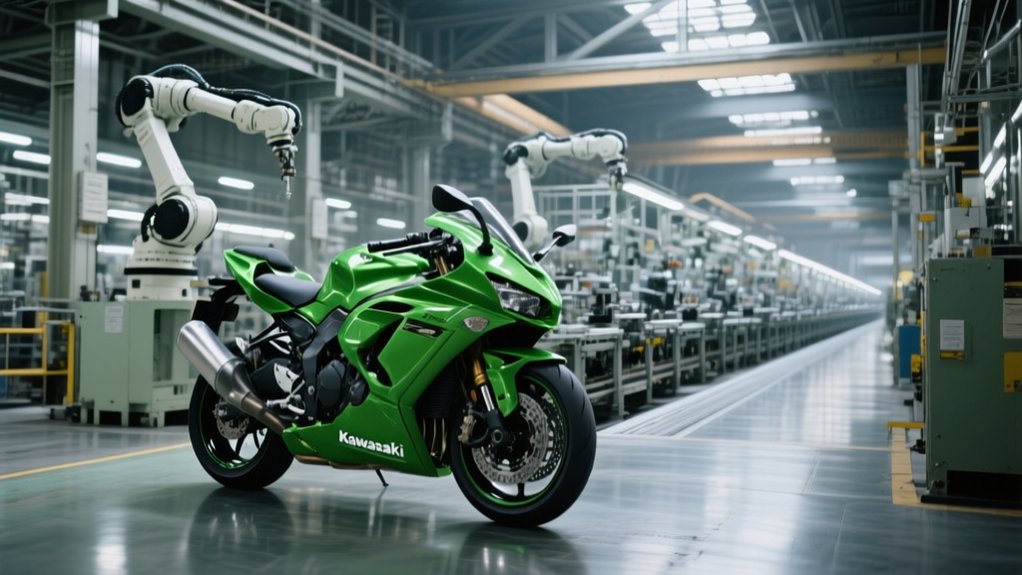
Three key facilities in Japan, located in Kobe and Akashi, form the backbone of Kawasaki’s motorcycle manufacturing. These manufacturing facilities drive the design, assembly, and production of flagship models, including the Ninja series and racing bikes.
Japan’s role goes beyond just assembly; it’s the central hub for research and development, which really fuels innovation.
Kobe focuses on advanced automation and precision engineering. This ensures durability and reliability in every motorcycle.
Akashi specializes in producing high-performance engines and core components. These are essential for Kawasaki’s global distribution.
Both plants integrate cutting-edge research and development. They’re always working to enhance technology and performance.
Manufacturing Facilities in the United States and Thailand
When you explore Kawasaki’s manufacturing footprint, you’ll find major facilities in the United States and Thailand that play essential roles in production and distribution. The manufacturing plant in Lincoln, Nebraska, was established in 1974 and has expanded to nearly 1.3 million square feet. It serves as a significant hub alongside the Maryville, Missouri plant, which focuses on engine production.
In Thailand’s Rayong Province, Kawasaki operates a plant that supports regional distribution and caters to Southeast Asia’s market demands.
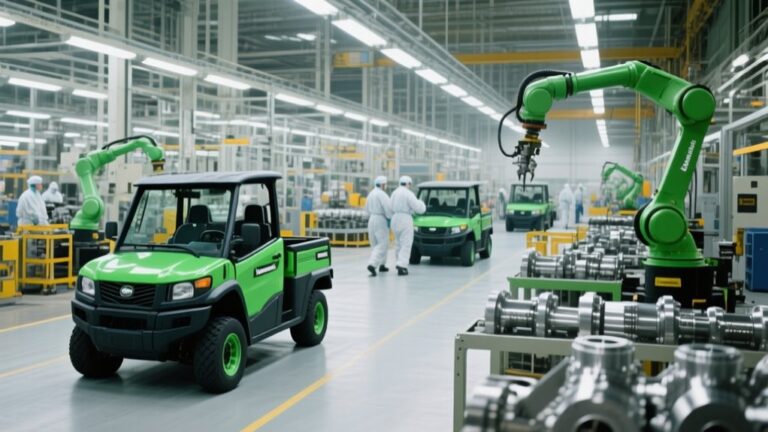
Both U.S. facilities blend Japanese and American techniques, employing the Kawasaki Production System to optimize efficiency and quality.
These strategically located plants enable Kawasaki to meet global demand effectively while adapting to local markets. This approach reinforces the company’s robust international manufacturing network without compromising standards.
How Kawasaki Ensures Quality Across Factories Worldwide
You’ll find that Kawasaki enforces rigorous quality control measures across all its factories to keep standards consistent. Skilled craftsmanship is a big part of the process, making sure every product meets durability and performance expectations.
Rigorous Quality Control
Although Kawasaki operates manufacturing plants across the globe, it maintains unwavering quality standards through rigorous control measures. You can trust that every motorcycle meets strict quality control benchmarks, regardless of where it’s made.
Kawasaki achieves this by implementing the Kawasaki Production System, which emphasizes just-in-time manufacturing and continuous improvement to enhance durability and performance. They also conduct thorough testing, including durability, safety, and performance assessments, before any product leaves the manufacturing facilities.
Regular inspections and audits are performed at factories in Japan, the U.S., and Thailand to ensure consistent adherence to Kawasaki’s quality protocols. These steps guarantee you receive a reliable, high-performing motorcycle.
Kawasaki’s dedication to meticulous quality control across all sites secures the brand’s reputation for safety and long-lasting durability worldwide. You can count on their commitment no matter where your bike is made.
Skilled Craftsmanship Standards
Because Kawasaki prioritizes skilled craftsmanship, it guarantees that every factory worldwide upholds exacting quality standards.
You’ll find that Kawasaki enforces rigorous quality control and manufacturing standards through the Kawasaki Production System. Employee training, especially the Kawasaki K-Tech program, hones precision, safety, and durability in every product.
Continuous improvement and regular audits keep these standards sharp across Japan, the U.S., and Thailand.
| Aspect | Implementation |
|---|---|
| Skilled Craftsmanship | Kawasaki K-Tech training focuses on accuracy and safety. |
| Quality Control | Advanced testing and inspection procedures. |
| Manufacturing Standards | Lean manufacturing via Kawasaki Production System. |
| Continuous Improvement | Global audits and process optimization. |
This approach guarantees you receive reliable, high-quality motorcycles and machinery wherever Kawasaki is made.
Frequently asked questions
What Are the Most Popular Kawasaki Motorcycle Models Today?
The most popular Kawasaki motorcycles today include the Ninja ZX-10R, known for its high performance and advanced electronics. It’s perfect if you’re into racing.
You’ll also find the Z900 is a favorite for its powerful engine and sleek naked design.
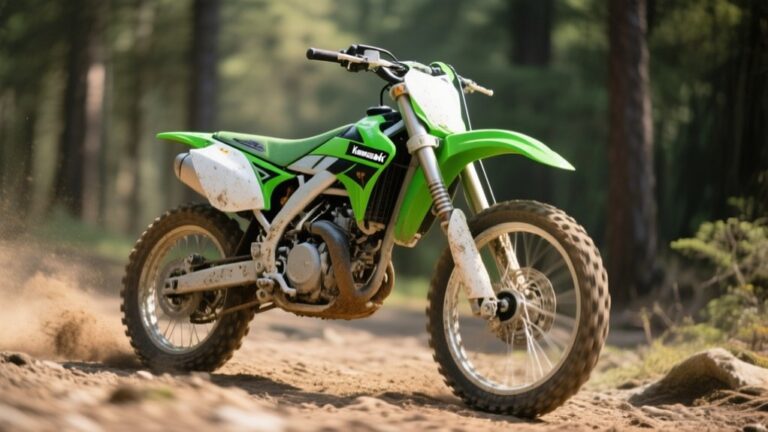
If motocross excites you, the KX250 and KX450 lead the market.
For cruising comfort, the Vulcan series, especially the Vulcan S, remains highly sought after by riders like you.
How Does Kawasaki Support Environmental Sustainability in Manufacturing?
Kawasaki supports environmental sustainability in manufacturing by using energy-efficient plants and renewable energy sources. You’ll find they integrate resource recycling systems like heat recovery and waste management to reduce environmental impact.
They also apply advanced pollution control technologies, including water treatment and flue gas desulfurization.
Kawasaki designs processes to conserve energy and materials, ensuring sustainability. Plus, they actively develop eco-friendly products and participate in green initiatives to minimize their carbon footprint.
It’s all about making manufacturing greener and more responsible.
What Types of Engines Does Kawasaki Use in Their Motorcycles?
Think of Kawasaki engines as the heartbeat of a finely tuned machine, powering various motorcycle styles. You’ll find liquid-cooled, four-stroke inline-four engines in their sportbikes, while cruisers use robust V-twins.
For raw power, Kawasaki’s supercharged four-cylinder engines roar in models like the Ninja H2R.
Their off-road bikes often feature agile 2-stroke or 4-stroke singles. Each engine blends performance, reliability, and cutting-edge tech, like digital fuel injection.
Does Kawasaki Manufacture Electric Motorcycles?
Yes, Kawasaki does manufacture electric motorcycles, but their electric lineup is still limited compared to gasoline models. You’ll find electric bikes like the Kawasaki Ninja e-1 mainly in Japan and Europe.
Kawasaki focuses on developing battery and motor technology through partnerships. They’re actively investing in electric propulsion to expand offerings.
But for now, their electric motorcycles aren’t widely available in markets like the United States.
Where Can I Find Kawasaki Motorcycle Dealerships Worldwide?
You can find Kawasaki motorcycle dealerships in almost every corner of the globe, from bustling US cities like Los Angeles and Miami to key European hubs such as London and Berlin. Kawasaki’s official website has a powerful dealer locator tool that makes tracking down authorized dealerships and service centers incredibly easy.
Whether you’re in Asia, Europe, or Oceania, you’ll get precise sales, parts, and support exactly where you need them. It’s pretty convenient no matter where you are. Just a few clicks and you’re set!
Final Thought
Think of Kawasaki motorcycles as a river, born in Tokyo’s industrial springs and flowing through decades of innovation. It branches into global streams like the U.S. and Thailand. Each factory adds its own current, making sure quality never falters.
Just like a river’s strength comes from its source and tributaries, Kawasaki’s legacy thrives on its Japanese roots and worldwide reach. It delivers performance and precision no matter where it’s made.