
Does Motorcycle Insurance Cover Theft – Straight Answer
Yes, your motorcycle insurance can cover theft, but only if you have full-coverage protection. After a theft, your insurer usually pays the bike’s actual cash value unless your policy has an agreed-value endorsement.
Your payout can be reduced by your deductible. Custom parts may also need separate coverage to be included in the claim.
You’ll usually need a police report, proof of ownership, and the vehicle details to file. The next sections explain what affects your settlement and how to protect yourself.
Does Motorcycle Insurance Cover Theft?

Yes—if you have all-inclusive motorcycle insurance, theft is typically covered.
Yes—if you have all-inclusive motorcycle insurance, theft is typically covered.
Your insurer will pay the bike’s actual cash value, or its agreed value if your policy specifies that, minus your deductible if the motorcycle isn’t recovered.
To get that protection, you need full coverage.
Without it, you usually pay the full loss yourself.
When you file a theft claim, provide a police report and proof of ownership.
You’ll also need vehicle details such as the VIN, parking location, and security measures.
Your policy controls how the insurer settles the claim.
This includes the deductible and whether aftermarket parts are covered.
If you owe money on the bike, the insurer may pay the lender first.
If you own it outright, you’ll receive the settlement directly.
How Comprehensive Coverage Pays for Theft
If your motorcycle is stolen and isn’t recovered, full coverage usually pays you up to its actual cash value—minus your deductible. Some policies also let you receive an agreed or stated value instead, as long as that amount is clearly listed and documented in your paperwork.
To file a claim, you’ll typically need a police report, proof that you owned the motorcycle, and records showing any custom parts or upgrades you’d installed.
Theft Claim Payout
When a theft claim is approved under full coverage, your insurer typically pays the motorcycle’s actual cash value at the time of loss, minus your deductible.
Comprehensive coverage usually requires a police report number, proof of ownership, and records for custom parts or upgrades. This helps the insurer assess value accurately.
If your policy includes an agreed-value term for a classic or high-value bike, the insurer pays that pre-set amount instead of market value.
If you still owe on a loan or lease, the insurer may issue payment to you and the lienholder, or apply it first to the balance.
Review storage, alarm, and key-security requirements, because violations can reduce or delay your theft payout.
Deductible And Actual Value
Once your theft claim is approved, all-inclusive coverage typically pays the motorcycle’s actual cash value at the time of loss, minus your deductible.
Your deductible is the amount you pay first, such as $500 or $1,000, before the insurer issues payment.
Actual cash value is based on comparable used-sale prices, then subtracts depreciation. That means newer bikes usually lead to larger settlements than older ones.
If your policy includes an agreed-value endorsement, you may receive a preset amount instead of actual cash value. This can reduce the impact of depreciation.
You should also check custom parts and equipment coverage. Aftermarket accessories may be limited unless you carry a separate endorsement with listed values and receipts.
How to Report a Stolen Motorcycle Fast

Report the theft to police immediately and get the report number, since insurers usually need it as the primary document for a theft claim.
To report the theft, give the officer the make, model, VIN, license plate, unique markings, and any modifications.
Use this quick reference:
| Action | Purpose |
|---|---|
| File police report | Start official record |
| Share VIN and plate | Aid identification |
| Note custom parts | Improve recovery |
| Contact your insurance | Begin claim process |
| Save proof of ownership | Confirm title |
Contact your insurance right after filing and provide the police report number, theft time, location, proof of ownership, and receipts.
If you have tracker data, footage timestamps, or witness details, send them promptly.
Check policy deadlines, and keep copies of every form and message to avoid delays or denial.
What Your Theft Claim Needs
A strong theft claim starts with solid documentation.
You should give your insurer the police report number, the exact theft time and location, and your motorcycle’s VIN, make, model, license plate, and distinguishing features.
You’ll also need proof of ownership, such as the title, registration, purchase receipt, and photos.
If you’ve added custom parts, include receipts or appraisals for those items too.
Be ready to explain where the bike was stored, who’d the keys, and what security devices you used, including locks, alarms, or GPS.
Your adjuster may also ask about recent servicing or any transfer of ownership.
The stronger your records, the smoother your claim review will be.
And the more accurately your loss can be documented.
What Affects Your Theft Payout?
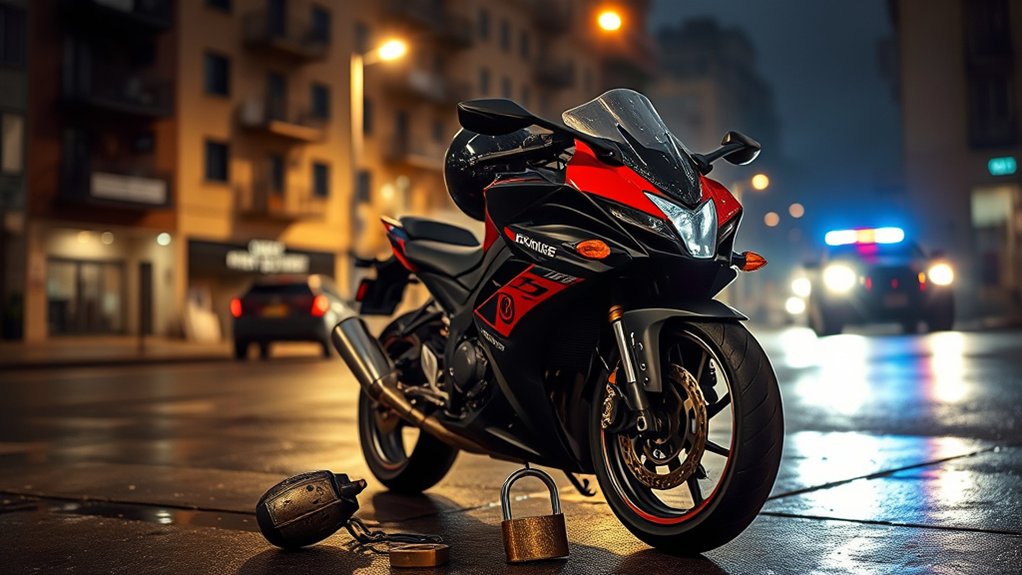
Your theft payout usually starts with your bike’s actual cash value at the time of the loss. From there, your deductible is subtracted based on the terms of your policy.
If you selected an agreed-value endorsement, you may receive the preset amount instead of a depreciated market value. Also, keep in mind that upgrades and accessories might only be included if they’re covered under your policy—and documented properly—so they can affect the final settlement.
Deductible And Policy Terms
When a theft claim is paid, your all-encompassing deductible comes out first. So a bike with an actual cash value of $8,000 and a $500 deductible would settle for $7,500.
Next, your policy terms determine whether you get actual cash value or an agreed-value amount. Under a standard policy, depreciation reduces payment. Under an agreed-value policy, the insurer pays the preset figure.
Your deductible, policy limits, and any separate cap for custom parts and equipment can further narrow the settlement. You may need a specific endorsement to avoid that.
Security measures also matter. If your policy requires a locked garage or an approved immobilizer and you didn’t comply, the insurer may reduce or deny your claim.
If you still owe on the bike, the insurer usually pays the lienholder first. Then it sends any remaining balance to you.
Bike Value And Upgrades
The payout on a stolen motorcycle usually starts with its actual cash value at the time of loss.
Depreciation can reduce what you receive before the deductible is applied.
If your bike has aftermarket upgrades, you’ll need proof your policy covers them.
Standard coverage may only pay for stock parts.
- actual cash value sets the base settlement.
- agreed-value policies can lock in a preset amount.
- aftermarket upgrades may need a CPE endorsement or receipts.
- your deductible lowers the final theft payout.
If you financed the bike, your lender may take the settlement first.
You could still owe a balance if the claim doesn’t match the loan.
Gap coverage can help close that shortfall.
Which Motorcycles Get Stolen Most?
Sport bikes are among the most frequently stolen motorcycles. Models like the Yamaha R1, Kawasaki Ninja, and Honda CBR series offer strong performance and parts with high resale value.
In motorcycle theft, you’ll also see high-value bikes and popular models targeted. Thieves can quickly sell engines, wheels, and electronics for profit.
Cruisers, especially Harley-Davidson models, face a similar risk. Buyers want whole bikes and aftermarket parts, which makes these bikes attractive to steal.
Mopeds and scooters in cities are stolen often too. They’re easy to move and resell locally, so they’re an easier target.
Obscure motorcycles usually draw less attention. Still, any bike with desirable components can become a target.
During summer and around events or parking hotspots, theft incidents rise. Increased visibility can alone make the risk go up.
How to Lower Motorcycle Theft Risk
If theft risk is highest for certain motorcycles, you can still reduce your chances by making yours harder to steal. To lower risk, protect your bike with layered security.
Motorcycle insurance covers theft only after a loss, not before it happens. So it helps to prevent the theft in the first place.
- Lock your motorcycle with a heavy-duty disc lock or chain and secure it to an immovable object.
- Park in a well-lit, busy area or a locked garage, especially overnight.
- Install a GPS tracker and alarm to improve recovery odds and deter thieves.
- Remove or secure seats, GPS units, and visible valuables.
These measures work best together. When you combine visible barriers, secure storage, and tracking, you make theft less likely.
It also shows careful ownership.
How to Compare Theft Coverage Quotes
When you compare motorcycle theft coverage quotes, first confirm whether theft is covered under the comprehensive policy. Also check whether the insurer pays actual cash value or an agreed or stated value after a loss.
Next, review each deductible carefully. A higher deductible can lower your premium, but it can increase your out-of-pocket cost if your bike isn’t recovered.
Then check what’s included for custom parts and equipment. Make sure aftermarket accessories and labor are covered, or determine if you need a separate endorsement.
Keep receipts or valuations ready for any upgrades. This helps you verify your coverage and avoid surprises during a claim.
Finally, verify any policy conditions that could void coverage. For example, storage requirements like a locked garage or an insurer-approved GPS tracker.
After that, compare claim handling and payout timelines. Also look at customer ratings and discounts for anti-theft devices or bundled policies to judge the true cost of full coverage insurance.
Frequently Asked Questions
Does Theft Coverage Apply to Custom Parts and Accessories?
Theft coverage usually doesn’t fully apply to custom parts and accessories unless you’ve added specific protection.
Your standard all-risk policy may cover the bike itself, but insurers often exclude non-standard items like paint, exhaust, seats, or electronics.
If you want those covered, you’ll need a Custom Parts and Equipment endorsement or agreed-value coverage.
You should keep receipts, photos, and appraisals, since your insurer may require proof before paying.
Will My Premium Increase After a Theft Claim?
Yes, your premium can increase after a theft claim.
A theft loss can feel like a ripple that spreads through your policy.
You’ll usually see a smaller hike than after an at-fault crash.
But increases of 10–30% aren’t uncommon.
Your insurer may also remove claim-free or accident-forgiveness discounts.
If you have anti-theft devices and a clean record afterward, you can help limit future surcharges over time.
Is Theft Covered if the Motorcycle Is Stolen From Storage?
Yes, if you have full coverage, theft from storage is usually covered.
Your insurer will treat it like a theft claim, but you’ll need a police report and proof of ownership.
You’ll typically get the bike’s actual cash value, minus your deductible.
Storage rules and limits on custom parts can affect what you recover, so check your policy carefully.
Does Roadside Assistance Help After a Motorcycle Theft?
No, roadside assistance usually won’t help with the theft itself, and that may disappoint you.
It’s meant for towing, jump starts, fuel delivery, and similar breakdown support. It’s not for recovery or replacement.
If police recover your bike, you might get towing help to move it to a secure location.
However, you’ll need full-coverage insurance to handle the loss.
Report the theft quickly to police, your insurer, and your roadside provider.
Can I Get Gap Coverage if the Bike Is Stolen?
Yes, you can get gap coverage if your bike is stolen, but only if you already have it on your policy or bought it separately.
You’ll need a thorough theft claim, a police report, and proof of ownership.
Once the insurer pays the motorcycle’s actual cash value minus your deductible, gap coverage can help cover any remaining loan or lease balance you still owe.
Conclusion
If your motorcycle is stolen, full coverage usually protects you, not basic liability.
Act quickly. File a police report, notify your insurer, and gather your keys, photos, and records.
Your payout depends on your policy terms, your deductible, and the bike’s actual value.
Theft can happen fast, like a thief in the night. With the right coverage and prevention, you can stay protected and ride with confidence.