Where To Buy Motorcycle Tires – Buying Guide
Buy motorcycle tires from the place with the lowest total installed cost, not the cheapest sticker price. Factor in shipping, mounting, balancing, disposal, taxes, and any mobile fee. Then confirm the exact size, load index, speed rating, and tubeless fitment.
Local shops can offer fast support and install help. Online retailers often cost less and typically ship in 2–4 business days.
Match your tire choice to your bike, budget, and riding style. There’s more to compare below.
Local Shop vs Online Retailer

When you’re deciding between a local shop and an online retailer, compare total cost, not just the tire price. A local shop may quote more upfront.
You can often get fitment checks, mounting, balancing, disposal, and warranty help immediately, without delay. If those services aren’t bundled, expect about $25–$50+ per tire.
Online retailers usually list lower prices. For example, a Full Bore M1 rear might be $134.96, and a Continental ContiMotion set could be $218.96.
You’ll still need installation and shipping, though. Buying a matched set online can reduce cost, but you must verify wheel compatibility, tubeless or tube fitment, size, speed/load ratings, and return rules before ordering.
Compare Motorcycle Tire Prices and Shipping
To compare motorcycle tire prices effectively, add shipping to the sticker price. Then compare both single-tire and matched-set listings.
Most tires here ship in 2–4 business days. So the real price point depends on the full out-the-door total, not the ad alone.
| Brand/Model | Listing | Price |
|---|---|---|
| ContiMotion set | 120/70ZR-17 + 190/50ZR-17 | $218.96 |
| Pirelli Angel ST set | 120/70ZR17 + 180/55ZR17 | $289.96–$294.96 |
| Full Bore M1 pair | 120/60ZR17 + 190/50ZR17 | $222.92 |
You can also spot savings in singles. A ContiMotion rear may drop from $156.89 to $128.96.
Compare the set total with separate fronts and rears. Then add mounting fees if your shop charges them.
Check Tire Size, Load, and Speed Ratings
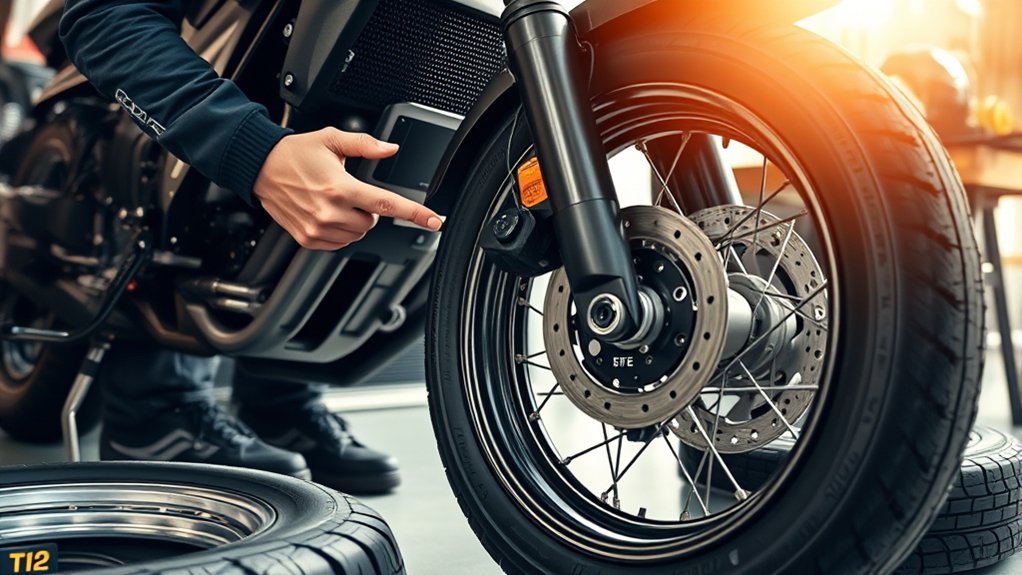
Check the sidewall code first, so you match the tire’s width, aspect ratio, and rim diameter to your bike’s spec.
Then verify the load index meets or exceeds OEM requirements—especially for the rear tire, since carrying and drive loads run higher.
Finally, confirm the speed rating is at least what the manufacturer calls for, because a lower rating can affect safety and may also impact warranty coverage.
Match Sidewall Size
Even if the tread looks right, you still need to match the full sidewall code before you buy.
Read the code, such as 120/70ZR17 58W, to confirm the sidewall size, load index, speed, and rim fit.
Then verify the rim diameter and aspect ratio match your wheel.
This helps maintain proper handling.
Choose the exact approved front and rear sizes when your manual calls for matched tires.
Never use a lower-rated tire, and confirm any alternative fitment in the manufacturer chart.
- 120 = tread width in millimeters
- 70 = sidewall height as a percentage of width
- 17 = rim diameter in inches
- W = speed rating that meets factory spec
Verify Load Index
Once the sidewall size matches, verify the load index and speed rating on the same code, such as 180/55ZR17 73W. Read the full marking: 17 confirms rim diameter. 180/55 confirms size. 73 shows load index, and W shows speed rating.
Use a load table. Index 73 equals 365 kg or 805 lbs per tire. This helps ensure your motorcycle can carry axle loads plus luggage.
| Code | Meaning | Risk if wrong |
|---|---|---|
| 73 | 365 kg | Overload failure |
| H | 130 mph | Heat stress |
| W | 168 mph | Legal trouble |
If you replace one tire, match or exceed the remaining tire’s ratings. Check your owner’s manual and fitment charts, because some 190/50 and 190/55 combinations can change load-carrying capacity and handling.
Confirm Speed Rating
To keep your bike safe and legal, match or exceed the OEM speed rating stamped on the sidewall.
A lower-rated tire can overheat, reduce stability, and void warranties.
Read the full sidewall code, not just the letter.
For example, 180/55ZR17 73W tells you width, aspect ratio, rim diameter, load index, and speed rating.
If you replace only one tire, make sure the new tire’s speed rating meets or beats the one still on the bike.
This helps keep handling balanced.
For matched pairs, use identical speed and load ratings.
Ideally, use the same model too, so ABS and traction control stay predictable.
- H = 130 mph
- V = 149 mph
- W = 168 mph
Choose higher ratings for heavy loads or track use.
Why Mounting and Balancing Costs Matter
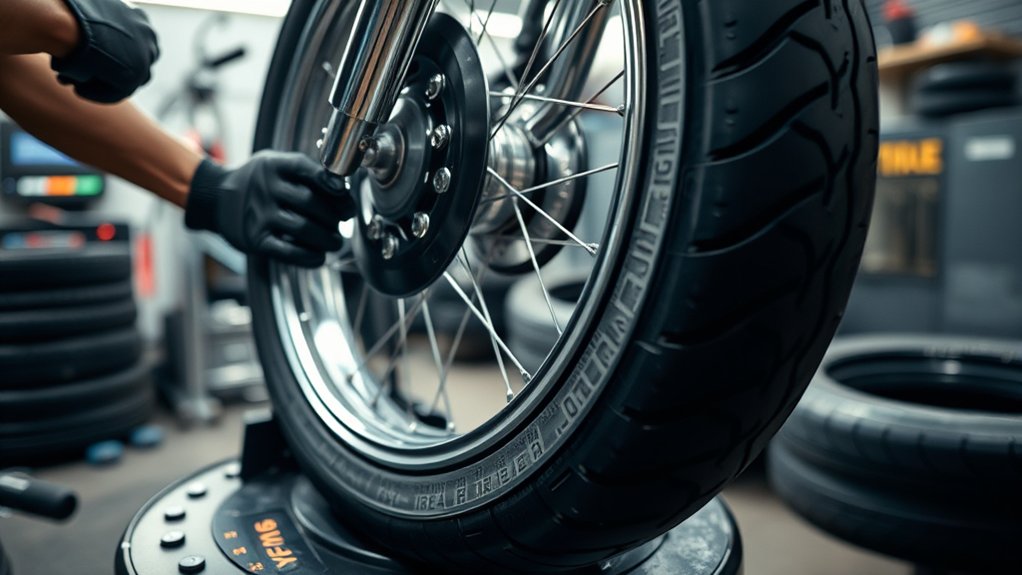
Mounting and balancing usually adds about $15–$40 per tire at a shop.
That small upfront cost helps prevent vibration, uneven wear, and premature tire replacement.
When you pay for proper mounting and balancing, you’re buying stability.
Dynamic balancing places wheel weights where they correct static and rotating imbalance, so your bike tracks cleanly and handles with more precision.
Skipping this work can leave you with wobble, stressed bearings, and faster suspension wear.
Don’t assume a cheap fee means a better deal.
Some low-cost shops cut corners on valve stems, torque, or balancing.
Ask whether they use a dynamic balancer and replace valve stems.
Compare the true installed price, including disposal, taxes, and any mobile-installation charge.
Best Places to Buy Touring Motorcycle Tires
Now that you’ve accounted for mounting and balancing, the next step is choosing a seller that matches your touring needs with the right tire, size, and service. For touring, look for street tires with mileage, wet grip, and stable load ratings.
After mounting and balancing, choose a seller that matches your touring needs with mileage, wet grip, and stable load ratings.
OEM and specialty motorcycle dealers can fit models like Pirelli Angel ST or Continental ContiMotion correctly. They can also confirm the correct fitment, like 120/70ZR17 front and 180/55–190/50ZR17 rear sizes.
Major online retailers often cost less and ship in 2–4 days. If you’re aiming to cut costs, value brands like Full Bore M1 can help, especially if you don’t need premium tech.
Before you buy, check tread compounds, ZW ratings, and tubeless compatibility. Big-box stores and marketplaces can work too, but verify installer fees and wheel type so you don’t lose time or money.
Best Places to Buy Sport Motorcycle Tires
For sport motorcycle tires, specialist online retailers are often the best place to buy.
You can compare matched front/rear sets and save on per-tire pricing.
For example, a Pirelli Diablo Rosso II set may run about $264.96.
Meanwhile, a Continental ContiSportAttack set can drop to $214.96.
You’ll want the right Front and Rear Motorcycle pairing, especially a matching Rear tire compound.
| Option | Price | Notes |
|---|---|---|
| Pirelli Diablo Rosso II | $264.96 | Matched set |
| Continental ContiSportAttack | $214.96 | Discounted set |
| Full Bore M1 rear | $134.96 | Budget value |
| Full Bore M1 front | $87.96 | Budget value |
Check radial or bias construction, tubeless fitment, and speed/load ratings on the sidewall.
If you need quick delivery, major-brand listings often ship in 2–4 business days.
Continental Tires for Commuting and Touring
Continental’s ContiMotion line is a smart pick for commuting and touring. It delivers dependable real-world value, with the 120/70ZR-17 front and 190/50ZR-17 rear matched set often listed around $218.96 and usually ships in 2–4 business days.
You get Z-rated performance, durable mileage, and stable handling on touring bikes.
- ZeroDegree steel-belt construction helps absorb impacts.
- Tread compounds balance wet grip and dry confidence.
Rear options like 180/55ZR-17 and 170/60ZR-17 can often drop to $128.96. With fast availability, you can replace worn tires quickly.
If you ride daily, ContiMotion gives consistent feedback at lean angles. It keeps long-haul comfort in the mix, too.
It’s a practical choice when you want dependable traction, efficient wear, and prompt delivery.
Continental Tires for Sportier Street Riding
If you want sportier street performance, Continental’s ContiMotion is a great place to start. It delivers touring-grade grip, stable feedback, and reliable wet and dry traction, and you don’t have to give up mileage.
Then, if you want even more response, step up to the ContiSportAttack matched set. You’ll notice sharper lean control, stronger edge support, and a compound designed for aggressive street riding with the occasional track day.
Both options use advanced belt construction and Z-rated designs, so you can choose the tire that best matches your bike’s speed and handling needs.
ContiMotion Touring Grip
ContiMotion is Continental’s value-focused sport-touring option when you want stable, predictable handling for commuting and longer rides. It’s designed for riders who don’t need track-level grip.
You get solid touring grip from its advanced compound and steel belt/ZeroDegree construction. This helps the tire absorb shock and stay composed in wet or dry conditions.
The matched 120/70ZR-17 front and 190/50ZR-17 rear set is priced at $218.96. Delivery is typically 2–4 business days.
- Mileage-focused performance for daily use
- Z-rated rear options: 180/55ZR-17 and 170/60ZR-17
- Individual rears often run $128.96–$149.85
- Best if you value longevity and all-weather traction
If you want a practical, confidence-building street tire, ContiMotion delivers.
ContiSportAttack Lean Control
Dial into sharper street performance with the ContiSportAttack. It’s Continental’s sportier, lean-friendly option for riders who want quicker turn-in and stronger edge grip than a touring tire can offer.
You get a 120/70ZR17 front and 180/55ZR17 rear matched set. Built with advanced steel-belt construction, it delivers consistent feedback and cornering stability at lean.
The specialized compound and tread design help you maintain grip on wet pavement. You still get confident dry traction for spirited street riding.
Compared with ContiMotion touring rubber, this tire favors sharper handling over maximum mileage. It’s a great fit if you value control more than long-haul wear.
At $239.99, discounted to $214.96, this is a practical upgrade. Shipping in 2 to 4 business days means you can get back to speed, precision, and control fast.
Pirelli Tires for Touring and Sport Riding
Pirelli gives you a strong spread of options for touring and spirited street riding. The Angel ST stands out as a sport-touring tire that uses a high-silica compound and modern tread geometry. It’s built for high mileage, neutral handling, and better wet and cold-weather grip.
If you want sharper response, the Pirelli Angel ST and Diablo Rosso II use matched front and rear fitments. This helps keep profile consistency through the tire’s life.
- Angel ST suits long-distance street use.
- Diablo Rosso II adds dual-compound grip.
- Asymmetric tread helps water evacuation.
- Typical sets fit 120/70ZR17 fronts.
You can usually find these Pirelli packs priced competitively. Delivery often takes 2 to 4 business days, so you can replace worn rubber without losing riding time.
Full Bore USA Tires for Value and Performance
Full Bore USA’s M1 series gives you a Z-rated radial option built for sport and street bikes. The tread geometry is tuned to deliver confident grip in both dry and wet conditions.
You’ll notice responsive handling and solid cornering stability, too. Plus, the heat-managed construction is designed to support spirited riding without the price tag of premium-brand tires.
With common DOT sizes and quick shipping, the M1 is a practical value play if you want performance—without overspending.
M1 Performance Overview
If you’re looking for a budget-friendly performance upgrade, the M1 line from Full Bore USA gives you a Z-rated radial built for street and sport bikes. It’s available in common fitments like 120/60-17 up front, and 180/55-17 or 190/50-17 in the rear.
You get an M1 tire tuned for high performance. The tread geometry helps you keep grip in dry corners, while still giving you confidence on wet roads.
Its radial carcass supports quick turn-in and stable feedback under load. That responsive feel makes it easier to carry speed through changes in direction.
- Street-focused compound
- Responsive sidewall feel
- Predictable lean progression
- Competitive pricing, from about $87.96 front
You can use the M1 on spirited rides without giving up practical durability. Full Bore’s rider-driven approach shows in a tire that balances grip, longevity, and everyday usability.
Value-Focused Rider Benefits
When you want to stretch your budget without backing off on performance, Full Bore USA’s M1 line is a smart buy.
You get a value-focused option from a rider-built U.S. brand, and the rubber compound plus Z-rated construction help keep grip and stability respectable for street use.
| Size | Price | Benefit |
|---|---|---|
| 120/60ZR17 front | $87.96 | Low entry cost |
| 180/55ZR17 rear | $136.96 | Common fitment |
| 190/50ZR17 rear | $134.96 | Sport-bike choice |
You can expect responsive handling, confident cornering, and dry and wet traction without paying premium-brand money.
If you need a quick replacement, 2–4 business day shipping helps you get back on the road fast.
Frequently Asked Questions
How Often Should Motorcycle Tires Be Replaced?
You should replace motorcycle tires when tread depth nears 1/32″ (0.8 mm),
when the wear bars become flush, or if you see damage.
On average, street tires last about 5,000–15,000 miles.
This depends on the compound, your bike, and how you ride.
Replace tires immediately if you spot sidewall cracks, bulges, cuts, exposed cords,
or repeated punctures.
Also, swap tires that are over 10 years old, even if they still look serviceable.
Can I Mix Different Tire Brands on One Motorcycle?
No, you really shouldn’t mix tire brands on one motorcycle unless you have to.
Manufacturers design matched front-and-rear tires for specific grip, stiffness, and wear patterns.
So mismatches can feel wildly unstable in braking and cornering.
If you must mix, keep the same tire type, construction, size, load index, and speed rating.
Try to match wear, check pressures, and test the bike carefully after fitting.
Do Motorcycle Tires Expire if Unused?
Yes, motorcycle tires do expire even if you never use them.
Check the DOT code on the sidewall; the last four digits show the manufacture week and year.
If a tire is 5 to 10 years old, or shows cracks, bulges, or feels hard, replace it.
Heat, sunlight, ozone, and poor storage speed aging, so store tires in a cool, dry, dark place to preserve rubber and grip.
Should I Buy Tubeless or Tube-Type Motorcycle Tires?
You should buy tubeless tires if your rim supports them. They’re safer on highways, seal punctures more slowly, and you can often plug them roadside.
Choose tube-type tires if you’ve got spoked or older rims, or your bike specifies tubes. They’re simpler for vintage and off-road use, but they can deflate faster if damaged.
Don’t cut corners. Match the tire type to your wheel design and manufacturer’s spec.
What Tread Pattern Suits Wet-Weather Riding Best?
You’ll want a directional or asymmetric tread pattern with deep circumferential grooves and well-angled lateral sipes.
It channels water away from the contact patch, so you’re less likely to hydroplane.
Look for larger central grooves, fine siping, and high-silica wet-compound sport-touring tires if you ride in cool rain.
Avoid overly slick patterns, since they won’t evacuate water as effectively at speed and can reduce wet braking confidence.
Conclusion
So, when you’re ready to refresh your ride, shop with a clear eye. Compare local shops and online retailers, and verify tire size, load, and speed ratings.
Before you commit, factor in mounting and balancing. This helps you avoid surprises and ensures the fit is done right.
If you want dependable touring rubber, look at Continental, Pirelli, or Full Bore USA. Choose based on your riding style and budget.
Pick the option that best suits your machine. Then you’ll roll out with confidence on a smoother, quieter road ahead.