Can You Trade In A Car For A Motorcycle – Find Out
You can trade in your car for a motorcycle at many dealerships, where your car’s trade-in value is applied as a down payment or price reduction. Dealers base the value on your vehicle’s make, model, condition, and market demand.
They usually offer less than private sales because of reconditioning costs. Positive equity lowers your motorcycle price, while negative equity might be added to financing. This trade-in often reduces sales tax, making it a convenient option.
Explore how the process works and what to take into account before deciding.
Can You Trade a Car for a Motorcycle?
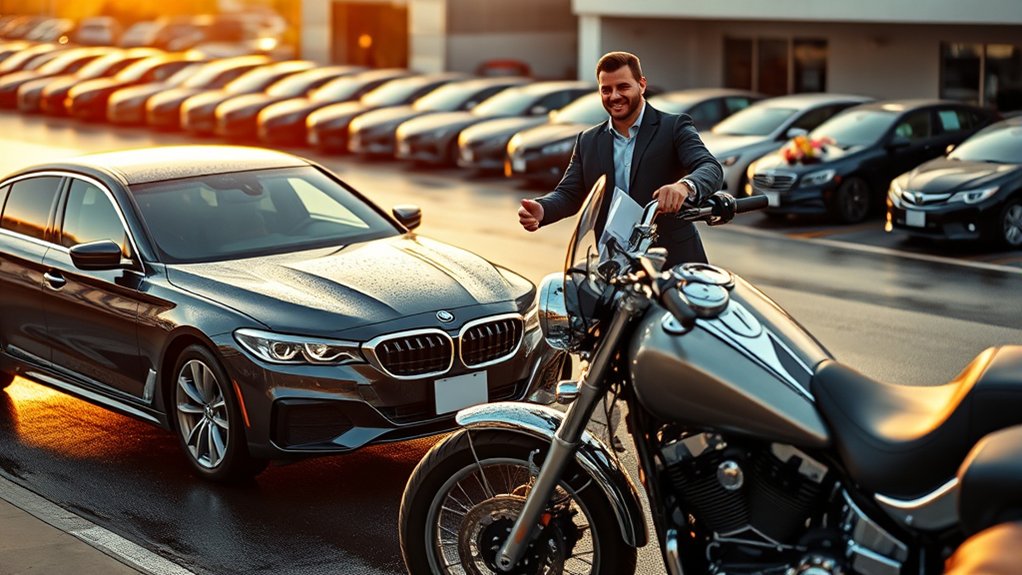
You can certainly trade in your car for a motorcycle at many dealerships. They’ll apply the agreed trade-in value as a down payment or price reduction on the bike. The trade-in value depends on your car’s make, model, year, mileage, condition, and current market demand.
Typically, it’s lower than what you’d get in a private sale because dealers need to cover reconditioning and resale costs. Before deciding to trade your motorcycle or car, it’s smart to get multiple quotes from car dealers, motorcycle dealers, and online tools like Kelley Blue Book.
Comparing these with private sale estimates helps make certain you get the best deal. Remember, trading in usually lowers the sales tax on your motorcycle purchase, offering additional savings in many states.
How Do Dealers Value Your Trade-In?
Dealers determine your trade-in’s value by analyzing several key factors, including the make, model, year, mileage, and overall condition of the vehicle. They rely on guides like Kelley Blue Book and internal auction data to estimate a trade-in value based on current market trends.
The dealership also deducts reconditioning and resale costs from the wholesale-equivalent value to finalize their offer. Seasonal and regional demand can affect the value of your motorcycle or car trade-in.
If you have an outstanding loan, the payoff amount is subtracted to find your net equity.
| Factor | Impact on Trade-In Value |
|---|---|
| Make & Model | Higher demand brands get more |
| Year & Mileage | Newer, low mileage = higher value |
| Condition | Cosmetic/mechanical issues lower |
| Market Demand | Seasonal/region affects pricing |
| Outstanding Loan | Payoff reduces net equity |
How Does Trading a Car for a Motorcycle Work?
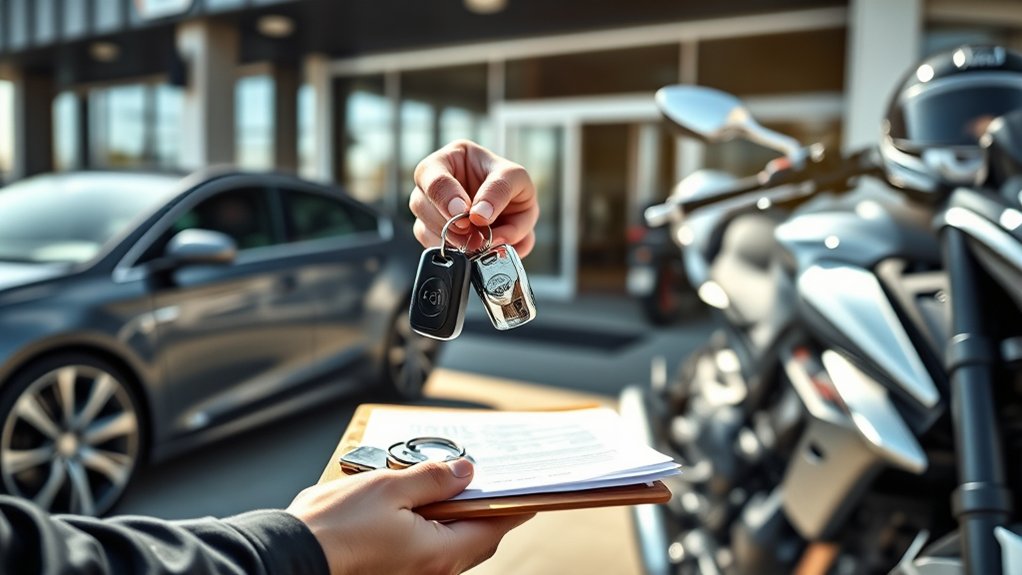
When you trade your car for a motorcycle, the dealer starts by checking out your vehicle. They’ll look at things like the make, model, year, mileage, condition, and how much demand there’s for it right now.
After that, they give you a trade-in value.
You can use this trade-in value to lower the price of the motorcycle you want to buy. It’s a great way to cut down on what you need to pay out of pocket.
Knowing how they figure out your car’s value and understanding the trade-in process can really help you negotiate better and make the whole deal go smoothly.
Trade-In Process Overview
Although trading a car for a motorcycle may seem complex, the process is straightforward once you understand the key steps.
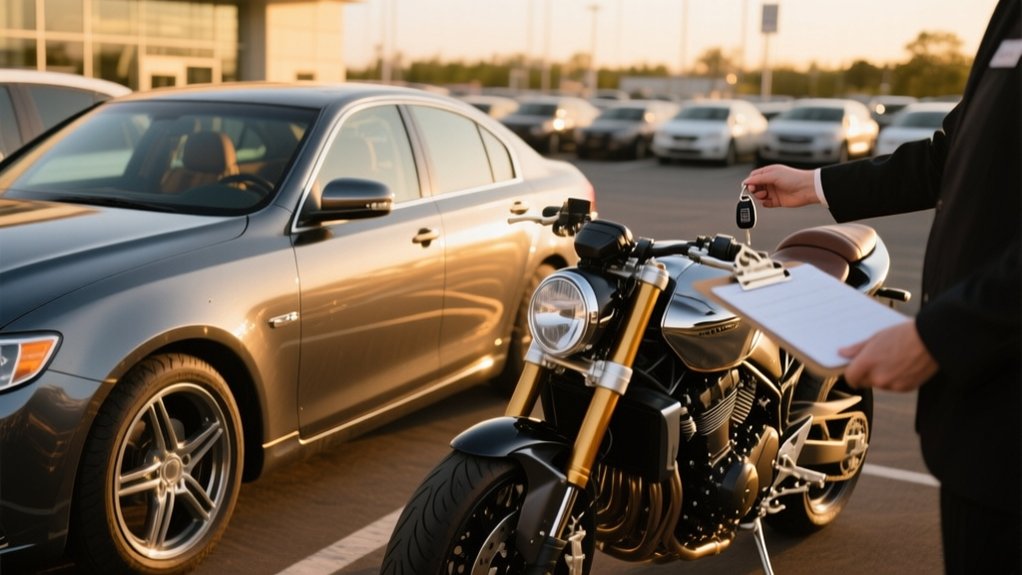
You start by bringing your car to a dealership, either a motorcycle or multi-brand one, where they inspect it and determine the trade-in value using factors like make, model, year, mileage, and condition.
The dealer then presents a trade-in offer, which accounts for reconditioning and resale costs.
If you still owe money on your car, the dealership obtains payoff information from your lender, settles the loan, and applies any equity, positive or negative, to your motorcycle purchase.
To speed things up, bring your car’s title or lender details, registration, maintenance records, and ID.
Before accepting, consider getting multiple trade-in quotes and comparing them with private-sale estimates for the best deal.
Value Assessment Factors
Since the value of your trade-in directly impacts your motorcycle purchase, it’s important to understand how dealers assess your car’s worth.
Dealers evaluate your vehicle based on its make, model year, mileage, and overall condition, both mechanical and cosmetic.
They reference wholesale trade-in values from guides like NADA or KBB rather than private-sale prices, so expect offers below what you might get selling privately.
Market demand also plays a pivotal role.
Seasonal trends and the motorcycle’s rarity influence appraisal and final trade-in value.
If you owe money on your car, the dealer pays off the lender, applying any positive equity toward your motorcycle or rolling negative equity into your financing.
Providing maintenance records and the bike’s title can streamline appraisal and potentially increase your trade-in value by demonstrating proper care.
Should You Prepare Your Car Before Trading It In?
Preparing your car thoroughly before trading it in can materially impact the offer you receive. To maximize your trade-in allowance toward a motorcycle, start by cleaning your car inside and out. Fix minor dings, replace burned-out bulbs, and top off fluids. Dealers deduct for visible issues.
Next, gather all necessary paperwork, including the clear title or lender payoff details, current registration, service records, and valid ID. This prevents delays and guarantees a smoother process.
Also, assess the value by checking market prices on sites like KBB or Edmunds and printing comparable listings to benchmark offers. Remove personal items and aftermarket accessories to present the vehicle in standard condition.
Preparing your car this way helps you negotiate confidently and secure a fair trade-in value when you trade in a motorcycle.
What Are the Benefits of Trading a Car for a Motorcycle?
When you trade your car for a motorcycle, you’ll quickly notice a big boost in fuel efficiency. In fact, motorcycles often get double or even triple the miles per gallon compared to typical cars.
Plus, parking becomes a breeze—especially in busy cities where finding a spot can be a real headache. All these perks add up to serious savings and make your daily commute way more convenient.
Improved Fuel Efficiency
Often, trading your car for a motorcycle leads to markedly improved fuel efficiency. Motorcycles typically deliver 45 to 80+ mpg, far surpassing the average car’s 25 to 30 mpg. This means you’ll spend appreciably less on fuel.
By switching from a car that averages 25 mpg to a motorcycle hitting 60 mpg, you cut fuel consumption by about 58% for the same distance. This improvement stems from motorcycles’ smaller engines and lighter weight, which reduce gasoline use and lower CO2 emissions.
That makes your daily commute more economical and environmentally friendly. Keep in mind, fuel efficiency varies by motorcycle type and depends on factors like riding style and maintenance. Nonetheless, trading your car for a motorcycle often translates into substantial fuel savings.
Enhanced Parking Convenience
Trading your car for a motorcycle can significantly free up parking challenges, especially in crowded urban areas. Motorcycles take up far less space, often fitting into dedicated motorcycle spots or using just two-thirds of a standard parking space. This means you’ll find it easier to park on busy streets or in packed lots.
Many cities and employers offer free or discounted motorcycle parking, adding value by reducing daily parking fees compared to cars. Plus, with your bike, you can access lane-splitting where legal and specific motorcycle parking zones, cutting down your commute and parking search time.
Trading your car for a bike also allows you to use smaller garages or shared spots, offering more flexible and often cheaper long-term parking options in areas with high car parking rates.
What Are the Drawbacks of Trading a Car for a Motorcycle?
Although motorcycles can offer lower insurance premiums and greater maneuverability, you should carefully consider several drawbacks before swapping your car for a bike. Trading a motorcycle often means accepting increased personal safety risks, as crash protection is far less than in cars.
Motorcycles offer savings and agility but come with significantly higher safety risks compared to cars.
Weather exposure and the need for costly protective gear add ongoing expenses.
Cargo space and passenger capacity drop markedly, limiting daily utility. Furthermore, motorcycles may depreciate faster and require more frequent maintenance, which can impact your overall costs.
When you trade in your bike, the trade-in value might also be less predictable compared to cars. These factors can outweigh the benefits if you rely on your vehicle for family travel or hauling, so evaluate whether a trade-in fits your lifestyle and budget.
Can You Trade a Motorcycle for a Car at a Dealership?
You can often trade a motorcycle for a car at many dealerships, where your bike’s trade-in value is applied toward your new vehicle purchase. Whether a dealer accepts your motorcycle depends on their policies and inventory needs. Some resell bikes to specialty dealers if they don’t retail motorcycles directly.
When trading in your motorcycle, the offer reflects wholesale trade-in value based on make, model, year, mileage, condition, and local demand, not private-sale price. If you still owe on your motorcycle loan, the lender payoff must be handled during trade-in, with any equity applied to your car purchase or negative equity covered by you.
Trading in a motorcycle at a dealership offers convenience and potential sales tax savings, but it’s wise to compare trade-in value offers before deciding.
When Is It Better to Trade In or Sell a Motorcycle or Car Privately?
Deciding between trading in your motorcycle or car versus selling it privately depends largely on your priorities and circumstances.
If you need speed and convenience, a trade-in offers same-day processing, including loan payoff, letting you leave with your new vehicle immediately.
However, selling privately often nets you a higher market value, as private party buyers typically pay retail prices, which exceed dealer trade-in offers that factor in reconditioning costs and resale margins.
To make an informed choice, consult valuation guides like KBB or CycleTrader and gather multiple dealer trade-in quotes.
Consider the tradeoffs: private sales may take weeks and involve risks such as scams, while trade-ins minimize hassle and paperwork but usually yield less money.
Your decision hinges on balancing time, effort, and financial goals.
How Trade-In Value Affects Taxes and Purchase Price
Understanding how trade-in value affects taxes and purchase price can help you maximize savings when exchanging your car for a motorcycle.
In many states, the dealership subtracts your car’s trade-in value from the motorcycle’s price before calculating sales tax. This way, you pay tax only on the net difference.
If you still owe a payoff on your car, the dealer applies that first. Any remaining equity lowers the motorcycle price or serves as a down payment. However, if you have negative equity rolled into the new purchase, your taxable amount may increase.
Dealers usually offer wholesale trade-in values, which might reduce your cash equity compared to private sales.
Make sure the dealership documents the trade-in credit and payoff clearly on the sales contract. Also, verify state-specific sales tax and registration rules in advance.
Frequently Asked Questions
Can I Trade in a Car for a Motorcycle if It’s Financed?
Yes, you can trade in a financed car for a motorcycle, but you’ll need lender approval and provide the loan payoff information. The dealer handles the title transfer after paying off your car loan.
If you have negative equity, you’ll either pay it out of pocket or roll it into your new motorcycle loan, which may increase payments.
Always review the deal carefully to make certain the terms work for you.
Do Dealerships Accept Trade-Ins From Out-Of-State Vehicles?
Yes, dealerships do accept trade-ins from out-of-state vehicles, but you’ll need to handle title transfer and provide clear out-of-state registration.
Be prepared for registration differences that might require extra ID or VIN verification.
Tax implications vary by state, so dealers check your residency to apply the correct rules.
Transport logistics and re-titling costs can reduce your trade-in’s value, so expect a slightly lower offer compared to in-state vehicles.
How Long Does the Trade-In Evaluation Process Usually Take?
The trade-in evaluation process usually takes 30 to 60 minutes for inspection and paperwork review.
If additional mechanical checks or lien verifications are needed, expect 1 to 3 hours or a follow-up appointment.
Time estimates also vary depending on dealer workload and seasonal demand.
Scheduling your appointment during slower periods can speed things up.
Dealers often take 1 to 5 business days to finalize payoff amounts and complete paperwork after your visit.
Are There Specific Motorcycle Brands More Likely to Accept Car Trades?
Like a well-oiled machine, premium cruisers and adventure tourers brands from heritage manufacturers often make trading in your car easier.
Big names like Harley-Davidson and BMW, known for their premium cruisers and adventure tourers, are more likely to accept car trades due to their multi-brand dealer groups and used-vehicle departments.
Sportbikes brands, however, tend to be less flexible, especially boutique shops focusing narrowly on motorcycles rather than broader vehicle inventory.
Can I Trade in Multiple Vehicles for One Motorcycle Purchase?
Yes, you can trade in multiple vehicles for one motorcycle purchase. Dealers handle title transfers for each vehicle separately and coordinate payoffs if you still owe loans.
They manage any equity stacking by applying combined trade-in values toward your motorcycle.
This process simplifies paperwork, but be aware that rolling negative equity into financing may increase your payments. Always compare offers and confirm how tax rules affect your trade-in credits before committing.
Conclusion
Trading a car for a motorcycle is totally doable, but it’s not as simple as swapping horses in the old west. Dealers carefully assess your car’s condition, mileage, and market demand to value your trade-in.
Preparing your vehicle boosts its worth, while knowing when to sell privately or trade helps you get the best deal. Keep tax implications in mind, too. Trading smartly can save you money and streamline your switch to two wheels.