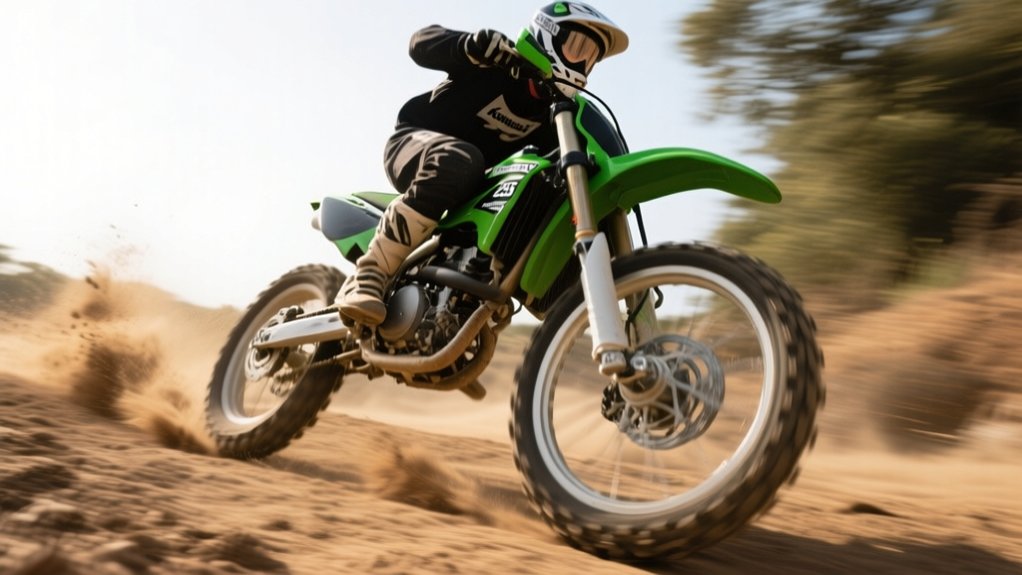
How Fast Does A Kawasaki 250 Dirt Bike Go – Overview
You can expect a Kawasaki 250 dirt bike to reach top speeds between 70 and 85 mph, depending on the model, rider weight, and terrain. Two-stroke versions often hit higher speeds, while four-strokes offer balanced power and control.
Performance also improves with upgrades like exhausts or ECU tuning. These bikes blend agility and speed, making them ideal for intermediate riders tackling trails or motocross.
Keep exploring to understand how factors, features, and maintenance impact your bike’s performance.
Typical Top Speeds of Kawasaki 250 Dirt Bikes
Although the top speed of a Kawasaki 250 dirt bike depends on various factors, you can generally expect it to reach between 70 and 85 mph. The engine size plays a vital role in determining these top speeds.
For example, two-stroke Kawasaki 250 models like the KTM 250 SX can hit up to approximately 85 mph, benefiting from their lighter, high-revving engines. In contrast, four-stroke models such as the KX250 typically reach around 78 mph, trading some speed for smoother power delivery.
Keep in mind that rider weight, terrain, and environmental conditions will influence actual performance. Kawasaki’s race models are engineered for high performance, pushing the upper limits of this speed range.
Understanding these variations helps you set realistic expectations for your bike’s capabilities. It’s all about knowing what your specific model can do and how conditions might affect it.
What a Kawasaki 250 Dirt Bike Is Designed For
You’ll find the Kawasaki 250 dirt bike is designed for off-road riding, trail adventures, and motocross. It offers a nice balance of speed and control.
It’s built with features that suit intermediate riders who want both agility and power on rugged terrain.
When you understand its purpose, it’s easy to see why this bike is so versatile for various off-road challenges.
It really shines whether you’re tackling trails or hitting the motocross track.
Purpose And Versatility
Because the Kawasaki 250 dirt bike combines a 250cc engine with a lightweight frame and adjustable suspension, it delivers versatile performance across various off-road activities. Its purpose centers on providing a balanced mix of power and control, making it ideal for riders who want adaptability in different environments.
You’ll find its versatility shines through in motocross racing, where agility and speed matter. It’s also great for trail riding, which requires durability and smooth handling on uneven terrain. Plus, it works well for dual-sport use, allowing you to shift seamlessly between off-road and street conditions.
This design prioritizes agility, durability, and performance. That means you can confidently tackle a range of terrains. Whether you’re riding for recreation or competition, the Kawasaki 250 offers the versatility you need to excel.
Target Rider Profile
The Kawasaki 250 dirt bike suits riders who want a balanced mix of power and control for off-road challenges. If you have some riding experience, this bike’s 249cc four-stroke engine delivers responsive performance while maintaining a manageable top speed. It’s ideal for honing your skills.
Its lightweight, agile frame fits taller teens and adults ready to tackle motocross tracks, trails, and light dual-sport adventures. You’ll appreciate the advanced suspension and handling technology designed to improve your off-road technique and race readiness.
This bike isn’t for beginners but for intermediate riders seeking versatility without sacrificing control or speed.
In short, if you want a reliable, versatile dirt bike that matches your growing riding experience and offers a rewarding top speed, the Kawasaki 250 is tailored for you.
How Kawasaki 250 Compares to Smaller and Larger Dirt Bikes
You’ll notice the Kawasaki 250 sits right in the middle when it comes to speed—faster than the smaller 125cc bikes but not quite as wild as the bigger 450cc models. It strikes a nice balance between power and control.
Because of its engine size, you get more speed without dealing with the bulk and tricky handling that come with larger dirt bikes.
Knowing these differences can really help you choose the right bike that matches your riding style and skill level.
Speed Comparison Overview
When comparing dirt bikes by engine size, the Kawasaki 250 stands out as a versatile middleweight option that balances speed and control. Its top speed ranges from 70 to 85 mph, making it faster than smaller 50cc and 125cc bikes but more manageable than larger 450cc models.
You’ll find it ideal whether you’re focused on casual riding or pushing your limits.
Consider these points when comparing speeds:
- Smaller bikes offer easier handling but lower top speeds, typically under 50 mph.
- Kawasaki 250 models provide a sweet spot with quick acceleration, especially two-strokes.
- Larger bikes exceed 85 mph but demand more skill and control during riding.
This balance lets you enjoy substantial speed without overwhelming complexity. It’s really about finding what works best for your riding style.
Engine Size Impact
Although engine size isn’t the only factor affecting dirt bike performance, it plays a crucial role in determining speed and handling. The Kawasaki 250’s engine size offers a top speed between 70 to 85 mph, positioning it well above smaller 50cc or 125cc bikes, which lack the same power and speed capabilities.
This 250cc engine size strikes a balance. You get more speed and power than entry-level bikes without the overwhelming force of larger models.
On the other hand, bigger bikes like 450cc models surpass 85 mph, delivering higher top speeds but demanding greater skill.
Handling and Control
Because it balances lightweight design with adjustable features, the Kawasaki 250 dirt bike delivers superior handling and control suited for intermediate riders. You’ll find it more nimble than smaller 125cc bikes thanks to its aluminum perimeter frame and Showa suspension, which improve ground-holding ability.
Compared to larger 450cc bikes, it offers easier handling, especially if you’re shifting from beginner models. The Kawasaki 250 also lets you customize control and comfort with adjustable suspension and ERGO-FIT handlebars and footpegs.
Plus, advanced electronics like Traction Control and launch control enhance stability during aggressive riding.
Key handling and control features include:
- Lightweight frame and advanced suspension for nimbleness
- Adjustable ergonomics for personalized comfort
- Electronic aids that improve stability and precision
Rider Weight and Terrain Effects on Kawasaki 250 Speed
Since rider weight directly affects the overall load on a Kawasaki 250 dirt bike, lighter riders typically experience higher top speeds, especially on challenging terrain. When you ride on rocky or sandy surfaces, the increased resistance and reduced traction slow you down, making rider weight more impactful.
On flat, smooth trails, rider weight has less effect, allowing the bike to reach its maximum speed more easily. You can optimize your speed by maintaining a proper riding position and minimizing extra gear or weight.
Carrying unnecessary weight, whether from your body or equipment, lowers acceleration and top speed, particularly on tough terrain.
Modifications to Boost Kawasaki 250 Speed
When you want to increase your Kawasaki 250 dirt bike’s speed, several modifications can make a noticeable difference. Key upgrades focus on improving power delivery and optimizing mechanical efficiency. Consider these effective changes:
Sprocket swaps are a great place to start. Increasing the rear sprocket size adjusts the gear ratio, which can boost top speed by allowing higher engine RPM to translate into faster wheel rotation.
Upgrading the exhaust system also helps a lot. Installing a high-performance, freer-flowing exhaust improves airflow, raising horsepower and enabling quicker acceleration and higher top speeds.
You might also want to look into ECU or fuel injection tuning. Adjusting engine parameters maximizes combustion efficiency and power output, which enhances overall speed.
Kawasaki 250 Suspension and Frame Effects on Speed
Upgrading your Kawasaki 250’s engine and drivetrain can boost its speed, but the bike’s suspension and frame play an equally important role in how fast you can safely go. The lightweight aluminum perimeter frame enhances maneuverability, letting you accelerate quicker and maintain control at high speeds.
Its stiff, lightweight design works with finely tuned suspension to keep stability and agility during fast rides. The Showa 49mm inverted coil-spring fork and Uni-Trak rear shock provide smooth damping and adjustable settings. This optimizes traction and ride comfort for different terrains.
| Component | Effect on Speed |
|---|---|
| Aluminum Frame | Improves acceleration & control |
| Showa Fork | Enhances stability |
| Uni-Trak Suspension | Optimizes traction & comfort |
| Revised Settings | Enables aggressive cornering |
Tech and Controls That Boost Kawasaki 250 Speed and Safety
Although raw power is essential, the Kawasaki KX250’s advanced tech and controls truly elevate your riding experience by balancing speed and safety. You benefit from features designed to maximize traction, acceleration, and handling precisely when you need them most.
The bike’s electronic systems and tunable components let you tailor performance to your riding style and terrain.
Key technologies include:
- Traction control that adjusts power delivery to maintain grip and prevent wheel spin, enhancing stability.
- Launch control which ensures ideal traction and acceleration from a standstill, helping you get off the line faster.
- Advanced ECU tuning and connectivity via Kawasaki’s RIDEOLOGY app let you monitor and fine-tune engine parameters for maximum efficiency and control.
Together, these systems guarantee a safer, faster ride without sacrificing responsiveness.
Who Should Choose a Kawasaki 250 Dirt Bike
If you’re looking to advance your off-road skills without sacrificing control, the Kawasaki 250 dirt bike offers an ideal balance of power and handling. You should consider who should choose a Kawasaki 250 dirt bike if you’re an intermediate rider aiming for versatility in trail riding, motocross, or light dual-sport use.
Its performance features include a race-ready engine and advanced suspension, making it appealing for competitive riders focused on high performance. The bike’s manageable size suits taller teenagers and adults stepping up to more powerful off-road machines.
Furthermore, if you want a durable, reliable dirt bike with customizable tech and race-inspired controls, this model fits perfectly. It provides a blend of control, power, and adaptability for diverse off-road challenges.
Maintenance Tips to Keep Your Kawasaki 250 Performing Well
Choosing a Kawasaki 250 dirt bike sets you up with a powerful and adaptable machine. But keeping it in top shape demands regular care.
To maintain peak performance, focus on critical upkeep tasks that enhance engine efficiency and safety. Key maintenance tips include:
- Regularly check and replace the air filter to guarantee ideal airflow and prevent engine strain.
- Change the engine oil and oil filter at manufacturer-recommended intervals to maintain smooth engine operation.
- Keep the chain lubricated and properly tensioned to avoid wear and ensure smooth power transfer.
Frequently asked questions
What Is the Fuel Efficiency of a Kawasaki 250 Dirt Bike?
You can expect the Kawasaki 250 dirt bike to deliver around 70 to 80 miles per gallon, thanks to its efficient 249cc four-stroke engine and advanced fuel injection system.
To keep fuel efficiency high, you should maintain the bike properly by cleaning the air filter and tuning it regularly.
How Heavy Is a Kawasaki 250 Dirt Bike?
Like a feather in a warrior’s hand, the Kawasaki 250 dirt bike weighs just around 222 pounds (101 kg). You’ll find this lightweight design perfect for carving through trails with agility and precision.
It’s crafted to give you control during jumps and tough climbs without feeling cumbersome.
This weight strikes a great balance, letting you push limits while maintaining the finesse every rider craves.
What Type of Fuel Does a Kawasaki 250 Dirt Bike Use?
You should use regular unleaded gasoline with an octane rating of 87 or higher for your Kawasaki 250 dirt bike. Sticking to the manufacturer’s recommendations guarantees your engine runs smoothly and avoids knocking.
If you’ve modified your bike for more power, higher-octane fuel might be better.
Avoid low-quality or contaminated fuel since it can damage your engine and reduce performance.
Always check your owner’s manual for exact fuel specs. It’s the best way to make sure you’re using the right fuel for your bike.
Can a Kawasaki 250 Dirt Bike Be Used on Paved Roads?
You can use a Kawasaki 250 dirt bike on paved roads only if it’s properly modified and registered as street-legal. Without necessary equipment like turn signals, headlights, and appropriate tires, it’s unsafe and often illegal.
The knobby tires reduce stability on pavement, so you’ll want to switch to street tires for better handling.
Always check local laws before riding on roads to guarantee compliance and safety. It’s better to be safe and legal than to risk getting a ticket or having an accident.
What Is the Warranty Period for a Kawasaki 250 Dirt Bike?
You get a standard one-year warranty when you buy a Kawasaki 250 dirt bike. You’ll find coverage for manufacturing defects and faulty parts within that period.
You won’t get protection for normal wear, tear, or accident damage.
You might also have options for extended warranties, sometimes up to two years, depending on the model or dealer.
Always check the specific warranty details before you purchase to know exactly what’s included. It’s a good idea to be clear on what’s covered so you don’t get any surprises later.
Final Thought
Picture yourself gripping the handlebars of a Kawasaki 250, feeling the power surge as you tear through rugged trails at impressive speeds. Whether you’re steering rocky paths or open stretches, this bike’s design, suspension, and tech work together to deliver a smooth, controlled ride.
By understanding its capabilities and maintaining it well, you’ll maximize both speed and safety. That way, every ride becomes an exhilarating adventure tailored perfectly to your skill and terrain.