How Many Cc Is A Ducati V2 – The Real Answer
Ducati V2 isn’t one fixed engine size, so the real answer depends on the model you mean.
You’re usually looking at the new 890 cc V2, which makes about 120 hp.
It uses Ducati’s 90-degree twin layout with IVT for a broad, flat torque curve.
If you mean the older Panigale V2 Superquadro, that engine is 955 cc.
The name signals the twin-cylinder family, not a single displacement.
And the details get more interesting from there.
Ducati V2 Cc: The Real Answer
If you’re asking how many cc a Ducati V2 is, the real answer depends on the exact model. The new Ducati V2 is 890 cc in its primary modern version, while the Panigale V2’s Superquadro engine is 955 cc.
You should verify the model designation, because Ducati V2 covers more than one twin-cylinder setup. The current 890 cc Ducati V2 delivers 120 hp at 10,750 rpm, or 126 hp with a racing exhaust. Another version is rated at 115 hp.
The Panigale V2 uses a 955 cc Superquadro with a 100 x 60.8 mm bore and stroke. In short, when you see Ducati V2, think twin layout first, then check whether you’re looking at the 890 cc or 955 cc spec.
Why Ducati Uses the V2 Name
Ducati uses the V2 name to identify its 90° V-twin layout, not just a single displacement figure. When you see V2, you’re seeing Ducati’s two-cylinder identity.
The badge points to a compact V2 engine with a 90° configuration and updated packaging. It includes rearward cylinder rotation for better mass centralization.
It also positions the bike between smaller twins and V4 machines. That means you can expect a focused mix of performance, ergonomics, and usability.
Ducati uses V2 to signal cylinder count, torque character, and service architecture. It also keeps the heritage visible.
That naming choice helps you understand the platform quickly. It separates product families without tying the bike to one fixed cc figure.
955 Cc Vs the New 890 Cc V2
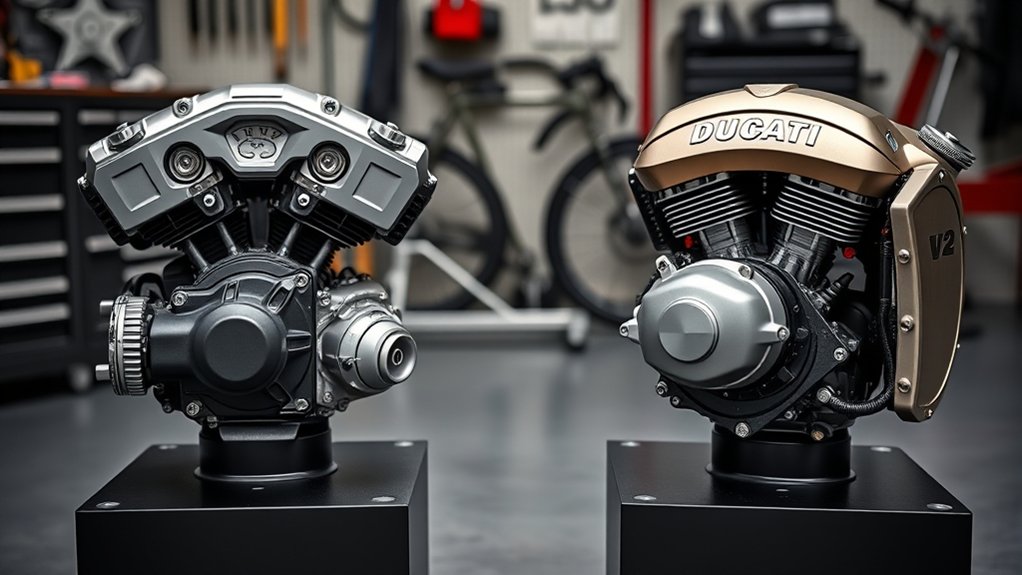
You can think of Ducati’s 955 cc V2 as the more “legacy” Superquadro twin, built around a 100 x 60.8 mm bore and stroke that produces 155 hp and 104 Nm.
Now the new 890 cc V2 goes for a very different direction: it drops to 96 x 91.5 mm, uses a lighter 90° layout, and adds variable intake timing to broaden the torque curve—while staying in a more compact package. So if you compare them directly, you’re mainly trading peak output for lower mass, updated packaging, and a noticeably more flexible power delivery.
955 Cc Legacy
The legacy Ducati V2 in the Panigale V2 was a 955 cc Superquadro twin with a 100 x 60.8 mm bore and stroke. It made 155 hp at 10,750 rpm and 104 Nm at 9,000 rpm.
You got a high-revving, oversquare package that defined the Panigale V2 before Ducati shifted to the 890 cc format. That 955 cc engine gave sharper top-end power and a strong track focus.
It also carried the larger Superquadro architecture. Compared with the new compact V2, it wasn’t as light or tightly packaged, but it set the performance baseline.
If you’re judging Ducati V2 capacity, the 955 cc legacy shows how the platform evolved. The focus moved from pure displacement and peak output toward a smaller, more efficient twin.
890 Cc New V2
At 890 cc, Ducati’s new V2 trims displacement from the old 955 cc Superquadro.
The Panigale V2 stays focused on high-rpm performance.
You get a compact 90° twin that weighs about 120 lb.
It uses rearward cylinder rotation, aluminum liners, and an internal heat exchanger to save space and control mass.
| Spec | new V2 |
|---|---|
| Displacement | 890 cc |
| Power | 120 hp @ 10,750 rpm |
The standard tune makes 69 lb-ft at 8,250 rpm.
With the track exhaust, output rises to about 126 hp and 73 lb-ft.
Ducati also offers a 115 hp variant with stronger internals.
It includes shorter first and second gears, so you can pick the Panigale V2 setup that fits your riding goals.
How the Ducati V2 Makes Power
You can make up to 120 hp from the 890 cc Ducati V2, with peak power hitting at 10,750 rpm in standard trim. And it’s not just about top-end—its torque curve stays broad and easy to use, too. You get 69 lb-ft at 8,250 rpm, plus more than 70% of that torque available from as low as 3,000 rpm.
That strong, responsive feel comes from the engine’s setup, including Intake Variable Timing, 52 mm throttle bodies, and ride-by-wire control, all working together to shape how the power builds and how the bike responds across the rev range.
V2 Power Output
Ducati’s new V2 displaces 890 cc and makes 120 hp at 10,750 rpm in standard tune.
It’s tuned for strong top-end performance without sacrificing usable midrange.
In the Ducati Panigale V2, you get a high-revving package with maximum torque shaped by a 96 mm bore, 91.5 mm stroke, 13.1:1 compression, 52 mm throttle bodies, and IVT intake timing.
These parts help it breathe efficiently and respond crisply.
Ride-by-wire, four Power Modes, and gear-by-gear torque mapping let you tailor output to the road or track.
If you fit the racing exhaust, output climbs to 126 hp and 73 lb-ft.
The detuned version still delivers 115 hp and 68 lb-ft.
That gives you a broader, more compliant setup.
Torque Delivery Curve
Beyond the Ducati V2’s 890 cc displacement and 120 hp headline, the real story is how it delivers that power.
You get a broad torque delivery curve. More than 70% of peak torque is already there at 3,000 rpm.
Output stays above 80% from roughly 3,500 to 11,000 rpm. Peak torque reaches 69 lb-ft at 8,250 rpm on the 120 hp tune.
The 115 hp version still holds 68 lb-ft. Intake Variable Timing helps by smoothing low-rpm response and keeping the top end responsive.
A 52 mm throttle body, sub-throttle injector, semi-dry sump, compact bore-stroke layout, and intake bypass circuit all support steady fueling. On track, a racing exhaust shifts the curve slightly and lifts output.
Intake And Timing
At the heart of the Ducati V2’s power delivery is an 890 cc twin with a 96 mm bore, 91.5 mm stroke, and a high 13.1:1 compression ratio.
Together, these help build strong midrange punch and a clean high-rpm pull.
You manage airflow through 52 mm throttle bodies with ride-by-wire and a sub-throttle injector.
And to broaden torque, the intake system uses variable timing.
| Feature | Effect |
|---|---|
| Intake Variable Timing | Broadens torque |
| 52° phasing range | Improves tractability |
| intake ducts bypass | Smooths mixing |
| Power Modes | Tunes response |
| Gear mapping | Refines delivery |
The intake ducts connect near the valves too, so the fuel mix stays even.
That keeps power delivery regular.
DOHC finger rockers and DLC-coated intake hardware also help reduce mass.
As a result, the engine revs crisply, but clearances need checking every 18,000 miles.
Ducati V2 Bore, Stroke, and Compression
The new Ducati V2’s 890 cc displacement comes from a 96 mm bore and 91.5 mm stroke. That gives it a near-square bore/stroke ratio of about 1.05. You get a layout that balances rev capability with strong midrange combustion.
The 13.1:1 compression ratio helps you extract efficient burn and crisp response. It also works with the 38.2 mm intake valves as the throttle body feeds them cleanly.
Compared with some Ducati engines, this V2 doesn’t rely on an extreme short-stroke design. Instead, it uses a compact 90° V architecture with thin-wall aluminum liners to package the cylinders tightly. That supports cooling and rigidity too.
In the Panigale V, these bore and stroke choices let the engine breathe hard. At the same time, they don’t sacrifice mechanical efficiency or top-end consistency.
Why the Ducati V2 Feels So Light
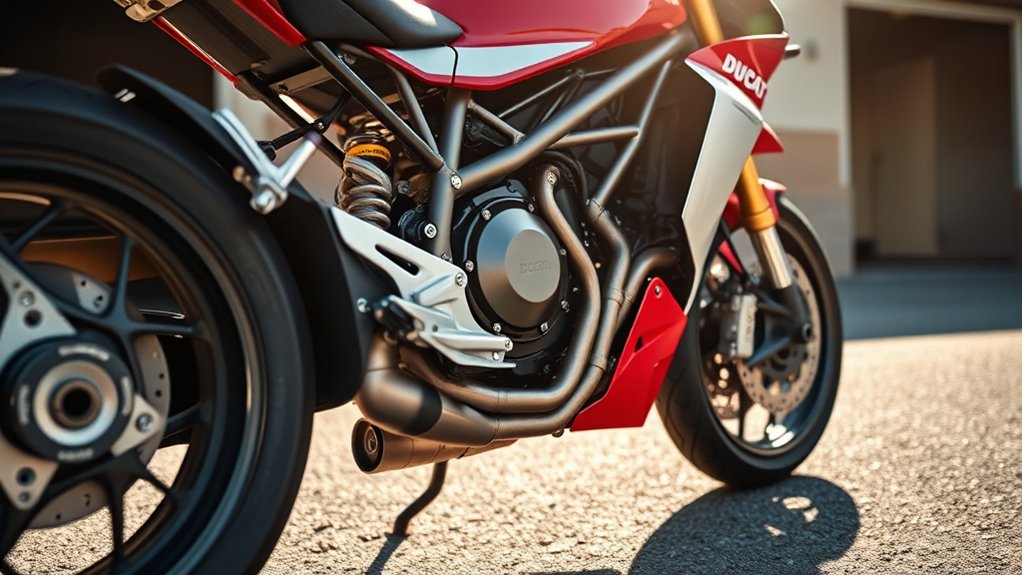
Even though the Ducati V2 displaces 890 cc, it feels unusually light because the engine itself weighs just 120 lb, making it the lightest Ducati twin.
You notice that low weight immediately in the new Panigale V. The slim 90° V-twin and rear cylinder rotated 20° rearward keep the package compact and centralize mass.
Ducati also tucks the water pump and the water/oil heat exchanger into the engine. So you don’t carry bulky hoses or an external cooler.
Die-cast crankcases with thin-walled aluminum liners let the head bolt directly to the crankcase. That trims bulk and boosts stiffness.
If you choose the racing exhaust, you shed another 10 lb. That sharpens handling and makes the bike feel even more flickable.
How the V2 Delivers Torque
Twist the throttle on the 890 cc Ducati V2 and you get 69 lb-ft of peak torque at 8,250 rpm,
with the racing exhaust version lifting that to 73 lb-ft.
Over 70% of peak torque arrives from 3,000 rpm.
Torque stays flat from 3,500 to 11,000 rpm.
IVT and 52 mm ride-by-wire sharpen response.
Gear maps tailor Ducati V2 torque delivery.
You feel that broad spread immediately.
The Ducati V2 pulls cleanly off idle, then keeps pushing without a harsh dip.
The flat torque curve makes throttle control easy in traffic and precise on corner exits.
Intake Variable Timing and the sub-throttle injector help shape linear low-rev delivery, while still supporting high-rpm performance.
If you choose the 115 hp version, shorter 1st and 2nd ratios can make the torque hit harder where you want it.
Ducati V2 Weight and Key Specs
At about 120 lb, the new 890 cc Ducati V2 is the lightest Ducati twin. It’s roughly 21.7 lb lighter than the Superquadro 955.
You get a compact 120 hp at 10,750 rpm in standard trim. Or, you can get 126 hp with a racing exhaust at 10,000 rpm.
Peak torque sits at 69 lb-ft at 8,250 rpm. You still have more than 70% available from 3,000 rpm.
Torque stays above 80% from 3,500 to 11,000 rpm. That means the Ducati Panigale V and V2 package strong output across the rev range.
Aluminum liners, a front-head water pump, and an internal water/oil heat exchanger keep the engine tight. They also remove the external oil cooler and help optimize weight distribution for the chassis.
How the Ducati V2 Feels on the Road
On the road, the 890 cc Ducati V2 feels broadly accessible and strikingly responsive. It delivers more than 70% of its peak torque from just 3,000 rpm.
Broadly accessible and strikingly responsive, the 890 cc Ducati V2 delivers over 70% of its peak torque from just 3,000 rpm.
You get smooth roll-on thrust, and the Ducati V2 stays linear as revs climb. That makes it easy to modulate your pace in traffic or on open roads.
Its ride-by-wire 52 mm throttle bodies and IVT intake timing sharpen response. They do so without making low-speed delivery feel abrupt.
- Strong torque from 3,000 rpm
- About 69 lb-ft at 8,250 rpm
- Smooth, tractable power band
- Confident DQS shifts and slipper clutch
At track pace, a racing exhaust makes it feel lighter and quicker. Routine service intervals also help you ride harder with less worry.
Frequently Asked Questions
Is the Ducati V2 Good for Beginners?
No, the Ducati V2 isn’t ideal for absolute beginners.
You’re dealing with about 120 hp, strong low-end torque, and sporty ergonomics, so it can punish sloppy throttle input.
Its electronics, riding modes, traction control, and cornering ABS help you manage it, but they don’t replace skill.
If you’re new, you’ll usually learn faster and safer on a lighter, lower-power bike before moving up to a V2.
Does the Ducati V2 Have Electronic Rider Aids?
Yes, you do get electronic rider aids on the Ducati V2.
You can use ride-by-wire throttle, ride modes, cornering ABS, Ducati Traction Control, Wheelie Control, and Engine Brake Control, all managed by a 6-axis IMU.
You also get Ducati Quick Shift for clutchless upshifts and downshifts.
The 4.3-inch TFT display lets you adjust and monitor these systems, so you can tailor the bike’s response to your riding style.
What Fuel Grade Does the Ducati V2 Require?
You need premium unleaded petrol. You should use at least 95 RON, and in the U.S. use 91 AKI for your Ducati V2.
For track riding or higher-output exhaust setups, use 98–100 RON.
Your engine’s management can adjust timing, but it can’t fully protect you from low-octane fuel.
Follow the manual and the fuel cap, and avoid excess ethanol unless Ducati explicitly allows it.
How Often Does the Ducati V2 Need Servicing?
You’ll service your Ducati V2 every 9,000 miles for oil changes.
Every 18,000 miles, you’ll handle valve clearance inspection and any needed adjustment.
During those scheduled services, you’ll also check the gearbox, clutch, drivetrain, fluids, and emissions/electronics systems.
Because it uses spring valve timing, you avoid the more frequent desmodromic maintenance older Ducatis needed.
Sticking to these intervals helps keep performance, reliability, and compliance consistent.
What Is the Ducati V2 Seat Height?
The Ducati V2 seat height is about 840 mm, or 33.1 inches.
You’ll get a sporty, track-focused riding position. Ducati also provides decent padding and room to move.
That seat height stays the same across Panigale V2 versions, including special editions like the Bayliss.
If you’re of average height, you’ll likely find it manageable. The bike’s relatively low 176 kg dry weight and accessible ergonomics also help.
Conclusion
So, if you’re asking how many cc a Ducati V2 is, the answer depends on the model year.
Older V2 models use a 955 cc engine, while the new V2 uses an 890 cc twin.
You get a lighter package, strong midrange torque, and smoother power delivery than you’d expect from the size.
For example, if you rode the 955 Panigale V2 back-to-back with the 890 V2, you’d notice the newer bike feels easier to steer and less tiring.