How Much Is An Electric Motorcycle – Here’s the Math
An electric motorcycle can cost about $2,000 for a basic city model.
Or it can run $10,000 to $20,000 for a full-size bike.
If you charge at home, you’ll usually spend about $70 to $200 a year for 10,000 km.
Public charging can push that to $300 to $500.
You’ll also save on oil changes, spark plugs, and exhaust work.
But battery wear and depreciation can still add up if you keep riding.
How Much Does an Electric Motorcycle Cost?
Electric motorcycle prices vary widely. If you’re looking at a new full-scale model, you’ll usually start around $10,000. Many mainstream bikes are priced well above that.
Electric motorcycle prices vary widely, with new full-scale models usually starting around $10,000.
You’ll also find smaller electric options, including some electric bikes and low-speed motorcycles, in the $1,000–$4,000 range. Entry pricing can drop further for budget street-legal models, such as the CSC City Slicker, which showed basic urban machines can cost under $2,500.
You should also factor in battery life. Pack wear can affect resale value after 3–5 years. Over time, lower charging costs help offset purchase price, since 10,000 km of electricity often costs far less than gasoline.
Market competition may reduce prices. Still, brand positioning keeps many electric motorcycles expensive.
What Does a Basic Electric Motorcycle Cost?
A basic electric motorcycle can cost as little as about $2,000 for an entry-level small urban model, such as the 2018 CSC City Slicker.
However, most full-scale bikes start closer to $10,000.
You’ll usually see full-size models priced from $10,000 to $20,000, depending on motor output, battery capacity, and brand positioning.
If you compare that with a professional electric conversion, which often runs $4,000 to $8,000, buying new can actually be the cheaper route.
Larger battery packs and longer warranties, including eight-year coverage, push the price up.
Still, they can improve resale value and reduce ownership risk.
Scarcity keeps prices elevated, but growing competition and shared EV components should lower costs over time.
How Electric Motorcycle Charging Costs Work
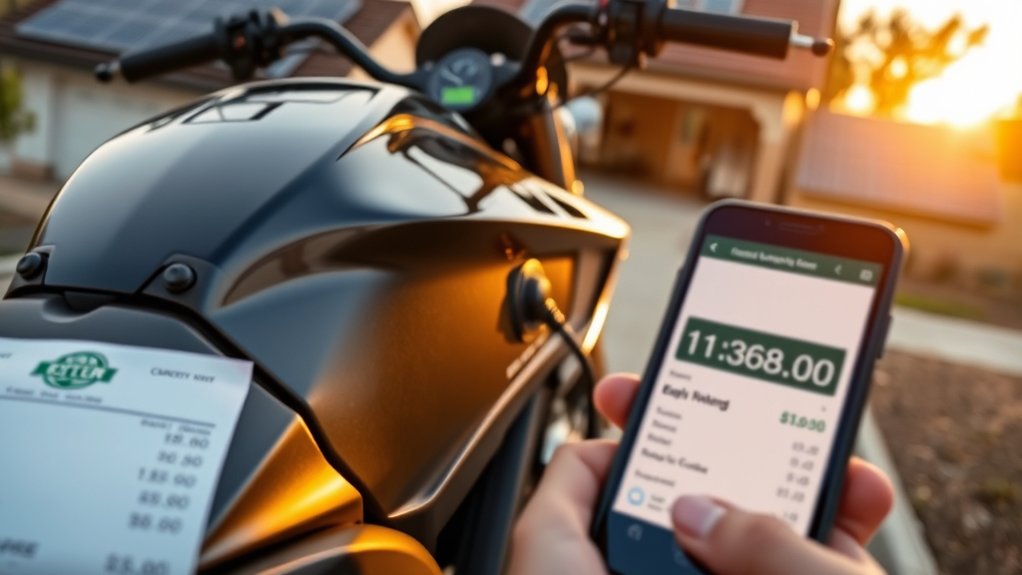
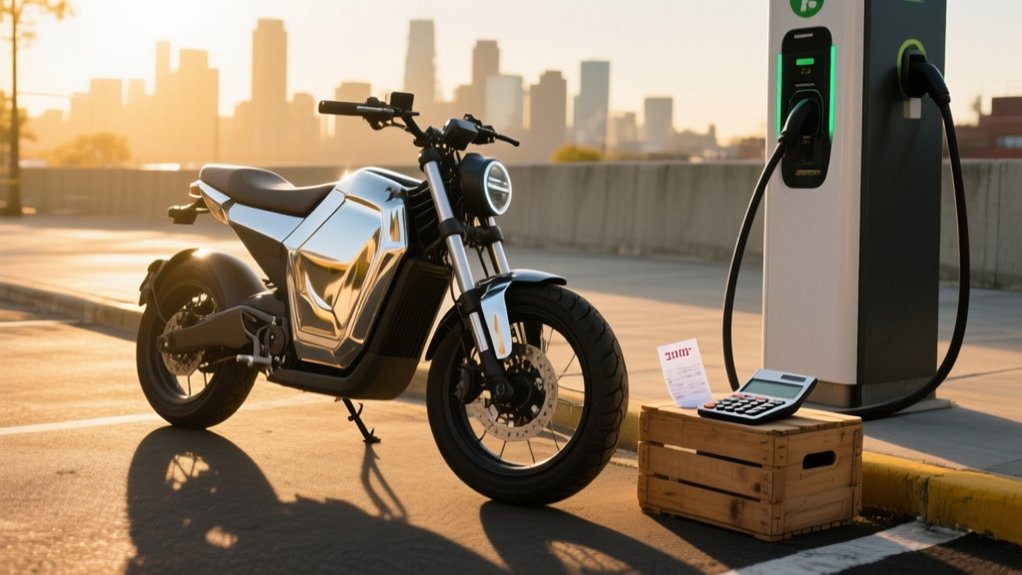
Your charging cost depends a lot on where you plug in. At home, electricity is usually around $0.05–$0.15 per kWh, but public charging stations often run closer to $0.30–$0.50 per kWh.
If you ride 10,000 km per year, you’ll typically use about 280–400 kWh overall. That means your annual charging costs could be roughly $14–$60 at home, or $84–$200 if you rely mostly on public networks.
One more thing to keep in mind: cold weather can increase energy use by about 15–30%.
On the bright side, if you have solar (home PV), your marginal cost per kWh can drop dramatically—sometimes close to zero, depending on how your system is set up.
Charging Rate Differences
Charging costs for an electric motorcycle depend mainly on where you plug in, because the per-kWh rate changes the operating cost far more than the battery size alone.
If your bike uses 2.8–4.0 kWh per 100 km, a $0.05–$0.15/kWh utility rate puts energy cost near $0.0014–$0.006 per km.
At $0.30–$0.50/kWh, that climbs to about $0.0084–$0.02 per km.
For a 2.16 kWh pack, you’d spend roughly $0.22 at $0.10/kWh or $0.86 at $0.40/kWh for a full charge.
Cold weather can cut range by 15–30%, so you’ll recharge more often and pay more per mile.
Solar offset or stable low rates can nearly eliminate this expense, while higher tariff charging does the opposite.
Home Vs Public Charging
At home, you’ll usually pay about $0.05–$0.15 per kWh.
An electric motorcycle that uses 2.8–4.0 kWh per 100 km costs roughly $1.40–$6.00 for that distance.
Public fast chargers often cost $0.30–$0.50 per kWh.
That means you’ll typically spend about $0.84–$2.00 more per 100 km.
| Charging location | Typical rate | Cost impact |
|---|---|---|
| Home | $0.05–$0.15/kWh | Lowest cost |
| Public fast charger | $0.30–$0.50/kWh | Higher cost |
| Home solar/low-rate utility | Near $0/kWh | Minimum cost |
For 10,000 km yearly, you’re looking at roughly $70–$200 at home.
Public charging usually lands around $300–$500.
Home charging is steadier, which makes it easier to budget.
Public charging is faster, but the extra fees can add up.
How Electric Motorcycle Costs Compare to Gas Bikes
You’ll usually pay more upfront for an electric motorcycle, but that cost can often balance out later. Because electricity is typically cheaper than gasoline and the drivetrain has fewer parts to wear out, you can save a lot on day-to-day expenses.
For most riders, energy savings can cut annual operating costs by about 60–75% compared with a gas bike. You’ll also likely spend less on routine maintenance since electric motorcycles don’t need oil changes and have fewer wear items overall.
Purchase Price Gap
Electric motorcycle purchase prices are still higher than comparable gas bikes, but the gap has started to narrow. You’ll usually see full-size models around $10,000, while many compact electric two-wheelers cost $1,000–$4,000.
That spread comes from limited model availability, smaller production volumes, and newer powertrain technology.
- Gas bikes often undercut e-motorcycles on sticker price.
- Budget urban electrics can fall below $3,000, like the CSC City Slicker.
- Scarcity keeps many electric list prices elevated today.
- Competition and EV tech transfer are gradually reducing costs.
Treat the upfront premium as the main barrier. Over time, lower operating and maintenance expenses can offset some of the gap, but the initial purchase price still drives most buying decisions.
Fuel Savings Math
Fuel savings is where an electric motorcycle starts to separate itself from a gas bike in real numbers. If you ride 10,000 km a year, you’ll use about 280–400 kWh in an e-motorcycle. That’s versus 250–300 L of fuel on a 2.5–3 L/100 km gas bike, and that’s a major cost gap.
| Annual use | Cost |
|---|---|
| Home charging | $14–$60 |
| Public charging | $84–$200 |
| Gas bike fuel | $2,000–$2,400 |
| Typical savings | 60–75% |
At urban duty cycles, your energy bill can drop fast, especially if you charge at home. Cold weather can trim range by 15–30%, so you may charge more often.
If you use solar or low-rate power, your annual electricity cost can approach zero. That widens the operating-cost gap even further.
Maintenance Cost Differences
Maintenance costs are usually where an electric motorcycle pulls ahead of a gas bike most clearly.
You skip oil changes, clutch service, and gearbox upkeep, and you often avoid chain replacement too.
Routine work usually narrows to tires, brake pads, and final-drive checks about every 30,000 km.
- Service intervals stay longer because the drivetrain has fewer wear parts.
- Energy costs often run $70-$200 per 10,000 km at home charging rates.
- Gas bikes can cost $1,600-$2,400 per 10,000 km at $8/L fuel.
- Battery life is 800-1,200 cycles, but degradation can reduce resale value.
Over time, you can save 60%-75% on operating costs.
Battery warranties still matter because they help protect residual value.
Which Maintenance Costs E-Motorcycles Skip
E-motorcycles often skip several routine service items that make up a big share of combustion-bike upkeep. That includes oil changes, spark plugs, fuel filters, and complex multi-gear transmission work.
You also avoid carburetors or injectors, exhaust systems, and timing belts. The electric powertrain doesn’t need them.
Many models use belt or shaft final drives. That means you don’t have to lubricate or adjust a chain as often, which cuts parts wear and labor time.
Your maintenance schedule usually shifts to tires, brake pads, and final-drive checks. This is often around every 30,000 km, with occasional coolant service or motor-seal inspection depending on the design.
With fewer moving parts, you generally get fewer consumables, longer service intervals, and lower shop charges over the bike’s life.
How Depreciation Affects Electric Motorcycle Value
When you buy an electric motorcycle, depreciation is often the biggest ownership cost after the purchase price itself. You’ll usually recover only 40–50% of the price after 3 years, while similar gas bikes can return 60–70%.
Battery wear matters. Lithium-ion packs often drop to 70–80% capacity after 800–1,200 cycles, which can trim resale value by 15–20% per year.
- Warranties can support residual value.
- Reconditioning may recover 30–40% of battery value.
- Brand and model change depreciation sharply.
- Complete service records slow value loss.
An 8-year battery guarantee can lift residuals to about 45–50%. Adventure-style models often hold value about 18% better than urban commuters.
Zero bikes may lose 55–60% in 3 years, while some Harley or Honda e-models may lose only 25–40%.
Which Electric Motorcycle Models Hold Value Best?
If you’re looking for electric motorcycles that hold value best, brand reputation and battery protection matter most.
Harley-Davidson and Honda models often lead resale charts because buyers trust their engineering and dealer support.
In many cases, three-year depreciation stays near 25–40%.
Zero Motorcycles can still attract strong demand, but many models lose 55–60% in three years.
Because of that, you should price them more conservatively.
Adventure-style e-motorcycles also tend to outperform urban commuters, retaining about 18% more value.
You can improve resale even more by keeping complete service records.
Documented maintenance can slow depreciation by 10–15%.
Battery warranties matter most for residual value.
An 8-year guarantee can lift residuals toward 45–50%, while reconditioning services may recover 30–40% of battery value at sale.
How Battery Life Impacts Resale Value
Your e-motorcycle’s battery degradation can have a real impact on resale value. Since most lithium-ion packs lose usable capacity after about 800–1,200 cycles, you may see the battery drop to around 70–80% of its original capacity over time.
And if the battery’s condition isn’t great—or it’s out of warranty—you could end up with depreciation in the neighborhood of 15–20% per year.
On the other hand, a strong manufacturer warranty can help a lot. With solid coverage, three-year residual values can land closer to about 45–50%.
Just keep in mind that models with expensive battery replacement often depreciate faster, but reconditioning or refurbishment may help recover some lost value and improve your trade-in price.
Battery Degradation Impact
Battery degradation is one of the biggest drivers of an electric motorcycle’s resale value. Lithium-ion packs typically last about 800–1,200 charge cycles, or roughly 3–5 years, before capacity drops to around 70–80% of original levels.
When that happens, you lose range and buyers discount the bike for replacement risk.
- Expect resale to fall about 15–20% each year as the pack ages.
- A hard-to-replace battery can push 3-year depreciation to 55–60%.
- Reconditioning may recover 30–40% of the battery’s remaining value.
- An 8-year warranty can lift 3-year resale estimates toward 45–50%.
You should treat battery health as a measurable asset, not a vague concern.
Warranties And Residuals
When battery life starts to taper, warranties become a major factor in what your electric motorcycle is worth on the used market.
Lithium-ion packs usually deliver 800 to 1,200 charge cycles, or about 3 to 5 years, before capacity falls to 70 to 80%. At that point, you’ll often see annual value loss of 15 to 20%, and typical 3-year residuals drop to 40 to 50%, well below comparable gas bikes.
An 8-year battery warranty can improve confidence and lift residuals toward 45 to 50% because you’re shifting replacement risk to the manufacturer. If the pack’s health is documented, battery reconditioning may recover 30 to 40% of its value and support a better trade-in price.
Without that protection, expected replacement costs can drive depreciation sharply higher.
When an Electric Motorcycle Is the Better Buy
For most city commuters, an electric motorcycle is the better buy because its operating costs are dramatically lower and more predictable than a gas bike’s.
You’ll usually spend 60–75% less on energy for under 50 miles a day, especially if you charge at home.
Typical consumption runs 2.8–4 kWh per 100 km. So 10,000 km can cost about $70–$200 on home electricity, versus roughly $1,600–$2,400 in gasoline at $8/L.
- You ride mostly in traffic.
- You can charge overnight.
- You value stable energy pricing.
- You don’t need long-range touring.
E-motorcycles also suit you if you want lower maintenance and can accept battery depreciation.
Gas bikes still make more sense for high-speed travel, long distances, or rapid refueling.
What To Budget Before You Buy
Before you buy, budget beyond the sticker price. Entry-level city e-motorcycles can start around $2,000, while many full-size models begin near $10,000 and can exceed that.
Plan for energy, insurance, gear, and a charging setup. Home charging usually costs about $70 to $200 a year for 10,000 km, but heavy public charging can raise that to $300 to $500.
Expect lower routine maintenance than a gas bike. There are no oil changes and fewer wear items.
Still, factor in faster depreciation and battery aging, which can trim resale value by 15% to 20% annually. After 3 years, you may recover only 40% to 50% of value.
Battery replacement can add several thousand dollars over time.
Frequently Asked Questions
How Long Do Electric Motorcycle Batteries Typically Last?
Electric motorcycle batteries typically last about 800–1,200 full charge cycles.
You’ll usually get over 3–5 years of riding.
After that, capacity drops to about 70–80% of its original level.
That means your range and resale value decline.
Annual wear can reduce value by 15–20%, but a strong warranty can help preserve it.
Reconditioning may recover 30–40% of its remaining value.
Can Home Solar Panels Charge an Electric Motorcycle?
Yes—you can charge your electric motorcycle with home solar panels, and that’s no coincidence if you already power your house with sunlight.
Your bike typically needs about 2.8–4 kWh per 100 km, so a modest array can cover daily riding.
A 5 kW system may generate around 20 kWh on a good day, enough for several charges.
Winter lowers output, so you may need grid backup or storage.
Are Electric Motorcycles Eligible for State Rebates?
Yes, you can often get state rebates for electric motorcycles. Eligibility varies by program.
Usually, you must buy a new model, register it in-state, and choose from an approved list. Some rebates also depend on income or vehicle type.
You usually won’t find a federal motorcycle tax credit. So state and utility incentives can matter most.
Check your state energy office, DMV, and utility websites for current rules.
How Much Does Electric Motorcycle Insurance Usually Cost?
Insurance for an electric motorcycle usually costs about $200 to $800 a year. You’ll pay more for high-performance or expensive models, and premiums can top $1,000.
Like a shield, your policy reflects the bike’s value. It also considers battery coverage, age, record, mileage, and use.
You can lower costs by comparing quotes. You can also bundle policies, add security, and choose a model with a strong battery warranty.
Do Electric Motorcycles Lose Range in Cold Weather?
Yes, electric motorcycles do lose range in cold weather. You’ll usually see about a 15–30% drop because low temperatures raise battery resistance and reduce available energy.
Your bike may also use extra power for heating and battery management. That cuts kilometers per charge.
Charging can take longer too. To limit losses, park indoors, pre-warm the battery, and use insulated storage or battery heaters when possible.
Conclusion
So, when you’re sizing up an electric motorcycle, you’re really weighing upfront price, charging costs, and long-term savings.
You’ll usually pay more at purchase, but you can skip some service bills and enjoy smoother, simpler upkeep.
If you choose a model with solid battery health and strong resale value, you’ll protect your budget better.
Before you buy, crunch the numbers carefully, because the right ride can deliver durable value and daily efficiency.