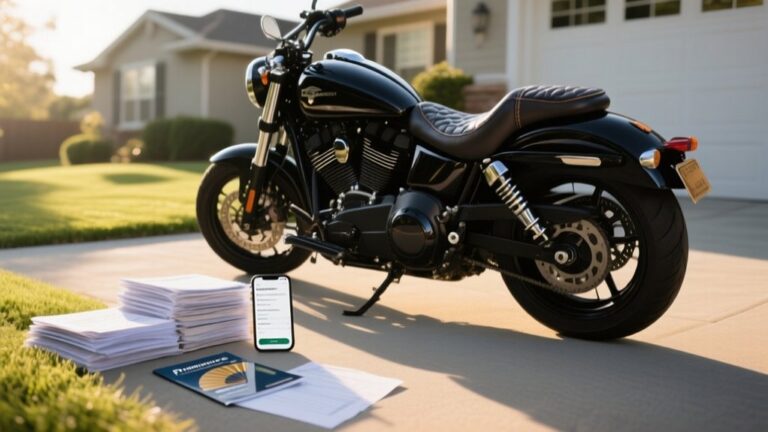
How To Get A Motorcycle License – Easy Guide
You can get your motorcycle license by meeting the minimum age and document requirements like ID, residency proof, and Social Security info. Start by applying for a motorcycle instruction permit and passing the written test.
Completing a motorcycle safety course can simplify the process by waiving some tests. After holding your permit and practicing, schedule your skills test with proper gear and a street-legal bike.
Keep your license updated and register your motorcycle. Keep going to uncover all the steps and tips for success.
What You Need to Qualify for a Motorcycle License

Before you can hit the road on two wheels, you need to meet specific qualifications set by your state. To get your motorcycle license, you must be at least the state’s minimum age, usually 16. If required, hold a valid driver’s license or learner permit.
Many states require you to complete an approved motorcycle safety course. This helps you develop essential skills and may waive certain tests. Be sure to keep your official completion certificate handy, as most DMVs need it within a valid timeframe, typically 12 to 24 months, to waive the skills test.
Once you meet these criteria and provide the necessary documents, you can apply for a Class M license. Meeting these steps guarantees you’re ready and qualified to ride safely and legally.
How to Apply for a Motorcycle Instruction Permit
Start your journey toward a motorcycle instruction permit by visiting your state motor vehicle office to complete the required application, selecting “Motorcycle Instruction Permit.” Bring your identity, residency, and Social Security documents, then pay the permit fee.
Begin your motorcycle permit process at the DMV with ID, residency proof, Social Security, and the application fee.
You’ll need to pass the motorcycle knowledge test, which is often available in multiple languages. If you don’t have a driver license, expect to take that test too.
Meet the minimum age and eligibility requirements, usually around 15½ or 16. Providing proof of completing an approved motorcycle safety course can often waive the skills test, so consider enrolling early.
Once you have your motorcycle instruction permit, follow permit restrictions carefully. No passengers, no freeway or night riding. Hold the permit for the required period before applying for your full license.
Pass the Motorcycle License Written Test

You’ll want to study your state’s Motorcycle Operator Manual carefully.
It’s a good idea to take online practice tests too, so you get a feel for the questions. Make sure to focus on key topics like signaling, lane positioning, and the specific traffic rules for motorcycles. If you prepare consistently, you’ll build up your confidence and have a much better chance of passing the written test on your first try.
Study Official Manuals
Mastering the official Motorcycle Operator Manual is essential to passing the written test with confidence. This manual covers key topics like traffic laws, right-of-way, signaling, lane positioning, speed management, and protective gear requirements you’ll encounter on the motorcycle knowledge test.
Focus your study on these areas and memorize important details such as helmet laws and permit restrictions. To reinforce your understanding, consider enrolling in a state-approved motorcycle safety course.
Completing this course not only deepens your knowledge but often grants a Certificate of Completion that can waive the written test altogether. By thoroughly studying the Motorcycle Operator Manual and taking advantage of a motorcycle safety course, you’ll prepare yourself effectively and increase your chances of passing the test on your first try.
Practice Sample Tests
To boost your confidence and sharpen your knowledge, explore free online motorcycle sample tests offered by your state’s DMV or the California DMV. These tests help you get familiar with the question format and key topics like helmet laws, signaling, and lane positioning.
Focus your study on sections of the Motorcycle Operator Manual most tested on sample tests to prepare effectively for your motorcycle permit. Time yourself to mimic real exam conditions, as most written tests require a 70–80% passing score.
Use feedback from practice tests to identify weak spots and review those manual sections immediately. If possible, try multiple formats—automated, printed, audio—to make sure you’re ready for the actual motorcycle skills test or written exam after completing a motorcycle safety course approved by your state.
How Completing a Motorcycle Safety Course Helps You
Completing a motorcycle safety course can actually help you skip the knowledge test, which means less time and stress at the DMV. Plus, you get hands-on experience practicing important skills like emergency braking and avoiding obstacles.
This kind of training doesn’t just build your confidence—it also gets you ready to ride safely out on the road. So, it’s a win-win!
Waives Knowledge Test
Although you still need to meet standard ID and residency requirements, finishing an approved motorcycle safety course can save you from taking the DMV’s knowledge or skills test. When you complete an MSF-approved or state-specific motorcycle safety course, you receive a completion certificate.
This certificate often allows you to waive the skills test or knowledge exam at the DMV if presented within its validity period.
| State | Course Type | Certificate Name | Validity Period | Test Waived |
|---|---|---|---|---|
| California | CMSP BRC | DL 389 | 12 months | Skills test |
| Texas | TDLR-approved | MSB-8/MSB-R | 24 months | Knowledge & Skills |
| Arizona | MSF-approved | MSF card | Varies | Skills or Written |
| Illinois | State-approved | Training card | Varies | Written or Road Test |
| Others | Various | Completion cert. | Varies | Knowledge/Skills |
Presenting your completion certificate lets you bypass DMV exams, streamlining licensing.
Enhances Riding Skills
Boost your riding confidence and safety by enrolling in an approved motorcycle safety course. Completing a Basic RiderCourse gives you 15 hours of combined classroom and on-cycle training that sharpens essential skills like clutch control, braking, turning, and hazard avoidance.
Many state programs also offer extended on-cycle practice to build your confidence in low-speed maneuvers and emergency stops. Earning a Completion Certificate not only proves your competence but often waives the DMV skills test.
These courses teach defensive riding techniques, helping you anticipate and react to risks, reducing crash chances. To keep your skills sharp, consider refresher courses or advanced clinics, which focus on braking, cornering, and emergency-avoidance drills.
With consistent training, you’ll enhance your motorcycle safety and become a more skilled, confident rider.
When and How to Take the Motorcycle License Skills Test
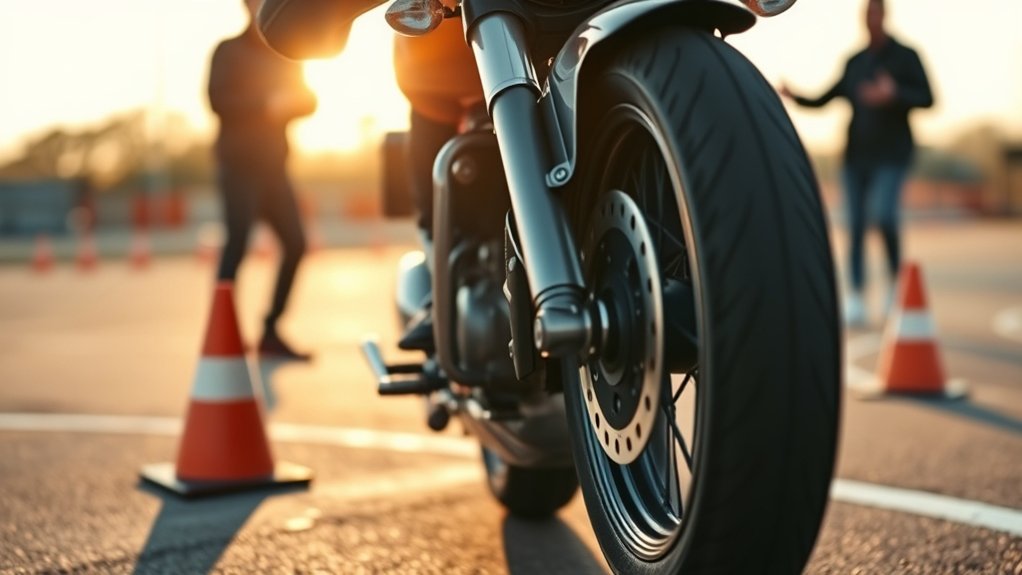
Schedule your motorcycle skills test at a local DMV, MVD, DPS office, or an approved testing location. Keep in mind that availability and weather conditions may affect testing.
If you’ve completed an approved motorcycle safety course, you might skip the skills test by presenting your completion card. Otherwise, bring a street-legal motorcycle and your learner permit.
Most states require you to hold the permit for six months before testing. The test evaluates maneuvers like balance, turns, and quick stops on a closed course.
| Requirement | Details | Notes |
|---|---|---|
| Motorcycle | Street-legal, registered, insured | Must meet test criteria |
| Safety Gear | DOT helmet, eye protection, proper attire | Mandatory for test |
| Retakes | Up to 3 per application or unlimited next day | Check state-specific rules |
What Documents to Bring to the DMV or Licensing Office
Before heading to the DMV or licensing office, make sure you have all the necessary documents ready to avoid delays.
Bring a valid government-issued photo ID, such as your driver license or passport. If you’re not a U.S. citizen, include proof of lawful presence.
You’ll also need proof of Social Security Number and proof of residency. Bring at least two documents like a utility bill or lease agreement dated within 60 days.
If you’ve completed a motorcycle safety course, don’t forget your Safety Course completion certificate to possibly waive the skills test.
For a motorcycle Class M license, bring your motorcycle’s current registration, proof of liability insurance, and license plate number, especially if you plan to use that bike for your skills test.
Being prepared guarantees a smooth process.
Know Your Motorcycle License Classes and Restrictions
When you’re planning to get your motorcycle license, understanding the different license classes and restrictions is essential to guarantee you meet your state’s requirements.
Most states classify motorcycles differently, such as a Class M motorcycle for larger bikes and separate classes for smaller scooters.
You might begin with a learner license that limits passengers, freeway, and night riding.
Also, motorcycle endorsements can be added to your existing driver’s license or issued as a standalone Class M license.
Completing a motorcycle safety course often waives the skills test and reduces restrictions.
Keep in mind:
- Class M usually covers motorcycles over 150cc.
- Learner licenses often require supervised riding and helmet use.
- Endorsements may be mandatory for registration renewal.
- Safety courses provide a valuable shortcut.
Prepare for the Road Test and Know What to Expect
You’ll want to get comfortable with key maneuvers like controlled stops, slow turns, and emergency braking to pass the road test with confidence.
Also, double-check that your motorcycle and gear meet all the legal requirements.
Try to arrive early with your documents in hand so you’re not caught off guard.
Knowing what to expect at the testing location and being ready for common challenges can really give you an edge on test day.
Road Test Components
Mastering the road test requires focused preparation on key skills like tight turns, quick stops, and controlled braking.
Your skills/road test usually lasts 10–15 minutes and covers maneuvers such as a low-speed cone weave or figure-eight.
Wearing required safety gear is essential: a DOT-approved helmet, eye protection, long sleeves, pants, and over-the-ankle footwear.
Many jurisdictions let you skip the test if you complete an approved motorcycle safety course, so check your local rules.
During the test, examiners assess clutch and throttle control, smooth starts and stops, proper signaling and lane positioning, scanning, hazard avoidance, and adherence to traffic laws.
Prepare thoroughly, and you’ll ride confidently through your test.
Testing Location Tips
Although preparing your riding skills is essential, arriving at the testing location fully ready can make or break your road test experience. Bring a street-legal motorcycle with current vehicle registration, a DOT-approved helmet, and required protective gear to avoid automatic disqualification.
Check the testing schedule and weather policies since skills testing may pause during unsafe conditions. Don’t forget your permit or ID and your motorcycle safety course completion card if applicable.
Practicing maneuvers near the test site will boost your confidence.
| What to Bring | Check Before Arrival | Test Day Tips |
|---|---|---|
| Vehicle registration | Weather and schedule | Arrive early |
| DOT-approved helmet | Testing format and language | Confirm paperwork is ready |
| Safety gear | Retest policies | Stay calm and focused |
Common Testing Challenges
When preparing for your motorcycle road test, it’s essential to understand the common challenges riders face and how to overcome them. The skills test includes slow-speed control, tight turns, quick stops, and obstacle avoidance. These are areas where many struggle. To pass confidently, you must practice riding these maneuvers until smooth.
Keep these tips in mind:
- Master slow-speed control by practicing figure-eights and low-speed stopping.
- Bring a street-legal motorcycle with all safety gear. Missing equipment can cancel your test.
- If you completed an approved motorcycle safety course, bring your completion card. This might let you waive the skills test.
- Be aware of testing restrictions like weather and heat, which can delay or limit retake opportunities.
Prepare thoroughly, and you’ll ace your motorcycle license test.
Register Your Motorcycle After Licensing
After you’ve secured your motorcycle license, the next step is to register your motorcycle with your state’s motor vehicle agency.
To register, you’ll need to submit proof of ownership, proof of insurance, valid identification, and pay the registration fee.
Submit proof of ownership, insurance, valid ID, and pay the registration fee to register your motorcycle.
Fees vary by state and may depend on your motorcycle’s type, weight, or model year, so check your state’s registration page for exact costs.
Some states also require safety or emissions inspections, a completed application form, and an odometer reading.
Once registered, you’ll receive license plates and registration stickers, which you must display as instructed.
Remember to keep your registration current by renewing it on time online, by mail, or in person to stay compliant and enjoy your ride without interruptions.
Safety and Legal Tips for Motorcycle Riders
Mastering safety and legal requirements is essential for every motorcycle rider to protect themselves and others on the road. To guarantee your motorcycle safety, start by completing a state-approved motorcycle safety course. This not only teaches crucial skills but often waives the DMV skills test when you show proof of completion.
Always adhere to helmet laws by wearing a DOT-approved helmet and proper gear. Carry all required documents like your course card, registration, and insurance to avoid legal issues.
Remember these key tips:
- Enroll in an approved motorcycle safety course to build confidence and skill.
- Wear protective gear compliant with helmet laws and state regulations.
- Carry proof of completion, registration, and insurance at all times.
- Practice defensive riding to stay visible and anticipate hazards.
Following these rules keeps you safe and compliant on every ride.
Frequently Asked Questions
Can I Transfer My Motorcycle License From Another State?
Yes, you can transfer your motorcycle license from another state, but you’ll need to meet reciprocity requirements.
Most states accept out-of-state endorsements if your license is valid and unrestricted, letting you skip skills tests.
Temporary licenses might be available during processing.
If you have a foreign license conversion, expect additional steps.
Always check your new state’s DMV for specific rules, required documents, and fees to make the process smooth and quick.
Are There Age Limits for Different Motorcycle License Classes?
Think of motorcycle licensing like climbing a ladder. Each rung represents a different age limit and class.
You’ll find minimum age requirements vary by state, often starting at 16, with some maximum age limits too.
Graduated licensing systems guide younger riders through restrictions.
Age exemptions let adults skip certain steps if they take approved courses.
Check your local DMV for exact details so you can safely and confidently hit the road.
How Long Is My Motorcycle Instruction Permit Valid?
Your motorcycle instruction permit duration depends on your state. It typically lasts between 6 to 24 months.
If your permit expires before you get your full license, you’ll need to start the renewal process. This may include retaking tests.
Some states offer temporary extensions if you can’t complete requirements in time. Always check your local MVD or DMV to avoid expiration consequences and stay on track toward riding legally and safely.
Can I Ride a Motorcycle Without Insurance During the Permit Phase?
Riding without insurance during your permit phase is like walking a tightrope without a safety net, risky and unwise. You must have rider liability coverage or temporary insurance, even with permit exclusions like no passengers or no freeway riding.
Skipping insurance can lead to hefty insurance penalties, fines, or license suspension. Protect yourself by ensuring your motorcycle is properly insured before hitting the road; it’s the smart move for every responsible rider.
What Happens if I Fail the Road Skills Test Multiple Times?
If you fail the road skills test multiple times, you’ll face licensing consequences like waiting periods and extra fees. Use retake strategies by focusing on weak areas identified during skill evaluation.
Consider enrolling in an approved motorcycle safety course, as completing it often offers waiver options that exempt you from further on-site tests.
Stay persistent, practice consistently, and use these resources to improve your skills and secure your license efficiently.
Conclusion
Getting your motorcycle license is like tuning a finely crafted engine. Each step, from the permit to the road test, builds your confidence and skill.
Remember, over 80% of new riders who complete a safety course pass their road test on the first try. By following these steps carefully and preparing thoroughly, you’re not just earning a license; you’re gearing up for a safer, more thrilling ride.
Keep focused, stay safe, and enjoy the freedom ahead.