What Does Msf Stand For Motorcycle – Meaning & More
MSF stands for Motorcycle Safety Foundation, the group behind standardized motorcycle training for new riders.
In an MSF Basic RiderCourse, you learn clutch control, braking, shifting, turns, and low-speed maneuvers in a classroom and on a closed range.
It’s designed to help you build control and confidence, but it doesn’t cover every real-world riding situation.
If you’re deciding which course fits your experience, the details below can help you choose.
What Is An MSF Motorcycle Class?
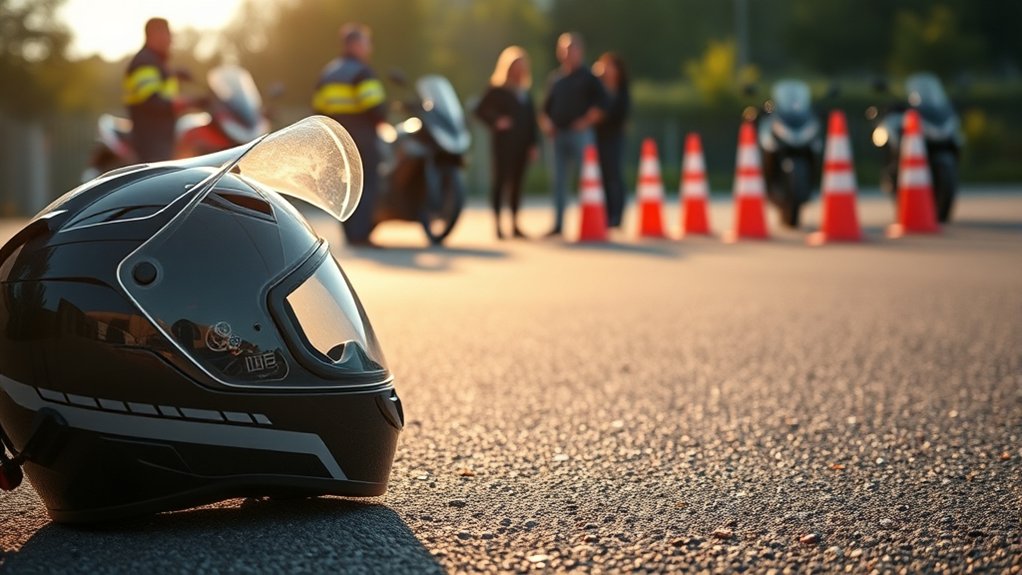
An MSF motorcycle class is the Motorcycle Safety Foundation’s standardized beginner training program. It’s usually called the Basic RiderCourse (BRC) and helps you build safe riding habits, traffic awareness, and crash-avoidance skills.
In the MSF Basic RiderCourse, you split time between classroom instruction and range practice. Typically, it’s 4–6 hours total, with about the same time in each setting.
On the range, you practice clutch and throttle control, braking, shifting, turning, and low-speed maneuvers. You do this with close instructor coaching throughout.
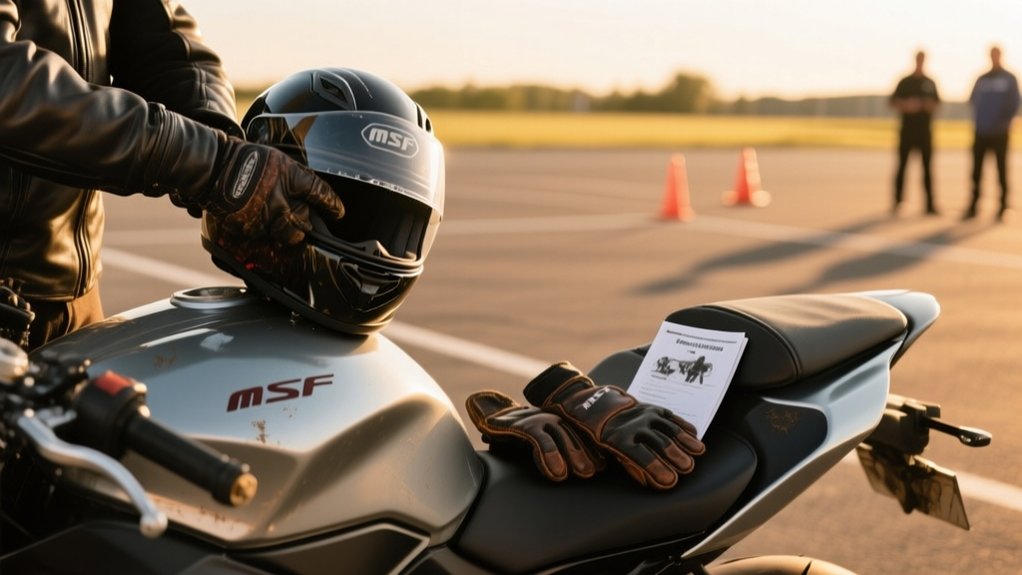
The course uses provided motorcycles. You must wear a helmet, gloves, long pants, a long-sleeve shirt or jacket, and over-the-ankle boots.
Small class sizes help you get hands-on feedback. Many states and insurers recognize this training for a licensing endorsement, written-exam credit, or a waiver after you pass the skills test and knowledge exam.
Why Take An MSF Class?
You take an MSF class to build your core riding skills with structured drills—things like braking, turning, clutch control, slow-speed maneuvers, and hazard avoidance.
Plus, you’ll practice in a controlled setting where trained instructors are there to give you direct feedback.
All of that helps you build safer habits, boost your confidence on the road, and figure out whether motorcycling is the right fit for you.
Skill Building Basics
Taking an MSF class gives you structured, hands-on training that’s hard to replace on your own.
The MSF Basic RiderCourse pairs classroom theory with range drills, so you can practice clutch control, braking, turning, and slow-speed maneuvers under instructor guidance.
This rider training uses risk-reduction techniques to build repeatable habits and confidence.
| Skill | Purpose | Drill focus |
|---|---|---|
| Clutch/throttle | Smooth launches | Friction-zone control |
| Braking | Controlled stops | Progressive pressure |
| Turning | Precise line choice | Head-turn input |
| Maneuvering | Low-speed balance | Tight-space practice |
| Feedback | Faster correction | Immediate coaching |
You’ll also earn a nationally recognized certificate.
Many states waive the licensing skills test after successful completion.
That makes the course practical, efficient, and technically focused.
Safer Riding Habits
MSF training builds safer riding habits by teaching you to scan 12–15 seconds ahead.
You’ll also learn to maintain a space cushion, signal early, and keep the motorcycle in the friction zone for better low-speed control.
In the MSF Basic RiderCourse, you practice defensive riding habits that directly support crash reduction in traffic and at intersections.
You’ll also learn to brake smoothly and predictably, ride within your skill limits, and avoid peer-pressure speeds and alcohol.
These habits matter because novice riders who complete MSF training show lower collision involvement than untrained riders, especially in the first year.
The course also reinforces clutch and throttle coordination and slow-speed maneuvers, so you can make safer decisions under pressure.
Confidence On Road
Safer riding habits lay the groundwork. MSF training turns that discipline into real road confidence.
When you take the MSF Basic RiderCourse, you practice clutch control, emergency braking, and slow-speed maneuvers in structured motorcycle safety training.
That repetition builds rider confidence and reduces hesitation in traffic.
| Benefit | Result |
|---|---|
| Skills practice | Better control |
| Hazard scanning | Faster responses |
| License waiver | Legal confidence |
| Insurance savings | Lower costs |
| Refresher training | Sustained confidence |
You’ll also learn defensive riding. You can spot left-turn threats and rear-end risks earlier.
Many riders refresh after winter or within 6–12 months to keep muscle memory sharp. Ongoing training helps you ride solo or in groups with more precision and less stress.
What Happens On The First Day?
On the first day of an MSF Basic RiderCourse, you’ll usually begin with a short classroom session.
It covers motorcycle controls, basic riding strategies, traffic laws, and protective gear.
This part typically lasts about 1–2 hours.
Then you complete a safety briefing, sign waivers, and get an overview of what to expect as a new rider.
Instructors also demonstrate throttle, clutch, brake, and shifting basics.
After that, you mount a bike and start learning hands-on.
Next, you move to low-speed parking-lot drills.
You’ll practice things like starting and stopping the engine, finding the friction zone, and braking and turning smoothly.
You can expect one-on-one coaching, skill checks, and maybe a quick quiz.
If you struggle, instructors may add extra practice.
Take your time, stay focused, and bring water.
What Gear Do You Need?
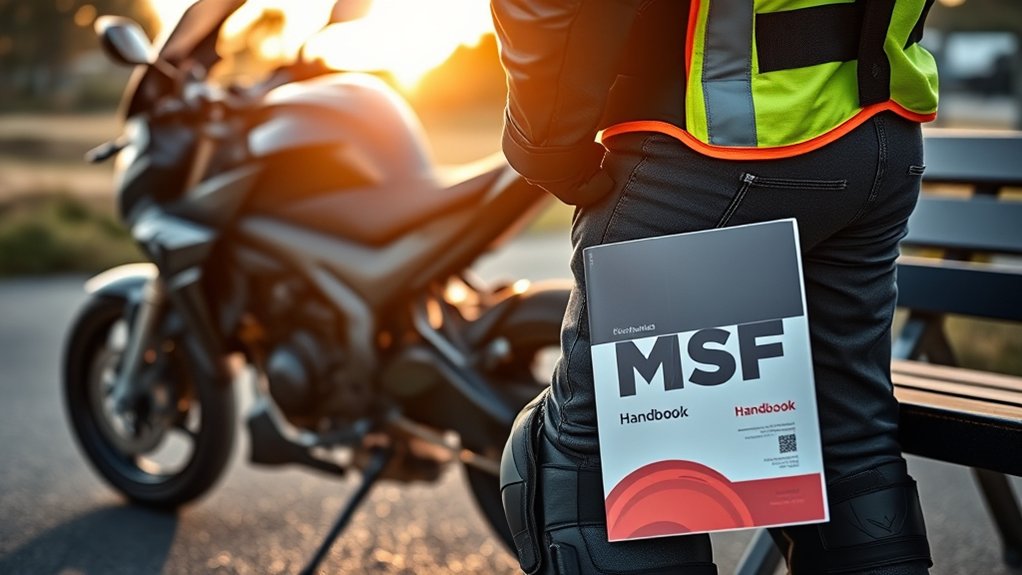
For the MSF Basic RiderCourse, you’ll need proper protective gear. Start with a DOT- or ECE-rated full-face helmet, since it offers the most important head protection.
Add a CE-rated armored jacket, CE-certified pants or armored jeans, and over-the-ankle boots. Finish with CE-rated gloves for added protection.
Choose gear that fits snugly and uses durable materials for abrasion and impact control. Protection matters more than appearance.
| Gear | Why it matters |
|---|---|
| Helmet | Reduces head injury risk |
| Jacket and pants | Add armor and abrasion resistance |
| Boots and gloves | Protect extremities and improve control |
This AI-generated checklist helps you prepare efficiently. Always verify certification labels before you ride.
Avoid non-certified items, since they can leave you exposed in a fall.
What Skills Do You Practice In MSF?
In the MSF Basic RiderCourse, you practice the core controls that make a motorcycle predictable.
You work on clutch friction zone control, smooth throttle application, and coordinated braking for starts, stops, and low-speed maneuvers.
Then you build balance and precision with slow-speed drills and lane-position exercises.
Figure-eights, cone weaves, and tight turns sharpen clutch control and head-and-eyes technique.
Emergency braking drills teach progressive front and rear brake use.
You’ll also practice straight-line stops.
Cornering and traffic exercises reinforce scanning, safe speed entry, and hazard awareness.
These skills help you manage power, keep the bike stable, and reduce risk in real traffic.
You also learn basic decision-making, following distance, and group-riding etiquette.
That way, you can judge whether you’re ready for the street.
How Does The MSF Riding Test Work?
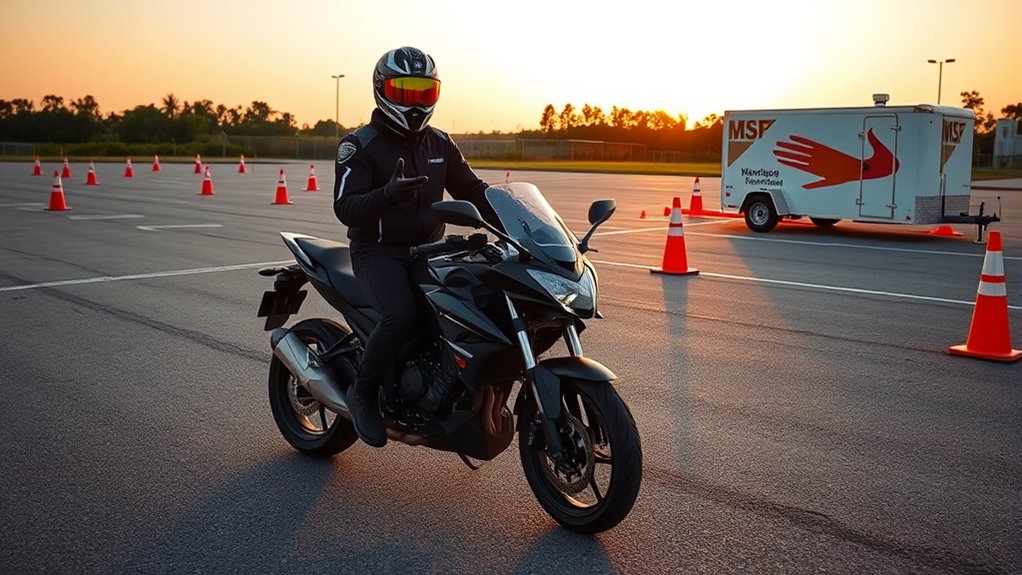
The MSF riding test usually includes two parts: a written knowledge check and an on-bike skills evaluation.
First, you’ll prove what you know, and then you’ll move to a marked training course where you’ll practice real riding tasks.
On the bike, you’ll perform things like slow-speed weaving, turns, quick stops, and swerves.
Instructors will watch closely and score how well you control the motorcycle—especially your smoothness, accuracy, and overall safety.
You pass by meeting the required standards and avoiding critical errors, not by riding fast.
MSF Test Format
Your MSF riding test usually combines a short written knowledge quiz with an on-bike skills evaluation on a closed course.
You’ll complete it on a provided training motorcycle, often in the 125–500cc range for the Basic RiderCourse.
You’ll ride a timed, instructor-scored sequence that checks low-speed control and safety habits.
The written quiz covers rules, signs, and basic motorcycle control.
The skills run tests clutch, throttle, braking, balance, and line choice.
Scoring is based on cone strikes, foot down, poor control, or unsafe errors.
Certified RiderCoaches watch each exercise and record demerits.
One major mistake can fail that maneuver, and too many errors can end the course.
If you pass, you may waive the state skills test and move closer to your license.
Skills Evaluation Tasks
Beyond the written quiz, the MSF riding test checks how well you handle the motorcycle in real riding tasks on a closed range.
You’ll ride an instructor-provided bike through timed or distance-limited drills.
These drills measure low-speed control, braking, swerving, and precise turning.
Expect figure-eight patterns, straight-line stops from set speeds, and quick avoidance maneuvers in marked lanes or cones.
Instructors watch your throttle control, friction-zone use, head turns, lane placement, and braking smoothness.
Then they score each exercise against specific criteria.
If you stall repeatedly, clip cones, or brake unsafely, you can fail a task even if you passed the quiz.
When you complete the skills test, you show basic riding competence and earn the course completion card used for licensing or insurance recognition.
Passing Requirements
Passing the MSF riding test depends on more than staying upright. You must complete each range exercise to standard and follow directions exactly.
You’ll be judged on straight-line braking, slow-speed control, cone weave, figure-8, and quick stops. Each maneuver is scored pass or fail.
Instructors watch for foot-downs, cone strikes, stalls, missed patterns, and unsafe inputs. Follow their guidance and take your time to stay accurate.
Use the friction zone and keep throttle control smooth. Look through each turn and keep your head up.
Brake firmly and stop where instructed. You need full attendance, and you may need to pass a written quiz or classroom module.
If you complete both parts, you’ll usually get a completion card. That card can waive the state skills test, but confirm local DMV rules since requirements vary.
Common Mistakes New Riders Make
New riders often make the same few mistakes.
They ride too fast for the conditions, look at the wrong point in the turn, and misuse the clutch and throttle.
Practice at walking pace.
Low-speed balance errors and stalls account for many beginner drops.
Turn your head toward the path you want.
Your bike usually follows your eyes.
Keep the friction zone controlled.
Coordinate clutch and throttle smoothly so you don’t lurch or stall in turns.
Don’t let ego push you to match faster riders.
Also, don’t squeeze into tight formations before you’re ready.
After a long break, especially in winter, your skills fade.
A refresher helps rebuild low-speed control and hazard response.
MSF Coach Tips That Help You Pass
MSF stands for Motorcycle Safety Foundation, and its basic Beginner RiderCourse combines classroom instruction with on-range riding drills to teach core skills.
To pass, you should focus on what coaches actually score: control, balance, and compliance.
Master the friction zone, keep a steady throttle, and turn your head where you want the bike to go.
Follow every instructor cue exactly.
The drills and scoring are standardized, so precision matters.
- Stay relaxed and breathe
- Use smooth clutch and throttle inputs
- Practice slow-speed turns and stops
Leave your ego out of it.
Tension makes low-speed riding harder, and coaches expect beginners to be nervous.
If you want to stay sharp, consider a seasonal refresher when conditions change.
MSF1 Vs. MSF2: Which Should You Take?
If you’re deciding between the two, MSF1 is the entry-level Basic RiderCourse. It teaches the fundamentals—clutch control, braking, low-speed maneuvers, and range drills.
MSF2 is the follow-up refresher for riders who already have basic skills. It sharpens braking, cornering, and hazard avoidance.
Pick MSF1 if you’re brand new, need a license waiver, or want structured, step-by-step instruction. It usually runs 2–3 days with classroom and on-bike sessions.
Choose MSF2 if you’ve already completed MSF1, have recent riding experience, or want a quick skills reset after time off. MSF1 builds safe basics and often provides loaner bikes.
MSF2 assumes competence and focuses on refining technique, confidence, and control at speed.
What MSF Training Won’t Teach You?
Although MSF courses build essential riding fundamentals, they don’t cover every skill you’ll need on the road.
MSF courses build the basics, but they don’t prepare you for every riding challenge on the road.
You’ll learn clutch control, braking, shifting, and low-speed maneuvers.
The basic course won’t teach advanced cornering, late apexing, trail braking, or precise body positioning for fast turns.
It also won’t fully expose you to real traffic complexity or varied hazards.
Complex multi-lane highway decisions.
Emergency avoidance on gravel, wet leaves, or oil.
Fatigue, impairment, and trip-planning judgment.
You also won’t get full training on group-ride formation.
You may also need more coaching to evaluate other riders’ competence and handle larger bikes at speed.
Those skills typically require on-road miles or an advanced MSF course.
Treat the basic course as a foundation, not complete road-riding preparation.
Frequently Asked Questions
Is MSF Required to Get a Motorcycle License?
No, you usually don’t need MSF to get a motorcycle license.
You can often qualify through your state’s DMV testing process instead.
However, if you complete an MSF Basic RiderCourse, your state may waive the skills test.
That can make licensing faster and simpler.
Rules vary by state, so check your DMV’s current requirements.
MSF training can also help you lower insurance costs and build safer riding skills.
How Long Does an MSF Motorcycle Course Last?
You’ll usually spend 15–16 hours in the MSF Basic RiderCourse. It’s often over two days or five weeknights.
You’ll get about 4–6 hours of classroom instruction. Then you’ll have 8–12 hours of on-bike practice, depending on class size and your pace.
If you take an eCourse format, you’ll do some lessons online first. Advanced MSF classes are shorter, usually 4–8 hours, and focus on skill refinement.
Does MSF Provide the Motorcycle for Training?
Yes, MSF usually provides the motorcycle for your training.
You’ll typically ride a course-owned bike in the Basic RiderCourse.
Instructors assign you a small-displacement model that’s easy to handle.
You usually don’t need to bring your own motorcycle.
Some sites may let you use your own bike if it meets registration, insurance, and safety rules.
Confirm the details with your local provider before class.
Can Beginners With No Experience Join MSF?
Yes, you can join MSF as a beginner with no riding experience.
You’ll learn the basics from scratch, including clutch control, shifting, braking, balance, and slow-speed turns.
Most courses supply a motorcycle and required gear, so you don’t need your own bike.
Expect classroom lessons, range practice, and a final skills test over 2–3 days.
If you follow instructions and practice, you’ll usually do well.
Will MSF Lower My Motorcycle Insurance Rates?
Yes, MSF can trim your insurance bill like shaving off extra costs.
You may get a 5%–15% discount after you complete a Basic RiderCourse and submit your completion card on time.
Availability, discount amounts, and rules vary by insurer and state.
Check local requirements and ask your insurer for written confirmation.
Also ask how long the discount lasts and whether you’ll need refresher training to keep it.
Conclusion
Now that you know what MSF stands for motorcycle, you can see why the course matters.
It gives you a structured, low-risk way to build control, confidence, and road awareness before you ride on your own.
If you think you can learn faster by skipping class, remember that habits formed early are hard to fix later.
Take the training, practice the basics, and you’ll be better prepared for real-world riding.