Who Establishes The Motorcycle Safety Training Program
You establish motorcycle safety training programs through a coordinated effort between federal agencies like the NHTSA, state departments of motor vehicles, and the Motorcycle Safety Foundation (MSF). The MSF develops standardized curricula and certifies instructors, while states approve programs and enforce training standards.
Local governments also support implementation to make certain of consistent, effective rider education. Together, these entities maintain quality, safety, and regulation. Understanding their roles will help you grasp how training remains reliable nationwide.
Why Motorcycle Safety Training Programs Matter

Although riding a motorcycle can be thrilling, it also comes with considerable risks that proper training can help you manage. Motorcycle safety education plays a vital role in reducing accidents and injuries by equipping you with essential rider skills. Certified instructors lead these programs, ensuring you learn under consistent safety standards that apply nationwide.
By participating in well-structured training, you not only enhance your ability to handle diverse road conditions but also contribute to overall accident reduction. Studies confirm that completing recognized courses markedly lowers your chances of injury.
Embracing motorcycle safety education is more than a requirement. It’s your best defense to ride responsibly and confidently.
Prioritizing this training ultimately protects you and other road users alike. So, if you’re serious about riding safely, taking a safety course is definitely the way to go.
Government Agencies Leading Motorcycle Safety Training
When you enroll in a motorcycle safety training program, state agencies like the Departments of Motor Vehicles (DMVs) and transportation offices are the ones who set the standards and oversee the process. These state agencies guarantee program standards are met, approving curricula and managing instructor certification to maintain quality and safety.
At the federal level, the Department of Transportation, through the National Highway Traffic Safety Administration, provides guidance and funding to support consistent, effective rider education nationwide.
Together, federal and state agencies collaborate closely to align training programs with national safety goals.
This partnership guarantees that when you participate in a certified program, you receive detailed, standardized instruction designed to enhance your motorcycle riding skills safely and responsibly. It’s all about making sure you get the best training possible.
State Departments of Motor Vehicles in Licensing and Training
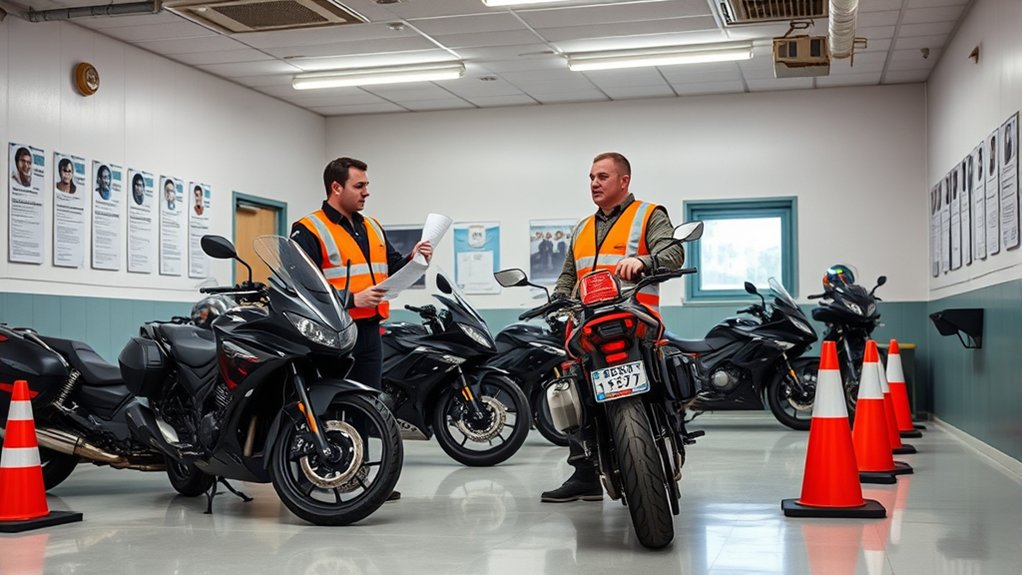
State Departments of Motor Vehicles (DMVs) play a central role in motorcycle safety training by setting and enforcing the standards for licensing and instruction within their states. You’ll find that state DMVs establish program standards, approve motorcycle safety training courses, and regulate instructor certification to guarantee consistent, high-quality instruction.
When you enroll in a state-approved program, it’s because the DMV has licensed that school and its instructors, confirming they meet rigorous requirements. State DMVs don’t stop at initial approval; they actively monitor programs for compliance and can suspend or revoke licenses if standards aren’t met.
State Transportation Offices Supporting Motorcycle Safety Training
You’ll find that state transportation offices play a key role in shaping motorcycle safety training. They set program guidelines and manage funding to keep things running smoothly.
Plus, they work closely with different agencies to make sure the training meets both state and federal requirements. Knowing how they fit into the picture helps explain why these programs stay effective and well-supported.
State Agency Roles
How do transportation offices contribute to motorcycle safety training? State transportation agencies play a vital role in program oversight by collaborating with departments like the Texas Department of Licensing and Regulation. They guarantee motorcycle safety training aligns with curriculum standards and regulatory requirements.
You’ll find these agencies coordinating with licensed schools and instructors to implement consistent training across jurisdictions. They also monitor compliance, making sure safety protocols are upheld.
Beyond oversight, these agencies handle funding allocation, managing resources such as the Motorcycle Education Fund to support training initiatives and safety campaigns.
Funding And Partnerships
Beyond overseeing curriculum and compliance, transportation offices support motorcycle safety training through targeted funding and strategic partnerships. State transportation agencies allocate funding from sources like the Motorcycle Education Fund, which is supported by licensing fees. This helps sustain motorcycle safety programs and instructor certification.
These agencies also collaborate with organizations such as the Motorcycle Safety Foundation and research institutions like the Texas A&M Transportation Institute to improve training methods. Through partnerships, they coordinate with local and regional authorities to make sure programs align with statewide safety policies.
On top of that, state transportation agencies lead public awareness campaigns to promote safe riding practices. By combining funding and collaborative efforts, these agencies play a vital role in maintaining and advancing effective motorcycle safety training across the state.
Program Implementation Guidelines
While state transportation offices partner closely with the Texas Department of Licensing and Regulation, they take the lead in developing regional guidelines to guarantee motorcycle safety training programs meet state-approved curricula and standards. You’ll find that state agencies play a pivotal role in program implementation by coordinating with local motorcycle schools and instructor licensing providers.
They ensure training providers strictly follow regulatory standards through regular reporting, inspections, and evaluations of training sites. These training guidelines help maintain consistency and quality across regions, so every rider receives effective education.
Furthermore, state transportation offices support funding distribution and public outreach efforts to promote motorcycle safety education. By overseeing these elements, they ensure the program operates smoothly and meets its goal of enhancing rider safety statewide.
MSF and Government Collaboration on Motorcycle Safety Training Programs
You’ll find that the Motorcycle Safety Foundation (MSF) plays a central role in developing standardized training programs by partnering closely with government agencies.
These collaborations help ensure that safety curricula meet consistent development standards and align with licensing requirements.
By working together, MSF and government bodies create effective motorcycle safety training programs that are tailored to fit regional needs.
It’s a teamwork approach that really makes a difference.
MSF Role Overview
How does the Motorcycle Safety Foundation (MSF) work with government agencies to enhance rider safety? The MSF develops and provides nationally recognized rider training curricula and safety standards that serve as the backbone for motorcycle safety programs across the country. You’ll find MSF’s rigorous instructor certification guarantees quality teaching, maintaining consistent training excellence.
The Motorcycle Safety Foundation collaborates with state Departments of Motor Vehicles and transportation agencies, integrating its programs into licensing requirements. This partnership helps standardize rider education nationwide.
By offering technical assistance and resources, MSF supports state and local initiatives, ensuring programs meet established safety benchmarks.
Federal and state agencies rely on MSF’s expertise to promote uniform, effective motorcycle safety training. That’s why MSF is a trusted leader in advancing rider safety through education and certification.
Government Partnerships
Because government agencies want to make riding safer, they work closely with the Motorcycle Safety Foundation (MSF) to create and roll out effective motorcycle training programs. These partnerships help keep rider education consistent and boost motorcycle safety across the country.
You’ll notice this teamwork in several ways. For example, state departments like DMVs approve and offer MSF-certified rider education courses that fit local needs.
Federal agencies, such as NHTSA, provide funding and support for these programs. They also count on MSF’s expertise to keep the curriculum top-notch.
Local governments get involved too. They set up their own training programs in partnership with MSF, making sure rider education is both accessible and standardized.
Program Development Standards
Although many organizations contribute to motorcycle safety, the Motorcycle Safety Foundation (MSF) plays a central role in developing and maintaining standardized training curricula. You’ll find that MSF collaborates closely with government agencies to guarantee these motorcycle safety training programs meet consistent, high-quality standards.
State DMVs approve and implement MSF-certified courses, integrating the curriculum into licensing requirements.
Federal agencies like NHTSA further support this effort by providing grants and guidance, promoting rider safety nationwide.
The MSF also offers technical assistance to help government agencies develop and maintain effective training programs.
By adopting or adapting MSF standards, state and local authorities ensure riders receive comprehensive education.
This makes the motorcycle safety training program both standardized and effective across the country.
How Motorcycle Safety Curriculum and Instructor Certification Are Established
When you enroll in a motorcycle safety course, you can trust that the curriculum and instructor qualifications meet high standards set by the Texas Department of Licensing and Regulation (TDLR). Here’s how the process works:
First, the TDLR sets the rules for the motorcycle safety curriculum, aligning with federal guidelines and NHTSA standards to ensure safety and consistency.
The TDLR establishes motorcycle safety curriculum rules aligned with federal and NHTSA standards for consistency.
Next, the Motorcycle Safety Foundation (MSF) develops nationally recognized curricula and instructor training programs that meet or exceed TDLR standards.
Only TDLR-approved instructor training providers can conduct courses and certify new instructors. These providers deliver approved courses that uphold quality through rigorous instructor certification.
This system guarantees that both the motorcycle safety curriculum and instructor certification maintain excellence and uniformity across Texas.
State Enforcement of Motorcycle Training Requirements
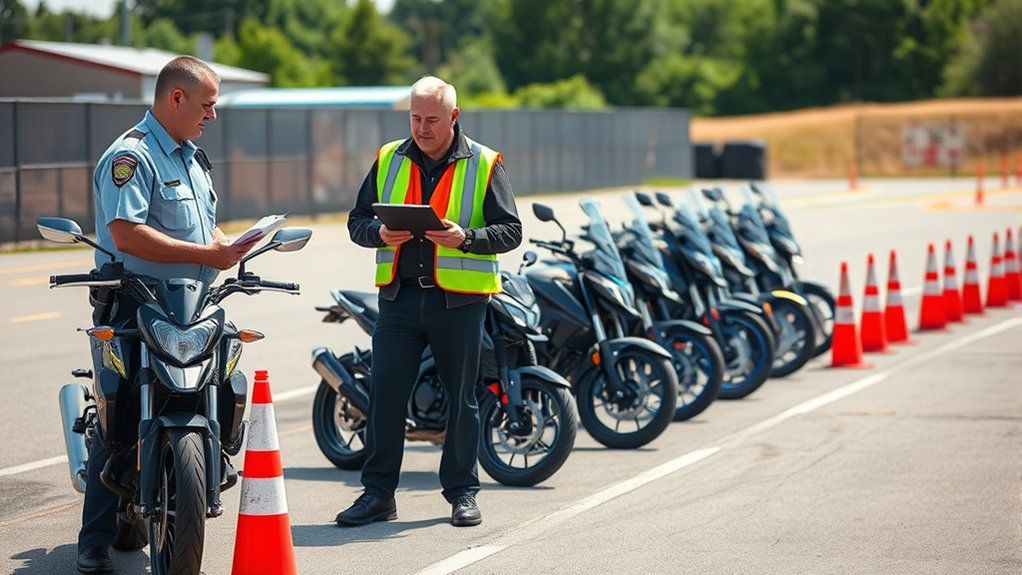
State departments of motor vehicles take charge of enforcing motorcycle safety training requirements to keep riders like you safe on the road. They regulate licensing, approve curriculum standards, and guarantee instructor certification to maintain consistent safety education.
Enforcement means monitoring motorcycle schools and instructors to make sure they follow state rules. If violations happen, state departments can suspend or revoke licenses to keep the program’s integrity intact. This system makes sure you get quality training before hitting the road.
| Responsibility | Role | Outcome |
|---|---|---|
| Licensing | Approve rider course completion | Valid motorcycle endorsement |
| Curriculum Standards | Set and review training content | Consistent safety education |
| Instructor Certification | Certify qualified trainers | Qualified instruction |
| Enforcement | Monitor & enforce compliance | High program accountability |
Measuring the Impact of Motorcycle Safety Training Programs
Understanding how well motorcycle safety training programs work helps improve rider protection and program quality. You can measure training effectiveness by focusing on key evaluation metrics that reveal safety outcomes.
First, examine crash reduction statistics. Studies show graduates experience considerably fewer crashes than non-participants.
Second, analyze injury prevention rates. Many states report up to a 37% drop in motorcycle injuries after introducing mandatory courses like California’s BRC.
Third, consider indirect indicators such as insurance discounts or license test waivers awarded to trained riders. These reflect the recognized value of the programs.
Continuous data collection by organizations like MSF ensures ongoing assessment of long-term benefits.
Frequently asked questions
What Are the Costs Associated With Motorcycle Safety Training Programs?
You’ll find that a $5 fee per transaction often goes toward funding motorcycle safety programs. It’s a good example of how small costs add up over time.
The main expenses include course enrollment fees, instructor certification, and licensing, all set by state agencies. You’ll also need to budget for training materials, safety gear, and school administrative costs.
These fees are designed to be reasonable and support effective training. Adjustments are made through legislation when necessary to keep things fair and up to date.
How Can Experienced Riders Benefit From Refresher Safety Courses?
You can sharpen your riding skills and stay updated on the latest safety techniques by taking refresher safety courses. These courses help you master advanced maneuvers, improve hazard awareness, and learn about new safety gear.
By reinforcing good habits, you reduce your accident risk.
Plus, many states waive licensing tests if you complete approved refresher training. That makes it easier for you to maintain your riding privileges confidently and safely.
Are There Online Options Available for Motorcycle Safety Training?
You can absolutely find online options for motorcycle safety training, much like using a telegraph to send messages today. It’s a modern twist! Many courses, including those from the Motorcycle Safety Foundation, offer online modules to cover theory before you hit the road.
However, you’ll still need in-person sessions to master practical riding skills and earn certification.
What Types of Motorcycles Are Used During Training Sessions?
During training sessions, you’ll typically use smaller, lightweight motorcycles. These are often dual-sport or standard bikes with engine sizes between 250cc and 450cc. They’re chosen because they’re easier to handle, which helps you build confidence and control.
Many of these bikes come with safety features and training aids like throttle restrictors to keep things safe.
Some courses even include a variety of bike types so you can practice different riding scenarios effectively. This way, you get a well-rounded experience that prepares you for real-world riding.
Can Motorcycle Safety Training Reduce Insurance Premiums?
Absolutely, completing motorcycle safety training can cut your costs considerably. Insurers often offer discounts, typically ranging from 10% to 20%, because trained riders present less risk.
By proving your proficiency through such courses, you not only boost your skills but also benefit from reduced premiums.
This proactive preparation shows responsibility. It makes you a more attractive policyholder and helps you save money while staying safe on the road.
Final Thought
Think of motorcycle safety training as the compass guiding your journey through winding roads. Just as a skilled navigator relies on precise tools and trusted maps, government agencies and organizations like the MSF establish clear programs and certified instructors to steer you safely.
By embracing these structured trainings, you’re not just learning to ride. You’re securing a safer path forward, ensuring every twist and turn leads you confidently home.