Who Owns Harley Davidson – The Answer
You own Harley-Davidson through a diverse group of public shareholders, including large institutional investors like Vanguard and BlackRock. These investors together influence the company’s direction.
Since going public in 1986, Harley-Davidson has remained independent with no single controlling owner. This dispersed ownership shapes governance, strategy, and innovation. It also supports growth through capital markets.
Understanding these dynamics shows how ownership affects everything from corporate decisions to market positioning and the rider experience. It’s pretty interesting to see how all these pieces come together.
Who Owns Harley-Davidson Stock Today?

Who exactly owns Harley-Davidson stock today? As a publicly traded company listed on the NYSE under the ticker symbol HOG, Harley-Davidson’s stock ownership is pretty diverse.
Institutional investors, like Vanguard Group and BlackRock, hold significant shares. They’ve a strong influence on company governance through voting rights and board elections.
You, as an individual investor, might also own Harley-Davidson shares through retirement accounts, mutual funds, or brokerage accounts.
Ownership is spread across thousands of individual and institutional shareholders, which means control isn’t concentrated in just a few hands.
This kind of distribution allows for a balanced influence on corporate decisions without any single party dominating.
Understanding this ownership structure helps you see how Harley-Davidson’s strategic direction aligns with the interests of both institutional and individual investors.
Is Harley-Davidson Independent or Owned by a Parent Company?
How does Harley-Davidson maintain its position in the market? The company remains independent, operating without a parent company since its founding in 1903. As a publicly traded company since 1986, Harley-Davidson’s ownership lies with diverse shareholders, including institutional and individual investors.
This dispersed ownership means no single entity controls the company directly. Governance is managed by a board of directors, ensuring strategic decisions align with shareholder interests and preserving Harley-Davidson’s autonomy.
| Aspect | Impact on You |
|---|---|
| Independent | Trust in authentic brand |
| Shareholders | Diverse ownership voice |
| Governance | Transparent decision-making |
This structure lets you rely on Harley-Davidson’s commitment to innovation and tradition, free from external corporate control.
How Do Institutional Investors Influence Harley-Davidson’s Ownership?
You should know that big institutional investors like Vanguard and BlackRock own a large chunk of Harley-Davidson’s stock. Because of this, they’ve a lot of voting power.
This means they can really influence important decisions, whether it’s about the company’s strategy or its financial policies.
Major Institutional Shareholders
Why do institutional investors like Vanguard Group and BlackRock play such an essential role in Harley-Davidson’s ownership structure? These major institutional shareholders hold significant stock holdings, giving them substantial voting rights.
As leading investment firms, they influence corporate governance and strategic decisions. You should understand their impact in three key ways:
- They represent a large portion of Harley-Davidson’s shares, making their votes critical in board elections and policy approvals.
- Their investment strategies shape Harley-Davidson’s long-term direction, affecting growth and market responses.
- Their quarterly disclosures reflect evolving stock holdings, signaling confidence or concern to the market.
Voting Power Impact
Where do institutional investors like Vanguard Group and BlackRock exert the most influence in Harley-Davidson’s ownership? They leverage significant voting power to shape corporate governance and major decisions.
As major shareholders, their voting rights directly affect Harley-Davidson ownership and strategic direction. You’ll notice their shareholder influence is critical during board elections, mergers, and policy approvals.
Managing funds for numerous individual investors, institutional investors amplify their impact, ensuring their preferences guide company management.
| Institutional Investor | Voting Power (%) | Key Influence Area |
|---|---|---|
| Vanguard Group | 8.5 | Board Elections |
| BlackRock | 7.8 | Mergers & Acquisitions |
| State Street | 4.2 | Corporate Policies |
| Fidelity | 3.9 | Strategic Decisions |
| T. Rowe Price | 3.6 | Governance Practices |
This concentration of voting rights makes them pivotal in Harley-Davidson’s ownership.
How Does Shareholder Voting Affect Harley-Davidson’s Strategy?
You play a key role in shaping Harley-Davidson’s strategy through shareholder voting. This voting influences major decisions like board elections and strategic initiatives.
When big investors like Vanguard and BlackRock cast their votes, they can really steer the company’s direction by approving or rejecting things like mergers, acquisitions, or product changes.
Basically, this process makes sure that management stays aligned with what shareholders care about. And that alignment directly impacts Harley-Davidson’s long-term focus and how the company operates day to day.
Shareholder Influence On Decisions
How do shareholder votes shape Harley-Davidson’s strategic direction? Shareholder voting plays a vital role by influencing board elections and key strategic decisions. Institutional investors like Vanguard and BlackRock hold significant sway, directing corporate governance and long-term strategy outcomes.
You can participate through proxy voting, ensuring your voice matters even if you can’t attend meetings. It’s a simple way to stay involved and help guide the company’s future.
Here’s how shareholder influence impacts Harley-Davidson:
- Board Elections: Shareholders elect board members who guide corporate priorities and oversight.
- Strategic Decisions: Votes determine initiatives like expanding electric vehicles and global markets.
- Corporate Governance: Shareholder input influences transparency and accountability practices.
Voting Impact On Strategy
Shareholder voting shapes Harley-Davidson’s strategic direction by determining key decisions that influence the company’s future. When you participate in shareholder voting, you directly impact board membership, which guides Harley-Davidson’s company strategy.
Institutional investors, who hold significant shares, wield considerable shareholder influence through their voting power. Their preferences often sway strategic decisions, from product development to market expansion and sustainability initiatives.
By voting on major corporate actions, you help define Harley-Davidson’s long-term priorities. Management closely monitors these voting patterns, especially shifts among large institutional investors, to align the company’s plans accordingly.
Ultimately, shareholder voting serves as a vital mechanism through which you can shape Harley-Davidson’s evolving strategy and guarantee it reflects the interests of its key stakeholders.
What Role Do the Board and CEO Play in Ownership and Control?
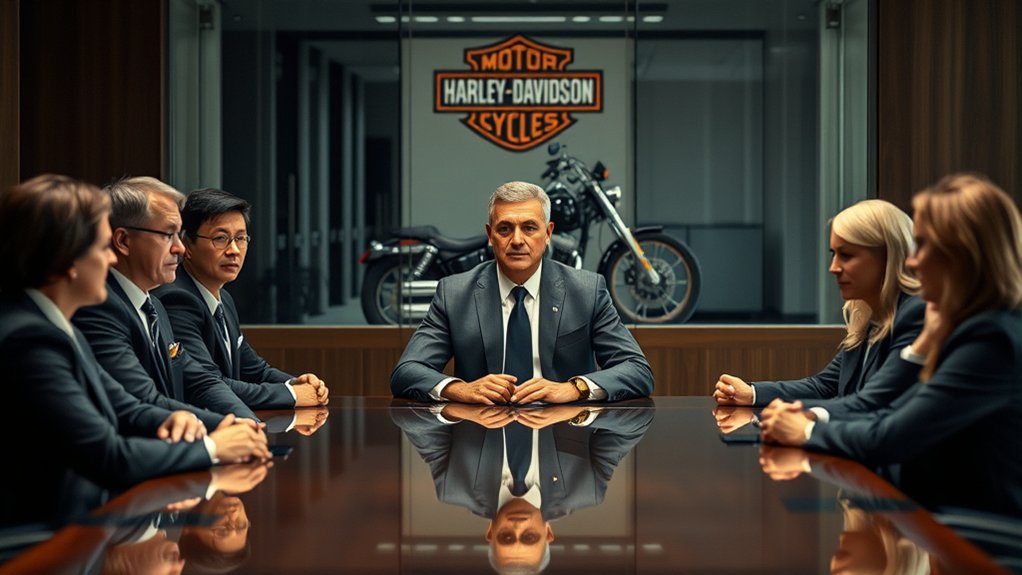
Although shareholders hold ultimate ownership, the board of directors and CEO play pivotal roles in controlling Harley-Davidson’s direction and operations. The board oversees strategic direction and major decisions, making sure shareholders’ interests are represented.
The CEO, who’s appointed by the board, manages daily operations and executes policies aligned with board strategies.
Shareholders influence corporate governance mainly through voting at annual meetings, which impacts leadership and key issues. You should understand that the board sets Harley-Davidson’s long-term goals and monitors management performance.
The CEO drives daily execution of these objectives, shaping company culture and results.
Shareholders keep their influence but really rely on the board and CEO to turn ownership into effective control. Together, the board and CEO form the core leadership that steers Harley-Davidson’s success.
How Has Harley-Davidson’s Ownership Evolved Since Its Founding?
Since its founding in 1903, Harley-Davidson’s ownership has undergone significant changes that reflect broader shifts in its corporate structure and market presence. Initially, it was family-owned by William Harley and the Davidson brothers.
The company stayed private until 1969, when it was sold to AMF. That marked its first big move to corporate ownership.
Then, in 1981, a group of investors led by Willie G. Davidson bought the company back, bringing independence back to Harley-Davidson.
By 1986, the company went public and got listed on the NYSE. This opened up ownership to a wide range of shareholders.
Today, Harley-Davidson’s ownership includes major investment firms like Vanguard and BlackRock. This shows how it moved from being family-owned to having institutional stakeholders.
It really reflects broader trends in corporate governance and market dynamics since the company’s founding.
How Does Public Trading Impact Harley-Davidson’s Growth and Governance?
When Harley-Davidson entered the public markets, it gained access to essential capital that fuels its growth and innovation initiatives. Public trading on the NYSE lets the company tap capital markets efficiently, which supports expansion and product development.
This setup spreads ownership among many shareholders, including big players like Vanguard and BlackRock.
These institutional investors influence corporate governance through their voting rights. So, public trading impacts Harley-Davidson in a few key ways.
First, enhanced market valuation drives strategic decision-making.
Then, shareholders get to elect the board of directors, which shapes long-term strategies.
Finally, dispersed ownership keeps any single party from having too much control, promoting balanced governance.
Why Does Ownership Structure Matter to Harley-Davidson Riders and Investors?
Because ownership structure shapes who holds decision-making power, it directly affects both Harley-Davidson riders and investors. The distribution of shares among shareholders, including major institutional investors like Vanguard and BlackRock, influences strategic decisions that define product innovation, pricing, and global expansion.
As a shareholder, your voting rights contribute to corporate influence on key policies, impacting motorcycle features and availability. Understanding this structure helps you assess company stability and growth potential, aligning investor interests with rider experiences.
When shareholders actively engage in voting, they steer Harley-Davidson’s direction, ensuring decisions reflect broad stakeholder priorities. Therefore, ownership structure is vital. It determines how effectively the company balances financial performance with long-term rider satisfaction and market competitiveness.
Frequently asked questions
How Does Harley-Davidson’s Ownership Affect Its Motorcycle Designs?
Harley-Davidson’s ownership shapes its motorcycle designs by pushing you to embrace classic, iconic styles that loyal fans expect. Shareholders and leadership prioritize blending tradition with innovation, so you’ll see models like the Softail combining modern tech with vintage looks.
Their influence also encourages customization options, giving you design flexibility while maintaining Harley’s cruiser heritage. This balance ensures every bike respects legacy yet meets diverse, global customer preferences.
Can Individual Investors Influence Harley-Davidson’s Product Lineup?
You might think you hold a key to Harley-Davidson’s product lineup, but your influence is more like a ripple than a wave. As an individual investor, you can vote on big corporate issues, yet day-to-day design choices remain firmly in the hands of executives and the Board.
While your voice matters in shareholder meetings, it rarely steers specific product decisions. Those choices are shaped mostly by institutional powers and leadership strategy.
What Impact Does Harley-Davidson’s Ownership Have on Its Environmental Policies?
Harley-Davidson’s ownership drives its environmental policies by pushing for innovation and sustainability. You’ll see this in their commitment to electric motorcycles like the LiveWire and eco-friendly manufacturing.
Shareholders expect the company to reduce emissions and improve brand reputation, so leadership focuses on meeting these demands.
This ownership influence guarantees Harley-Davidson balances market expectations with environmental responsibility. It’s all about accelerating the shift toward greener technologies and practices.
How Do Ownership Changes Affect Harley-Davidson’s Global Market Presence?
You’ll find that ownership changes have boosted Harley-Davidson’s global presence by expanding manufacturing to countries like Brazil and Thailand. They’ve also increased international dealerships and tailored products for local markets.
For instance, after launching in India in 2009, Harley markedly grew its customer base there.
These shifts let you see how strategic decisions under new ownership directly enhance Harley’s adaptability and competitiveness worldwide.
Does Harley-Davidson Offer Employee Stock Ownership Plans?
No, Harley-Davidson doesn’t offer an Employee Stock Ownership Plan (ESOP). Instead, ownership is mainly held by institutional investors and individual shareholders.
The company provides competitive salaries, benefits, and incentive programs. However, it hasn’t established a formal program for employees to acquire stock directly through an ESOP.
If you’re an employee, your stock ownership likely comes indirectly from retirement accounts or mutual funds rather than a dedicated employee stock plan.
Final Thought
You hold the reins when understanding Harley-Davidson’s ownership. It’s a dynamic dance between public investors, institutional players, and leadership steering the brand’s course. Like a finely tuned engine, each shareholder’s vote and the board’s decisions fuel its growth and strategy.
Knowing this ownership landscape lets you see how control shapes the ride. It ensures Harley-Davidson remains both a powerful machine and a symbol of freedom for riders and investors alike.