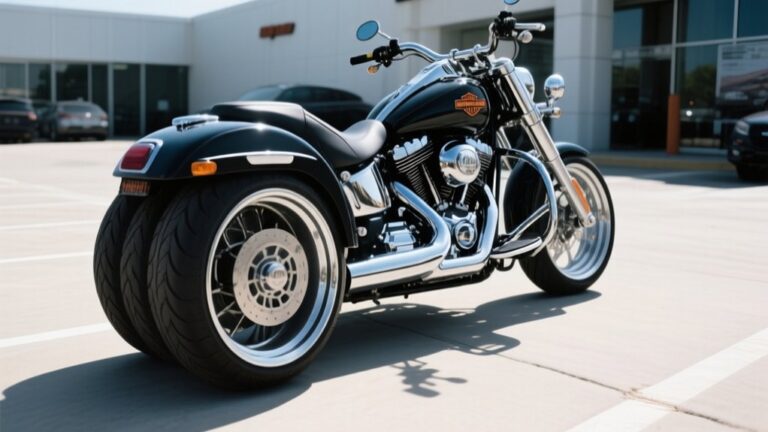
How Many Cc Is A Harley – By the Numbers
If you’re wondering how many cc a Harley has, it varies from 883 cc in smaller Sportster engines up to 1,868 cc in the largest Twin Cam 114 models. The well-known 103 engine sits at 1,690 cc, offering solid power without being the biggest. Engine size is often encoded in the VIN’s seventh character, helping you identify what’s under the hood.
Want to understand how these numbers translate to performance and upgrades? Let’s dive into what those cc figures really mean for your ride.
What Harley’s CC Number Really Means for Your Ride
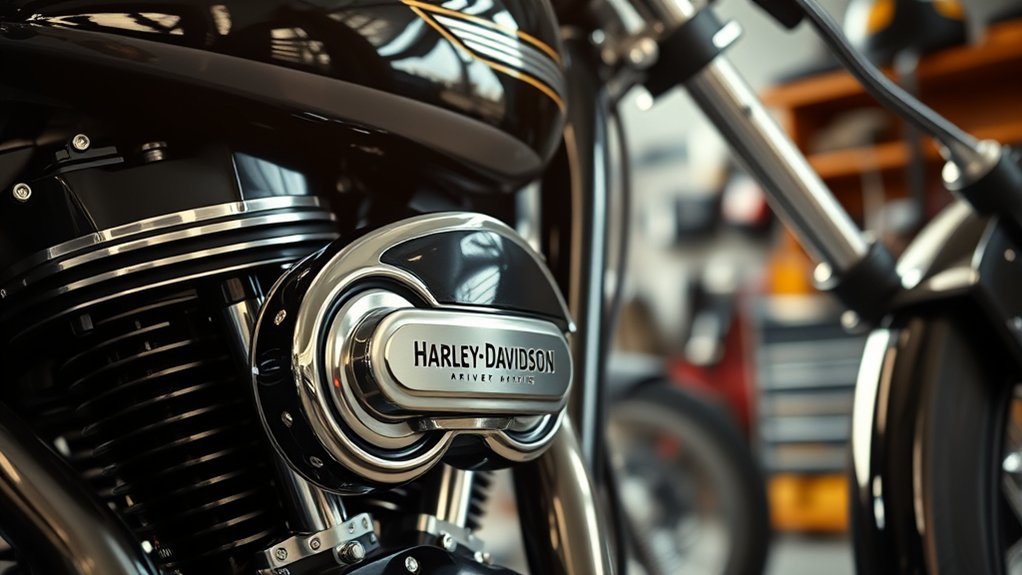
What does the CC number on your Harley really tell you about your bike? It reveals the engine size, which is a key factor in performance and compatibility. You can decode this information through VIN coding.
The seventh position in the VIN reveals displacement.
The seventh VIN character unlocks key info about your Harley’s engine displacement and performance potential.
Letters like C, D, and J indicate a 107 cubic inch engine, while K, P, F, and L represent 114 cubic inches. Some models use H or L to show a 117 cubic inch engine, depending on the year and series.
Cross-referencing this VIN letter with engine stamps and serial numbers confirms the exact Harley displacement.
Knowing your engine size helps you make informed decisions on upgrades, tuning, and parts. This way, your ride performs optimally and fits your style.
How the 103 Engine Stacks Up Against Other Harleys
You’ll find the 103 engine packs 1,690 cc, which makes it more powerful than Harley’s 96 cubic inch models.
It shares key dimensions with other engines but offers a noticeable boost in torque and performance.
If you compare it to the larger 114 engine, it really helps you see where the 103 fits in Harley’s lineup.
103 Engine Displacement
How does the Harley-Davidson 103 engine compare to other engines in the lineup? Introduced as a standard powerplant starting with the 2012 model year, the 103 engine replaced the Twin Cam 96 in many Harley models, including the popular Electra Glide.
With a displacement of 1,690 cc (103 cubic inches), it offers a significant boost in torque and performance.
The engine’s bore measures 3.875 inches, paired with a 4.375-inch stroke, which together define its capacity.
Positioned between the smaller Sportster engines and the larger Milwaukee-Eight models, the 103 provides a balanced option for riders seeking more power without jumping to the biggest displacement.
If you’re a new account looking to understand Harley’s engine options, the 103 stands out as a versatile and reliable choice in the lineup.
It’s really a sweet spot for those who want solid performance but don’t need the absolute biggest engine out there.
Comparison With Other Engines
Building on the 103 engine’s specifications, it’s clear this powerplant holds a distinct position within Harley-Davidson’s lineup.
With 1,690 cc, it surpasses the Twin Cam 96’s 1,584 cc and the Evolution engine’s 1,340 cc, offering you noticeably more power. However, it falls slightly short of the Milwaukee-Eight 107’s 1,750 cc and the Twin Cam 114’s impressive 1,868 cc.
If you’re upgrading from smaller engines like the Sportster’s 883 cc or 1200 cc, the 103 strikes a solid balance between increased displacement and dependable performance. This makes it a popular choice for riders seeking more muscle without sacrificing reliability.
In comparison, the 103 engine fits neatly between entry-level and high-displacement Harley engines, providing a versatile and powerful option. It’s a great middle ground if you want something more than the basics but aren’t ready to jump into the biggest engines just yet.
Why Harley Doesn’t Publish Official 103 Engine Horsepower Numbers
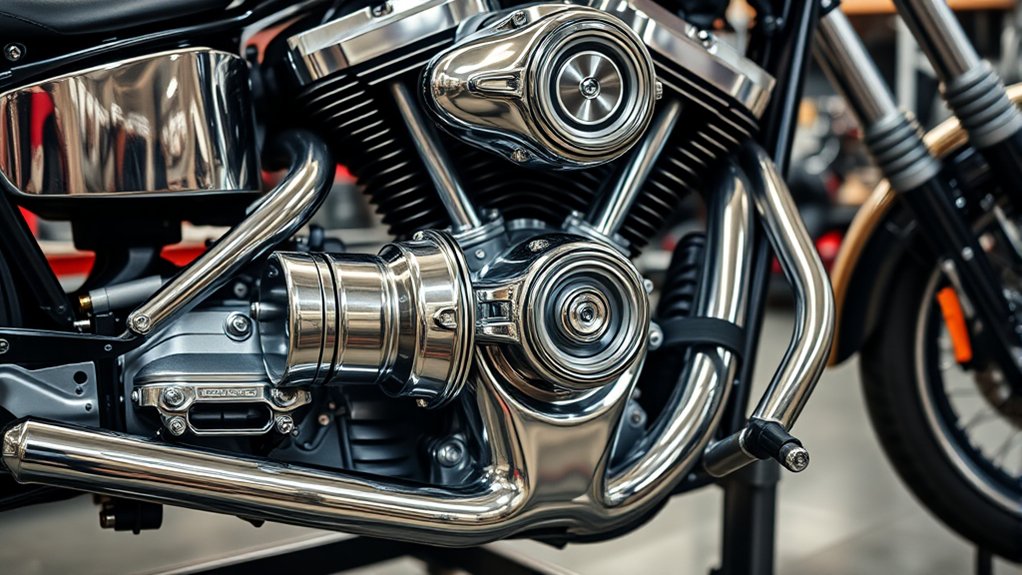
Although many riders are eager to know the exact horsepower of Harley’s 103 engine, the company chooses not to publish official figures. Instead, Harley-Davidson highlights torque ratings, focusing on the engine’s overall performance and reliability rather than peak horsepower.
You’ll find that different dyno tests and tuning variations produce inconsistent horsepower numbers. This makes it impractical for Harley to release a definitive figure.
Rather than chase exact horsepower, Harley’s marketing and technical materials emphasize the 103 engine’s robust torque, which better represents real-world riding experience.
If you want horsepower estimates, you’ll need to rely on third-party dyno results, but keep in mind these can vary widely.
This approach underscores Harley’s focus on practical power over headline-grabbing numbers. It’s really about how the bike feels on the road, not just what the numbers say.
Which Harley Models Came With the 103 Engine : And When
When you look at Harley-Davidson’s lineup from the 2010s, you’ll see the 103 engine playing a central role across several popular models. First introduced in a 2003 CVO, it became standard in many models starting in 2012.
The engine powered Touring bikes like the Road King and Street Glide until 2016, while Dyna and Softail models such as the Fat Bob and Low Rider used it through 2017.
In 2017, Touring models shifted to the Milwaukee-Eight engine, but Dynas and Softails kept the 103 for a bit longer.
Here’s a quick overview:
- 2003: Debut in CVO models
- 2012–2016: Standard in Touring lineup
- 2012–2017: Featured in Dyna and Softail models
- 2017: Touring lineup moved to Milwaukee-Eight
- Key powerplant for 2010s Harley motorcycles
Cracking the Code: Reading 103 Engine Numbers and Harley VINs
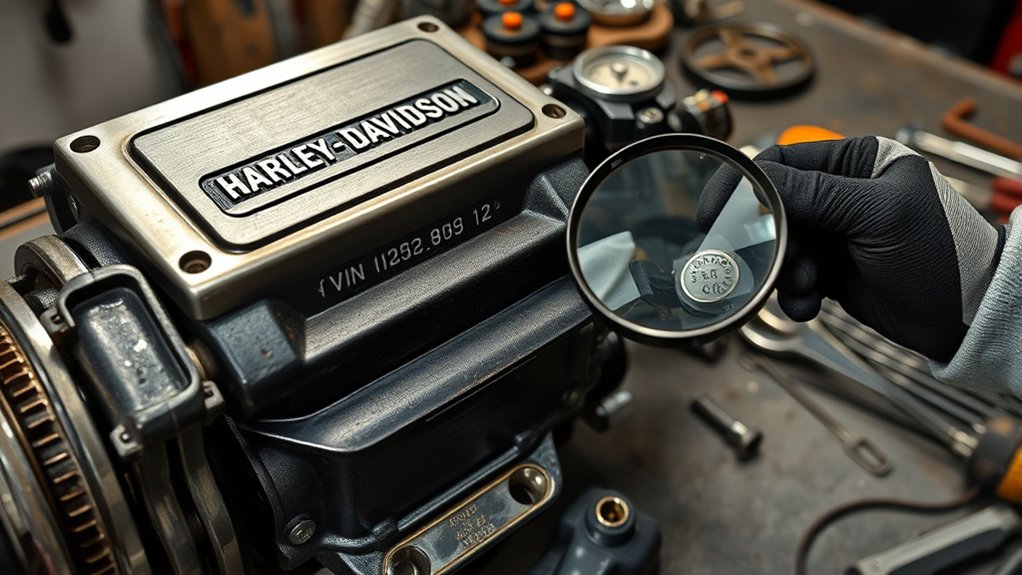
Since Harley-Davidson uses specific codes within its VINs and engine numbers, you can accurately identify your bike’s engine size and production details by learning how to read them. The 7th letter in the VIN reveals engine size. Letters like C, D, and J stand for 107 cubic inches, while K, P, F, and L indicate 114 cubic inches.
To confirm, cross-reference the stamped engine number on the case with the VIN. Engine serials, such as Ktmg653594, also help pinpoint production year and engine type when decoded properly.
Use online charts or community resources to decode these codes confidently.
| VIN 7th Letter | Engine Size (cu in) | Example Serial Code |
|---|---|---|
| C, D, J | 107 | Ktmg653594 |
| K, P, F, L | 114 | Ktmg653594 |
| Others | Varies | Varies |
Troubleshooting Common Issues and Keeping Your 103 Engine Happy
You’ll want to regularly check your cam chain tensioner to prevent wear and keep your engine timing spot on. It’s a simple step that can save you from bigger headaches down the road.
Managing heat is especially important, particularly if you’ve got an air-cooled model. So, make sure your cooling system is working efficiently to keep things running cool.
Taking these steps helps your 103 engine run smoothly and avoid common issues, keeping you on the road without a hitch.
Cam Chain Tensioner Wear
If your Harley-Davidson 103 engine starts making rattling noises at startup or idle, worn cam chain tensioners might be the culprit. This is a pretty common issue, often caused by insufficient lubrication or just high mileage.
Ignoring tensioner wear can lead to improper valve timing and some serious engine damage.
To keep your 103 engine running smoothly, make sure to inspect and replace the tensioner regularly. You might also consider upgrading to heavy-duty tensioners or aftermarket kits—they tend to last longer and offer better durability.
And don’t forget, proper oil changes with Harley-recommended oils play a huge role in minimizing wear.
- Rattling noises at idle often signal tensioner wear
- Insufficient lubrication accelerates tensioner damage
- Regular inspection prevents costly engine repairs
- Heavy-duty or aftermarket kits improve lifespan
- Use high-quality oils to guarantee proper tensioner function
Heat Management Tips
When managing the heat of your Harley 103 engine, ensuring adequate airflow is a top priority to prevent overheating and keep your bike running smoothly. Avoid prolonged idling, and consider upgrading to high-flow air filters and exhausts to help with cooling. Also, make sure to keep the cooling fins clean for better heat dissipation.
Using quality, cooler-running lubricants can make a big difference in maintaining the right temperature. Don’t forget to regularly check your cam chain tensioners to keep everything in good working order.
Keep an eye on your engine gauges and be quick to address any signs of overheating. Catching problems early can save you from costly damage down the road.
| Tip | Action | Benefit |
|---|---|---|
| Airflow | Upgrade filters & exhaust | Reduces heat buildup |
| Lubricants | Use cooler-running oils | Enhances heat dissipation |
| Component Inspection | Check cam chain tensioners | Maintains engine health |
| Temperature Monitoring | Watch gauges, act on warnings | Prevents engine damage |
Upgrades That Actually Make a Difference for the 103 Engine
How can you truly unleash the potential of your Harley 103 engine? Focused upgrades can really transform your ride’s power and responsiveness.
Start by improving airflow with a high-performance intake and exhaust system. This combo boosts horsepower and torque noticeably.
Enhance airflow with a high-performance intake and exhaust to significantly increase horsepower and torque.
Installing a camshaft designed specifically for the 103 enhances power delivery even more. You might also consider a big-bore kit to increase displacement from 103 to 107 or even 114 cubic inches. This gives you a serious performance jump you’ll feel on the road.
Don’t forget to reflash or remap your ECU to optimize fuel delivery and timing, especially after making modifications.
Always pair upgrades with proper tuning and quality components to maximize gains and keep your engine reliable.
- High-performance intake and exhaust
- 103-specific camshaft
- Big-bore displacement kits
- ECU reflashing/remapping
- Precision tuning with quality parts
Frequently asked questions
What Maintenance Schedule Is Best for a Harley 103 Engine?
You should stick to oil changes every 3,000 to 5,000 miles to keep your Harley 103 engine running smoothly.
Check and adjust valve clearances every 10,000 miles.
Replace spark plugs along with the air filter between 10,000 and 12,000 miles.
Don’t forget to inspect the primary chain tensioner and drive belt as specified in the manual.
If your model has liquid cooling, regularly monitor coolant levels to avoid overheating.
Keeping up with these maintenance tasks will help ensure your engine stays in great shape for the long haul.
Can I Use Regular Fuel With a 103 Engine?
Yes, you can use regular 87-octane fuel with your Harley 103 engine, but it depends on your bike’s tune.
While Harley recommends 91-octane for best performance, many riders run regular fuel without damage.
Just know that using lower octane might slightly reduce power and fuel efficiency if your engine isn’t adjusted properly.
Always check your owner’s manual or talk to a dealer to make sure your bike’s setup supports regular fuel safely.
How Does the 103 Engine Affect Harley’s Fuel Efficiency?
Think of the 103 engine as a hungry beast. It demands more fuel than smaller Harleys, so you’ll notice lower miles per gallon.
Its bigger displacement and higher compression push power but eat efficiency, especially if you throttle hard or ride aggressively.
You can improve fuel economy with proper tuning and maintenance. But don’t expect it to sip fuel like a smaller engine.
The extra power comes with a fuel cost you’ll definitely feel.
Are There Specific Oil Types Recommended for the 103 Engine?
Yes, you should use high-quality 20W-50 synthetic or mineral oil for the 103 engine. Make sure it meets API Service Classification SH, SJ, or higher to protect your engine properly.
Stick to motorcycle-specific oils with anti-wear additives designed for air-cooled engines. Avoid automotive oils that lack these features.
Regular oil changes every 5,000 miles keep your engine running smoothly and extend its life. It’s a simple step, but it really makes a difference in performance and longevity.
Just remember, using the right oil is key to getting the most out of your 103 engine.
What Are Common Signs of Wear Unique to the 103 Engine?
You’ll notice rattling during acceleration, whining at idle, and excessive oil use if your Harley 103 engine’s wearing out. You might also feel a loss of power and hear unusual noises.
Sometimes, you could even find metal shavings in the oil.
These signs usually point to issues like cam chain tensioner failure, compensator gear wear, piston and cylinder heat problems, or worn piston rings.
Catching these early helps keep your ride smooth and powerful. So, it’s a good idea to pay attention and get things checked before they get worse.
Final Thought
Understanding Harley’s cc numbers is like decoding a secret map to your ride’s performance. The 103 engine, while not boasting official horsepower figures, offers reliable power and a distinct Harley experience.
Knowing which models carry this engine and how to maintain or upgrade it keeps your bike running smoothly. With this knowledge, you’re geared up to make smart choices that keep your Harley roaring down the road with confidence.