Do Motorcycle Helmets Expire – Surprising Answer
Yes, motorcycle helmets do expire, typically within 3 to 5 years from their manufacture date because of invisible degradation of EPS foam and shell materials. Even if your helmet looks fine on the outside, UV exposure, heat, chemicals, and micro-impact damage can reduce its protective ability.
If you crash, you need to replace your helmet immediately, no matter if there’s visible damage or not. Proper storage can help extend its life a bit, but the manufacturer’s guidelines and material limits ultimately determine how long it lasts.
Knowing why helmets age and how to keep an eye on their condition helps make sure you stay safe on the road.
Do Motorcycle Helmets Expire? What You Need to Know

Although motorcycle helmets don’t carry a universal expiration date, manufacturers and safety experts recommend replacing them every 3 to 5 years from first use or about 5 years from manufacture. You should check the helmet’s manufacture date inside the shell and consider its age carefully.
Even if your helmet looks intact, materials like the EPS foam liner and adhesives degrade over time due to UV exposure, heat, sweat, and chemicals, reducing impact absorption. If your helmet is more than 5 years old or has been subjected to harsh conditions, its protective performance may be compromised.
After any crash or if you notice damage, replace it immediately. When you open a new account with a helmet, track its age precisely, as prolonged use beyond recommended years old can jeopardize your safety.
How Long Do Motorcycle Helmets Last?
You should replace your helmet every 3 to 5 years if you use it regularly.
But if it’s only lightly used and stored well, it can last about 5 to 7 years.
Over time, materials break down because of things like UV exposure, heat, and chemicals, which means the helmet won’t protect you as well.
Helmet Lifespan Guidelines
Determining the lifespan of a motorcycle helmet means looking at things like how often you ride, how you store it, and how much it’s exposed to the elements. You should also think about how often you ride, how you take care of the visor, and doing regular fit checks when figuring out how long your helmet will last.
Manufacturers usually say replace your helmet every 3–5 years if you use it regularly. If you use it lightly or store it well, it can last about 5 years. But if you crash, you need to replace it right away because the EPS foam inside gets compressed and can’t protect you anymore.
Things like exposure to weather and chemicals can speed up wear and tear, which means your helmet won’t last as long. Checking the fit often helps make sure that the retention system is still working properly.
| Factor | Recommended Lifespan |
|---|---|
| Regular Use | 3–5 years |
| Light Use/Storage | Up to 5 years |
| Post-Crash | Immediate replacement |
| Visor and Padding Care | Frequent inspection needed |
| Fit Checks | Before every ride |
Material Degradation Factors
Since motorcycle helmets rely on materials like polymer shells and EPS foam for impact protection, understanding how these components degrade over time is essential. UV effects accelerate polymer shell brittleness and EPS foam deterioration by breaking chemical bonds, reducing structural integrity within a few years of sun exposure.
Foam chemistry plays a critical role as EPS foam undergoes compression and micro-fracturing from repeated minor impacts, diminishing its energy absorption capacity. Furthermore, adhesive breakdown caused by chemical exposure, such as from cleaners, sunscreen, or insect repellent, weakens internal bonds and makes material aging worse.
Environmental factors like heat and humidity also speed up these degradation processes. Recognizing these material degradation factors helps explain why helmets lose protective performance over time, which is why regular evaluation is necessary even if there’s no visible damage.
Replacement Timing Criteria
Material degradation clearly impacts helmet safety, making it important to understand when a helmet should be replaced. Manufacturers recommend replacing helmets every 3–5 years based on impact testing data. Some high-quality models may last up to 7 years if undamaged and stored properly.
You should immediately replace your helmet after any crash or significant impact. Invisible EPS foam compression compromises energy absorption, regardless of visible damage.
Usage tracking is critical. Frequent riding, heavy sweating, UV exposure, and heat accelerate material breakdown, warranting earlier replacement, often within 3 years.
Replacement etiquette mandates retiring helmets with cracked shells, compromised liners, or faulty retention systems regardless of age. By following these criteria, you guarantee peak protection and compliance with safety standards over your helmet’s lifecycle.
What Causes Motorcycle Helmets to Degrade Over Time?
Although motorcycle helmets are built to protect you, their materials degrade over time due to environmental and physical factors. UV degradation breaks down shell polymers and foam binders, weakening impact resistance.
The EPS foam’s cellular structure becomes brittle from repeated temperature cycles and moisture exposure, altering foam chemistry. Sweat, oils, and cleaners chemically attack inner liners and foam, accelerating degradation.
Minor impacts compress EPS cells irreversibly, cumulatively diminishing protection.
| Factor | Effect on Helmet Material |
|---|---|
| UV Degradation | Polymer breakdown reduces shell strength |
| Foam Chemistry | EPS foam brittleness lowers energy absorption |
| Environmental Exposure | Moisture and heat accelerate aging |
| Physical Impacts | Compressed foam cells degrade impact resistance |
How Does Storage Affect Your Helmet’s Lifespan?
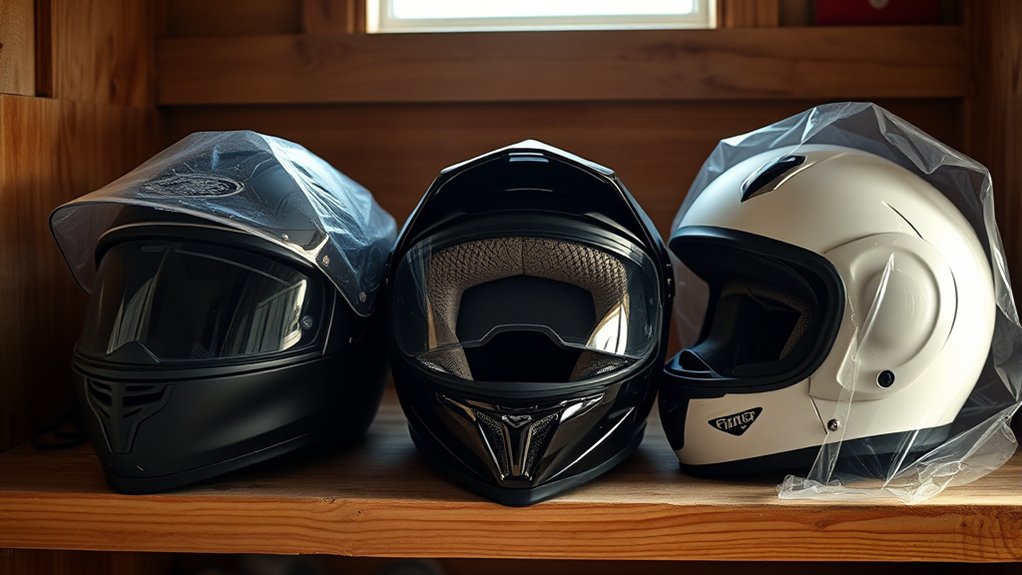
Proper storage plays a critical role in maintaining your motorcycle helmet’s protective capabilities over time. Ambient storage conditions markedly influence material integrity.
Follow these key guidelines:
- Store your helmet in a cool, dry place to guarantee peak humidity control. This helps prevent foam and adhesive deterioration.
- Avoid direct sunlight and heat sources above 60°C (140°F). Doing so protects shell resins and EPS foam from accelerated degradation.
- Maintain minimal strap tension during storage to prevent liner deformation. This preserves energy-absorption performance.
- Keep the helmet away from chemicals like sunscreen and alcohol-based cleaners. These substances weaken foam adhesives and padding.
Adhering to these practices extends your helmet’s effective lifespan by mitigating environmental and mechanical stress factors during ambient storage.
How Can You Tell If Your Helmet Is Unsafe to Use?
Regularly evaluating your helmet’s condition is essential to guarantee it remains safe for use. Begin with fit testing to confirm the helmet still fits snugly without excessive movement.
Inspect visual cues meticulously: look for cracks, dents, or crushed EPS foam inside the shell, as these indicate compromised impact absorption. Examine the liner for thinning, sticky residue, or hardening caused by UV or chemical exposure, signaling material degradation.
Assess strap integrity by checking for frayed fibers, brittle plastic buckles, or stretched components. Any weakness here undermines retention during a crash. Even if there’s no visible damage, replace your helmet immediately after any impact since EPS compression is often invisible but critical.
When and Why Should You Replace Your Helmet?

Because the structural integrity of a motorcycle helmet degrades over time and with impact, you should replace it immediately after any crash or hard hit.
Even if the shell appears intact, the EPS foam’s energy-absorbing capacity may be compromised, as impact indicators reveal.
Furthermore, consider these critical factors:
- Replace helmets every 3 to 5 years if used regularly. UV, heat, and sweat degrade materials.
- Store-only helmets may last 5 to 7 years, but conservative replacement is advised.
- Chemical exposure or visible damage like crushed foam, cracked shell, or deteriorated straps demands earlier replacement.
- Monitor fit adjustment needs, since changes affect protection and rider psychology, which impacts safety.
Always check manufacture dates and err on the side of caution to maintain peak impact protection and rider confidence.
Which Helmet Materials Last the Longest and Why?
Understanding when to replace your helmet involves more than just time and visible damage. The materials used in its construction play a key role in how long it maintains protective qualities.
Carbon fiber shells excel in long-term durability because of their superior structural stiffness and resistance to fatigue under repeated stress. Fiberglass composite shells offer excellent impact dispersion by layering woven fibers with resin. They outperform thermoplastic shells against prolonged impacts and UV exposure.
Shells made from ABS or polycarbonate thermoplastics, while tougher against single-impact puncture, degrade faster under UV and chemical exposure. The multi-density foam liners, especially advanced EPS variants, sustain foam performance longer by managing energy absorption efficiently. This is unlike single-density EPS that brittles over time.
Combining robust shell materials with high-quality multi-density liners guarantees peak long-term helmet safety.
What Do Manufacturers Say About Helmet Expiration?
You’ll notice that manufacturers usually set clear expiration guidelines based on how materials degrade over time and safety testing results. Most often, they suggest replacing your helmet every 3 to 5 years.
They also stress the importance of swapping out your helmet right after any crash, because even if it looks fine, the foam inside could be damaged in ways you can’t see—no matter how old the helmet is.
Since different brands and models have their own standards and timelines, it’s really important to check the instructions that come with your specific helmet. That way, you can be sure you’re getting the best protection possible.
Manufacturer Expiration Guidelines
Although manufacturers vary in their specific guidelines, most agree that motorcycle helmets should be replaced every 3 to 5 years from the manufacture date under normal use.
You’ll find that:
- Label visibility inside the helmet often indicates the manufacture date or explicit expiration, aiding precise service life calculation.
- Warranty implications may void if you ignore these guidelines or fail to replace helmets after significant impacts.
- Retail guidance typically aligns with these timelines, emphasizing regular inspection and adherence to manufacturer instructions.
- Environmental factors and professional use can necessitate earlier replacement, as degradation accelerates beyond the typical 3-5 years.
Recommended Replacement Timeline
Manufacturers and safety organizations generally recommend replacing motorcycle helmets every 3 to 5 years from the manufacture date under normal conditions. This timeline accounts for material degradation influenced by usage patterns and environmental factors.
Seasonal storage plays a critical role; helmets stored properly in controlled environments degrade slower than those exposed to heat, UV, or chemicals. Even if you use your helmet sparingly, aging of EPS foam and plastics reduces impact absorption over time.
Replacement reminders should prioritize the manufacture date stamped inside the helmet, not the purchase date, ensuring accurate lifespan tracking. Remember, any crash mandates immediate replacement regardless of visible damage.
While some riders may extend use beyond five years, adhering to manufacturer guidelines maximizes safety and maintains helmet integrity throughout its service life.
Safety Standards And Testing
Because helmet materials degrade over time, safety standards like DOT, ECE, and Snell certify impact performance only at the time of testing and don’t guarantee long-term durability. Manufacturers emphasize that standards evolution focuses on lab simulation of impact repeatability but can’t replicate real-world aging effects.
Certification tests assess initial impact resistance, not material degradation from UV, heat, or chemicals. Time-based replacement recommendations (3–5 years) reflect known EPS foam and retention system deterioration.
Post-impact helmet retirement is mandatory because invisible EPS foam crushing compromises protection. You should understand that while these standards provide baseline safety, they don’t address long-term service life.
Helmet expiration advice relies on scientific analysis of material aging beyond certification testing, underscoring why you must replace helmets periodically regardless of visible condition.
How to Maintain Your Helmet for Longer Use
To extend your helmet’s effective lifespan, you should store it in a cool, dry place away from direct sunlight and heat sources. These can accelerate degradation of the shell and foam.
Implement regular cleaning with mild soap and water. Avoid harsh solvents because they weaken plastics and adhesives.
Perform strap maintenance by inspecting straps, D-rings, and buckles for fraying or damage. Replace the helmet if fasteners fail or the fit becomes insecure.
Visor care is equally critical. Clean it gently to maintain clarity and avoid scratches that impair vision.
Always inspect the liner and shell for hairline cracks or brittleness. Remember, replacing your helmet every 3–5 years or immediately after significant impact guarantees peak protection since EPS foam degrades and loses energy absorption capacity over time.
Frequently Asked Questions
Can Helmet Expiration Vary by Helmet Brand or Model?
Yes, helmet expiration can vary markedly due to brand differences and model variations.
You’ll find that manufacturing changes, like shell materials and foam densities, directly affect a helmet’s service life.
Some brands use advanced composites extending lifespan, while others rely on basic materials needing earlier replacement.
Always check your helmet’s manual or manufacturer’s site since expiration recommendations adapt to these technical factors, ensuring your helmet maintains its protective integrity.
Are There Specific Helmet Certifications Affected by Helmet Age?
Yes, specific helmet certifications like ECE 22.06 and Snell are influenced by helmet age. Their safety standards rely on testing intervals that assume helmets are new or minimally aged.
While certification labels don’t require renewal, the protective performance can degrade over time. You should consider certification renewal with regard to replacing helmets, since aging materials may fail safety standards despite an unchanged certification label.
How Do Helmet Expiration Guidelines Differ Internationally?
You’ll find helmet expiration guidelines vary internationally due to differing safety standards.
In the U.S., manufacturers often recommend a 5-year service life to reduce material degradation risks.
Europe’s ECE standards focus on ongoing certification without a fixed expiry date. They emphasize replacing helmets after an impact or if there are signs of wear.
Meanwhile, Australia and New Zealand suggest a lifespan of 5 to 10 years based on exposure. These differences reflect regional climate, regulatory philosophy, and how material degradation affects helmet integrity over time.
Can Helmet Liners or Pads Be Replaced Separately?
Yes, you can replace removable liners and cheek pads separately to address sweat stains or wear without discarding the entire helmet.
Just remember, only comfort liners and fabric pads are replaceable. Foam degradation in the EPS liner isn’t fixable and means you must replace the helmet.
Always match replacement parts exactly by model and year to maintain the helmet’s fit, safety geometry, and certification integrity.
Do Helmets Expire Faster in Extreme Climates?
Yes, helmets do expire faster in extreme climates. Like a fragile clockwork, climate degradation accelerates wear through UV exposure, temperature cycling, and humidity.
These factors break down the shell and foam, compromising impact absorption even if the helmet seems intact.
You’ll need to replace helmets sooner in hot, sunny, or coastal areas due to accelerated material aging and corrosion, ensuring your protection remains reliable under harsher environmental stress.
Conclusion
Your motorcycle helmet isn’t just gear; it’s your lifeline, like a shield that weakens with time. Even if it looks fine, materials degrade, and protective properties diminish.
Regularly inspect for damage and replace your helmet every 5 years or sooner after impact. Proper storage and maintenance can extend its life, but don’t risk safety for longevity.
Remember, a helmet’s expiration isn’t just a date; it’s a critical safety threshold you can’t ignore.