How Many Cc Is A Harley 107 – Facts & Figures
The Harley Milwaukee Eight 107 engine displaces 1,750 cc (107 cubic inches), delivering about 92.5 horsepower and up to 112 lb-ft of torque. Its bore measures 3.937 inches with a 4.375-inch stroke, optimizing power and torque for touring performance.
The engine features advanced four-valve heads, dual spark plugs, and a hybrid air-oil cooling system that reduces temperature by 100°F. If you want to understand how upgrades and design influence its efficiency and ride quality, there’s more to explore.
What Is the Milwaukee-Eight 107 Engine Displacement?
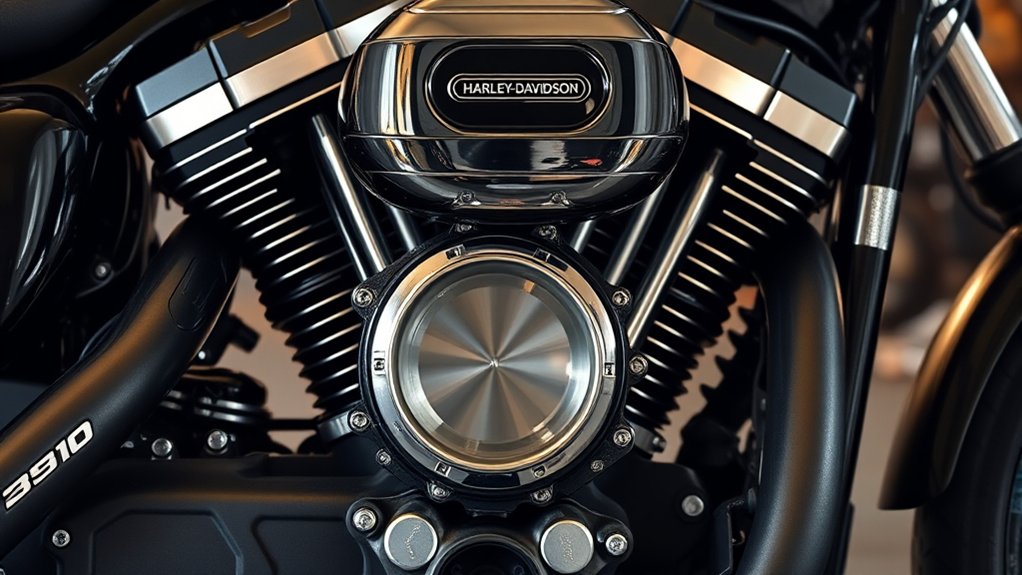
What exactly is the displacement of the Milwaukee-Eight 107 engine? Displacement refers to the total volume swept by all the pistons inside the cylinders, and for the Milwaukee-Eight 107, it measures 107 cubic inches.
Converted to metric units, this displacement is approximately 1,750 cc.
This figure defines the engine’s capacity to draw in air-fuel mixture for combustion, directly influencing its power output and torque characteristics.
The Milwaukee-Eight 107’s displacement places it in a competitive range for Harley-Davidson’s touring and cruiser motorcycles, balancing performance and reliability.
Understanding this displacement in cc helps you appreciate the engine’s capability without needing to convert units on your own.
This makes it straightforward when comparing with other engines or specifications.
What Bore and Stroke Mean for the 107 Engine
Knowing the Milwaukee-Eight 107’s displacement in cubic inches and cc sets the stage for understanding how its bore and stroke dimensions shape its performance. The 107 engine’s bore measures 3.937 inches, indicating the cylinder diameter, while its stroke is 4.375 inches, defining how far the piston travels inside the cylinder. These dimensions directly determine the engine’s displacement, which is approximately 107 cubic inches.
Specifically, the 107’s relatively longer stroke compared to its bore results in enhanced torque delivery and a broader power band. This means you get strong low-end power and smoother acceleration.
Understanding bore and stroke together helps you grasp how the engine balances power output and efficiency.
How the Milwaukee-Eight 107 Compares to Other Engines
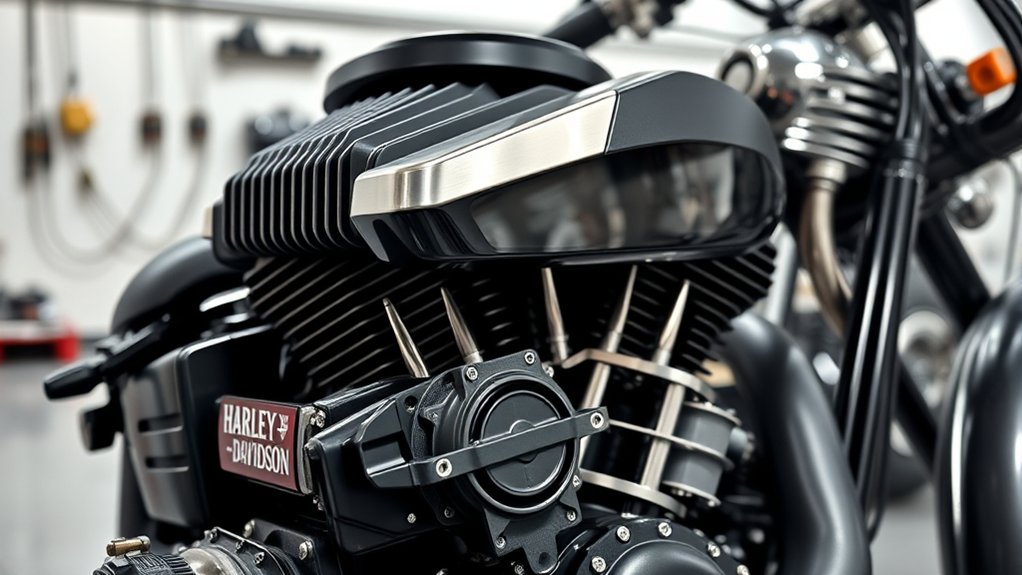
You’ll find the Milwaukee-Eight 107 delivers 1,750 cc of displacement, which strikes a nice balance between power and torque.
Now, when you compare it to the bigger 114 engine, the 107 does have a bit less output.
But don’t let that fool you—it still offers strong performance that’s perfect for everyday riding.
Knowing these differences makes it easier to see how the 107 measures up against earlier Harley engines.
Displacement and Torque Comparison
Although the Milwaukee-Eight 107 engine shares a displacement close to 1,750 cc (107 cubic inches), it delivers up to 112 lb⋅ft of torque, roughly 10% more than the Twin Cam 110.
This increase comes from the Milwaukee-Eight’s improved bore and stroke dimensions, which are 3.937 inches and 4.375 inches respectively. These changes optimize displacement and combustion efficiency.
You’ll notice the engine’s design focuses on enhanced airflow and higher compression ratios. These features help achieve the torque boost without increasing displacement.
When you compare torque output, the Milwaukee-Eight 107 really stands out by offering a great balance of power and responsiveness.
This makes it a technically advanced option within Harley’s engine lineup. It emphasizes improved torque delivery while maintaining the familiar 107 cubic inch displacement standard.
Performance Versus Previous Models
When comparing the Milwaukee-Eight 107 to previous Harley engines, you’ll notice it delivers between 108 and 112 lb⋅ft of torque. This marks a notable improvement over earlier models like the Twin Cam 110. That’s roughly 10% more torque, which directly boosts acceleration and ride responsiveness.
The Milwaukee-Eight 107 accelerates 11% faster from 0-60 mph, thanks to its optimized intake and exhaust flow capacity. This flow capacity is 50% greater than its predecessors, which really makes a difference.
Producing approximately 92.5 hp at 5020 rpm, this engine balances power and efficiency better than the Twin Cam series. Its advanced design not only boosts raw torque but also improves thermal management and overall performance.
Design Features That Boost 107 Engine Performance and Torque
Because performance and torque are critical for the Harley 107 engine, its design incorporates several key features to maximize both. The engine’s higher compression ratio enhances combustion efficiency, which directly increases torque and acceleration.
Performance and torque are maximized through a higher compression ratio for enhanced combustion and acceleration.
Four-valve cylinder heads improve airflow capacity by 50%, allowing more air-fuel mixture into the combustion chamber and boosting power output.
The flat, four-valve combustion chamber paired with dual spark plugs ensures more complete and efficient combustion. This translates into increased torque you can really feel.
Plus, lightweight pistons with low-tension rings reduce internal friction, helping the engine run smoother and more efficiently.
The redesigned crankcase adds strength without adding unnecessary weight.
Together, these elements optimize the engine’s mechanical efficiency. The result? Strong, reliable torque and improved overall performance that riders notice instantly.
Cooling Systems in the Milwaukee-Eight 107 Engine
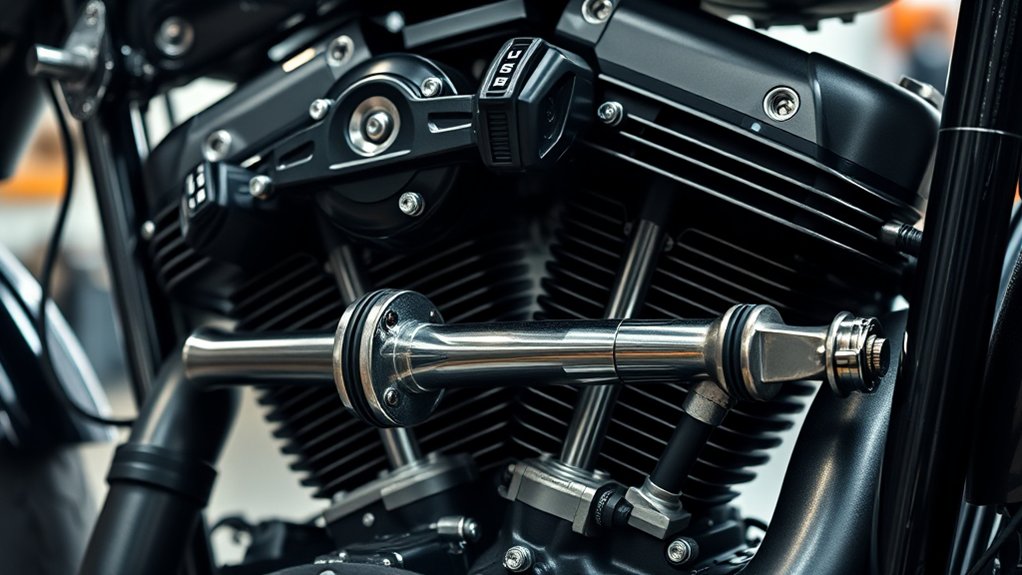
Effective heat management is crucial for the Milwaukee-Eight 107 engine’s performance and longevity. This engine uses a combination of air-cooled and oil-cooled cylinder heads to keep temperatures just right under different conditions.
In Twin-Cooled models, liquid cooling zeroes in on critical areas, especially around the cylinder heads and exhaust valves. This helps prevent overheating and keeps performance steady.
The system includes a chin radiator and an oil pump cooling mechanism. Together, they cut down overall engine heat by about 100°F.
This smart cooling approach boosts durability and reduces heat buildup that might make the ride uncomfortable.
How the 107 Engine Improves Comfort and Heat Management
Although the Milwaukee-Eight 107 engine packs impressive power, it also prioritizes rider comfort by managing heat intelligently. Its advanced heat management system ensures the engine runs cooler, enhancing your riding experience.
The Milwaukee-Eight 107 expertly balances powerful performance with advanced heat management for a cooler, more comfortable ride.
Here’s how the Milwaukee-Eight 107 improves comfort and heat management:
- The enhanced cooling system reduces engine heat by up to 100°F using strategic air and oil cooling.
- Redesigned crankcase and improved airflow dissipate heat more efficiently, preventing overheating.
- Relocated exhaust components minimize heat transfer to you, reducing discomfort during long rides.
- Twin-Cooled models circulate water and antifreeze around exhaust valves, optimizing heat regulation and engine longevity.
You’ll appreciate how these technical improvements keep the engine running cooler while maintaining high torque without sacrificing comfort. It’s all designed to make your ride smoother and more enjoyable.
Common Upgrades for the Milwaukee-Eight 107 Engine
You can boost your Milwaukee-Eight 107’s displacement with bore upgrade kits that increase it to 114 cc, giving you more power and torque. It’s a straightforward way to get that extra punch out of your engine.
Along with that, enhancing performance often means upgrading the air intake and exhaust systems. Improving airflow and efficiency here can make a noticeable difference.
Together, these modifications set the stage for further tuning and help you get the most out of your engine’s output.
Bore Upgrade Kits
When upgrading your Milwaukee-Eight 107 engine, bore upgrade kits offer a straightforward way to increase displacement by enlarging the cylinder bore diameter from 3.937 inches to about 4.000 inches.
This modification raises the engine displacement from 107 cubic inches (1750 cc) to roughly 114 cubic inches (1870 cc).
Bore upgrade kits replace the pistons and cylinders with larger components while keeping the stroke unchanged. Here’s what you need to know about bore upgrade kits:
- They increase displacement by enlarging the cylinder bore diameter.
- Pistons and cylinders are swapped for bigger, compatible parts.
- Stroke length remains the same, focusing solely on bore size.
- The result is a measurable boost in horsepower and torque without engine replacement.
These kits provide a practical, precise upgrade path for your Milwaukee-Eight 107. It’s a smart way to get more power without going through a full engine swap.
Performance Enhancement Options
Bore upgrade kits set the foundation for boosting your Milwaukee-Eight 107’s displacement. But to fully capitalize on these gains, you’ll want to explore additional performance enhancement options.
Replacing stock pistons and cylinders with larger, precision-machined components is a common upgrade that raises displacement and torque.
You can further optimize performance by installing aftermarket camshafts designed to improve valve timing and lift, maximizing airflow.
Increasing compression ratios through head milling or high-compression pistons also elevates engine efficiency and output.
However, these modifications require precise tuning to guarantee safe operation and reliability.
Using quality parts and professional calibration is critical when upgrading displacement and performance.
This approach enables your Harley to deliver consistent power and responsiveness after the upgrade.
How 107 Engine Specs Affect Fuel Efficiency and Power
Although the Harley 107 engine boasts a larger displacement of approximately 1,750 cc, it maintains impressive fuel efficiency through advanced design features like four-valve heads and refined airflow. You’ll notice how these specs directly impact both fuel economy and power output. Here’s what matters most:
- Displacement: The 1,750 cc size increases torque, enhancing acceleration without sacrificing efficiency.
- Horsepower: Delivering around 92.5 hp at 5,020 rpm, it balances strong performance with controlled fuel use.
- Cooling system: Its advanced cooling technology prevents overheating, sustaining ideal combustion and fuel consumption.
- Airflow and combustion: Four-valve heads and a larger bore improve air intake and fuel burn, maximizing power while minimizing waste.
Together, these elements ensure you get a powerful ride that’s also fuel-conscious. It’s all about finding that sweet spot between power and efficiency.
Harley Models That Use the Milwaukee-Eight 107 Engine
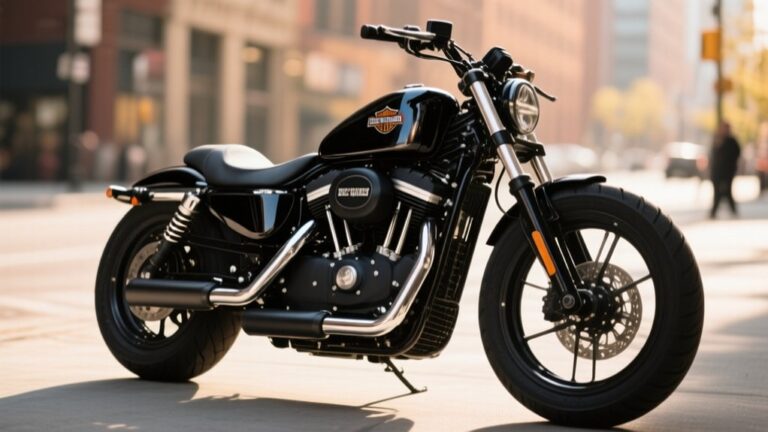
If you’re looking to experience the power and efficiency of the Milwaukee-Eight 107 engine, several Harley-Davidson models incorporate this 1,750 cc powerhouse. The Milwaukee-Eight 107, with a displacement of 107 cubic inches, is standard in key touring models like the Street Glide, Road Glide, and Ultra Limited.
Introduced in 2017, these models benefit from the engine’s four-valve cylinder heads and dual spark plugs, which enhance combustion efficiency. Producing roughly 92.5 horsepower and between 108 to 112 lb-ft of torque, the 107 engine delivers robust performance tailored for long-distance touring.
If you want a Harley that balances power and reliability, focusing on these touring models equipped with the Milwaukee-Eight 107 engine ensures you get ideal displacement and technical sophistication for demanding road conditions. It’s a solid choice for riders who want both strength and smooth performance.
Frequently asked questions
What Is the Maintenance Schedule for the Milwaukee-Eight 107 Engine?
You should change the oil every 10,000 miles or once a year, whichever comes first.
Replace the spark plugs every 10,000 miles to keep the engine running smoothly.
You won’t need to adjust valve lash since it’s factory-set for life.
Inspect the drive belt, clutch, and other drive components at every 10,000-mile interval.
If you have a Twin-Cooled model, check the cooling system regularly to guarantee proper temperature control.
It’s a good way to keep everything running just right.
How Loud Is the Harley 107 Engine Compared to Other Models?
You’ll find the Harley 107 engine produces a moderate exhaust level, around 80-85 decibels at typical riding speeds. It’s quieter than larger Milwaukee-Eight models like the 114 or 117 and less aggressive than custom or aftermarket exhaust setups.
The 107 balances a deep, throaty tone with effective noise suppression, meeting EPA standards.
Compared to other cruisers, it’s louder than standard Japanese bikes but more refined and less intrusive than high-performance Harleys.
What Type of Fuel Is Recommended for the Milwaukee-Eight 107?
You might think regular gas works fine, but the Milwaukee-Eight 107 actually requires premium unleaded fuel with at least a 91 octane rating to run ideally.
Using lower octane fuel can cause knocking, which reduces engine efficiency and can hurt performance.
It’s best to stick to fuel that meets API SN or SP specs.
Also, avoid ethanol blends above 10%.
Higher ethanol content can degrade engine components over time and mess with smooth operation.
Are There Any Known Reliability Issues With the 107 Engine?
You won’t find widespread reliability issues with the Harley 107 engine. It’s built with a factory-set valve lash designed to be maintenance-free, which boosts durability.
Harley’s extensive testing confirms it performs consistently under normal use.
Just be cautious with aftermarket modifications. They can introduce problems not present in the stock engine.
If you maintain it properly, the 107 engine should serve you reliably for many miles.
Can the Milwaukee-Eight 107 Engine Be Used in Custom Builds?
Yes, you can absolutely use the Milwaukee-Eight 107 engine in custom builds. Despite its compact size, it delivers robust power and offers modular design flexibility.
This means you can easily modify displacement with big bore kits or other upgrades.
Its reliable construction supports high-performance tuning, making it a practical choice for personalized Harley projects.
You’ll find it balances power and adaptability, perfect for crafting a unique, high-functioning motorcycle.
Final Thought
Think of the Milwaukee-Eight 107 engine as the heart of your Harley. It’s precise, powerful, and finely tuned. Its 1,746 cc displacement fuels every ride with reliable torque and efficiency.
Smart design features manage heat and enhance comfort. Understanding its bore, stroke, and cooling systems helps you optimize performance and upgrades.
Embrace this engine’s balance of strength and control. You’ll get a ride that’s both technically sound and thrillingly alive.