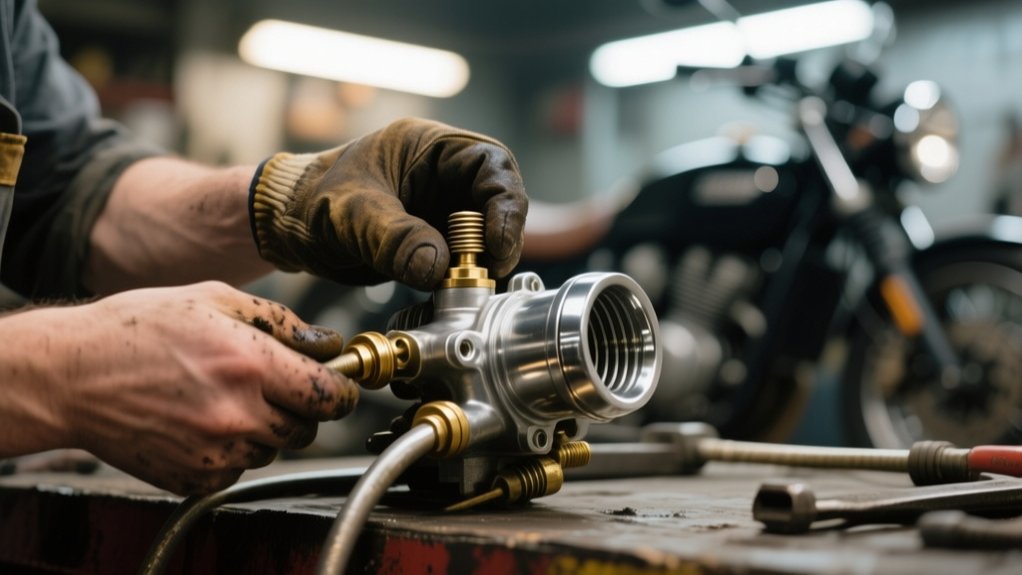
How To Adjust Motorcycle Carburetor – Quick Guide
Start with a warm engine, choke off, and the air filter in place. Then use a screwdriver to find the idle speed screw and mixture screw on the carburetor. Make only 1/4-turn changes.
Turn the idle screw to set RPM to spec, usually 1,000–1,500. Next, adjust the mixture for the smoothest, highest idle. Then recheck throttle return, vacuum leaks, and cable binding.
Finally, road-test and fine-tune for cleaner response and stronger pull.
What You Need Before Tuning a Motorcycle Carburetor
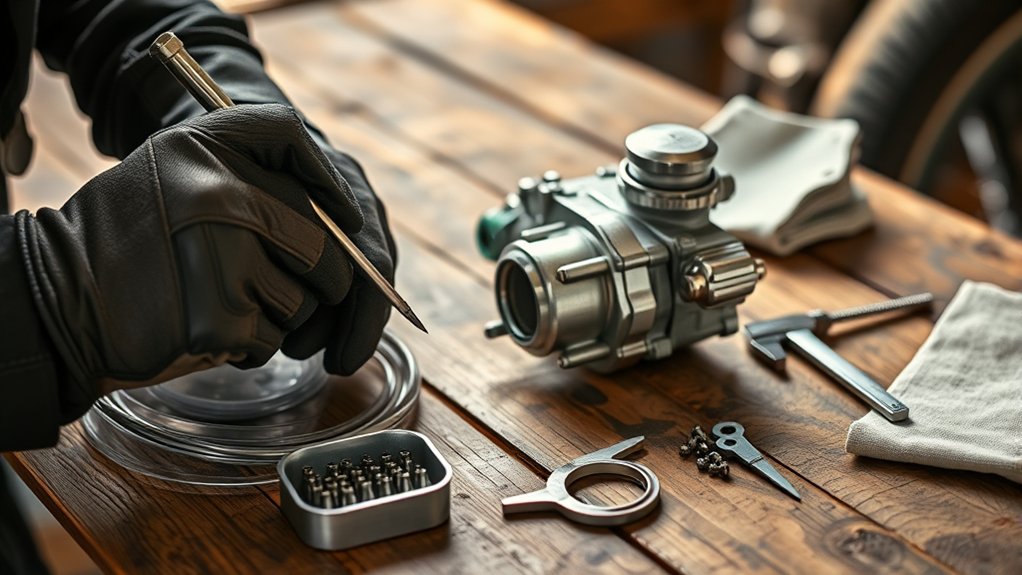
Before you touch the carburetor, gather the right tools.
Gather the right tools before you touch the carburetor.
You’ll need a flat and Phillips screwdriver set, plus a wrench or socket set.
If you have them, use a vacuum gauge and a tachometer for accurate mixture and idle adjustments.
Set up in a well-ventilated area, and wear gloves and eye protection.
Make sure the engine is cooled or warmed according to the service procedure.
Keep the owner’s manual handy so you can confirm the specified idle RPM and any factory screw settings.
Before tuning, verify the choke is off.
Also check that the throttle cables move freely and the intake boots seal without leaks.
Finally, you’ll need access to the carburetor layout.
Identify the idle screw and idle mixture screw before you begin tuning.
Find the Motorcycle Carburetor and Idle Screws
On most 150cc bikes, the carburetor sits directly under the air filter housing on top of the engine. So first, remove the airbox or the filter cover so you can actually reach it.
Next, find the idle speed screw. It’s usually the larger external screw on the carb body, and it controls the throttle opening when the bike is at rest.
If your carb has a mixture (fuel/air) screw too, look for a smaller flat-head screw near the intake throat, typically on the front or side of the carb.
Carburetor Location
Look under the air filter housing to find the carburetor on most 150cc motorcycles. It usually sits on top of the engine, between the cylinder head and the airbox.
Remove the air filter cover and element, then inspect the carb body. Check the throttle linkage and vacuum boots too.
You’ll usually spot the idle screw as a larger external stop screw. The smaller mixture screws typically sit on the front or side.
- Confirm the choke is fully off.
- Check that the throttle cables move freely.
- Make sure the throttle plate returns to the idle stop.
This layout helps you identify the correct adjustment points fast. When you know where the carburetor lives, you can work efficiently and avoid guessing.
Idle Screw Access
Once you’ve exposed the carburetor by removing the air cleaner cover and filter, you can zero in on the idle screw.
On most 150cc bikes, the carb sits under the airbox. The throttle stop adjustment screw is usually on the side or front of the carb body near the throttle linkage.
It’s larger than the small idle mixture screw. Trace the throttle cable to the carb top to confirm which screw limits the throttle plate opening and controls idle speed.
If your bike has twin or triple carbs, locate each idle screw between the carb bodies, often between cylinders.
Before any idle adjustment, make sure the choke is off and the linkage moves freely. This lets the throttle plate close fully against the bore.
Warm Up the Engine Before Adjusting
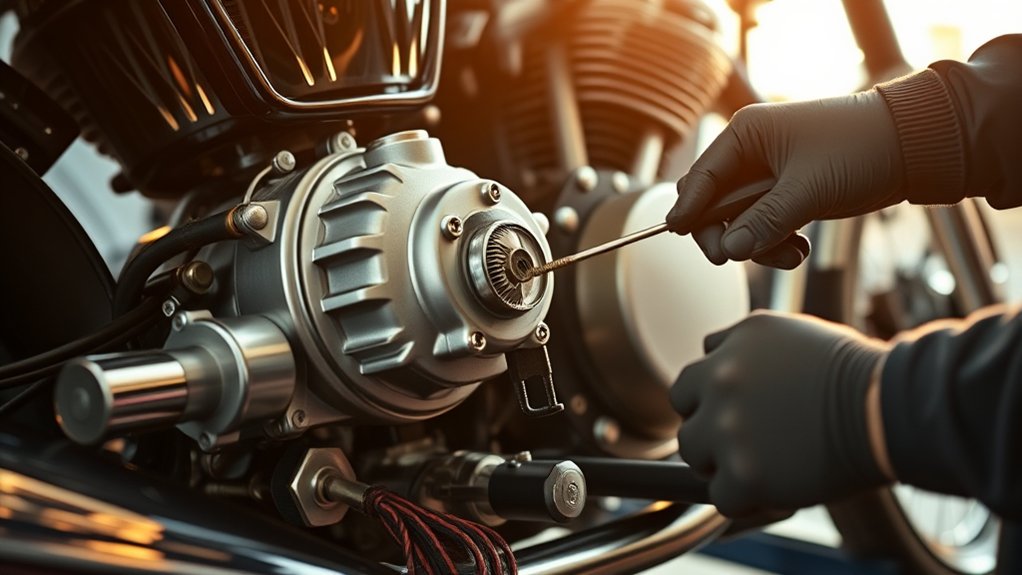
Let the motorcycle idle until it reaches normal operating temperature before you adjust the carburetor. Usually, this takes about 5–10 minutes on a 150cc engine.
Warm the engine so the carburetor and mixture behave like they do under real running conditions. Fuel vaporization and idle characteristics change a lot between cold and hot states, so warmed-up engines need smaller mixture tweaks.
Always do idle and mixture tuning with the engine at operating temperature. This helps prevent over-rich choke compensation from masking the true settings. If it’s cold outside, double-check that the choke is fully off before making final carburetor adjustments.
- Confirm normal heat soak.
- Make one adjustment at a time.
- Wait 30 seconds, then recheck.
Set the Idle Speed to Spec
With the engine fully warm and the choke off, find the idle speed screw. Then adjust it in small increments to control the RPM. Use a tachometer to set the idle within the manufacturer’s specified range—often around 1,000–1,500 rpm. After each adjustment, let the engine stabilize before making another change.
If the idle won’t settle properly, double-check that the throttle linkage isn’t binding. Also confirm that the idle screw allows the throttle plate to close fully.
Idle Speed Adjustment
Warm the engine to normal operating temperature before you adjust the idle speed. This helps the throttle plate and fuel mixture reflect real running conditions.
Locate the idle speed screw on the carburetor body. It’s usually between the throttle cables.
Turn the screw clockwise to raise RPM. Turn it counterclockwise to lower it.
Use a tachometer and set the idle speed to the manufacturer’s 150cc spec. It’s typically 1,200 to 1,500 rpm for stable running.
Make changes in about 1/4-turn steps. Wait 30 seconds, then recheck.
- Confirm the engine settles smoothly after each change.
- Watch for throttle return without binding or choke engagement.
- Reinstall the air filter housing before final testing.
Correct Rpm Setting
Set the idle speed to the manufacturer’s specified RPM using a tachometer, not guesswork.
Warm the engine to normal operating temperature first, since a cold engine needs a richer air-fuel mixture and will read low.
Make sure the choke is fully off and the throttle cables aren’t binding.
This ensures the adjustment screw can close the throttle plate completely.
Turn the idle speed screw clockwise to raise RPM or counterclockwise to lower it.
Change it in 1/4-turn steps, then wait about 30 seconds after each adjustment for the engine to stabilize.
Set the idle to the spec in your owner’s manual.
Many 150cc bikes are often around 1,200 to 1,500 rpm.
Reinstall the air cleaner, then road test it.
Confirm it returns to idle correctly.
Adjust the Motorcycle Carburetor Mixture Screws
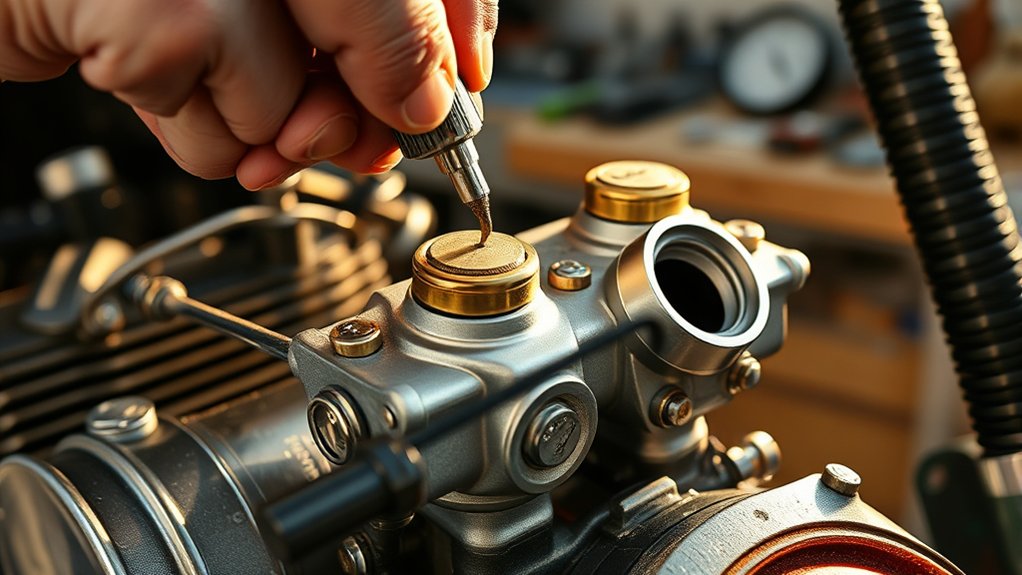
Once the engine is warm and running, locate the idle or mixture screw on the front of each carburetor. With the airbox removed, it’s usually a flat-head screw.
On multi-carb setups, you may have one screw per carburetor, or a screw bank for each cylinder. Back each adjustment screw out 1/4 turn to set a lean baseline.
Then turn it in slowly and equally to change the amount of fuel. Make each change in 1/4-turn steps.
Wait about 30 seconds after every tweak. Stop at the smoothest, highest idle.
If you have a vacuum gauge or synchronizer, use it to match settings across carbs. Unequal screws can cause rough running and weak response.
Once you find the best mixture, reset idle speed to spec. Then recheck the screws because RPM changes can shift balance.
Fix High Idle, Choke, and Throttle Return
If your idle is stuck around 3000 rpm, start by checking the throttle cable and linkage. Look for binding or too little free play so the throttle can fully close against the idle stop.
If it can’t close, the idle screw won’t be able to bring the RPM down.
Next, make sure the choke lever is fully off, since even partial enrichment can raise idle once the engine warms.
Then inspect the throttle return spring. It should be present, hooked correctly, and under firm tension so the throttle plate snaps shut.
After these mechanical checks, set the adjustment screw to the manufacturer’s idle spec. Do this with the engine at operating temperature, usually about 800–1200 rpm on many 150cc bikes.
If the idle still wanders, fine-tune the mixture. Aim for smooth running and clean throttle response.
Check for Vacuum Leaks and Cable Binding
Even with the idle screw set correctly, a vacuum leak can still push the idle up by several hundred RPM. Inspect the intake boots, carb-to-engine seals, and all vacuum hoses for cracks, tears, loose clamps, or poor seating.
A vacuum leak can raise idle by several hundred RPM, even when the idle screw is set correctly.
Warm the engine, then mist carb cleaner or propane around the boots and carb bases. If RPM changes, you’ve found the leak.
Next, check the throttle and choke cables for free movement and correct routing. A binding cable can hold the plates open, so confirm the return springs are seated too.
- Re-seat brittle hoses and tighten clamps.
- Verify the fuel petcock, intake manifold, and vacuum advance lines.
- Confirm the adjustment screw isn’t masking an air and fuel issue.
Road-Test and Fine-Tune the Carburetor
With the engine warmed to normal operating temperature, take the bike on a varied road test. Watch for symptoms that reveal whether the main jet or needle clip needs adjustment.
Use gentle throttle for a baseline, then steady cruise, and finally full-throttle pulls. Note RPM with a tachometer so you can compare changes.
A lean setup usually causes hesitation, pinging, or bogging under load. A rich setup shows flat spots, black smoke, or a noticeable fuel smell.
Make one notch change at a time. Then repeat the same route until acceleration feels smooth and response is immediate.
If idle shifts after a main-jet change, return to the warm engine. Correct it with the adjustment screws, changing fuel and air in 30 to 60 second intervals.
Recheck everything after a 10 to 15 minute ride.
Frequently Asked Questions
How Do I Know if My Carburetor Jets Need Cleaning?
You’ll know your carburetor jets need cleaning if your engine idles poorly, stumbles on throttle, or smells strongly of fuel.
Black, sooty spark plugs also point to rich, dirty jets.
If it hesitates at mid-throttle, starts hard after sitting, or the float bowl drains slowly, debris is likely blocking fuel flow.
Pull the jets and check for varnish, gum, or pitting.
Cleaning should restore smooth idle and crisp throttle response.
What Symptoms Indicate a Worn Carburetor Float Needle?
You’ll notice a worn carburetor float needle when fuel overflows, drips from the overflow tube, or leaks after shutdown.
You may also see a rich idle, black sooty plugs, a fuel smell, or bogging on throttle tip-in.
You might even find fuel in the airbox.
If the float bowl level reads too high or won’t stay stable, the needle isn’t sealing.
Inspect the needle tip, the seat, and the float height, then replace any worn parts.
Can Aftermarket Exhaust Affect Carburetor Adjustment?
Yes, an aftermarket exhaust can definitely change your carburetor setup.
For example, if you bolt on a free-flow pipe to your 150cc bike, it often runs leaner and can cause midrange hesitation.
In most cases, you’ll need to rejet the main jet by about 1–2 sizes.
Then fine-tune the pilot screw and the needle if it still feels off.
Test the bike hot, under load, and confirm using plug color or AFR before you ride hard.
How Often Should Motorcycle Carburetors Be Synchronized?
You should synchronize your motorcycle carburetors every 3,000–6,000 km. Most riders do it at each oil change, or about twice a year.
You should also resync them if you notice uneven idle or rough running. Do it if throttle response feels off, or after any intake work like removing the air filter, servicing the carbs, or replacing intake boots.
If you change jets, adjust the mixture, or one cylinder starts acting differently, sync them again. Make sure the engine is fully warmed up before you do.
What Causes Carburetor Icing in Cold Weather?
You’re seeing a tiny winter trap.
Moist air slips through the carburetor, chills in the venturi and throttle plate, and the pressure drop plus fuel vaporization can freeze that moisture on the walls.
That ice narrows airflow, especially in humid weather and at partial throttle.
You’ll notice power loss, a rough idle, or stalling.
Open the throttle or use carb heat, and you’ll often melt the blockage fast.
Conclusion
You’ve just done one of the most powerful little tune-ups on a motorcycle. With the idle set, mixture screws dialed in, and leaks ruled out, your carb should respond like a perfectly synced machine—crisp, smooth, and ready to roar.
If the engine still stumbles, don’t guess. Fine-tune again and verify every screw, cable, and hose.
A correctly adjusted carb can transform a rough ride into an unbelievably clean, effortless throttle response.