How To Get A Title For A Motorcycle – Made Easy
Start by locating the motorcycle’s VIN on the steering neck, frame, or under the seat. Then compare it with the bill of sale and any old paperwork.
Run a VIN check for theft, salvage, or liens before you apply. Next, gather your ID, bill of sale, insurance, and any inspection forms your DMV needs.
If you don’t have a title, ask about a duplicate, bonded title, or a special no-title process. There’s more to know.
Check Your VIN and Title Status
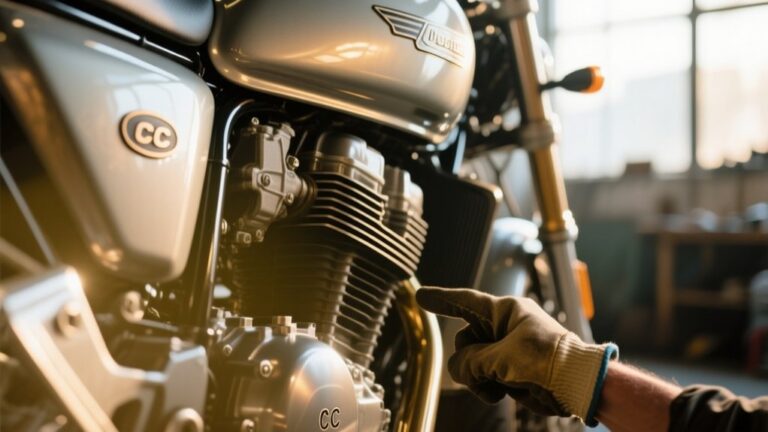
Start by locating the motorcycle’s VIN, usually on the steering neck, frame near the engine, or under the seat.
Locate the motorcycle’s VIN on the steering neck, frame near the engine, or under the seat.
Then run it through a NICB, Carfax, or state DMV VIN check to see whether the bike is reported stolen, salvaged, or tied to any liens.
Next, compare that VIN with your bill of sale, registration, and any previous title so every number matches.
If the bike was last titled in another state, use that state’s online title search or call its DMV to confirm the title status, the registered owner, and whether a duplicate title is possible.
If the VIN is missing or unreadable, expect a physical inspection or new assignment before you can move forward.
Keep copies of any discrepancies for your records.
Gather the Paperwork DMV Needs
Gather all the documents the DMV will want before you apply.
Keep them organized so you can move through the process quickly.
Record the motorcycle’s VIN from the steering neck, frame, or paperwork.
The DMV uses it to verify the bike and check title records.
Bring a signed bill of sale.
Also bring your government-issued photo ID and any proof of ownership you have.
This can include previous registration or a notarized affidavit if the motorcycle title is missing.
Complete the state title application.
If required, add the odometer reading.
Be ready to pay title fees and taxes.
If your state asks for it, schedule a VIN inspection or police verification.
This is for an out-of-state, rebuilt, donor, or untitled bike to confirm the VIN is clear and the motorcycle isn’t stolen.
Get a Duplicate Motorcycle Title
If your motorcycle title is lost, stolen, or damaged, request a duplicate from the state motor vehicle agency where the bike was last titled.
Start by completing that state’s replacement title form and gather your ID, the motorcycle VIN, and any registration number you have.
Start by completing the replacement title form and gathering your ID, VIN, and registration number.
If you’re the last registered owner, many states let you apply online or by mail through the Department of Motor Vehicles.
Expect a typical fee of about $15–$40.
Some states may also require a VIN inspection or a notarized affidavit before they issue the duplicate title.
If a lienholder is listed, include their information or get their consent.
Processing usually takes 2–6 weeks, though faster service is sometimes available.
Apply for a Bonded Motorcycle Title
If your state DMV won’t issue a regular title because the ownership trail is broken, you may be able to apply for a bonded motorcycle title instead.
In most cases, you’ll need to submit a title application, proof of ownership, a VIN inspection, a government-issued ID, and a reasonable value estimate. After that, you’ll buy a surety bond from a licensed provider.
Once you turn in the bond along with your DMV paperwork, the state can issue a bonded title. That bonded title usually helps you move forward and work toward getting a clear title later.
Bonded Title Basics
When a motorcycle’s ownership trail is broken, a bonded title can help you clean things up. It lets you get a legal title in your name.
You’ll buy a surety bond, usually set at 1.5 times the bike’s appraised value. Or it may be based on the amount your state requires.
That bond protects any prior owner who later proves a valid claim. To apply, you typically submit a title application, bill of sale, and VIN inspection.
You’ll also need proof you tried to get a regular title. Plus, you’ll provide identification and the bond to your DMV or title agency.
Keep in mind that eligibility rules, fees, and waiting periods vary by state. Bonded titles usually cost more than a duplicate title.
Still, they’re often your best option when the ownership record is missing or broken.
Bond Purchase Steps
Start by confirming your state allows bonded titles. Also check the exact bond amount and eligibility rules, since they can vary.
Next, get a professional appraisal or use a DMV value guide to find your motorcycle’s appraised value. The surety bond premium usually depends on that number.
Then buy the surety bond from a licensed bond or insurance company. Purchase it in the amount your DMV requires, often 1.5 times the motorcycle’s value.
Make sure the bond lists the state DMV as obligee and you as principal. Then complete the bonded title packet with your bill of sale, VIN inspection, affidavits, ID, and the bond.
Finally, pay the fees. After approval, keep your bond records during the conditional period.
Get a Vermont Motorcycle Title for Older Bikes
For older motorcycles, Vermont can be a practical way to get a title even if your home state won’t issue one easily.
You apply through Vermont’s registration process for out-of-state or never-titled bikes.
Submit the DMV form, a bill of sale, and any proof you have showing possession.
You’ll also need VIN verification, and Vermont may inspect the bike or run a VIN history check.
This is to confirm it isn’t stolen or branded.
Pay the title, registration, and sales tax fees, then wait for your Vermont title.
If your state accepts Vermont paperwork, you can often use that title to get your local one.
This option works well for 15-year-old motorcycles and older, but confirm reciprocity first.
Handle Rebuilt or Custom Motorcycles
Because rebuilt and custom motorcycles usually need extra proof, you’ll often have to show a VIN inspection, receipts for major parts, and a signed bill of sale or statement of facts. This should explain how the bike was assembled.
If the bike is rebuilt, expect the DMV to review salvage paperwork and rebuild inspection results. It may also require any safety or emissions checks before issuing a branded title.
If the original VIN is missing or damaged, you may need a state-assigned VIN after an official inspection. For a custom build, gather proof of purchase for the engine, frame, and transmission, plus a notarized affidavit from the builder or seller.
When you can’t fully document ownership, apply for a bonded title to establish your claim. Then you can move forward.
What to Do When You Only Have a Bill of Sale
If you only have a bill of sale, it’s good to know that it usually isn’t enough by itself to get a motorcycle titled.
Still, it should contain key details—like the buyer and seller’s information, the VIN, the purchase price, the date of sale, and both parties’ signatures.
Next, check the VIN to make sure the motorcycle isn’t stolen and isn’t tied to a lien, because either one can derail the process.
After that, use the bill of sale along with any supporting paperwork you have to apply for the title through your DMV.
Bill Of Sale Limits
A bill of sale can help, but it usually won’t get you a motorcycle title on its own.
A bill of sale alone is usually only enough as backup proof when you apply for a new title or start the bonded title process.
If the seller never gave you the original title, get a notarized bill of sale that includes both names, the VIN, price, date, and signatures.
Many DMVs also want prior registration, insurance papers, ID, and a VIN inspection before they’ll move forward.
If you’re filing for a bonded title, expect to buy a surety bond set by your state.
Then keep the bill of sale with your paperwork.
If it’s your only document, ask the DMV about a no-title procedure.
Find The VIN
Start by tracking down the motorcycle’s VIN and writing it down exactly as it appears.
You can usually locate the VIN on the steering neck, frame near the engine, under the gas tank, on the frame backbone, or the engine case.
If you only have a bill of sale, use that VIN to check the NICB, state DMV, or Carfax for theft reports or liens.
| Spot | What to Check | Why It Matters |
|---|---|---|
| Steering neck | Stamped VIN | Common primary location |
| Frame/engine area | Matching numbers | Confirms identity |
| Bill of sale | Listed VIN | Helps with searches |
If the numbers don’t match, get a VIN inspection or police verification form.
If no VIN exists, ask your DMV about assignment.
Keep photos and records.
Apply For Title
When you only have a bill of sale, first run the motorcycle’s VIN through the NICB or your state DMV records to make sure it isn’t stolen or liened. Then, check whether your state will accept a notarized bill of sale with a title application and ID.
If it does, submit the form and fees. These usually run about $15–$100.
If the seller lost the original, contact the last state that titled the bike. Ask for a duplicate title using the VIN and the seller’s name.
If ownership is broken, you may need a certified statement, VIN inspection, and a bonded title. Keep every bill of sale, email, report, and DMV receipt to support your claim.
Resolve Theft, Lien, and Ownership Claims
If the VIN or title records show the motorcycle is stolen or has an active lien, contact law enforcement and the lienholder right away. You can’t get a clean title until the issue is resolved.
Check a VIN report to confirm whether it’s reported stolen, branded salvage, or tied to a lien. If a third party challenges ownership, collect a signed bill of sale, payment proof, seller messages, VIN inspection, and notarized affidavits.
Check a VIN report for stolen, salvage, or lien issues, then gather proof if ownership is challenged.
Submit the documents to the DMV for review. Once the ownership trail is broken, you may need a bonded title to protect against future claims.
- Run a VIN check
- Notify police and lienholder
- Gather ownership records
- File bond documents
- Consider a quiet title action
Register the Motorcycle and Get Insured
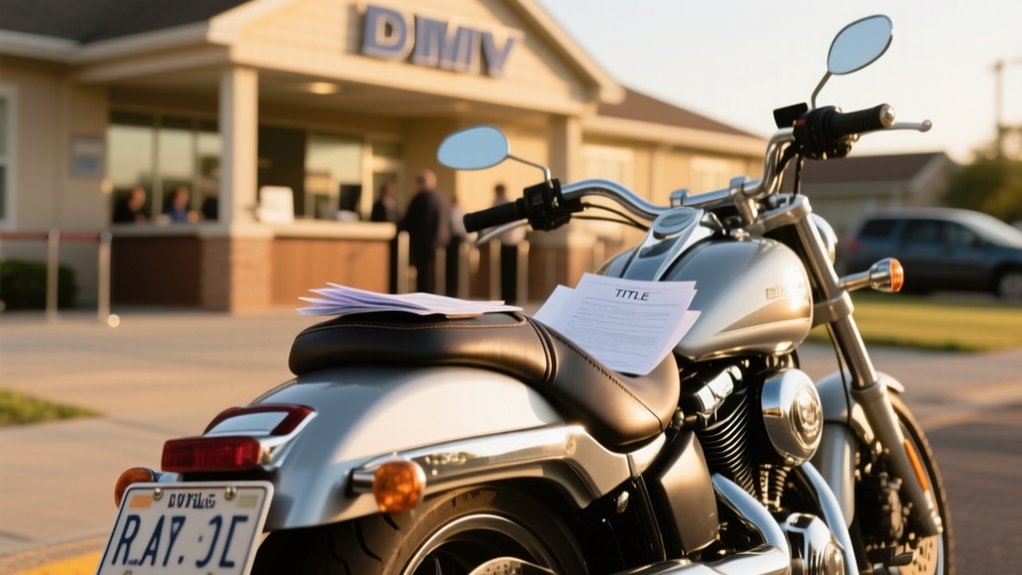
Once you have a valid title—original, duplicate, or bonded—you can register the motorcycle and get it insured. At the DMV, bring your title, a completed registration form, your ID, proof of residency, and any VIN verification. You’ll also need proof of insurance that meets your state’s minimum liability limits before they issue plates.
| Item | Why it matters | Tip |
|---|---|---|
| title | proves ownership | Keep it ready |
| registration | gets legal plates | Apply promptly |
| proof of insurance | satisfies DMV rules | Carry it on the bike |
Pay the required fees and sales tax. Costs often range from $15 to $200. If you mail your application, processing can take 2–6 weeks.
After registration, keep your insurance card current. Renew both on time.
Avoid Common Motorcycle Title Mistakes
Before you buy a motorcycle, check the VIN on the steering neck or engine case. Then run a VIN history report through NICB or Carfax.
A hidden theft record, salvage brand, or lien can derail your title transfer.
Don’t trust a bill of sale alone. You usually need the signed title to register the bike.
If the seller says there’s a lost title, tell them to request a duplicate from the last titling state.
- Verify VIN details match every document.
- Ask for the original title, not just proof of sale.
- Keep texts, emails, and receipts.
- Plan for a bonded title if needed.
- Save affidavits for any title gap.
Frequently Asked Questions
Can I Title a Motorcycle Without the Original Owner’s Signature?
Yes, you can, but it usually isn’t as easy as signing the original title.
You’ll typically need another route, like a bonded title, a court order, or your state’s affidavit process.
If you know the last owner, you may be able to use a notarized power of attorney or a signed affidavit.
Collect your bill of sale, VIN inspection, receipts, and your ID, then confirm your DMV’s exact requirements before you apply.
How Long Does a Motorcycle Title Transfer Usually Take?
Usually, you’ll wait about 2–6 weeks for a motorcycle title transfer. In some states, the paperwork can take a gentler stroll.
If you need a duplicate title, it usually finishes in 2–4 weeks. Electronic processing can happen in just a few days.
Add 1–4 weeks if you need a VIN inspection. Missing signatures or unresolved liens can slow things down quite a bit.
What if the VIN Plate Is Missing or Damaged?
If the VIN plate is missing or damaged, you’ll usually need a physical VIN inspection before you can title the bike.
Look for alternate VIN spots on the frame, steering neck, engine case, or swingarm, and take dated photos.
Then submit those to the DMV.
If no readable VIN exists, you may need a reassigned VIN, a notarized statement, extra fees, and added waiting time.
Can I Get a Title With an Out-Of-State Bill of Sale?
Yes, you can sometimes get a title with an out-of-state bill of sale, but usually you need more.
You’ll likely need a VIN inspection, your ID, and a notarized affidavit.
Some states also require the seller’s duplicate title first.
Check your DMV rules before you apply.
Also, run a VIN history check.
If your state allows it, you may need a bonded title instead.
Do I Need Insurance Before Applying for a Motorcycle Title?
Not usually, you don’t need insurance just to apply for a motorcycle title.
You can often submit the paperwork, fees, and ownership proof first.
But if you plan to register it or ride away, you’ll likely need coverage and proof of insurance.
Some states want it sooner, especially for plates or temporary permits.
Check your DMV’s rules, since requirements can change.
Penalties for going uninsured can be costly.
Conclusion
Getting a motorcycle title doesn’t have to feel like chasing down a lost key in a dark garage.
If you check your VIN, gather the right paperwork, and choose the right path, you can move forward with confidence.
Pick the option that fits your situation, like duplicate, bonded, Vermont, or a bill of sale.
Then stay organized, follow your DMV’s rules, and don’t ignore liens or theft issues.
Handle the details now, and you’ll be ready to register, insure, and ride with peace of mind.