How Fast Will An Electric 50cc Motorcycle Go – Guide
An electric 50cc motorcycle usually tops out around 30 to 40 mph in real-world use.
Some tuned setups can hit 45 to 50 mph briefly on flat ground.
Your actual speed depends on battery voltage, controller limits, rider weight, wind, hills, and tire pressure.
At higher speeds, range drops fast because drag rises sharply.
Keep going and you’ll see how battery size, legality, and safety gear shape the ride.
How Fast Does a 50cc E-Motorcycle Go?

A 50cc-equivalent electric motorcycle typically tops out at about 25–40 mph (40–64 km/h).
A 50cc-equivalent electric motorcycle usually tops out around 25–40 mph, depending on power, weight, and conditions.
The exact figure depends on motor output, gearing, battery voltage, and rider load.
If you choose a 1,000–4,000 W setup, you’ll often see a real-world top speed near 30–35 mph.
That’s usually lower than the highest brochure number.
Higher-voltage packs can help you sustain speed.
But wind drag and body weight quickly cut into performance.
That’s why a claimed MPH electric bike figure rarely matches flat-road, ideal-condition testing.
You should also check local rules, because legal class limits can cap the speed you’re allowed to use on public roads.
In practice, you’re balancing acceleration, range, and the speed your system can actually maintain.
What 50cc Top Speed Really Means?
When you see a “50cc” rating, it’s best to think of it as a *performance class* rather than a literal engine size—especially with electric models. In real-world use, many “50cc equivalent” scooters typically top out somewhere around 30–40 mph.
That said, your real top speed can be affected by more than just the rating. Legal speed limits may be lower than what the scooter could technically do, and if you go beyond those rules, you may need motorcycle licensing and registration.
On top of that, your actual speed will depend on factors like motor output, battery voltage and capacity, aerodynamics, gearing, controller limits, rider weight, hills, and headwinds.
50cc Speed Expectations
For most 50cc-class motorcycles, top speed is about 28–40 mph (45–65 km/h), not highway cruising speeds.
Expect that from a stock gas bike, an Electric Scooter, or a “50cc equivalent” electric motorcycle.
Gearing, rider mass, wind resistance, and road grade can push it up or down.
If you ride a Euro-restricted moped, its speed usually lands near 28–30 mph (45–50 km/h).
The controller or governor limits output.
A race-tuned two-stroke can exceed 55 mph, but it trades durability for speed.
In practice, aerodynamics dominate as you approach the upper end.
Acceleration fades and range drops quickly.
Think of 50cc as an urban performance class, not a sustained high-speed platform.
Legal Top-Speed Limits
Top speed on a 50cc-class electric motorcycle isn’t just a performance number. It often defines the vehicle’s legal category.
In many markets, “50cc” really means a capped top speed. Often it’s 30–45 km/h, not displacement.
If you ride in the EU, a 45 km/h limit usually places you in the moped class (L1e). That changes licensing, helmet use, and where you can ride.
In the U.S., exceeding local speed limits for mopeds or e-bikes can reclassify your machine as a motorcycle. Then you may need registration, insurance, and a motorcycle license.
You need to verify your jurisdiction’s threshold before buying or modifying. Keep the controller and speed governor aligned with the legal cap.
Otherwise, you risk fines and impoundment. You could also lose bicycle-style legal treatment.
Real-World Performance Factors
Even if a 50cc-class electric motorcycle is rated to match a 50cc gas moped, real-world top speed usually lands around 30–50 mph (48–80 km/h).
It depends on several limiting factors. You’ll see speed shift with load, terrain, and tuning.
Rider and cargo weight increase drag.
Higher wind resistance reduces peak mph.
Battery voltage drops under hard acceleration.
State of charge can cause voltage sag.
Tire pressure and gearing alter rolling losses.
If your battery isn’t full, expect a 10–25% speed drop under load, especially on hills.
Low-pressure tires, rough pavement, or aggressive tread add resistance.
Motor controller caps and firmware limiters can also hold you below mechanical potential.
Advertised figures usually assume flat ground and ideal conditions.
They also often rely on de-restricted settings.
How Battery Size Affects Speed and Range
You can think of battery capacity as stored energy, measured in watt-hours (Wh), because Wh = V × Ah. That energy is what ultimately limits how far you can ride.
In general, a larger battery—especially if it’s a higher voltage pack—helps you maintain speed without drawing as much current. That usually means less heat in the motor and controller. But even with a bigger pack, once you’re near ~50 mph, aerodynamic drag takes over, and your Wh/mi still climbs fast.
For planning, it’s a good idea to use only about 85–90% of the battery’s nominal capacity. That way, your range estimate better reflects real-world performance and leaves you some useful reserve.
Battery Capacity Basics
- More Wh means longer high-speed runtime.
- Usable energy is only about 85–90% of nameplate Wh.
- Higher voltage packs support faster motor spin.
- Aerodynamic drag raises Wh per mile sharply.
- Extra battery weight can blunt acceleration.
At 40–50 mph, consumption can climb to 85–120 Wh per mile.
So you’ll deplete even a large pack faster than you expect.
That’s why capacity planning matters more than sticker ratings alone.
Wh, Speed, And Range
How far can a 50cc electric motorcycle really go at speed? Your battery capacity, measured in Wh, sets the energy budget first.
A 72V 40Ah pack stores 2,880 Wh, but the BMS and voltage sag usually leave about 2,450–2,590 Wh usable. At 100 Wh/mi, you’d expect roughly 28–29 miles.
At higher speeds, consumption rises fast because drag increases with speed squared. Around 20–25 mph, you might use 20–40 Wh/mi.
Near 50 mph, 85–120 Wh/mi is more realistic. Higher voltage systems like 72V help you hold top speed with less current, less heat, and less sag.
Bigger packs such as 3,600 Wh extend cruising range, but they can’t offset the steep power demand at sustained speed.
Planning Real-World Distance
Planning real-world distance starts with battery capacity in watt-hours. That’s the energy budget your 50cc electric motorcycle can actually spend on speed. You won’t use all of it: expect about 85%–90% as usable energy from a full battery.
- 72V 40Ah pack: about 2,448–2,592 Wh usable
- Near-top speed draw: roughly 85–120 Wh/mi
- 2,592 Wh at speed: about 21–30 miles
- 20–35 mph cruising: 40–80+ miles
Cold weather, wind, load, and aging can cut range by 10%–25%.
A slight jump from 40 to 50 mph can raise drag sharply and reduce range by 30% or more. For accurate planning, trust telemetry and use conservative Wh/mi figures. That’s how you preserve zero-emissions mobility without overestimating distance.
Why Real-World Riding Cuts Performance?
Even if a 50cc-equivalent electric motorcycle is rated for a certain top speed, real-world riding usually cuts that performance. Aerodynamic drag rises sharply with speed, so jumping from 30 to 50 mph can nearly double the power demand and slash range.
You also lose usable energy when battery voltage sags under high current, especially during hard launches or sustained near-max throttle. Frequent stops and sprints waste far more power than steady cruising, and electric bikes behave similarly here.
Heat or cold can trim output further. Tire drag, your riding posture, extra cargo, headwinds, and hills all reduce speed too.
If you wear protective gear and sit upright, you can add even more drag. So expect laboratory claims to drop 5–15% in normal use.
How 50cc E-Motorcycles Compare to Mopeds?
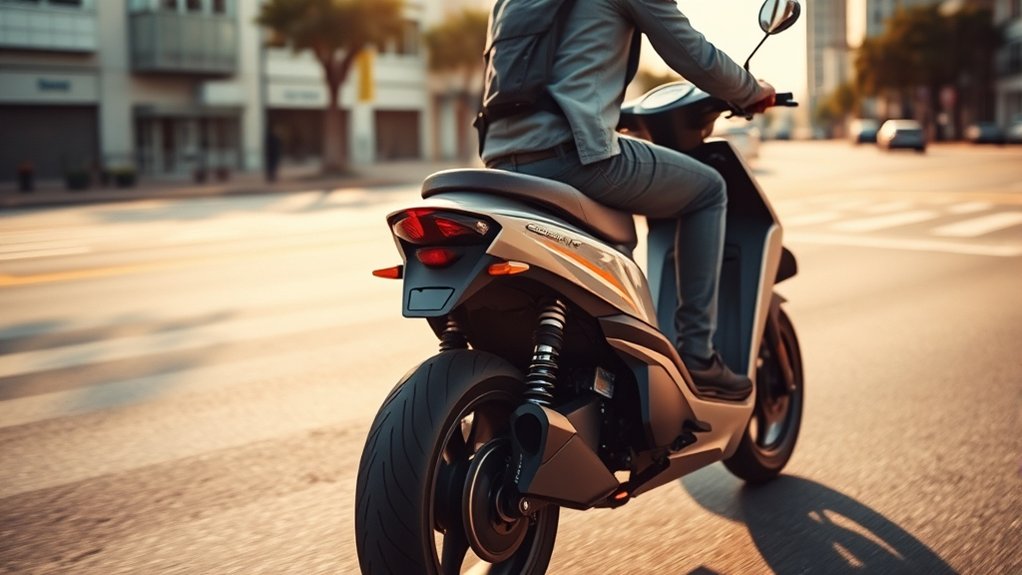
50cc-class electric motorcycles often blur the line with mopeds. In practice, they sit in the same speed bracket.
Many can do 30–50 mph, which is faster than low-speed e-bikes. It also overlaps with quicker mopeds.
You’ll notice the overlap in throttle control, reinforced frames, hydraulic disc brakes, suspension tuning, and motor vehicle classification.
Legally, you may need moped or motorcycle licensing, registration, and insurance depending on your jurisdiction.
Mechanically, these machines act less like pedal-assist bikes. They feel more like compact motor vehicles.
Their riding style is upright, simple, and traffic-capable. But their range changes sharply with speed.
You might get 40–80 miles at 20–35 mph. Yet you may only see 15–35 miles near top speed.
That’s why they function as moped alternatives, not true e-bikes.
What Safety Gear You Need at 50cc Speeds?
At 30–50 mph, you need motorcycle-grade protection, not bicycle gear.
For an electric 50cc-class bike with fast acceleration, start with a DOT- or ECE-rated full-face helmet.
It shields your face, jaw, and eyes from impact and windblast.
Wear a CE-rated jacket with shoulder, elbow, and back armor.
Choose abrasion-resistant textile or leather for better slide protection.
Use CE-rated armored pants or reinforced riding jeans with knee protection.
Lower-body injuries are common in these crashes.
Choose full gauntlet gloves with knuckle armor.
They help preserve grip and protect your hands.
Finish with over-the-ankle boots that have stiff soles and ankle support.
That can reduce fractures and protect your feet.
Add a back protector, reflective tape or a vest, and eye protection.
A highway-rated visor or goggles improve visibility and crash survival.
Who a 50cc E-Motorcycle Fits Best?

If you’re already gearing up for motorcycle-level protection, the next question is whether a 50cc-equivalent electric motorcycle matches your riding needs.
You’re a strong fit if you want urban mobility with faster acceleration than an e-bike and don’t need highway speeds.
- You commute 10–40 miles round-trip.
- You ride in city or suburban traffic.
- You accept 15–35 miles of sustained high-speed range.
- You already handle throttle, brakes, and suspension well.
- You can meet registration, insurance, and licensing rules.
You’ll also benefit if you want lower operating costs and zero tailpipe emissions.
However, expect motorcycle-grade maintenance and full protective gear.
If you’re an experienced cyclist or moped rider, this platform gives you practical speed without the complexity or cost of a full-size motorcycle.
Frequently Asked Questions
How Long Does It Take to Fully Charge?
It usually takes about 1.5 to 4 hours to fully charge a 50cc-equivalent electric motorcycle.
The exact time depends on the charger power and battery size.
With a 2 kW onboard charger and a 2–3 kWh battery, you’ll often reach 100% in roughly 1.5 to 2 hours.
With a 1 kW charger, it may take around 3 to 4 hours.
Fast chargers can cut the time significantly, but the final phase usually tapers.
That tapering is why charging doesn’t always finish instantly.
What Maintenance Does the Battery Need?
You don’t need much battery maintenance, but you do need disciplined care.
Keep charge between 20% and 80% for daily use, and don’t deep-cycle it often.
Use the OEM charger at the specified voltage and current, not a random fast charger.
Store it at 40% to 60% SOC in a cool, dry place.
Inspect cables, BMS status, and casing regularly.
Watch for heat, swelling, corrosion, or unusual voltage sag.
Can Hills Reduce an Electric 50CC Bike’s Speed?
Yes, hills can cut your electric 50cc bike’s speed sharply. You’ll often lose 20–50% on sustained climbs.
Steep grades can drop top speed below 20–30 mph. The motor power and battery voltage sag both play a big role.
Rider weight, cargo, wind, and tire drag affect the result too. A stronger motor, like a 3–5 kW unit, holds speed better.
Dual-motor setups can improve climbing as well. They may reduce range, though.
Are Electric 50CC Motorcycles Waterproof?
No, you shouldn’t treat electric 50cc motorcycles as fully waterproof.
You’ll usually get splash resistance from sealed battery packs and IP-rated controllers, but you can’t submerge them.
Rain may be fine, yet flooded roads, pressure washing, and soaked charge ports can trigger corrosion or faults.
Check your bike’s IP rating, keep connectors dry, and inspect seals after wet rides.
Manufacturers often exclude immersion damage from warranty coverage.
What License Do I Need to Ride One?
You’ll usually need at least a moped or motorcycle endorsement, but your state’s rules decide which one.
If your electric 50cc-class bike tops about 30 to 35 mph, you often need a full motorcycle license.
Slower models may qualify as mopeds with a standard or moped permit.
You may also need registration, title, insurance, and a DOT-rated helmet.
Check your DMV before you ride. Requirements vary widely.
Conclusion
So, if you’re expecting a tiny electric 50cc motorcycle to sprint like a superbike, you’re way off.
In reality, it’s built for modest city speeds.
That’s because battery size, rider weight, wind, and terrain all chip away at top performance.
Still, for short commutes and low-stress rides, it’s a smart, efficient choice.
You’ll have enough speed to move through traffic without feeling like you’re piloting a rocket.