What Are Fairings On A Motorcycle – Simple Breakdown
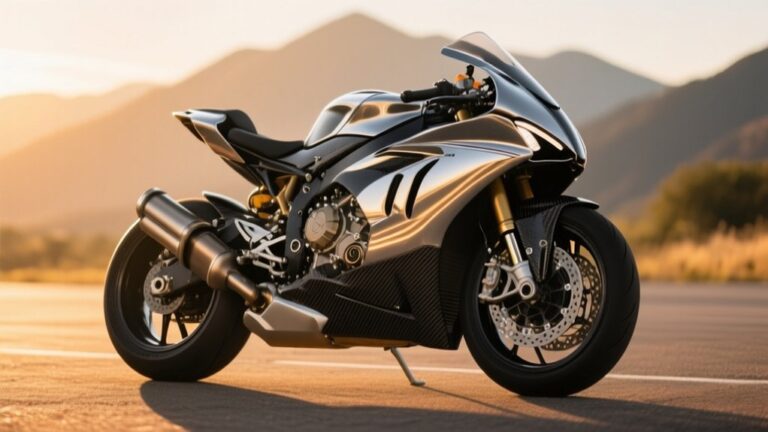
Fairings on a motorcycle are aerodynamic panels, usually made from ABS plastic, fiberglass, or carbon fiber. They are fitted to reduce drag and improve stability. These panels streamline airflow around the front, sides, and belly.
This helps you cut wind resistance, increase fuel efficiency, and reduce rider fatigue. Types range from full fairings for maximum aerodynamic benefits to smaller bikini styles for light wind deflection. Understanding material choice and mounting can optimize handling and safety.
Keep exploring to discover how fairings fit your riding style and needs.
What Motorcycle Fairings Are and Why They Matter

Motorcycle fairings are external panels, typically made from ABS plastic, fiberglass, or carbon fiber. You fit them to the front, sides, belly, or tail of your bike to streamline airflow and reduce aerodynamic drag.
Motorcycle fairings, crafted from ABS, fiberglass, or carbon fiber, enhance airflow and cut aerodynamic drag.
These panels play a pivotal role in improving aerodynamics by lowering wind resistance, which enhances stability and fuel efficiency, especially on touring bikes. Full fairings offer maximum coverage, helping you reduce wind drag markedly while allowing a tucked riding posture that raises top speed.
Half fairings provide moderate protection and weight savings, balancing comfort and performance. Besides aerodynamics, motorcycle fairings protect the rider from wind, weather, and debris, reducing fatigue on long rides.
Choosing the right material, like ABS plastic for durability or carbon fiber for lightweight strength, ensures your fairings effectively shield both rider and mechanical components.
How Different Fairing Types Affect Performance and Style
You’ll notice that full fairings really cut down on aerodynamic drag, which means you get a higher top speed and better fuel efficiency.
On the other hand, half and quarter fairings strike a balance—they offer decent wind protection without adding too much weight, plus they look pretty stylish.
Each type of fairing also changes how the bike handles. For instance, frame-mounted full fairings help improve stability by reducing steering inertia.
Aerodynamic Impact Variations
Although fairings primarily influence a bike’s aesthetics, their design markedly impacts aerodynamic performance and rider comfort.
Motorcycle fairings vary in aerodynamic effect: Full fairings enclose the front, sides, and belly, appreciably reducing drag by enabling you to tuck in, enhancing top speed and fuel efficiency.
Half fairings shield your chest and head from windblast, balancing aerodynamic gains and reduced steering inertia compared to bulky touring fairings.
Quarter fairings offer minimal aerodynamic benefit, primarily deflecting air from your upper torso rather than cutting drag.
Belly pans minimize underbody turbulence and aerodynamic lift, boosting high-speed stability while containing leaks.
Advanced streamliner designs achieve the lowest drag but can compromise stability and crosswind handling.
Understanding these variations helps you optimize performance, comfort, and stability based on your riding style and needs.
Style Influences And Trends
Fairing design doesn’t just shape how your bike cuts through the air, it also defines its visual identity and riding experience. Style influences vary: full fairings, common on sportbikes, reduce drag and let you tuck in for speed and fuel efficiency, creating an aggressive look.
Quarter fairings strike a balance by offering some wind protection while keeping a naked aesthetic. Touring fairings focus on comfort with large windshields and integrated storage, giving a bulky “bagger” presence.
Material choice further impacts style and function. ABS plastic fairings provide smooth OEM finishes and durability, while carbon fiber fairings offer lightweight, race-oriented performance with a premium appearance.
Aftermarket fairings let you customize these traits, tailoring your bike’s look and performance to your preferences and riding needs.
Handling And Stability Effects
When you choose a full fairing, you gain significant drag reduction that lets you tuck in tightly, boosting high-speed stability and top speed. However, the added front-end mass can slightly dull low-speed handling response.
Frame-mounted fairings enhance stability by transferring wind loads to the chassis, reducing steering inertia and improving resistance to crosswinds compared to fork-mounted fairings, which increase front-end mass on the handlebars.
Incorporating a belly fairing decreases aerodynamic lift and underbody turbulence, refining straight-line stability and braking predictability.
Lightweight materials like carbon fiber used in racing fairings cut weight and rotating mass, sharpening handling but often at the expense of durability. Conversely, large touring fairings prioritize rider comfort but can impair low-speed maneuvering and increase crosswind sensitivity if not aerodynamically optimized.
Understanding these effects helps you balance performance and style effectively.
Popular Motorcycle Fairing Designs for Touring and Sport Bikes
Explore how different fairing designs optimize performance and comfort for touring and sport motorcycles. Motorcycle fairings like full fairings enclose the front, sides, and belly, reducing drag and improving fuel economy by allowing you to tuck in for higher speeds.
Different fairing designs enhance touring and sport motorcycle performance by improving aerodynamics and rider comfort.
Half fairings cover the upper front and windscreen, cutting windblast while exposing the engine for cooling and easy maintenance. For touring motorcycles, batwing fairings mount on the handlebars or frame, offering maximum wind protection and often integrating storage and infotainment for long rides.
Smaller bikini fairings mainly provide aesthetic appeal and minor wind deflection on naked bikes. Tail fairings, common on sport and race-oriented models, smooth airflow around the rear, enhancing aerodynamics and high-speed stability.
Each design balances protection, cooling, and aerodynamic efficiency tailored to your riding needs.
Fairing Materials: What They’re Made Of and Why It Matters

You’ll find that most OEM fairings are made from injection-molded ABS plastic. This material is popular because it offers a consistent fit, good impact resistance, and solid strength.
On the other hand, aftermarket options often feature fiberglass, which is lighter and easier to repair.
Then there’s carbon fiber, which is the go-to for top-tier stiffness and minimal weight. However, it comes with a higher price tag and can be more complicated to fix if damaged. Knowing the ins and outs of these materials makes it easier to pick fairings that strike the right balance between durability, performance, and upkeep—tailored just for your riding style.
Common Fairing Materials
Although many materials can be used for motorcycle fairings, each comes with distinct trade-offs in strength, weight, cost, and repairability.
Most OEM fairings are made from ABS plastic via injection molding. This offers rigidity, impact resistance, and consistent fit at low cost.
Fiberglass is common in aftermarket fairings because it’s lightweight and easy to repair.
However, the finish and thickness can vary quite a bit.
Carbon fibre reinforced polymer provides a superior strength-to-weight ratio and stiffness, which is why it’s popular for racing fairings.
But it’s costly and difficult to fix.
You’ll also find polypropylene and lower-grade plastics in budget kits, which sacrifice fit and durability.
To summarize:
- ABS: injection-molded, uniform, cost-effective
- Fiberglass: hand-laid, lightweight, repairable
- Carbon fiber: stiff, lightweight, expensive
Choosing materials really depends on the manufacturing method and what you plan to use the fairing for.
Material Properties Compared
Understanding the material properties of motorcycle fairings is essential when selecting the right component for your bike’s intended use. ABS plastic, commonly injection-molded, offers consistent fit, low cost, good impact resistance, and slight flexibility. This makes it ideal for everyday durability.
Fiberglass, lighter than many ABS parts, provides superior stiffness and excellent repairability through sanding and resin re-lay. But it’s more brittle and prone to cracking on hard impacts.
Carbon fiber excels in stiffness and weight reduction, delivering the highest strength-to-weight ratio. However, its high cost and complex repair process limit it to high-performance applications.
Production methods influence uniformity and finish quality. ABS injection molding yields precision, while fiberglass and carbon fiber require additional finishing. You’ll balance cost, weight, impact behavior, stiffness, and repairability to match your riding needs.
Impact On Performance
When choosing fairing materials, you directly influence your motorcycle’s performance characteristics, including weight, aerodynamics, and crash behavior. The choice between ABS plastic, fiberglass, and carbon-fibre affects key factors:
- Weight: Carbon-fibre fairings are the lightest, enhancing acceleration and handling. Fiberglass offers a mid-weight option, while ABS plastic is the heaviest but balances cost and impact resistance.
- Aerodynamics: Precision-molded ABS fairings provide smooth fit and optimal drag reduction, improving fuel efficiency more than raw material alone.
- Crash Durability: ABS flexes on impact, fiberglass cracks but repairs easily, and carbon-fibre is strong yet prone to costly delamination.
Selecting the right fairings means balancing these elements to maximize your bike’s agility, speed, and resilience.
How Motorcycle Fairings Improve Aerodynamics and Rider Comfort

By streamlining airflow around the motorcycle and rider, full and half fairings greatly reduce drag coefficients. This lets you harness more engine power for increased top speed and better fuel efficiency. A full fairing with a windshield lets you tuck behind the windscreen, cutting rider-induced drag notably.
Belly pans smooth underbody airflow and reduce lift, which enhances high-speed stability. Frame-mounted fairings relocate mass off the steering, improving handling responsiveness. Moreover, fairings reduce wind buffeting and rider fatigue, boosting comfort during long rides.
| Component | Function | Benefit |
|---|---|---|
| Full fairing | Streamlines airflow | Reduces drag, improves speed |
| Windshield/windscreen | Shields rider wind pressure | Enhances rider comfort |
| Belly pan | Smooths underbody flow | Increases stability |
| Frame-mounted fairing | Reduces fork rotational inertia | Improves handling responsiveness |
| Lower fairing panels | Reduces aerodynamic lift | Boosts front-end grip |
Safety and Stability Concerns With Motorcycle Fairings
Although motorcycle fairings offer aerodynamic and comfort benefits, they can introduce significant safety and stability challenges if not properly designed or mounted. You need to take into account how fairings increase or decrease stability and handle air drag and crosswinds.
Key concerns include: Frame-mounted full fairings generally enhance high-speed stability and reduce buffeting, while handlebar-mounted fairings add rotational inertia, making low-speed steering heavier and less responsive.
Under-fairings and belly pans must be precisely engineered to avoid aerodynamic lift or instability caused by altered underbody airflow, which can degrade handling or cause wobble.
Material and mounting quality matter: flexible ABS or PP panels may flutter or shift, disrupting airflow and reducing predictable stability compared to rigid fiberglass or carbon-fiber fairings.
Understanding these factors helps you maintain safe, stable riding performance.
How to Choose the Right Motorcycle Fairing for Your Bike
Selecting the right motorcycle fairing demands careful consideration of your riding style, bike model, and performance goals. Choose full fairings for aerodynamic efficiency and touring comfort, half or bikini fairings for urban riding and easier maintenance.
Prioritize material: ABS offers durability and OEM fit, fiberglass balances weight and repairability, carbon fiber delivers top strength at a premium cost. Make certain model-specific fitment to avoid alignment issues; aftermarket fairing kits may require extra work.
Frame-mounted fairings reduce steering effort, while touring batwing fairings enhance wind protection and infotainment mounting. Consider installation complexity and budget. Professional fitting is advisable for integrated electronics.
| Fairing Type | Best Use |
|---|---|
| Full Fairing | High-speed, touring |
| Half Fairing | Commuting, café style |
| Bikini Fairing | Lightweight, minimal |
| ABS Material | Durable, cost-effective |
| Carbon Fiber | Lightweight, high strength |
Frequently Asked Questions
Can I Install Motorcycle Fairings Myself Without Professional Help?
Yes, you can install motorcycle fairings yourself if you have basic tools like a socket set, screwdrivers, and a torque wrench.
Your skill level should be moderate since fitment issues and paint matching can get tricky.
Installation time ranges from 2 to 6 hours, depending on the material choice and mounting hardware complexity.
Expect a cost estimate lower than professional service, but prioritize DIY safety, especially when wiring or cutting is involved, to avoid damage or injury.
How Do Fairings Affect Fuel Efficiency on Long Rides?
Fairings reduce aerodynamic drag and wind resistance, improving your fuel consumption on long rides. They help you adopt a tucked riding posture, cutting frontal area and enhancing cruise stability.
Proper weight distribution from frame-mounted fairings maintains steering control, while engine cooling guarantees performance isn’t compromised. Tailwind effects and varying road conditions influence efficiency, but overall, fairings let you sustain steadier speeds with less throttle, saving fuel over extended trips.
Are There Specific Fairings Designed for Off-Road Motorcycles?
Yes, off-road fairings are specifically designed for rugged use. You’ll find motocross numberplates and waterproof bodypanels that protect electronics without adding weight.
Dual sport fairings and adventure windshields balance wind protection with trail clearance. Trail handguards shield controls, while enduro skidplates and bashplate integration guard the engine from rocks.
Offroad aerodynamics prioritize durability and full steering lock, ensuring your bike handles rough terrain without compromising stability or protection.
What Maintenance Is Required for Keeping Fairings in Good Condition?
You might be surprised how essential regular maintenance is for your fairings. Stick to a strict cleaning frequency using mild soap and soft cloths to prevent damage.
Inspect fasteners monthly, ensuring mount alignment and hardware lubrication to avoid rattles. Apply UV protection and sealants every few months to guard paint and finishes.
Address paint touchups and crack repair promptly to stop damage spread. Finally, follow proper storage precautions to preserve your fairings’ integrity and longevity.
Do Fairings Impact the Resale Value of a Motorcycle?
Fairings markedly affect your motorcycle’s resale impact by shaping market perception and buyer preferences. Cosmetic damage or poor color matching lowers appeal, increasing depreciation rate.
Maintaining brand premium with OEM fairings and proper documentation records boosts value. Aftermarket modifications that fit well and enhance performance can attract niche buyers, but ill-fitting or nonfunctional parts reduce worth.
Keeping fairings intact and matching original specs guarantees better resale outcomes and wider buyer interest.
Conclusion
Choosing the right motorcycle fairing is like fitting a tailored suit. It enhances both performance and comfort precisely for your ride. Fairings improve aerodynamics, reduce wind fatigue, and protect essential components, boosting stability and safety.
Whether you prioritize touring comfort or sporty agility, understanding fairing types and materials lets you make a practical choice that suits your bike’s design and riding style. Invest wisely, and your bike will perform smoother, faster, and safer on every journey.