What Causes A Motorcycle To Backfire – The Full Story
Your motorcycle usually backfires because the engine is running lean, there’s an exhaust leak, or the ignition is firing at the wrong time. Start by checking plug leads, coil wiring, and spark quality. Then verify timing.
Next, inspect the pilot jet, needle position, and carb wear. A too-small jet or worn needle can cause decel popping.
Also check the header and joint seals for soot or leaks. Once you confirm that, the rest of the diagnosis gets more specific.
Why Motorcycles Backfire After Repairs

After repairs, motorcycles often backfire because something in the air, fuel, exhaust, or ignition system was disturbed during reassembly.
You may have a lean pilot circuit, misrouted hoses, or a damaged intake boot that lets extra air in.
If you disturbed the carburetor or throttle bodies, incorrect synchronization or unchanged pilot and needle settings can leave the mixture too lean at closed throttle.
Then unburnt fuel can ignite in the exhaust system.
Loose exhaust gasket joints can also leak air and leave black soot at the seams.
If coil wires, pickup leads, or timing components were reconnected wrong, the firing event shifts and backfires get stronger under acceleration.
Recheck every connector, seal, and setting before you ride.
Then test for leaks.
Check the Plug Leads First
Start by checking the plug leads. After a repair, swapped or loose connections are a common cause of backfiring on multi-cylinder bikes.
Start by checking the plug leads—after a repair, swapped or loose connections often cause backfiring on multi-cylinder bikes.
Verify each lead is fully seated on the spark plug and coil terminal. Then inspect the boot for cracks, corrosion, or carbon tracking.
A weak connection can leave one cylinder firing poorly. It can also push unburnt mixture into the exhaust.
- Confirm lead routing matches the bike’s firing order
- Measure lead resistance; most modern HT leads read 3–10 kΩ
- Replace any crusted, heat-damaged, or arcing lead
If you find damage near the header or under the saddle, replace the lead before further testing. Once the leads check out, revisit timing and coil-to-cylinder pairing in the service manual. Then move on to carburetion or exhaust faults.
Verify Coil-to-Cylinder Wiring

Next, verify the coil-to-cylinder wiring against the service manual so each lead goes to the correct plug.
On many four-cylinder bikes, the coils fire paired cylinders such as 1 and 4, and 2 and 3.
A swapped lead can upset the firing order and send sparks out of sequence.
Trace every coil wire from the coil to its spark plug.
Confirm the exact pairing with the OEM diagram or the color code.
If you find a miswire, correct it before running the engine.
Labeling leads and coils during disassembly helps you avoid repeat errors.
After reconnecting everything, perform a compression and spark test on each cylinder.
Then start the engine briefly.
You’re looking for smooth firing, no misfires, and no decel backfires from exhaust ignition.
Confirm Ignition Timing and Spark
With the coil-to-cylinder wiring confirmed, check that the spark actually arrives at the correct time.
Use a timing light or dial indicator at the crank and verify static timing matches spec, often 10–15° BTDC.
If timing is advanced or retarded, backfire can follow.
Inspect points, advance parts, and the stator key for wear or slip.
Even 1–2° drift per 1,000–2,000 miles matters.
Confirm timing at idle and under load.
Do this with the engine fully warm, since advance curves can shift.
Test spark strength with a spark tester.
Weak or intermittent output can light the mixture late in the exhaust.
Keep every connection firm and routed correctly.
If you find inconsistent timing or weak spark, service or replace the affected parts before you chase other causes.
Inspect the Pilot Jet and Idle Mixture
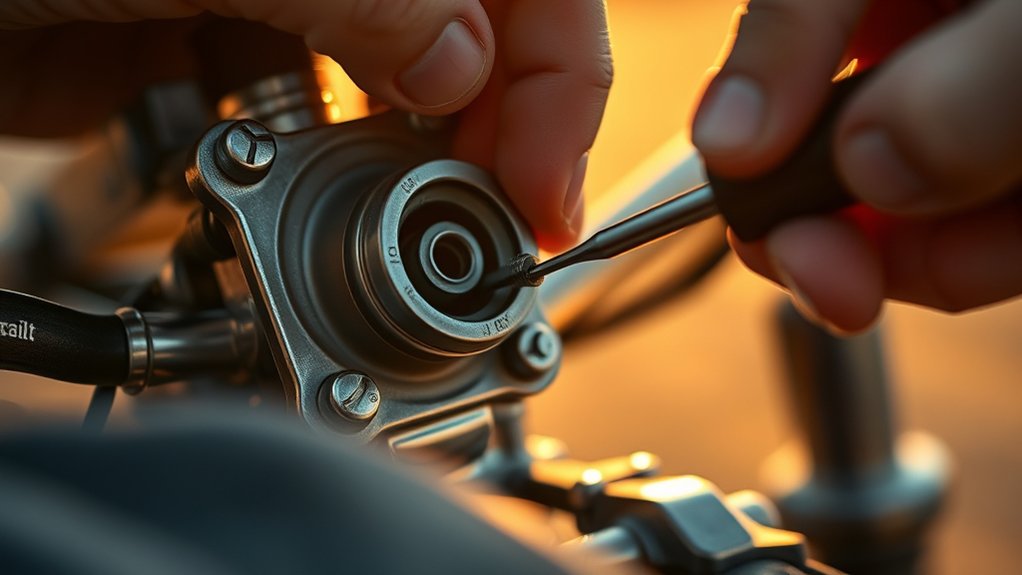
Check the pilot jet and idle mixture next. The idle circuit controls fuel delivery at closed and near-closed throttle.
If the pilot jet’s too small or the mixture’s too lean, unburned fuel can reach the exhaust. This can cause deceleration popping.
Clean the pilot jet and internal passages first. Then inspect the carburetor for wear that can mimic a restricted jet.
If the circuit still runs lean, step up one pilot size at a time (for example, from 33 to 35). Test after each change so you don’t over-reichen it.
A lean idle circuit can also make the engine die when you snap the throttle shut. It can even cause poor shifts.
If pilot changes don’t fix that, check the needle and needle jet next.
Look for Exhaust Leaks at the Joints
Check the header joints first. Look for black soot, loose flanges, or any damaged gaskets—those usually point to an exhaust leak.
Then, inspect the midpipe seals. Make sure there aren’t slipped joints or cracked welds, because even a small leak can let fresh air into the exhaust stream.
That can change backpressure and lead to popping, so seal or replace the faulty parts right away.
Check Header Joints
Inspect the header-to-midpipe and midpipe-to-silencer joints for exhaust leaks. Even small leaks can pull in fresh air and let unburnt fuel ignite outside the combustion chamber. This can worsen backfires and deceleration popping.
Check the header joints closely, since a leaking flange changes scavenging and backpressure. It can also upset cylinder filling. Use a running engine carefully to listen for hissing or tapping, then verify with soapy water at the joint.
Look for:
- Black soot or carbon at the seam
- Bubbles from escaping exhaust gas
- Loose bolts, damaged gaskets, or crushed pipe ends
If you find a leak, tighten the hardware to spec. Replace worn seals, or apply high-temperature exhaust sealant. Repair damaged sections so the connection stays gas-tight and combustion stays inside the system.
Inspect Midpipe Seals
If your bike still pops on deceleration, inspect the midpipe seals next. Trace the header-to-midpipe and midpipe-to-silencer joints for soot or carbon. Those marks usually mean exhaust is leaking into fresh air.
| Check point | What you’re looking for | Action |
|---|---|---|
| Gasket | Cracks, flattening | Replace |
| Flange face | Pitting, corrosion | Clean or resurface |
| Clamp seal | Loose fit, gaps | Retorque |
A leaking joint lets oxygen enter the exhaust stream and ignite unburnt fuel. That ignition creates decel popping.
Inspect the gaskets, O-rings, and clamp faces closely. Even a small flange gap can leak under pressure.
Tighten the clamps, replace worn seals, then recheck for soot. Listen for a cleaner exhaust note while revving. If the backfire persists, move on to carburetion, ignition timing, or internal engine faults.
Check Carburetor Wear and Needle Setup
Check the carburetor needle, needle jet, and slide for wear, because oval bores or damaged parts can lean the mixture at part-throttle and trigger decel popping.
Then verify the pilot circuit next—if the pilot jet is too small or clogged, it won’t supply enough fuel when you roll off the throttle.
After that, adjust the needle clip height one step at a time and test ride, since clip position controls the mixture from about 1/8 to 3/4 throttle.
Needle And Jet Wear
Worn needle tapers, a grooved needle, or an oversized needle jet can upset fuel metering between idle and mid-throttle. The mixture can go lean, causing misfires or popping on deceleration.
Inspect the needle and jet for wear. Even small clearance changes can weaken fuel control under partial throttle.
- Check the needle taper for grooves or polishing.
- Measure needle jet wear and bore ovality.
- Verify clip position for the throttle range you ride.
If the clip sits too high, you’ll richen the midrange. If it sits too low, you’ll create a lean spot when you roll off. Loose fits in the slide or needle seat can also let the air fuel ratio drift.
If adjustments don’t stop the popping, replace the worn needle, needle jet, or damaged carburetor internals.
Pilot Circuit Test
At closed or near-closed throttle, the pilot circuit controls idle and deceleration fueling.
So a pilot jet that’s too small can cause lean popping, unstable idle, or stalling when you snap the throttle shut.
Test it by changing the pilot jet one size at a time, like 33 to 35.
After each swap, check the throttle-off behavior carefully.
Also verify the pilot air screw still changes mixture through its normal range.
If it doesn’t, suspect wear.
Inspect the pilot jet, slide, needle, and needle jet for scoring or looseness.
Any of that can skew low-throttle fueling.
Read the spark plug too: tan is close, black is rich, white is lean.
If rapid closure still backfires, check for exhaust leaks and ignition timing or plug-lead errors before blaming carburetion.
Needle Clip Adjustment
Dial in the needle clip to tune the mid-throttle mixture.
Raise the clip to lower the needle and lean the circuit.
Lower the clip raises the needle and richens it.
Most carburetors offer 1–5 clip positions for this adjustment.
Adjust one step at a time, then ride-test.
Check for decel popping or hesitation after each change.
If the symptom improves, keep the setting.
If it worsens, return to the previous notch.
Check the needle and jet bore for oval wear or excess clearance.
Verify the needle model and taper before changing base settings.
Inspect the clip groove for damage or flattening.
If you find measurable wear, replace the needle, jet, or slider assembly.
A worn taper or loose needle can drop fuel flow unexpectedly.
That can create a lean backfire under throttle, especially when pilot and main jetting are close.
How to Test Each Fix One by One
To isolate the real cause of motorcycle backfiring, change only one variable at a time and test it immediately. If you install a larger pilot jet, such as moving from 33 to 35, ride several short runs. Watch deceleration and throttle-off popping.
Log idle quality, off-throttle behavior, and acceleration after each carburetor change. Do this for the pilot jet, needle clip, needle, or main jet.
When you adjust needle position, evaluate throttle response and mid-throttle shift across multiple RPM ranges. The needle taper controls mixture from about 1/8 to 3/4 throttle.
If you’ve repaired an exhaust leak, inspect the header-to-midpipe and midpipe-to-silencer joints for fresh soot. Then retest.
If backfiring continues, check coil pairing and ignition timing before retesting.
Frequently Asked Questions
Can a Bad Fuel Cap Cause Motorcycle Backfiring?
Yes, a bad fuel cap can cause your motorcycle to backfire.
If the cap’s vent clogs, it can build tank vacuum and restrict fuel flow, making the engine run lean, especially on deceleration.
A damaged seal can also upset pressure and the fuel mixture.
You might notice it after long rides, or when loosening the cap helps.
Inspect, clean, or replace the cap first, then verify fuel delivery and ignition.
Does Cold Weather Make a Motorcycle Backfire More?
Yes—cold weather can make your motorcycle backfire more. In temperatures near 32°F, denser air can lean your mixture enough to trigger popping on deceleration.
You’ll also get poorer fuel vaporization, so unburnt fuel can ignite in the exhaust. If you ride a carbureted bike, use proper choke and check jetting. Fuel-injected bikes usually compensate better with cold-start maps and fewer misfires.
Will Aftermarket Exhausts Increase Backfiring?
Yes, aftermarket exhausts can increase backfiring if you don’t tune the bike to match.
You’ll often reduce backpressure, change scavenging, and alter the air/fuel balance, which can let unburnt fuel ignite in the pipe.
Leaks at joints can add oxygen and make popping worse.
A louder muffler won’t cause every backfire, but it will make them more noticeable.
Rejetting or ECU remapping often fixes the issue.
Can Old Fuel Cause Backfiring Under Acceleration?
Yes, old fuel can cause backfiring under acceleration.
You can get oxidized fuel, varnish, and ethanol-related moisture that clog jets and passages.
When you open the throttle, this can create lean bursts and uneven combustion.
Stale fuel also loses volatility, so it can’t provide a richer mixture when the engine needs it most.
If you’ve run fuel older than 30 to 90 days, drain it.
Clean the system and refill with fresh fuel or stabilized gasoline.
Does a Clogged Air Filter Trigger Motorcycle Backfire?
Yes, a clogged air filter can trigger motorcycle backfire. Restricted airflow upsets combustion.
On carbureted bikes, you may run rich at closed throttle. On fuel-injected models, the ECU may compensate for the airflow change.
That can cause incomplete burn, rough idle, black plugs, and exhaust popping on deceleration.
Inspect and replace the filter if it’s dirty. Restoring airflow often stops the backfire quickly and reliably.
Conclusion
In short, you can stop motorcycle backfire by tracing each trigger methodically.
Start with plug leads, then confirm coil-to-cylinder wiring and set ignition timing.
After that, verify spark first.
Next, inspect the pilot jet and idle mixture.
Check exhaust joints, carburetor wear, and the needle setup too.
Test each fix one by one so you can isolate the issue fast.
With careful checks and clean connections, you’ll restore smooth combustion.
You’ll also get steady throttle response and strong, reliable performance.